
The German grape is a modern self-negative hybrid. Mid-season and early varieties were crossed, resulting in a mid-early variety, ready for harvest as early as mid- to late August. It is characterized by multi-hued berries and colorful clusters.
Description of table grapes Herman
The Latin name of this variety is Vitis German. It has the following appearance and characteristics:
- Bush. Tall – from 3 to 4 m, with strong brown shoots and green leaves.
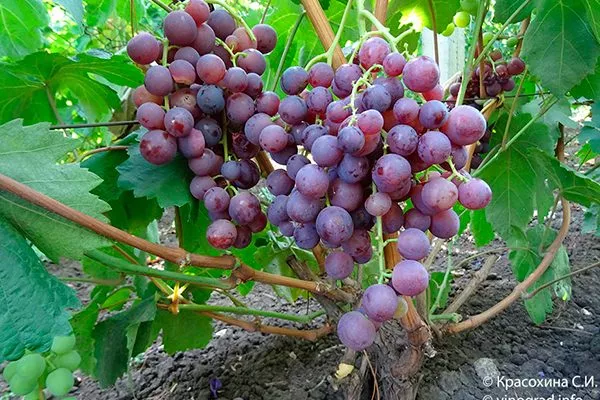
- Clusters. Large in size – weighing from 800 to 1500 g. Their density of fruits is average.
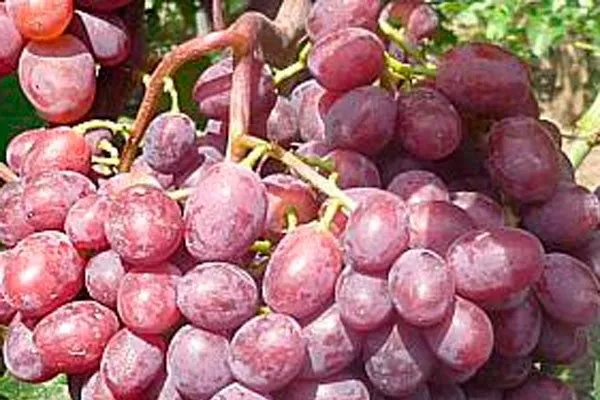
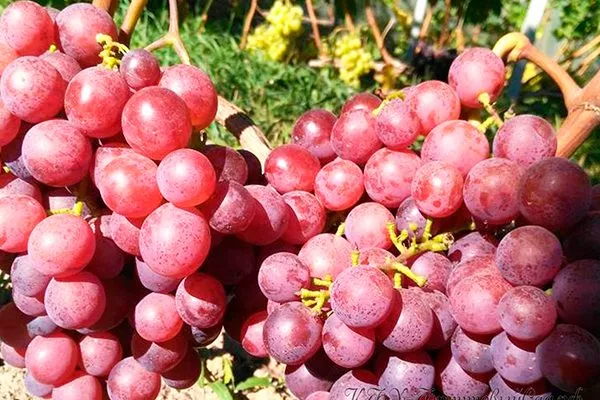
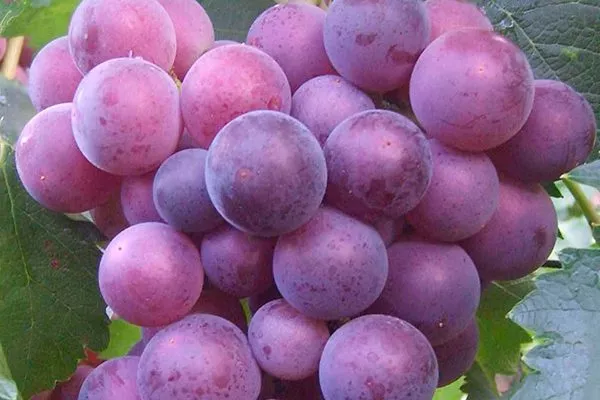
- Fruit. The berries' color is a beautiful blend of several shades—lilac, violet, reddish-brown, and plum. The skin's surface has an ashy haze resembling a purine coating. The berries are round in shape and large in size—each berry weighs between 10 and 15 grams.
The pulp is distinguished by its increased juiciness and elasticity at the same time; when bitten, a specific crunch is felt. - Taste. It is distinguished by its richness and harmony, the taste is more sweet than sour.
- Flowers. It is bisexual, so the bush does not need pollinating plants.
Characteristics
The German grape is a mid-early variety, meaning the fruit ripens in 110-130 days. However, the variety also has other characteristics:
| Meaning | Description |
| Frost resistance | -20-23 degrees |
| Frost resistance zone | 4 |
| Height | Strong |
| Need for shelter | Yes |
| Harvest time | from August to September |
| Recommended area | solar |
| Productivity | From 20 to 30 kg can be removed from 1 sq. m. |
| Purpose | tableware |
| Group | liana-like |
| The cycle of life | perennial |
| Trunk | multi-barreled |
| Taste | dessert |
| Budding period | May |
| Presence of spikes | No |
| Leaf type | three-bladed |
| Decorative parameters | foliar |
| Landing | single, group, hedge |
| Soil | any |
| Place | open ground |
| Growing regions by purpose | Moscow region and other areas of the Central part, south |
Origin
Amateur breeder E. G. Pavlovsky developed the variety using a complex crossbreeding technique. He used the "Gift to Zaporizhzhya" variety as the mother plant and a mixture of pollen from "Kardinal" and "Talisman."
Beneficial properties
Herman grapes have proven to be very beneficial, as they contain many useful substances that have a beneficial effect on the entire human body:
- sugar in an easily digestible form - fructose, essential glucose, raffinose, xylose;
- organic acids;
- minerals – phosphorus, manganese, calcium, iron, magnesium, potassium;
- vitamins – B6, A, B12, PP, B1, C;
- pectins, tannins, etc.
Eating juicy berries normalizes the stomach's microflora, acid-base balance, and gallbladder function. Additionally, metabolism and digestion are restored, the immune system is strengthened, harmful cholesterol and other compounds are eliminated, and insomnia is alleviated.
Usage
Large berries are versatile—they're used to make juices, compotes, jams, and preserves, eaten fresh, and are also used by winemakers to make liqueurs and dessert wines. Thanks to their excellent shelf life and transportability, the grapes are also grown commercially.
Features of cultivation
Planting and caring for this variety is straightforward, as all the steps are standard. However, it's important to consider a few nuances:
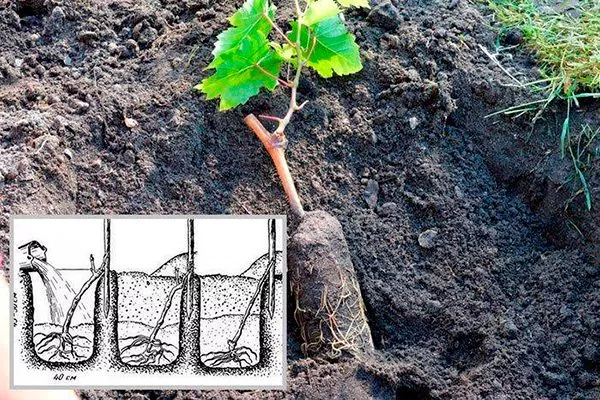
- seedling planting time: from March 20 to May 20, depending on the region;

- composition of the soil mixture for the planting hole - equal amounts of the top layer of turf soil and humus (1 part each), peat and river sand (2 parts each), superphosphate (100-120 g per hole), wood ash (250-350 g);
- planting hole dimensions: 60x60x60 cm;
- distance from fences, buildings and other plants – 80-120 cm;
- groundwater level from the earth's surface – 150-200 cm;
- watering an adult bush - twice a year in normal weather, more often in severe drought;
- the amount of water per bush is 15 l;
- fertilizing - four times a year, but it is important to have not only nitrogen, phosphorus and potassium, but also chromium, boron, zinc, thanks to which the berries will be sweeter;
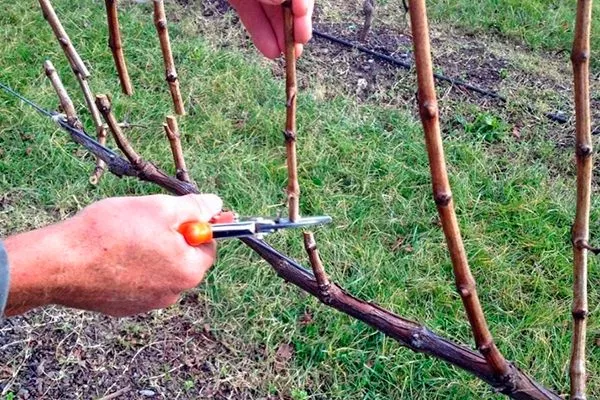
- pruning – sanitary twice per season;
- bush formation – not required (any method is optional).
- ✓ Soil pH should be between 6.0-7.0 for optimal growth.
- ✓ The soil must have good drainage to avoid water stagnation.
For the German grape, gardeners recommend a special fertilization scheme:
- in the first days of May, use Terraflex Start - for one bush, take 40 g per 10 liters of water;
- after June 20, feed again with the same fertilizer, but add 30 g per 10 liters of water;
- in mid-August use Terraflex Final (40 g per 10 l of water);
- At the end of October, take an ash solution (150-180 g of ash per 10 liters of hot water), this is the consumption for one bush.
You can use other fertilizers, but Teraflex contains all the necessary components for the variety in its entirety.
Diseases and pests of grapes
The variety is quite resistant to diseases and pests, except for the following:
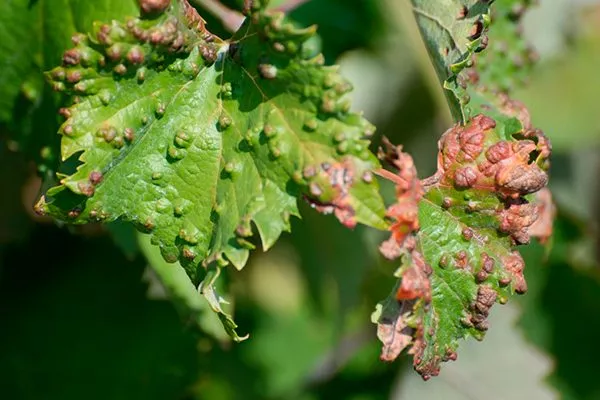
- Spider mite. It's gray-green at first, turning red-orange as it matures. It first appears on leaves, from which it sucks the sap. In winter, it resides under the bark. It can be recognized by its webbing, yellowed leaves, and deformation, which then causes them to turn brown and dry out.
Chemical control agents include Kleschevit, Iskra-Bio, Fitoverm, Bitoksibatsilin, Thiovit-Jet, and Fufanon. Spraying is done four times at weekly intervals. Prevention includes sanitary pruning, removing foliage from the ground, and thinning branches. - Oidium. It manifests itself as a grayish coating, drying and deformation of leaves, and brownish spots on shoots. An ash-like coating appears on inflorescences and berries.
Thiovit Jet, Rayok, Skor are used for treatment. - Mildew. The foliage becomes covered with yellowish-green, oily spots on the upper surface, and a whitish coating on the underside. The leaves then turn brown and dry out. As the disease progresses, the berry clusters are also affected.
It is treated with HOM, Topaz, Fitosporin, Skor.
| Disease/Pest | Sustainability | Control measures |
|---|---|---|
| Spider mite | Low | Chemicals |
| Oidium | Average | Tiovit Jet, Rayok, Skor |
| Mildew | Average | HOM, Topaz, Fitosporin |
Shelter for the winter
Covering bushes isn't necessary only in the southern regions; it's required in other areas. But first, you need to prepare the plant:
- Apply fertilizer after harvesting.
- Remove all side shoots and prune. This should be done in mid-October.
- Loosen the soil around the tree trunk, water generously to replenish moisture, and apply mulch. Apply a layer of mulch approximately 10-20 cm.
- Connect the shoots together and tie them with a rope.
- Roll into a ring.
- Place boards around the trunk area and place the shoots on them.
- Spray the above-ground part with a pink solution of manganese or dust with powdered wood ash.
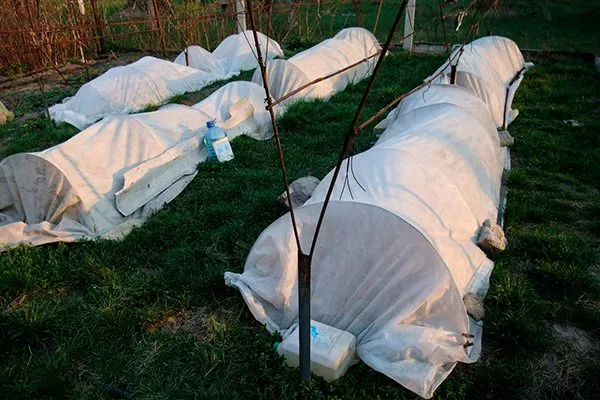
- Place spruce branches on top and cover with agrofibre or lutrasil.
- Fix the structure.
Reviews
The German grape is a hobby variety because it is not listed in the Russian State Register. However, it is popular among both professional and novice gardeners due to its ease of cultivation and excellent taste. It can be propagated in various ways, including by root suckers, as there are many shoots near the bush.