
The "Lady Fingers" grape is considered one of the best table grapes in the history of viticulture. Despite the emergence of new and exciting varieties, "Lady Fingers" remains popular. Gardeners prize this grape for its exceptional flavor and unique berry shape.
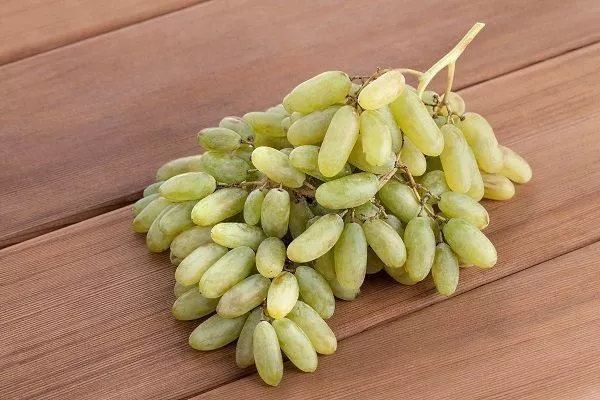
grape variety "Ladyfingers"
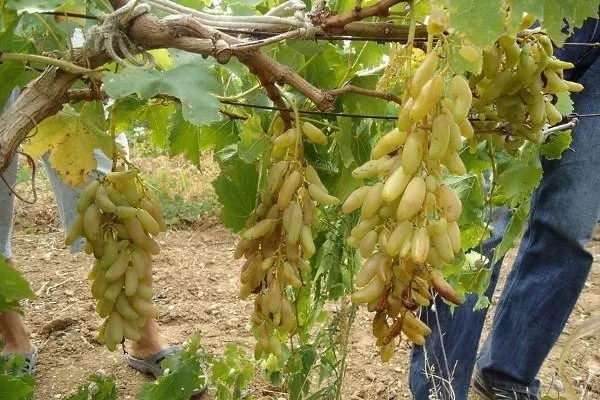
Ladyfingers grapes are used as raw material for producing raisins because they are seedless.
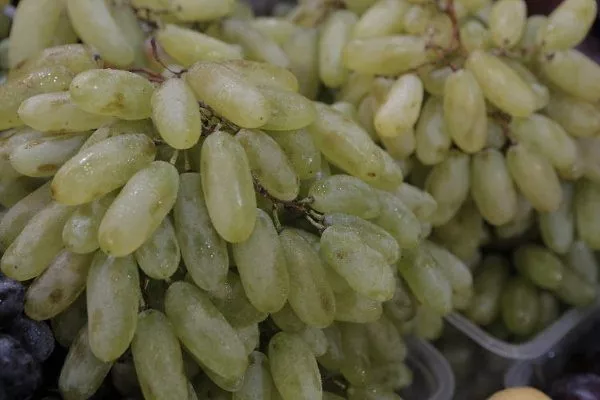
The "Ladyfingers" grape variety is in demand and popular in the retail sector
History of variety selection
This variety has been grown in Central Asia for centuries. It is believed to have been artificially bred, through selective breeding of wild grapes. "Ladyfingers" is an unofficial name for the Khusaine White variety, but this is the name by which this heat-loving grape is known to our gardeners.
The berries have an unusual, elongated shape, hence the association. Dagestanis call this grape "Shah-izum," Azerbaijanis call it Itsaptuk, Turkmens call it Guseiny, and in Astrakhan they call it "Bokalny."
General description of grapes
The "Ladyfingers" grape is easily recognized by its distinctive berry shape. The clusters are very appetizing and beautiful. Let's find out what else makes this famous variety special.
Clusters
The clusters of Damskie Fingers are loose and fairly large. The shape is conical or cylindrical. Cluster parameters:
- length – 20-50 cm;
- width – 10-25 cm;
- weight – 500-600 g.
The comb is fragile and grassy.
Berries
The fruits are large, elongated, cylindrical, and yellow-green. The flesh is translucent. When ripe, the grapes acquire a light pink blush. Berry characteristics:
- length – 2.5-4 cm;
- width – 1.5-2.5 cm;
- weight – 5-7 g.
The skin is thin, elastic, and coated with a waxy coating. Most importantly, the fruit is virtually seedless.
Vine
"Ladyfingers" bushes are vigorous and require support. The vines are strong, thick, and long. Branches can grow up to 5-6 meters in length. The vines are covered with medium-sized, bright green leaves, 3- or 5-lobed and rounded.
The undersides of the leaves have a slight, bristly pubescence, and the leaf edges are slightly raised. The bushes produce numerous side shoots, which require regular removal.
What are the characteristics of Ladyfingers?
The variety has excellent taste and marketability, but other characteristics are not so clear-cut. This grape is truly "capricious," requiring specific conditions for growth and fruiting.
A review of the "Ladyfingers" grape variety is presented in the video below:
Ripening time
This variety belongs to the mid-late group. Ripening is quite slow – from the beginning of flowering to full ripening of the berries takes 130-155 days. In regions with short summers, the fruits do not have time to ripen. Even in Central Asia, the bunches ripen only by early September.
Fruiting period
The variety produces its first harvest in the fourth year after planting. Full fruiting occurs in the fifth year. To ensure the grapes are ready for this process, they should be regularly fertilized.
Productivity
The yield of "Khusayne Bely" is high, but not consistent. This grape is very demanding. To obtain 40 tons of grapes per hectare, ideal growing conditions must be created.
Taste characteristics
The grapes are sweet, juicy, and crunchy when bitten. Husayneh was once considered the pinnacle of grape flavor, and even today it remains one of the most delicious grape varieties.
Lady's Fingers possess a unique characteristic: although sweet, they quench thirst perfectly. The secret to this effect lies in the combination of their low sugar content and low acidity. The sugar content is approximately 17%, with an acidity of 4.5 g/l. When overripe, the fruits become somewhat bland.
Tasting score: 8.5 on a 10-point scale.
Application and purpose
This variety is renowned for its excellent flavor—the berries are delicious fresh. "Khusayne White" is a dried variety and is ideal for making raisins. "Lady Fingers" can also be used to make wine, juices, compotes, and marinades. It's also excellent for decorative purposes.
Regionalism
The variety is widespread in its native Uzbekistan and other Central Asian countries. "Khusayne White" is grown wherever suitable growing conditions exist:
- on the Crimean peninsula;
- in the south of Russia;
- in the Caucasus and other regions with warm winters and long summers.
Growing this variety in central Russia is difficult due to cold winters and short summers. Only the most dedicated and patient fans of this variety succeed in growing "Ladyfingers" in such challenging conditions.
Pollination features
The variety is self-fertile – it has bisexual flowers, so there is no need for additional pollination.
Frost resistance
The variety is not frost-hardy, which explains its limited distribution. The vines can withstand temperatures down to -10-15°C. This grape requires shelter if frosts in its growing area exceed this mark.
Drought resistance
The variety doesn't tolerate drought well. "Ladyfingers" is a fussy variety, and watering is essential for fruiting. Due to its low drought tolerance, it requires regular watering. However, excessive waterlogging is also dangerous for the variety, as it can cause rot.
Resistance to diseases and pests
The variety has low disease resistance—1-1.5 points out of 10. To grow a healthy crop, preventative and treatment measures are necessary, as well as regular fertilization, both root and foliar. Potassium and phosphorus fertilizers are particularly effective in combating diseases and pests.
Like all Central Asian varieties, "Lady Fingers" has poor resistance to fungal infections. This grape is susceptible to powdery mildew, downy mildew, and various parasites.
Advantages and disadvantages
Despite its shortcomings, "Khusayne White" has remained the most popular variety for several centuries. For its magnificent, sweet, crunchy berries, gardeners are willing to accept the challenges of growing it.
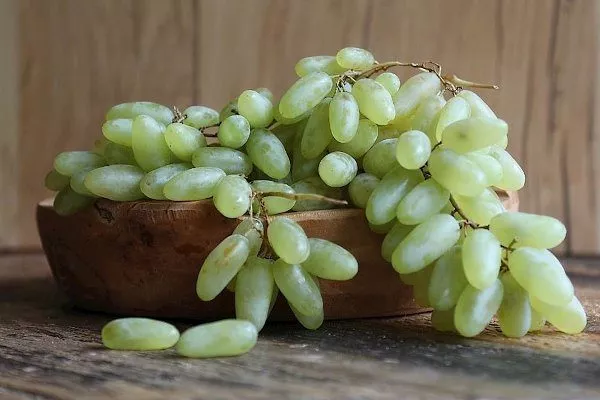
Advantages:
- high taste characteristics;
- spectacular appearance of bunches;
- absence of seeds;
- possibility of making raisins;
- high yield;
- self-pollination;
- good transportability;
- The bunches are well preserved on the vine.
Flaws:
- Low frost resistance makes this variety difficult to grow in temperate climates. Winter shelter is necessary even in the southern regions of Russia.
- The berries are not suitable for long-term storage.
- Low resistance to diseases, susceptible to attacks by parasitic insects.
- Low fertility.
- Demanding in terms of growing conditions – climate, care, etc. For the berries to be sweet, the variety needs a lot of warmth and sun.
Landing site
Landing site requirements:
- good lighting;
- protection from drafts and north wind;
- lack of shadow;
- preference is given to light fertile soils;
- groundwater level – not less than 2.5 m.
- ✓ The optimal soil temperature for planting should be at least +10°C.
- ✓ The distance between bushes should be at least 3 meters to ensure sufficient space for growth.
The optimal option is the southern or southwestern side of the site, covered from the north by a wall, fence or garden plantings.
Planting dates
A major advantage of "Ladyfingers" is that they can be planted at any time except winter. The exact planting time depends on the climate and the grape's propagation method.
The following periods are suitable for planting dormant seedlings and cuttings:
- early and mid-spring;
- mid-October.
Green seedlings with leaves and shoots are planted when stable spring warmth sets in, or even in summer.
If we are talking about grafting cuttings, then this can be done in the middle or at the end of spring - having adapted, they will grow intensively, and by autumn they will be well strengthened.
"Ladyfingers" can also be propagated by layering at any time—spring or fall. Layerings root quickly and can be transplanted as full-grown plants.
Planting diagram
This variety is characterized by vigorous bushes, so they require plenty of space to grow. The optimal planting pattern for seedlings is 3 x 5 m. The minimum hole depth is 80 cm.
How to plant grapes?
The planting technique depends on the chosen propagation method. Let's consider planting "Ladyfingers" grapes using seedlings and grafting.
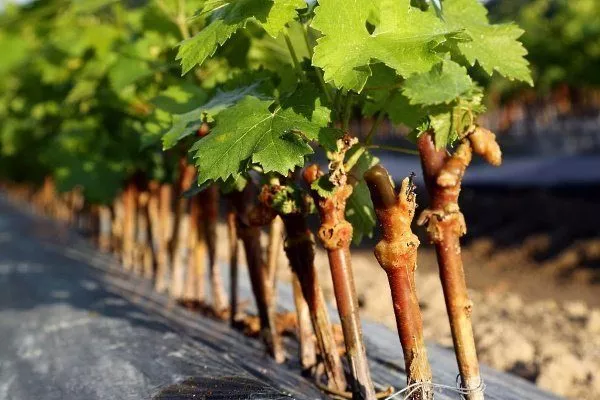
seedlings
The order of planting seedlings:
- Dig a hole 80-90 cm deep.
- Place crushed stone, gravel, broken brick on the bottom – a drainage layer.
- Fill it 1/3 full with soil mixture - mix fertile soil with compost in equal parts, add some superphosphate, potassium and nitrogen fertilizers (30-50 g each).
- Add another layer of soil on top of the fertilizer to prevent the seedling's roots from getting burned.
- Prepare the supports in advance – posts with trellises.
- Now take a break—for a couple of weeks—to let the soil settle. If the holes are prepared in the fall, they will remain in place until spring.
- When it’s time to plant (the soil has warmed up to +10 degrees), place the roots of the seedlings in water for 3-4 days.
- Carefully lower the seedling into the hole, roots on fertile soil, and pour in a bucket of water to compact the soil.
- Cover the seedling's roots with soil. Tamp it down with your hands and water again. A couple of buckets of water will be enough.
- Place a support near the seedling on the north side to prevent the bush from creeping along the ground.
The root collar of the seedling must remain above the soil level; covering it with soil is strictly prohibited.
By vaccination
Grafting is a simple and economical method of propagating grapes, but to implement it, you need to have old grape bushes that will be used as rootstocks.
Vaccination procedure:
- Prepare cuttings for grafting—this is done in early spring or fall. The optimal number of buds is 2-3.
- Cut the bottom part into a wedge shape on both sides.
- Before grafting, cuttings, like seedlings, are dipped in water for several days.
- Prepare the rootstock: cut off the old bush, leaving a 10 cm high stump. Split it exactly down the middle so that the cutting can be inserted into the resulting gap.
- Place the wedge-cut end of the cutting into the prepared split. Pull the split tightly together and coat it with clay.
- Water the rootstock well – with three buckets of water.
- Build a support for the future bush. Fertilize the bush and mulch the soil humus, circle around the tree trunk.
How to care for ladyfingers?
The variety is very demanding in terms of care – Ladies' fingers require a full range of care measures for successful fruiting.
Moisture
Water is the primary requirement for the 'Ladyfingers' variety. It's especially important to water the bushes after winter dormancy, during and after flowering. During drought, increase the amount and frequency of watering. After fruit set, reduce watering.
Top dressing
Principles of feeding "Ladyfingers":
- Nitrogen fertilizers are applied at the beginning of the growing season. This supplementation has a beneficial effect on shoot growth and helps the plant prepare for fruiting.
- In spring and summer, potassium and phosphorus fertilizers are applied – they are important for the formation of bushes.
- If the bushes are lagging in development, foliar feeding is used - spraying with liquid fertilizers.
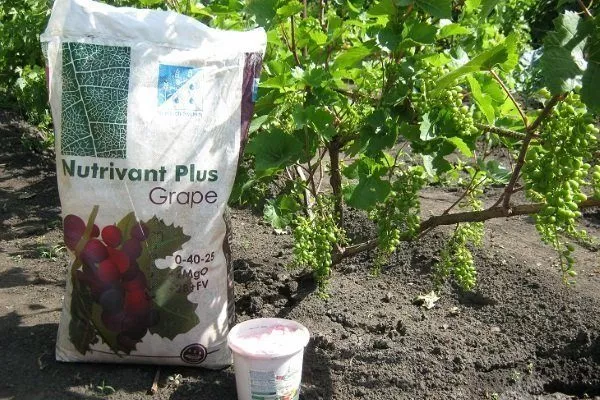
Fertilizing grapes – timing and dosage:
| Type of feeding | When to apply/spray | Composition (doses are given for 1 sq. m) |
| Under the root | half a month before flowering | Nitrophoska – 50 g. |
| Spraying | two days before flowering | For 10 l:
|
| Under the root | half a month after flowering | Nitrophoska – 40-60 g. |
| Spraying | at the stage of formation of small berries | For 10 l:
|
| Under the root | a week before harvest | For 10 l:
|
| Under the root | ripening period | For 10 liters – infusion of ash with microfertilizers (1-2 tablets). |
| Under the root | after harvest | For 10 l:
|
Trimming
A distinctive feature of this variety is its small number of fruiting shoots. Therefore, the main care task is to prune the bushes correctly and in a timely manner. Pruning rules:
- The shoots have a low level of fruitfulness, so long pruning is used, shortening the shoots by 4-10 buds.
- The shoots intended for fruiting must be undamaged. They are left only if they are fully ripened and have grown to their full length.
- Medium-sized stems are preferred—in mature bushes, they reach 1 cm in thickness. Thicker shoots bend poorly and can break, and fruit buds do not grow well on them. Branches thinner than 1 cm are weak and lack sufficient nutritional reserves.
- When pruning, exercise caution - any damage can lead to the formation of wounds that will not heal on perennial branches.
- To calculate how many shoots to leave on a bush, count the number of buds. It's recommended to leave 8-12 buds per square meter.
Gardeners debate how many buds should be left on a bush. Some believe there should be more to compensate for potential frost losses. Others, on the contrary, believe that leaving a reserve complicates pruning, as numerous shoots emerge from lateral and dormant buds.
Principles of pruning technique:
- Make the cut perfectly straight – use sharp pruning shears.
- Cut old branches at a right angle to keep the cutting area small.
- When pruning old stems, try to keep as far away from the base as possible.
- When pruning young shoots, step back 1-3 cm from the lower bud.
Insulation
Before covering the grapes, water them 2-3 days before insulating them. Dry soil freezes deeper and faster than wet soil. Watering increases the soil's heat capacity. For each year of the vine's life, add 2 buckets of water.
Shelter order:
- To prevent vines from rotting from contact with damp soil, place spruce branches or wooden planks underneath them. Avoid placing insulating material on the ground. In winter, the ground's warmth prevents the vines from freezing.
- The branches are tied into bundles with synthetic rope or soft wire. Do not tighten too tightly, as this can damage the shoots.
- The vines are laid and secured with staples so that they are 10 cm from the ground.
- Use dry and disinfected insulation. To repel mice, use tansy, wild rosemary, calendula, or wormwood. Place the grass between the layers of insulation.
For "Ladyfingers" that are afraid of the cold, full cover is recommended, which offers two options:
- tunnel – agrofibre or other covering material is placed on a frame made of arches;
- sandwich – the covering material is applied to the vine in several layers.
Pest and disease control
Susceptibility to fungal diseases is one of the variety's main drawbacks. The most common diseases affecting "Ladyfingers" are:
- oidium (powdery mildew);
- mildew.
A characteristic sign of powdery mildew is the smell of rotten fish.
The most dangerous pests for "Ladyfingers":
- thrips;
- aphid;
- phylloxera;
- leaf roller;
- spider mite.
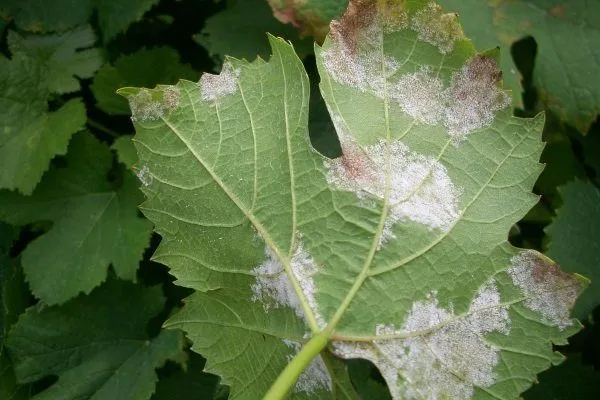
Measures to combat lady finger diseases:
| Diseases and pests | Symptoms and harm | How to fight? |
| Oidium | The disease can destroy up to 80% of the harvest. A dirty, gray, powdery coating forms on shoots and leaves. Unopened inflorescences die, and the berries stop growing and dry out. |
|
| Mildew | It appears in damp weather. Oily, yellow spots appear on the above-ground parts. The vines dry out and fall off, unripe berries rot, and ripe ones become sour. |
|
Pest control measures:
- timely weed control, loosening and annual digging of the soil;
- clearing bushes of old bark in the spring (the removed bark is burned);
- uprooting and destroying diseased bushes;
- If the plantings are attacked by phylloxera, grapes are not planted in that place for 20 years;
- preventative treatments against aphids, weevils, leaf rollers, mites, thrips - bushes are sprayed with Actellic, Fufanon, Aktara;
- Spraying with Confidor and Karate helps against phylloxera and leafhoppers;
- "Mukhoed", "Zemlin" and "Bazudin" help against May beetles and cutworms - granules are scattered between the rows during digging.
- Spray with Bordeaux mixture in early spring before the buds open.
- Treat the bushes with fungicides every 2 weeks during the growing season.
- Use insecticides at the first sign of pests.
Spraying schedule: 2-3 times at 10-day intervals. The final spraying should be carried out no later than 3 weeks before harvest.
A folk remedy for spider mites is a garlic infusion. Add 200 g of garlic to a bucket of water. A decoction of onion peels is effective against leaf rollers.
Reviews of the variety
The famous "Lady Fingers" variety is a classic of viticulture and a benchmark for grape flavor. Unfortunately, this variety is difficult to grow in most of Russia due to extremely cold winters and short summers. However, with proper care, gardeners in the southern regions can grow this exceptionally delicious grape.