
Rovada currant is an excellent choice for those seeking a reliable and productive variety for home and commercial cultivation. Good productivity, disease and frost resistance, and the versatility of its berries make this variety indispensable for gardeners. With simple cultivation practices, bountiful harvests can be achieved.
History of selection
This Dutch variety was developed at the Institute of Crop Breeding in 1980 under the direction of L. M. Wassenaar. The Heinemann Rote Spatlese and Fat Prolific varieties were used in its creation.
Growing regions
This currant variety is not suitable for planting in areas with a sharply continental climate, where hot summers combine with very cold winters. Therefore, it is not recommended to grow this plant in the Urals, northeastern Ukraine, and northwestern Russia.
Description of appearance
Currants are one of the most popular garden crops, and the Rovada variety, although brought from the Netherlands relatively recently, is quickly gaining popularity.
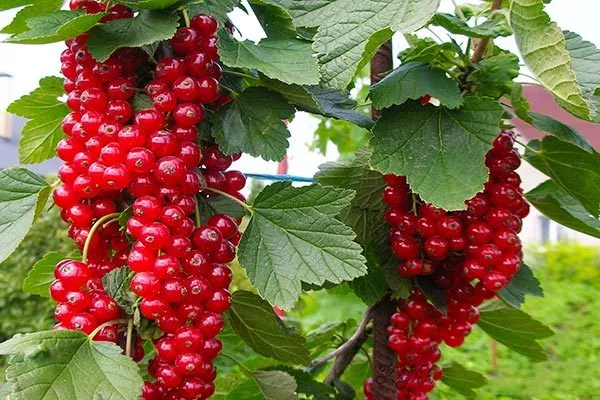
Gardeners value it for its excellent taste, unpretentiousness, and ability to produce generous harvests with minimal effort.
Bush
The plants are medium-sized, reaching a height of 1.5 to 1.7 meters. They have a wide, dense crown. Branches can grow up to 1 meter, requiring support during the fruiting period. Replacement shoots, arising from buds at the root collar, are strong and vigorous, and grow rapidly.
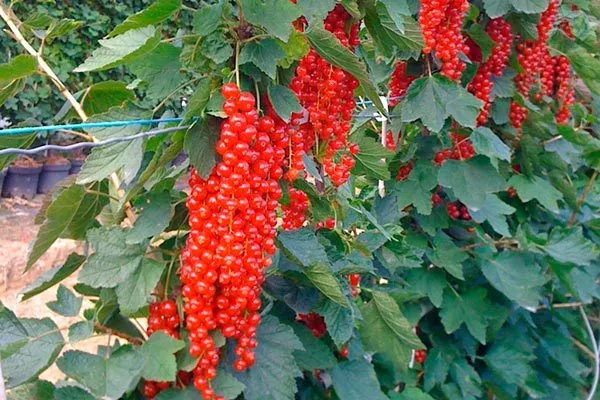
A bush is considered mature at 4-5 years, when basal shoots begin to form. With proper care, this variety can bear fruit for up to 20 years. The most intensive growth occurs in the first two years. Regular pruning and thinning of the crown helps maintain a high-quality harvest.
Leaves
Large, 3-5-lobed leaves with an elongated, pointed center and distinctly serrated edges. The leaf blade is dense, wrinkled, glossy, and green, slightly pubescent on the underside. By autumn, the leaves turn yellow.
Flowers
Rovada blooms late, in May-June. During this period, the plants are covered in numerous inflorescences, forming long clusters. Each cluster consists of 20-25 small, bell-shaped flowers, which open sequentially, starting at the base of the cluster and moving toward the top.
Fruits and their taste
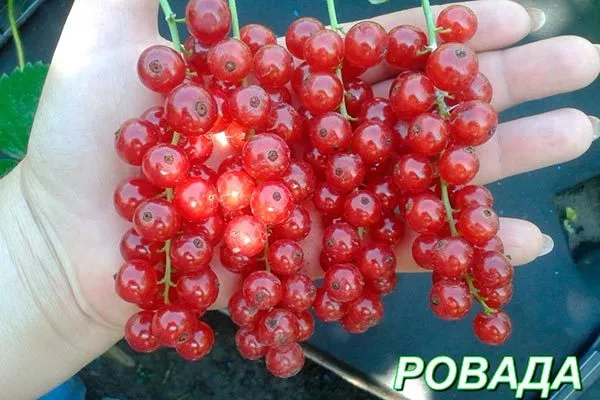
The berries are large, weighing from 0.8 to 1.6 g. They are round in shape and dark red in color. The flesh is juicy and firm, with a sweet, slightly tart flavor and a distinct sourness. The aroma is delicate and pleasant.
Characteristics of the variety
To successfully grow red currants, it's important to consider both their strengths and weaknesses. The crop has many positive qualities and characteristics.
Drought resistance, frost resistance
Hardiness zone 4. Bushes can withstand short-term low temperatures down to -34°C without significant damage. This variety is also drought-resistant.
Pollination, flowering and ripening
One of the variety's key advantages is the absence of barren flowers. Almost every flower is pollinated and forms a full-fledged ovary. Since the flowers are monocotyledonous, the plant is self-pollinating and does not require an external pollinator.
The first fruits begin to ripen in the third ten days of June to early July, depending on the region. Fruiting continues for 5-6 weeks.
Useful properties of red currant
The fruits have a sweet and sour taste and have a healing effect on the body.
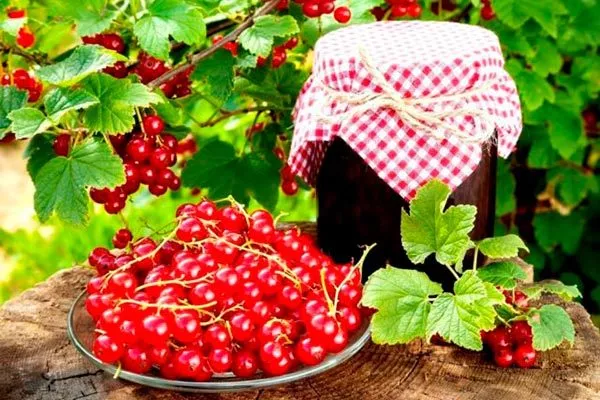
Regular consumption of berries promotes the following results:
Productivity
The fruiting period lasts 45-50 days. A single bush can yield over 10 kg of berries. Productivity when grown on large farms is approximately 35 tons per hectare.
The variety is not prone to shedding after ripening, and the berries can remain on the shoots for a long time without suffering from overheating in the sun or rotting in rainy weather.
Immunity
The crop has a strong immune system and is resistant to powdery mildew and rust. However, given the potential risk of infection, regular preventative maintenance remains necessary.
Landing
It is best to plant seedlings in late summer or early fall, although many gardeners prefer to plant in the first half of spring.
The plant requires fertile black soil, sandy loam or loamy soil with neutral acidity.
- ✓ The soil pH level should be strictly within 6.0-6.5 for optimal nutrient absorption.
- ✓ The depth of groundwater is at least 1.5 m to prevent rotting of the root system.
Selecting and preparing a planting site
Black soil and loamy soils are particularly fertile for successful cultivation. If the soil is heavy, dig it up and add sand to improve water permeability.
Currants prefer sunny sites, which contributes to a juicy and high-quality harvest. The best planting location is a south-facing garden, protected from the wind. They grow well in partial shade or near fruit trees, with the exception of walnut.
The soil should be neutral or slightly acidic. To soften it, use wood ash or lime. Dig the soil until it's loose, then disinfect it with a fungicide (such as a 4% solution of potassium permanganate or copper oxychloride). After 3-4 days, dig it again, adding humus or compost.
Landing rules
Dig holes up to 70 cm deep and in diameter. When planting in groups, maintain a distance of 1-1.5 m between plants. Before planting, inspect the seedlings for rot, disease, and dead branches. Then soak the roots in water for 5-6 hours.
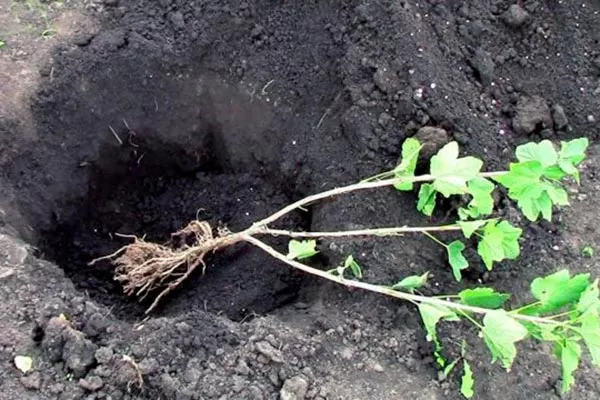
Follow the recommendations:
- Place gravel or drainage material and a little soil mixed with fertilizer at the bottom of the planting hole.
- Spread the roots evenly over the soil, then cover with soil.
- Plant seedlings and cuttings at a 45-50° angle so that the above-ground portion begins 5-7 cm above the root collar. Form a root circle around the trunk and add soil if necessary to keep the roots off the surface.
Some agronomists cover planted cuttings with a dome-shaped cover to create a favorable microclimate, which promotes rapid rooting and shoot emergence. Regardless of the season, mulch the bushes with sawdust or agrofibre, which will help reduce the frequency of watering.
Methods of reproduction
Gardeners increase the number of seedlings in several ways. It's important to choose the best option for you.
Cuttings
Carry out this process in the fall, using three-year-old bushes. Follow these instructions:
- From healthy, strong shoots, cut cuttings 30-40 cm long, leaving 4 buds on each.
- Place the cuttings in a rooting stimulator solution until roots appear, then plant them in a fertile mixture and cover with film, creating greenhouse conditions.
- In the spring, when the cuttings have taken root, plant them in open ground.
- Take green cuttings in June-July during the active growth period. Cut them with a 5 cm section of the mother branch, leaving a length of up to 4 cm.
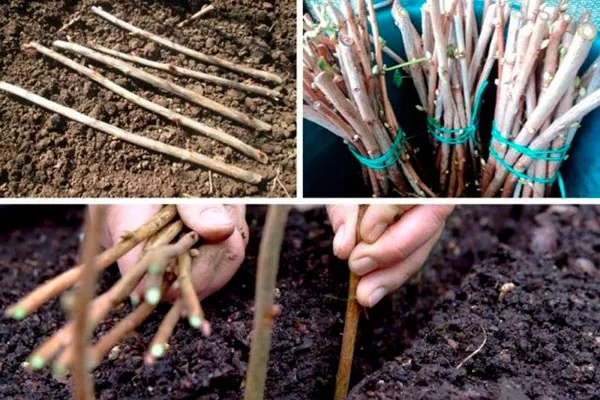
Plant immediately in the ground, placing the mother branch horizontally and the cutting vertically.
Digging in cuttings
Prepare the material in early spring. Select a side branch growing at the base of the bush, bend it to the ground, cover it with soil to a depth of 10-15 cm, and secure it in place.
After rooting in the fall, cut the cutting from the mother plant and transplant it to a permanent location.
By dividing the bush
This is the most traumatic method, but it's used less frequently. Follow these rules:
- Dig up the mother bush, cut off old branches at the root, leaving only young shoots.
- Inspect the root system and remove any damaged or rotten roots.
- Divide the plant into 2-4 parts so that each division has developing buds. After this, disinfect the roots in a weak solution of potassium permanganate and soak them in a rooting stimulator for 24 hours.
- Plant the prepared divisions in the ground in a permanent location.
Growing and care
Although the Rovada currant is generally easy to grow, certain care guidelines are still necessary to ensure a high yield. These guidelines determine the yield.
Watering and fertilizing
Use several methods for this: root watering, sprinkler irrigation, and automatic systems. Each bush should receive at least 7-10 liters of water. After watering, loosen the soil to prevent a crust from forming on the surface.
Depends on the time of year:
- In the spring Water the plants every 5-7 days, which helps them prepare for active flowering and fruiting.
- In summer In rainy weather, watering the crop 1-2 times a month is sufficient. During drought, increase the frequency depending on soil conditions.
- In the fall Carry out moisture-recharging watering to prepare the bushes for winter.
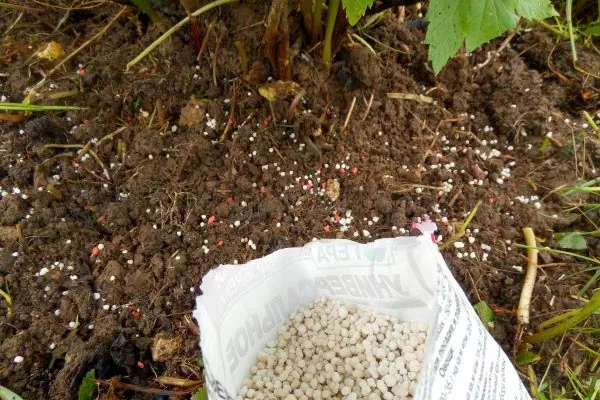
Fertilize currants throughout the growing season (usually 4-7 times). Use nitrogen fertilizers in the spring and organic supplements in the fall. Complex mineral fertilizers are beneficial during flowering.
Preparing for winter
Start with sanitary pruning. Remove diseased, weak, and damaged shoots, and remove foliage and old branches. Then follow these instructions:
- Dig up the tree trunk circle and add fertilizer, preferably organic fertilizer combined with phosphorus and potassium.
- Mulch the plants with natural materials – sawdust or spruce branches.
- After watering, apply a new layer of mulch about 10 cm thick to the ground to protect the root system from freezing.
For additional protection, cover the currants with agrofibre, cardboard or roofing felt, after tying the stems.
Formative pruning
Pruning helps give the bush an attractive appearance and promotes consistent fruiting. In the first year after planting, leave 5-6 strong shoots. In the second and subsequent years, add two more viable shoots. By the age of four, the plant reaches maturity, with 7-9 shoots of varying ages.
- In early spring, spray the bushes with a 3% solution of Bordeaux mixture.
- Before flowering, treat plants with a copper-based fungicide.
- After harvesting, repeat the treatment with Bordeaux mixture.
Diseases and pests
The Rovada red currant variety is highly resistant to diseases and pests. However, in rare cases, the following problems may arise:
- Anthracnose. The disease causes rotting not only of the above-ground portion of the bush, but also of the roots and fruits. Treatment involves the use of products containing high concentrations of sulfur and the removal of affected leaves.
- Powdery mildew. It develops in high-humidity conditions, causing a gray coating to appear on leaves and young shoots. To combat the disease, use fungicides such as Topaz.
- Septoria. It appears as rusty spots on the leaves. Treatment: Bordeaux mixture. To avoid the disease, follow proper agricultural practices and carry out preventative treatments in the fall and spring.
Currants can be attacked by pests such as:
- Glass-box. The pest lays eggs in buds, which hatch into caterpillars that damage buds and shoots. For preventative measures, use Malathion in the fall.
- Aphid. To prevent the appearance of insects, treat the crop with insecticides before and after flowering, spray with a soap-soda solution.
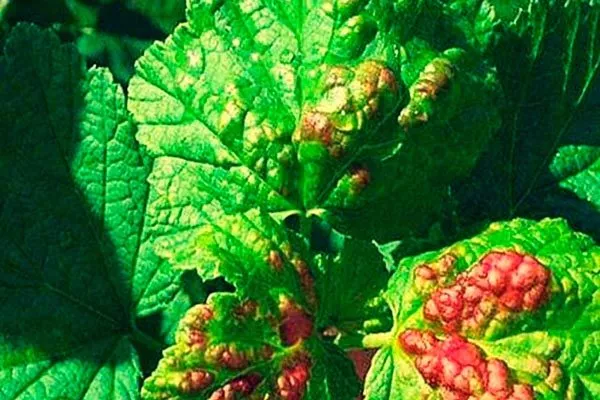
Caring for the plant is not difficult if you follow the correct agricultural practices.
Harvesting
Harvest berries with their bunches intact to preserve their appearance and extend their shelf life. Rinse them and store them in a container. Dry, freeze, or eat some fresh.
Rovada currants are suitable for short-distance transportation. Store freshly harvested berries in the refrigerator at temperatures between 10°C and 0°C, while frozen berries retain their quality for 3 months.
Positive and negative qualities
Before growing a crop, carefully study its advantages and disadvantages to avoid potential difficulties. This variety has many advantages:
Among the disadvantages, some gardeners note high sensitivity to sudden climate changes, a low rooting rate of young cuttings, the prevalence of poor-quality planting material, and dense bushes that reduce yield.
Reviews
Rovada currant is one of the most popular and high-yielding varieties, recognized by gardeners across Russia. It produces abundant yields of sweet and tart berries and is highly resistant to diseases and adverse weather conditions. It's important to understand the characteristics of this crop and provide proper care to ensure bountiful harvests.