
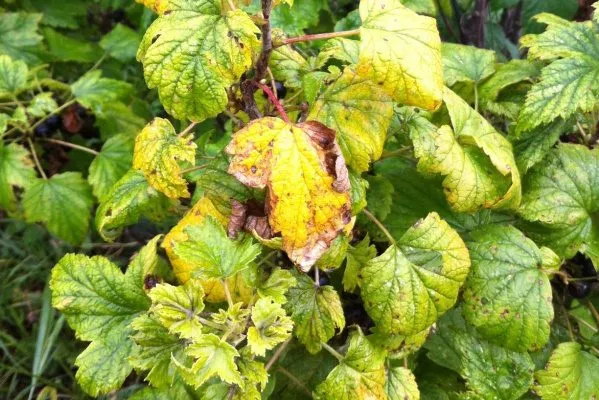
Currants are deciduous perennial shrubs with tasty and aromatic berries. They produce a good harvest of versatile fruits. However, this can change. Gardeners often encounter yellowing foliage. This problem negatively impacts plant growth. There are many causes, most of which can be addressed.
Diseases as a cause
Currants are primarily affected by fungal and viral diseases. The first signs of illness appear in early spring. If action is not taken promptly, the pathogens can destroy the bush in a single season.
| Name | Disease resistance | Ripening period | Berry size |
|---|---|---|---|
| Terry | Low | Average | Small |
| Spheroteka | Average | Early | Average |
| Rust | High | Late | Large |
| Spotting | Average | Average | Small |
| Anthracnose | Low | Late | Average |
Terry
Diagnosing the disease at an early stage is quite difficult, and even when damage can be seen, the currant bush often cannot be saved.
Signs:
- purple color and double structure of inflorescences;
- yellowing of leaves, which acquire an elongated shape;
- the berries fall off or become small.
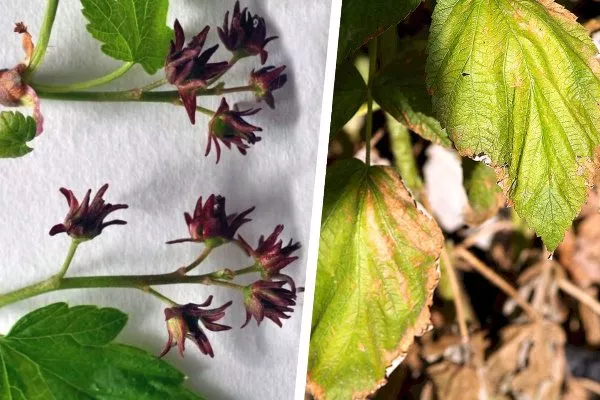
The problem most often arises due to incorrectly selected seedlings – diseased specimens were purchased.
If the disease is detected before it destroys the plant, the bush can be treated with colloidal sulfur. Mix 100 g of the product per 10 liters of water. Spray immediately after preparation.
Spheroteka
This is a fungal disease. Its development is facilitated by specific weather conditions, the proximity of diseased plants, and excess nitrogen. It appears on currant leaves, berries, and shoots. Initially, parts of the plant become covered with a powdery coating.
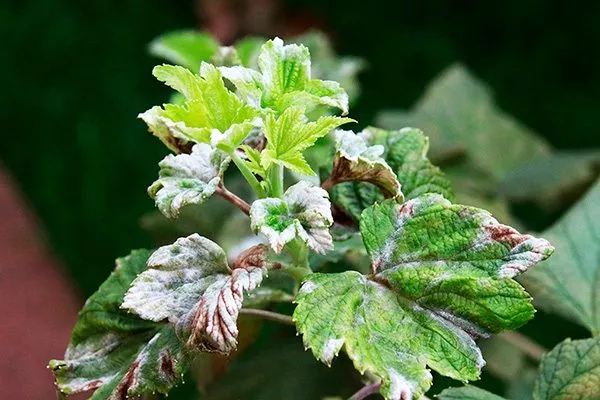
As the disease progresses, the color changes to brown, then darkens. Affected areas turn yellow, dry out, and curl. Fruits fall off before ripening.
Treatment methods:
- Prune diseased parts of the bush.
- Dissolve 300 g of ferrous sulfate in 10 liters of water. Spray the plant.
- At an early stage, a folk remedy is effective: 50 g of washing soda, 50 g of laundry soap, 10 liters of water. Foliar treatment is recommended.
Rust
Two types of rust can develop on currants: cup rust and columnar rust. The main differences are the shape and type of pathogen (fungus) and the time of onset. The negative impact is the same.
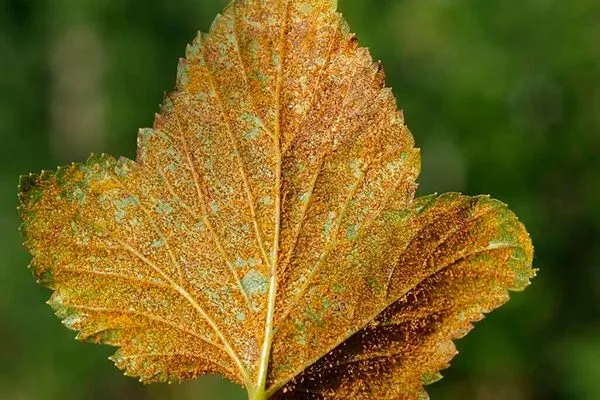
Yellow spots appear on the leaves. An orange "cushion" forms on the underside. On the berries, the disease appears as a white coating. By midsummer, the branches also begin to suffer, becoming bare.
Treatment:
- Cut off diseased leaves and burn them.
- Train the soil under the bush.
- Spray with Fitosporin-M: 5 g of concentrate per 10 liters of water. This amount is sufficient for spraying 100 square meters of garden. Apply twice, separated by two weeks.
Spotting
The fungus develops in vegetation not cleared from the site in the fall. It is spread by wind.
Signs of the disease:
- a large number of round, pale brown spots form on the leaves; as the disease progresses, the color changes to yellow with a brown border;
- The leaves fall off when the infection is severe.
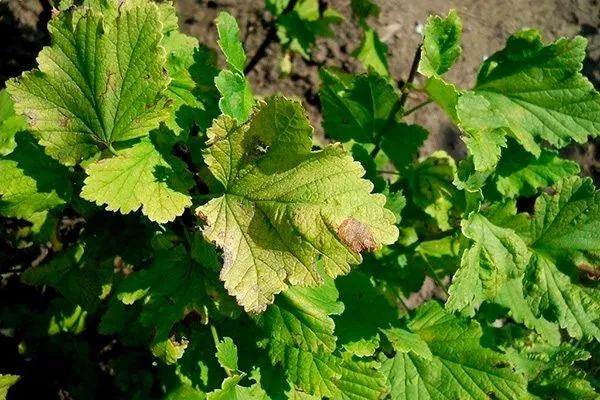
A solution of copper sulfate can help get rid of the problem: 40 g of the solution + 10 liters of water. Foliar treatment.
Anthracnose
A fungal disease. It appears as brown spots on the leaf blade. Initially, the spots are about 1 mm in size. But over time, the disease progresses, covering the entire leaf. Leaves lose their color due to the destruction of chlorophyll. Anthracnose can also attack the petioles, resulting in the crown being bare.
Reasons:
- hot weather combined with high humidity;
- Violation of the rules for carrying out sanitary pruning.
Fungicides provide quick results and are more effective against anthracnose. A single application is sufficient. The choice of spraying agent is based on the time:
- In spring – Nitrafen (300 g per 10 l of water per 1 bush).
- Before the buds appear and open – Cumulus (35 g per 10 l of water. 2 treatments with an interval of 2 weeks).
Pests
Yellowing currant foliage is often caused by pests. Diagnosing the infestation is not difficult. A thorough inspection of the bush is sufficient. Insects typically attack during flowering and berry formation.
| Name | Method of struggle | Period of activity | Vulnerability to drugs |
|---|---|---|---|
| Kidney mite | Colloidal sulfur | Spring | High |
| Gall aphid | Actellic | Summer | Average |
| Glass-box | Fitoverm | Autumn | Low |
| Spider mite | Anti-tick | Summer | High |
Kidney mite
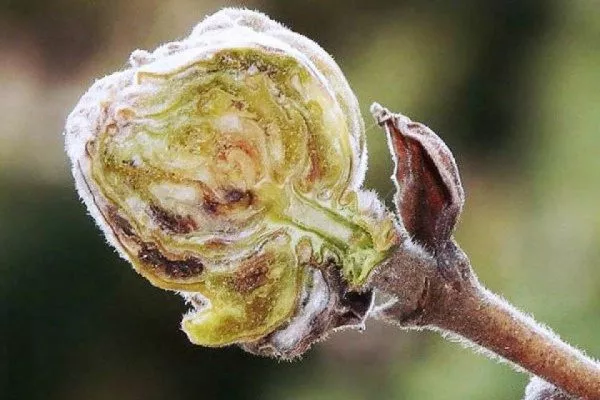
The pest hides in the scales of fruit buds. This action leads to a significant reduction in yield. Signs of damage:
- deformation and enlargement of the kidneys;
- the foliage turns yellow.
Pests can also negatively affect shoots. They tend to reproduce rapidly. When there isn't enough room on the foliage for the entire swarm, branches become the primary food source. As a result, the structure changes, becoming flimsy and crooked.
The cause is hot summers. The larvae live in the trunk tissue and become active when temperatures rise.
Colloidal sulfur is an effective remedy for spider mites. Mix 10 g of powder in 10 liters of water. Spray the area after clearing the affected areas from the bush. Repeat the treatment twice, separated by two weeks, but reduce the dosage by half the second time.
Gall aphid
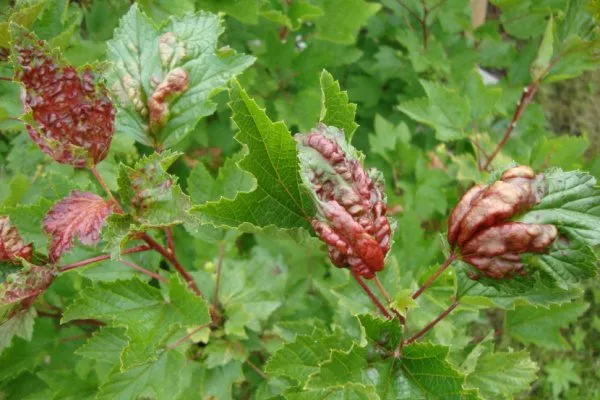
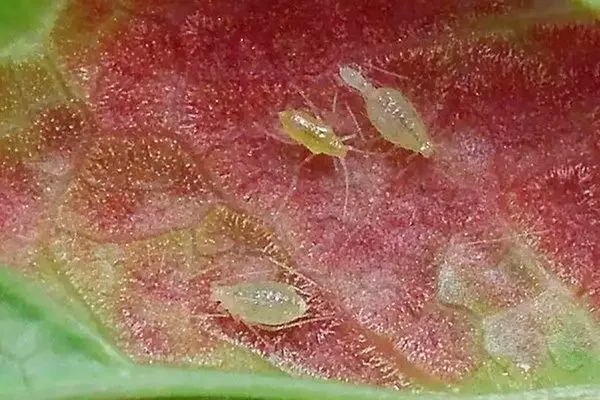
The presence of this pest on currant bushes is manifested by brownish-yellow swellings on the leaves. The color of the lesions depends on the variety. Over time, the swellings begin to turn black, and the foliage dries up. Branches are also susceptible to this problem.
Parasites affect the fruits. They become noticeably smaller, and yields drop.
Hot and dry summers promote the active spread of the pest. detection of aphids Treat the planting with Actellic twice, 2 weeks apart. Directions: Dissolve 2 ml of the chemical in 1.3 liters of water. Apply foliarly. Apply 1.5 liters per 10 square meters of planting.
Glass-box
Controlling this pest is very difficult. This is because the insect lives inside the shoots, where pesticides and their active ingredients cannot penetrate. In the fall, the moth finds a place to live in the cracks of branches. As the weather warms, the pest begins laying eggs, which damage the plant.
Signs:
- there are traces of excrement on the shoots;
- the leaves turn yellow and become smaller;
- the fruits stop growing;
- the inflorescences dry up immediately;
- mass berry dumping.
- ✓ The presence of small holes in the shoots through which the pest’s excrement comes out.
- ✓ The shoots become brittle and break easily when trying to bend them.
Fitoverm helps combat the problem: 2 ml of the product per 1 liter of water. Spray twice, 2 weeks apart. For a noticeable effect, use at least 1 liter of the product per bush.
Spider mite
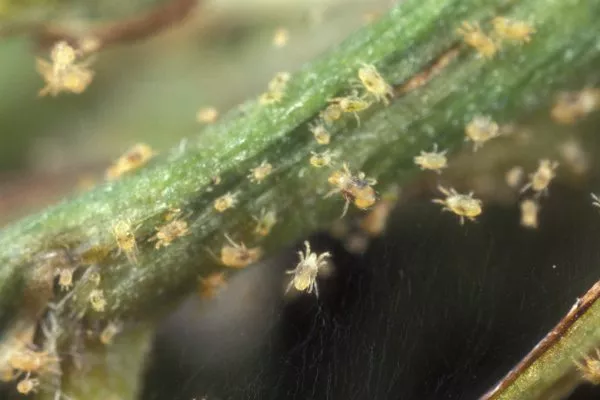
One of the most destructive pests of currants. Females lay eggs during warm weather in the vegetation around currant trunks or in bark crevices. The hatched offspring attack the crop in search of food.
Symptoms:
- light yellow or brown spots form on the inner side of the leaves, which gradually increase in size;
- the tops of the shoots wither;
- the leaves are deformed, the edges curl;
- inflorescences acquire an ugly shape;
- petioles covered with cobwebs.
Anti-Kleshch helps remove pests from bushes. After spraying, the insect dies within 36 hours. Recipe: dissolve 1 ml of the product in 1 liter of water. Mix thoroughly and bring the volume up to 10 liters.
Violation of agricultural technology rules
If there are no signs of pests and the disease hasn't been diagnosed, but the currant leaves still turn yellow, the cause may be the plant's age. A bush that's been growing for over 15 years, due to the natural aging process, begins to take on an uncharacteristic color.
Under- or over-watering
Currants are a crop that cannot fully grow and bear fruit without water. However, watering should be moderate. During dry, hot summers, the soil around the plant should be moistened. Particular attention is paid during flowering, fruit formation, and ripening. A lack of moisture manifests itself as yellowing of the crown.
Each plant requires 10-20 liters of water, depending on the variety and size. The frequency of application is twice a month. The only time you should reduce the watering frequency is in the event of rain.
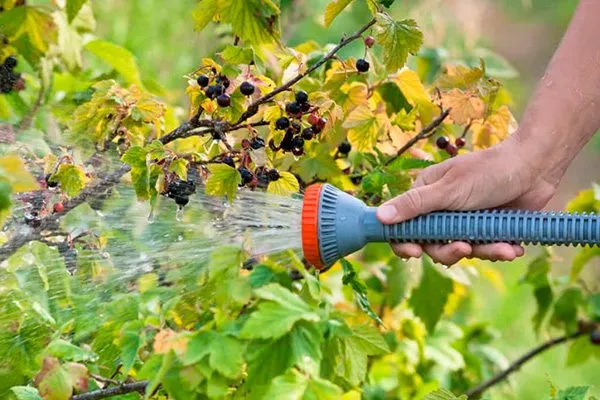
Overwatering is detrimental to perennials. The root system, left in wet soil for long periods, begins to rot. To avoid negative consequences, it is recommended to use drainage when planting and loosen the soil throughout the season.
Lack or excess of fertilizers
Currants are fertilized with nitrogen, phosphorus, and potassium fertilizers. If the dosage is incorrect, the plant may receive too much or too little micronutrients. This leads to certain consequences.
How does excess or deficiency of nutrients manifest itself:
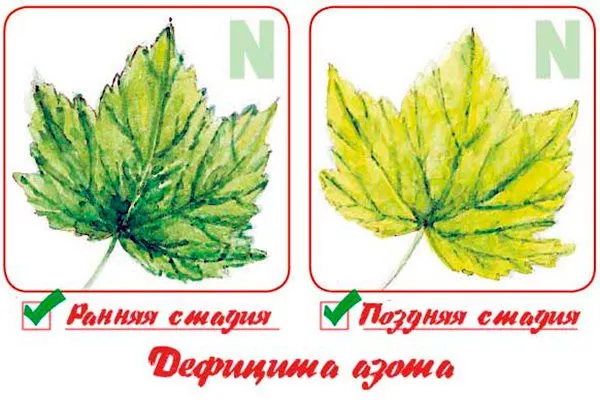
- Nitrogen. If it's deficient, the leaf blade becomes discolored, leaving only the veins green. The shoots stretch out and become thin. Leaf fall begins early in the fall.
When oversaturated, the leaves have a rich green hue and are brittle. Nitrogen-based fertilizers apply in springA good solution is to use urea. For 10 liters of water, you'll need 20 g of the substance. This is the recommended amount for one mature plant.

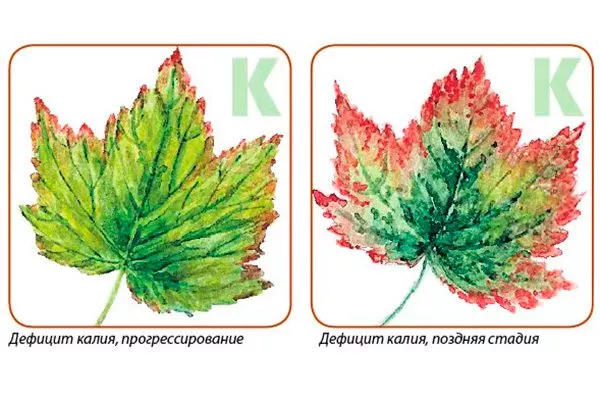
- Potassium. If there is a deficiency: the leaves turn yellow at the edges, the middle remains green.
Excess: The leaf blade becomes deformed, curls downward, and dries out right on the stem. Potassium sulfate can be used to restore the balance. Apply it in June. Spread 10 g of the product under one bush, and dig the soil to a depth of 40 cm.
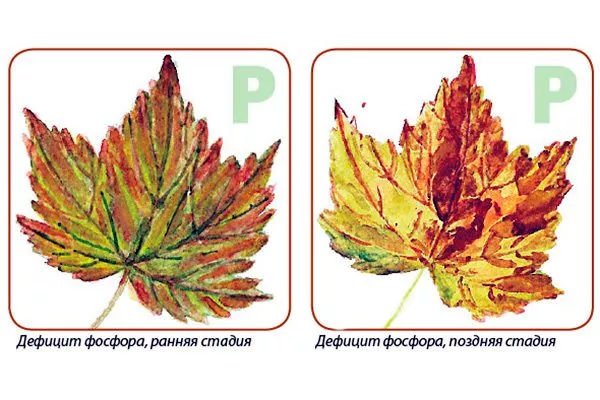
- Phosphorus. When there is a deficiency, red and purple spots appear on the leaves, the edges curl downwards, and sudden summer leaf falls occur.
Excess: the inner leaf surface and petiole turn red. Apply micronutrients in the fall: 5 kg of compost, 45-50 g of superphosphate, 40 g of potassium sulfate.
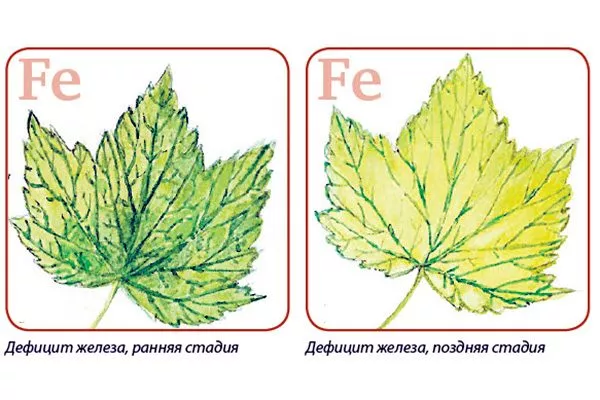
- IronIf the substance is low, the leaves will turn yellow and the edges will dry out. Excessive amounts are indicated by wilted leaves with light veins. Water the plant when the above signs appear. Iron chelate is suitable for watering. Prepare a solution of 1 g of the substance and 2 liters of water. This is the recommended dose for one plant.
Poor root development
If the root system is poorly developed, then in addition to yellowing foliage, the plant will also experience poor growth. It will not reach the size typical for a given age.
There are several reasons:
- The planting hole is too small, the root has nowhere to grow, and new shoots do not appear.
- The seedling was planted at an angle.
- When placing the seed in the hole, the location of the neck was not taken into account; it remained on the surface and was not deepened by 6 cm.
- There's no drainage to allow moisture to pass through. The root system begins to rot.
- The distance between plantings was not maintained. The distance between specimens should be approximately 2 m.
The problem can only be solved plant transplantation according to strict rules, since the procedure is traumatic.
The planting time was chosen incorrectly
Planting currants, regardless of variety, follows the rules. Sometimes, work begins in early spring, when the risk of returning night frosts has not passed. Such plantings have a low survival rate. Leaves begin to turn yellow due to exposure to cold soil.
Weather conditions
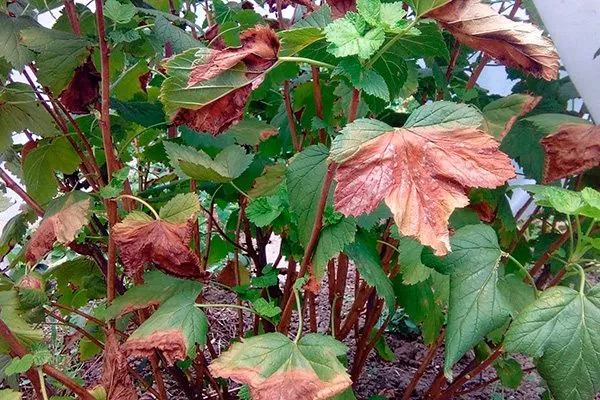
In the first half of summer, many regions experience a temperature spike. The heat and dry air cause the bush to dehydrate, the leaves dry out, and the petiole separates from the branch and falls off. Yellowing begins at the tips. The color changes gradually, eventually covering the entire leaf blade with a dry, yellow crust.
Frequent and heavy rainfall negatively affects the plant. Initially, the crown turns yellow, then darkens, softens, and rots.
Currants are sun-loving crops. If they are planted in the shade or near tall trees that block sunlight from reaching the perennial, the leaves will grow small and yellow. Excessive sunlight also causes color changes. This phenomenon is characterized by scorching.
Incorrect wintering
Planting currants in your garden should be based on the climate. Choose varieties suitable for your region. Varieties with low frost resistance are only suitable for the south of the country.
Species introduced to thrive in hot, short summers and harsh, long winters feel uncomfortable in hot climates. This is manifested by a yellowing of the leaves.
Control methods and treatment
Chemical treatments are most often used to treat currant diseases, as they are more effective. Folk remedies help combat insects. However, some gardeners use a combination of treatments, while others choose a method based on the severity of the problem or the severity of the infestation.
Folk remedies
These preparations are harmless, but their effectiveness is reduced. Infusions can be used throughout the growing season.
Home remedies recipes:
- Mustard. Dissolve 40 g of dry mustard in 10 liters of hot water. Apply the mixture after it has cooled completely. Apply foliarly in the evening or morning. The mixture helps eliminate fungus. To prevent pest attacks, sprinkle the bush with mustard after flowering.
- Garlic. Chop a medium-sized head of the vegetable. Pour 1 liter of boiled water over it. Let it steep for 7 days. Before use, dilute 50 ml of the infusion in 10 liters of water. Suitable for killing small numbers of ticks.
- Wood ash. Protects against powdery mildew. Dissolve 1 kg of powder in 10 liters of water. Let the infusion steep for 4 days. After this time, add 50 g of laundry soap. Spray the plant twice, 2 weeks apart.
- Serum. This is a method for getting rid of fungus. Dilute it at a rate of 1 liter of fermented milk product per 9 liters of water.
Chemicals
Chemical treatments, as well as folk remedies, are used to address various issues that cause yellowing. They are applied in the spring or summer.
Which formulations are considered the most effective and popular among gardeners:
- Prophylactic. A concentrated oil emulsion. Used to control pests. Can be sprayed before bud swelling. The working solution is 500 liters of product per 10 liters of water. Spraying is recommended at an air temperature of approximately 4 degrees Celsius.
- KleschevitApply the treatment after the first leaves appear. A mixture of 1 ml of the product and 2 liters of water helps combat not only spider mites but also powdery mildew. The recommended dose per plant is 2 liters.
- Spark. It's needed during the formation and growth of green mass. The spray is easy to prepare: dissolve one tablet in 10 liters of water. For every 10 square meters, use 1.5 liters. It protects against almost all pests in the early stages of infestation.
- Oxychom. Helps combat leaf spot, anthracnose, late blight, and spider mite attacks. Dissolve 15 g of the product in 10 liters of water and spray on a windless day. There is no strict dosage, but the key rule is to avoid the mixture dripping from the leaves onto the soil.
Timing and rules of prevention
While it's possible to combat the problem of yellowing currant leaves, preventing it from occurring is far more effective. There are a number of preventative measures to take in the fall.
What is recommended to do:
- If the bush is infested with insects, treat it with chemicals in the fall. It may be possible to postpone the work until spring before the buds open.
- Do not neglect sanitary and formative trimmingAfter removing branches, treat all cuts with garden pitch to prevent pests from penetrating the plant tissue.
- Loosening the soil around the tree trunk and then sprinkling it with wood ash, mustard, or ground pepper can help reduce the likelihood of pests. Perform this procedure after the leaves have fallen.
- Always collect and burn vegetation near the planting.
- Good companions for currants include garlic, onions, and calendula. The strong aroma repels insects.
Currants are a perennial fruit crop. Their foliage often turns yellow. There are many causes: diseases, pests, and gardener's mistakes. All problems can be overcome. The key is to diagnose the deformity promptly.