
Fall pruning is a mandatory agricultural practice that allows you to achieve several goals simultaneously. Pruning techniques vary depending on the desired goals and the age of the bush. Let's learn how to properly prune currant bushes in the fall.
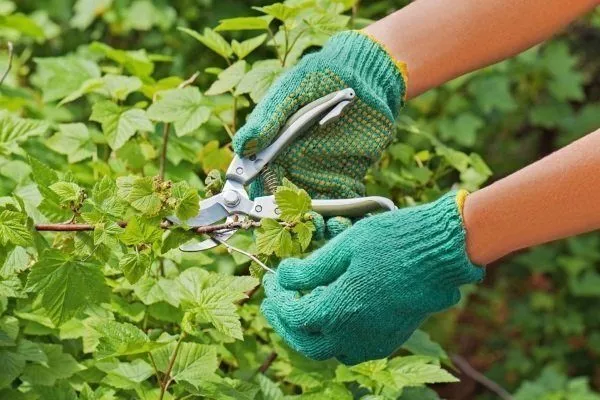
When is autumn pruning required?
Currant seedlings grow quickly—in a couple of years, the bush expands, gains strength, and begins to produce fruit. After 3-4 years, fruiting begins to decline, and the bush itself loses its shape, becoming too bulky—it needs pruning.
The best time to prune currant bushes is in the fall. When the bush is ready for winter and sap flow has ceased, the plant experiences minimal stress from shoot removal.
Pruning is a complex agricultural technique, the subtleties of which gardeners spend years mastering. But the main rule applies to all types of pruning: each branch should receive its fair share of sunlight.
Pruning purposes:
- Remove old branches – they suck nutrients from the bush, reducing yield.
- Remove branches that thicken the bush to ensure sunlight reaches the fruits.
- Remove dry, diseased and frostbitten shoots.
Trimming results:
- stimulates the growth of young branches;
- the growth and development of the bush is accelerated;
- the bush takes on a neat shape;
- the fruiting period is extended to 15 years.
With proper care, you can extend the lifespan of a currant bush fivefold. We recommend reading the article about How to care for currant bushes in autumn.
Dates and weather conditions
Autumn is the most favorable and safe time for pruning shrubs. Pruning currants in the spring is dangerous—they bud early, and the risk of frost is high. In autumn, however, there's no such danger—you can slowly remove all excess shoots.
The procedure is carried out in late October or early November, when the bushes have completed all growing processes. Cold weather reduces stress and injury to the plant. Pruning is carried out when the bushes have shed all their leaves. This allows the gardener to assess the condition of the branches on bare bushes. Pruning is done on a dry, sunny day.
By region
Currant pruning should be done between leaf fall and the first frost. The exact timing depends on the region and its climate.
Currant pruning times by region:
| Region | Recommended timeframes |
| Moscow region | end of October (soil freezing here begins around November 15) |
| Leningrad region | from October 15 |
| Siberia | Given the region's unstable climate, pruning is carried out here from the beginning of September. |
To confirm that it's time to prune, make a cut on the shoot. If sap starts to ooze from the wound, it's too early to prune the bushes; postpone the procedure for a week.
According to the lunar calendar
Experts don't recognize the lunar calendar, but amateur gardeners often consult it. It's believed that the best time to prune trees and shrubs is during the waning moon (phases 3 and 4), when the plant's sap is at its lowest. In the fall, pruning is recommended during the waning moon, shortly before the new moon.
It's strictly not recommended to prune currants during the new moon, especially a few days before the new moon. However, experts say it's best to trim the tops during the new moon.
The best days for autumn pruning according to the lunar calendar for 2019:
| Month | Favorable |
| September | 2, 5, 7, 9 |
| October | 1, 4, 5, 10, 29, 31 |
| november | 3, 7, 8, 11, 28, 30 |
Gardeners believe that pruning during the waxing moon makes the bush thick and spreading, and during the waning moon it promotes the growth of the root system.
Tools and other equipment
Pruning tools should be sharpened and disinfected to ensure clean cuts without spreading infection to healthy bushes.
- ✓ Tools should be made of high-quality steel for durability and ease of sharpening.
- ✓ Pruning shears and loppers should have ergonomic handles to reduce fatigue during prolonged use.
- ✓ To disinfect tools before pruning, it is recommended to use a solution of potassium permanganate or alcohol, and not just water.
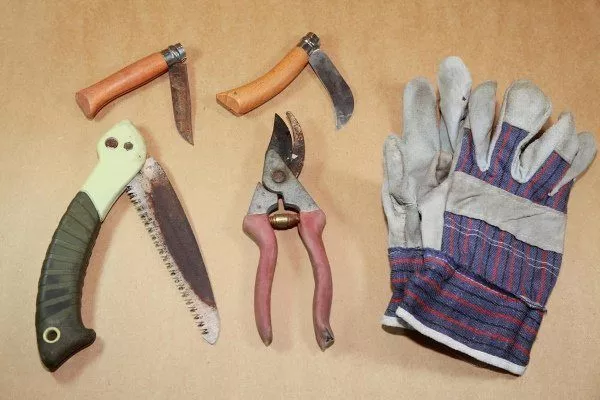
To prune a currant bush, you will need:
- Garden knife. It allows you to make even cuts. It is used only on thin branches.
- Secateurs. For removing thin and middle-aged shoots.
- Hacksaw. Take a saw with small teeth for cutting thick branches.
- Hedge trimmer. Handles branches of any thickness and allows you to shape your bush to your desired shape.
- Loppers. A tool with long handles that allows you to reach branches in hard-to-reach places.
Pruning purposes
There are several types of currant pruning. Each type serves a specific purpose:
- Sanitary. Its purpose is to remove all unnecessary shoots, including those that are diseased, damaged, dry, or defective. It is prohibited to break off shoots by hand, leaving stumps, as this increases the risk of rot.
- Rejuvenating. It's designed to remove old branches that drain the plant's sap. This increases the plant's yield.
- Molding. This pruning is aimed at shaping the bush. It ensures uniform fruiting across branches of varying ages. It gives the bush a neat and attractive appearance, easy to maintain, and conducive to fruit ripening.
- Supportive. This is carried out throughout the life of the bush and is aimed at maintaining good growth, fruiting, and the health of mature plants. The goal is to prevent branches from growing beyond the established bush.
- Topping. This involves removing the tops of the shoots using pruning shears, cutting 2-5 cm off the shoot. The process is similar to formative pruning, but the effect is similar to sanitary and rejuvenating treatments. Pinching is used only on blackcurrants, as red and white currants produce berries on the upper branches, and removing the tops will negatively impact their yield.
Pruning rules
The order and rules for pruning currants in autumn:
- First, sanitary pruning is carried out, removing:
- cut to the ring, broken, thin, short and deep-growing shoots;
- one of two intertwining shoots;
- branches lying on the ground - in summer they do not have enough light and they practically do not bear fruit;
- branches affected by diseases and pests.
- branches whose wood is not yet ripe - they will be damaged during frosts.
- Then rejuvenating pruning is carried out:
- remove all shoots older than 5 years;
- branches older than 3 years are shortened by a quarter;
- when pruning annual shoots, 4-5 of the strongest shoots are left and the rest are cut out;
- cut the annual growth by a third.
- Next, formative pruning is performed, the details of which depend on the type of bush—red and black currants are pruned differently. All excess shoots that have grown over the summer are removed.
The video below shows the rules for pruning currants in the fall:
To increase the yield, several branches of different ages – from 1 to 6 years – are left on the bushes.
Pruning methods and instructions
Currant bushes need to be pruned throughout their lifespan. There are various pruning methods, varying not only in technique but also in the goals they serve. Let's look at the most popular pruning methods.
Before landing
Principles of pruning seedlings before planting:
- Before planting the seedlings in the ground, their tops are cut off.
- Only 2-3 buds are left on each branch.
- Weak branches are pruned more severely, leaving only 1-2 buds.
Pruning the tops stimulates branching, which contributes to increased yield and makes the bushes more powerful.
For rejuvenation
Rejuvenating pruning is best done in the fall. The timing depends on the currant variety:
- black is rejuvenated at the age of 5;
- red - at 8 years old.
To rejuvenate currants, remove old shoots in one of three ways:
- Cut to ring. The branch is cut off entirely, leaving no stump. The cuts are sealed with garden pitch.
- By cutting to the bud. The shoot is shortened—only a portion of it is cut off. If the bush is sparse, the cut is made to a bud facing inward—to encourage bushier growth.
- By cutting to the outer bud. If the bush is too dense, then the cut is made on the outer bud - so that it becomes thinner.
Rejuvenating pruning has its own nuances for red and black currants:
- Blackcurrants produce their main harvest on three-year-old shoots. Therefore, all branches older than five years are removed. To stimulate the growth of one-year-old shoots, they are pruned by a third. If the bush has many two-year-old shoots—more than eight—the three-year-old shoots are removed completely.
- Red and white currants produce their most productive shoots when they are 5-8 years old. Therefore, all branches older than 8 years are removed, leaving no more than 12 branches on the bush.
Red and white currants are also often pruned partially, or forced to branch. This involves rejuvenating old but fruit-bearing branches, 5-6 years old. A strong, first-order branch is selected. The skeletal branch is cut off after branching.
Old, overgrown shrubs are rejuvenated gradually, leaving 15-18 fruiting branches. The rejuvenation procedure is as follows:
- Cut off the zero shoots, leaving the three strongest ones.
- Remove all shoots that are thickening the bush.
- Gradually prune old skeletal branches—no more than 5 per year. First, remove those that are more than 5 years old—they are easily identified by their slight growth, bark color, and secondary branches.
In 3-4 years the old bush is brought back to normal condition.
An experienced gardener explains what you need to know about pruning currants in the video below:
After harvesting
Experienced gardeners practice pruning immediately after harvesting. The benefits of this method include:
- The branches receive more sunlight, which promotes photosynthesis of young shoots.
- The plant does not waste energy on unnecessary shoots.
- The internal branches, like the lateral shoots, grow intensively, forming a beautiful bush shape.
- The risk of fungal infections is reduced.
Pruning immediately after fruiting increases next year's yield. If you notice your bush's fruit production is declining, pick the berries and cut out 2-3 main branches, cutting them down to the roots. Most importantly, don't leave any stumps. This will free up space for new branches, and the sun will better illuminate the fruit next year.
Michurin's method
A personal garden is one thing, but an entire plantation of shrubs is quite another. For industrial-scale cultivation, conventional pruning methods prove unprofitable. For intensive currant cultivation, the Michurin pruning method is used. Developed at the Michurin All-Russian Research Institute of Horticulture, this method increases yields by 30%.
Currant pruning procedure according to Michurin:
- Planted currants are not pruned for five years. Fruiting begins in the second year.
- In the 5th or 6th year, 50% of the plantation is cut down to the roots. The soil is fertilized. The remaining bushes continue to bear fruit.
- After a year, the grown root young shoots are thinned out, leaving about 20% of the shoots.
- A year later, the remaining old bushes are cut back. The rest are thinned out and trimmed.
The rejuvenation process allows for harvesting for another three years. After that, the bushes must be uprooted.
Radical method
Radical pruning is performed to rejuvenate bushes aged 8-15 years. Its purpose is to prolong fruiting.
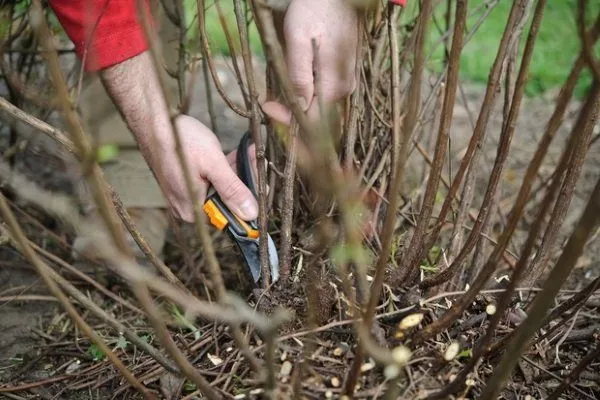
The order of radical pruning:
- Trim all branches to the ground, leaving stumps no more than 3-4 cm high.
- Coat the cut areas with garden pitch.
- Sprinkle the soil around the stumps generously with humus and sprinkle it on the stumps remaining from the bush.
- To prevent the roots from freezing in winter, place the remains of the bush on top mulch straw or sawdust.
The time for pruning is late autumn, when all the leaves have fallen from the bush. Radical pruning stimulates the awakening of basal buds, and new shoots will emerge in the spring. The strongest shoots will be selected from these and will form the new crown.
Trimming on a trellis
The method of growing berry crops on trellises originated in Western Europe. This approach reduces the final yield, but the berries are sweeter and larger.
The procedure for pruning currants when grown on trellises:
- After planting, trim all lateral shoots on the seedlings to 5 cm. This extensive pruning transforms growth buds into fruit buds.
- Prune branches near the ground to keep the berries off the ground. Avoid cutting the main shoot. Regularly pruning the lower branches will ensure the fruit is formed at a height of 90-150 cm, making harvesting easier.
- If the plant forms two trunks, select the stronger one and remove the second one.
- In subsequent years, the currant bush is trained by regularly pruning basal shoots and those close to the ground. The currant bush should resemble a columnar tree.
Pruning currant bushes
Standard pruning was once popular in Russia, back in the 19th century. It was later forgotten, but now it's making a comeback. This unusual pruning method allows you to shape a currant bush into a spreading miniature tree.
Trimming order:
- Select one, the most vigorous shoot—it will become the trunk of the currant "tree." Prune all other branches.
- Shorten the vertical shoot chosen to serve as the trunk to the desired height – 80-100 cm. Leave 3-4 upper buds to form the crown.
- Wrap the lower part of the shoot with opaque film or a tube (plastic or rubber). Place a support—a pipe, a wooden beam, or something similar—to support the "tree."
- Pinch off the lateral shoots that will appear near the upper buds after 3-5 leaves.
- In the second year, pinch off new shoots.
- In the third year, the plant takes on the shape of a tree. Prune out all broken, diseased, and weak branches. Remove suckers regularly.
Pruning by year
Currant pruning is performed annually. The first time, the seedling is pruned immediately after planting—before its first winter. During this initial pruning, all foliage and young shoots are removed, leaving only the buds at the base of the seedling. Subsequently, the pruning procedure varies slightly from year to year.
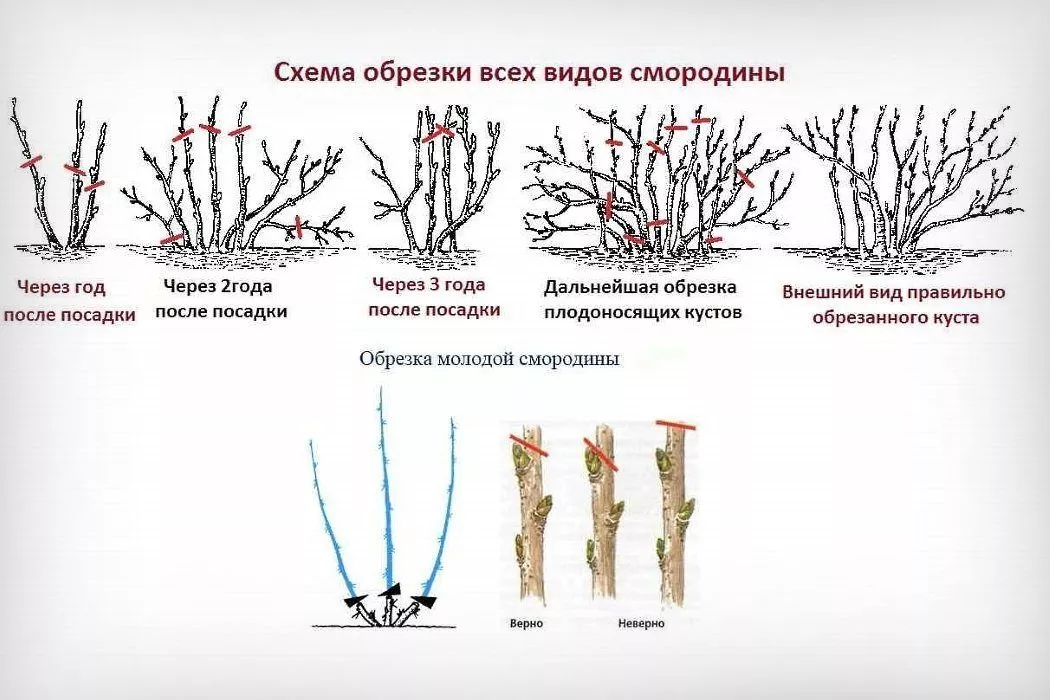
One year after planting
In their second year, currant seedlings are pruned and pinched—this is the main goal of pruning at this stage. This pruning helps shape the bush and accelerate its development.
Features of pruning one year after planting:
- Leave only the strongest shoots. The optimal number is 3-4. All other growth is trimmed off.
- It is recommended to pinch the tops of the remaining shoots.
Before pruning a seedling, assess its condition: on weak bushes, the growth is cut back to 2-3 buds; on an average-developed plant, only 1-2 shoots are left.
In 2 years
In the third year, the bush continues to be shaped. The pruning procedure is as follows:
- Do not prune last year's branches, or shorten them by a couple of buds so that the crown forms evenly.
- Cut out all root suckers.
- Remove all young shoots growing towards the trunk, as well as all adjacent branches.
- From the young ones, leave 2-3 of the most promising ones.
In 3 years
In the fourth year of life, the formation of the bush is still ongoing, so pruning is almost the same as the previous one:
- Cut out the root shoots completely to prevent the bush from growing too large and dense.
- Remove weak young branches growing inward from the bush. Leave only those growing away from the trunk.
- Leave last year's and earlier branches. Trim their ends to avoid wasting nutrients.
If pruning is done correctly, by the fourth year, the currant bush will be a well-developed, spherical bush. At this age, there are approximately 10 shoots, each of varying ages.
In this video, a gardener shares his experience pruning fruit and berry bushes, using red and black currants as an example:
Further pruning
In its fifth year, a currant bush reaches its peak fruiting. At this time, shoots begin to lignify, drawing to the end of their life cycle. If these shoots are not removed, yield will decline—the older shoots will drain the bush's energy.
Principles of pruning in the 5th year of life:
- The main goal at this stage is to rejuvenate the bush, so remove all old and dried branches to make room for young shoots.
- Don't prune all the old, woody shoots at once—you can't expose the bush to such stress. Prune these branches gradually, year after year.
- When pruning old branches, remove diseased and crooked shoots, as well as suckers—vertical, overgrown shoots that drain the plant's energy. Leave only healthy, fruit-bearing branches.
- Prune 2-4 year old branches to the 4th bud, and one year old branches to the 2nd.
Rake up fallen leaves and all pruned branches and burn them to prevent the spread of pests and diseases. Read about currant diseases and pests.here.
Features of pruning different varieties of currants
The pruning technique, or rather its subtleties, depends on currant varietiesCurrant varieties differ in nuances:
- Altai;
- with active shoot formation;
- with passive shoot formation.
Altai varieties
A distinctive feature of Altai varieties is that they bear fruit in the middle and upper parts of the stem. Therefore, cutting these parts of the shoots reduces the yield. With these varieties, only old, well-fruited branches are pruned. All other shoots are left unpruned, except for diseased or insect-damaged shoots.
With active shoot formation
Varieties with active fruiting have a large number of bud shoots, which form in large numbers each year. They germinate primarily in the root zone of the bush. These buds are sparsely branched and should be pruned. If a bud shoot reaches 30 cm, it is pruned, removing weak buds.
With passive shoot formation
Varieties with passive fruiting are less popular than the previous currant varieties because they grow too slowly. Young branches on these bushes are pruned only slightly, or not at all. By pruning suckers and old branches (up to six years old), the young branches are given the opportunity to develop and produce a good harvest.
Care after pruning
After autumn pruning, currant bushes go into hibernation, so no further maintenance is required. Just a few steps remain:
- Loosen the soil. Add potassium fertilizer and superphosphate. Spread humus or compost around the bushes.
- Spray the bushes with Karbofos, Bordeaux mixture, and colloidal sulfur to prevent diseases and pests.
- Insulate the tree trunk circle by adding peat or sawdust in a 10 cm layer.
- Deeply loosen the soil around the bush to improve root aeration.
- Apply phosphorus-potassium fertilizers at a rate of 40-50 g per bush to maintain the plant’s immunity.
- Mulch the tree trunk circle with a 10 cm layer of peat or sawdust to protect the roots from frost.
Gardeners' mistakes
Common mistakes when pruning currants:
- They leave a lot of branches. Novice gardeners often neglect their shoots, failing to prune them and leaving too many old branches. This neglect results in a drop in yield. The bush spends energy supporting the old branches rather than producing fruit.
- The timing of pruning is chosen incorrectly. Delaying pruning can cause the bush to freeze. However, if pruning begins before the leaves have fallen and the sap has stopped flowing, the currant bush will "cry" for a long time after pruning. This stresses the plant, increasing the risk of infection, and reducing its immunity and yield.
Autumn pruning is a mandatory agricultural practice when growing currants. By remembering the pruning procedure and rules, you can maintain high yields and extend the life of your currant bushes.