
Timely and proper pruning of fruit bushes can significantly extend the life of the plants and increase the yield. Pruning is performed in both spring and fall, but the goals are different. For example, autumn pruning is done for general rejuvenation and formation of the bush, and in spring - to remove frozen and diseased shoots.
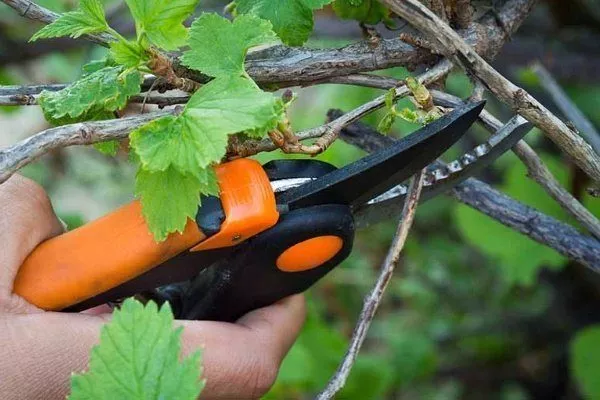
Advantages and disadvantages of spring pruning of currants
Without proper care, this fruit bush can produce good yields for about five years, after which the yield declines. However, with timely and proper pruning, the period of high yields can be increased fivefold for black currants and threefold for red and white currants.
The main advantage of spring pruning is that it minimizes the risk of frostbite at the cut site. It also reduces the likelihood of misidentifying shoots that are not capable of bearing fruit. By spring, it becomes clear how well the plant has survived the winter.
Overall, spring pruning will provide you with the following benefits:
- The plant will redistribute the nutrients to the shoots in such a way that the largest portion of nutrients will be directed to the strongest remaining branches, resulting in an increase in both the overall volume of fruit harvested and its size.
- As a result of balanced lighting achieved by thinning, the ripening times of the berries in the bush as a whole and the bunches in particular are synchronized.
- Removing infected and insect-damaged branches minimizes the risk of the entire bush becoming diseased.
- Partial pruning of branches stimulates the growth of new shoots, which will be ready for active fruiting the following year.
The disadvantages of the procedure include the following factors:
- Spring pruning is considered an additional, not a primary measure.
- If you skip autumn treatment, hoping to catch up in the spring, the measure will not bring the expected result, but will only slightly improve the situation, provided the technique is followed.
When pruning in spring, a plant ready to grow will be forced to expend energy on repairing damage and increasing the number of new shoots, which can negatively affect the ripening time of the fruit.
The long-term benefits of spring pruning outweigh the foreseeable risks, so the procedure is highly valued by experienced gardeners and is widely used.
Features of spring pruning of black, white and red currants
Black, red, and white currants require different treatments. While black currants are recommended to be pruned in late fall, white and red currants are best pruned in spring or even summer, after fruiting. Pruning principles also vary.
Bush black currant – wide, spreading, with multiple branches, the bush quickly becomes dense, depriving the fruiting shoots of the necessary sunlight needed for uniform berry ripening. Branches older than five years do not produce fruit at all, but they do produce fruiting branches, which produce berries in the second year.
Formative pruning of blackcurrants begins at planting and is performed twice a year. Once the bush reaches five years of age, a rejuvenating treatment is performed. After rejuvenating pruning, the bush should have five mature branches and the same number of young branches.
This video explains and demonstrates how to prune black currants in the spring:
U red and white currants Young shoots aged 2-3 years are not removed, and the tops are not pinched to encourage lateral branches. This is because the shoots branch weakly or not at all; they are all "skeletal," meaning the main shoots grow directly from the root collar.
The refusal to pinch the tops is also related to the peculiarities of vegetation - due to the absence of lateral branches, it is on the upper parts of the main shoots that red and white currants set fruit ovaries.
General principles of bush formation for mature plants remain the same once the plant reaches the age at which yield declines. Regular rejuvenation pruning should be performed, removing old branches.
Red and white currants are not pruned to the root, but rather a few buds are left at the bottom of the shoot, which quickly increases the size of the bush, and with it the number of fruiting branches.
In the following video, an experienced gardener shares his knowledge on the proper pruning of red currants:
Unlike black currants, these types of currants are considered old when shoots are 7 years old, not 5.
Peculiarities of pruning young and old currants
Different treatment methods are used for young bushes and those that have passed their peak fruiting age (5-7 years). In young plants, the shoot tips are primarily pruned to shape the bush.
In first-year seedlings, only 2-3 basal buds are left, completely removing existing shoots. This measure helps to obtain about 5 branches ready for fruiting by the end of summer.
In subsequent years, continue to pinch the tops and remove the so-called “zero” shoots – those that appeared last summer, leaving only 3-5 of the most powerful ones.
Starting in the sixth year, rejuvenation treatment begins: branches with cracked bark, dry, frost-damaged, and diseased ones are removed. This is necessary to prevent the plant from wasting energy on supporting shoots that are not capable of abundant fruiting, and also to ensure the young shoots receive the necessary amount of sunlight, as old branches significantly thicken and shade the bush.
Bushes up to 5 years old are formed, and after that they are rejuvenated and thinned out.
Deadlines
Spring pruning should be done before active sap flow begins, which can be determined by bud swelling. Currants begin growing early, so pruning should be done in early spring, while there's still snow cover.
If you missed the specified deadlines and the buds have swollen, you can prune the plant, but you must take into account the time it takes to recover from stress—the fruit ripening period may shift significantly.
After removing thick branches (more than 2 cm in diameter), be sure to treat the cut areas with a compound that will promote rapid healing of the damage - clay or garden pitch.
To increase the effectiveness of the clay putty, mix it with mullein and dilute it with water to form a paste. Apply the resulting mixture to exposed cuts. This mixture can also be used to treat any other damage to the trunk, from minor scratches to breaks.
Avoid using large quantities of manure, especially fresh manure, as this can burn the plant, and instead of accelerating its adaptation, you'll have the opposite effect. Clay should be the main component.
For red and white currants, it's recommended to delay treatment until mid-April in central Russia. Black currants, however, should be treated in March, before warm average daily temperatures set in.
Rules
Before spring pruning, inspect the bush and determine whether it requires this procedure. First, remove any damaged shoots, those affected by diseases and insects. Read about currant diseases and pests. hereThey can be identified by the following signs:
- the bark is cracked;
- lichen or other foreign inclusions appeared on the surface;
- the branch is dry or broken;
- areas of blackened bark appeared;
- the shoot is drooping or lying on the ground.
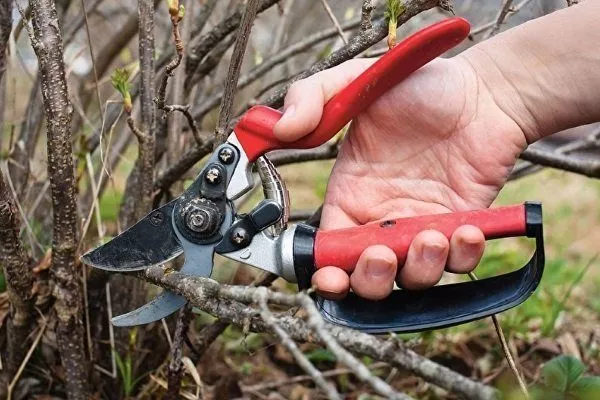
After this, you need to determine the age of the remaining branches, as currants require shoots of varying ages to produce abundant fruit. Visual indicators of shoots of different ages are as follows:
- first-year plants are thin, green, without lateral branches;
- two-year-olds - similar to first-years, only the color of the bark changes to brown;
- shoots aged 3-4 years – dark brown bark color, presence of lateral branches (in black currant);
- five-year-old shoots (seven-year-old for red and white currants) and older - the bark cracks, lichen may appear.
- ✓ Blackcurrant shoots older than 5 years not only have cracks in the bark, but also a significant reduction in the diameter of new growth compared to young shoots.
- ✓ In red and white currants, old shoots (7 years and older) may retain smooth bark, but are distinguished by an almost complete absence of fruit buds.
Following the rule of leaving five young and five mature branches, at this stage remove shoots older than five years. Prune even those that are disease-free, leaving four to five of the healthiest.
Next, select the best young shoots (the same number) and remove the rest. Pay particular attention to the branches that point inward—they must be removed without fail.
For maximum efficiency, take note of the rules of experienced gardeners:
- Always use only perfectly sharpened tools.
- Trim the branch in such a way as not to interfere with the flow of sap.
Currant pruning patterns
First, determine the purpose of your bush pruning: shaping or rejuvenation. Then, choose the appropriate pruning method from the options below.
The main techniques in the spring pruning procedure are as follows:
- Root pruning This method is used when a shoot needs to be completely removed (if it's diseased, infested, etc.). To prevent the remaining branch from rotting and root infection, no stumps are left and the cut is positioned exactly where it branches off from the root collar.
- A cut of the upper part of a shoot with one or two buds - used to stimulate branching - based on the knowledge that the plant receives the most abundant nourishment from the top three buds, when using this technique, leave the section of the branch where the buds are directed outward untouched, and remove the top with the buds from which branches will grow towards the center of the bush.
- Ring pruning – Complete removal of lateral branches to stimulate their renewal, primarily for blackcurrants. This is preferably done in the fall, but can also be done in the spring if pruning was not performed in the fall. Specific instructions: the cut should be strictly perpendicular to the shoot's growth direction and positioned along the main branch, avoiding it and preventing the formation of a stub from the removed shoot.
- Thinning out branches Only shoots that thicken the bush are pruned, while those that extend outward are preserved. It is recommended to leave no more than 5 mm between the awn shoot and the cut point to minimize the stump and prevent damage to the remaining bud.
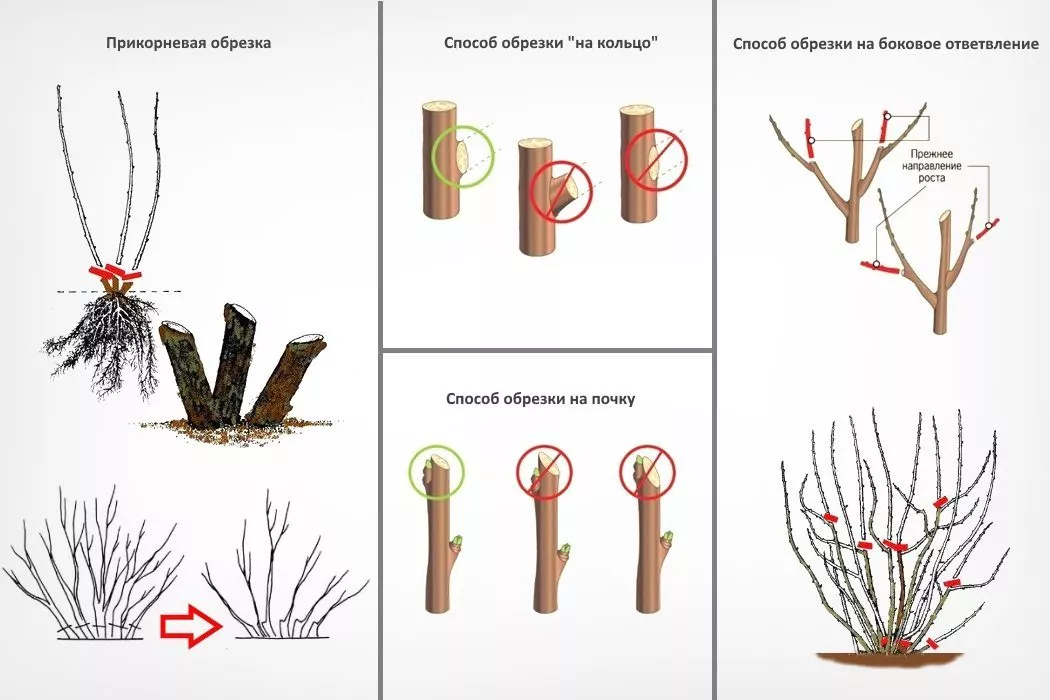
The methods listed above are suitable for you if you're an experienced gardener and have a good understanding of what we're talking about. If you're just starting out as a gardener, use the recommendations below:
- Find branches with a diameter greater than 1 cm and remove them all.
- Now trim off the branches lying on the ground and those pointing downwards.
- The next step is to remove the shoots that are directed towards the center of the bush.
- Finally, trim off the branches that point straight up using the ring technique.
These recommendations will allow you to achieve high fruiting rates without requiring any special knowledge or skills.
Caring for currants after pruning
Pruning is stressful for currants, and mature plants, which are more difficult to recover from due to their age, react particularly sharply to such procedures. To speed up this process, the bushes need to be fertilized.
Fertilizers are selected based on the timing of the procedure. At different stages of the growing season, the plant has a particularly acute need for various nutrients:
- When pruning in spring, complex fertilizers are appropriate. However, pay particular attention to the fertilizer's content of phosphorus and potassium in equal proportions. Currants also respond well to nitrogen enrichment (superphosphate, urea, and ammophoska are suitable).
- The best organic fertilizers are cow dung and horse manure, which also contain nitrogen as the main beneficial substance.
- Organic matter must be well-rotted, preferably aged for at least two years. Fresh manure in its pure form can cause serious damage to the root system and can kill the plant.
- Open cuts must be sealed with clay or garden pitch to prevent infection from entering the channels through which the sap flows.
We recommend reading the article about How to properly care for currants in the spring.
Common mistakes
Among the main mistakes of novice gardeners, the two most common are:
- cutting out all young shoots, based on the assumption that the older, more powerful branches will produce a greater harvest;
- removing all old branches in the hope that a complete renewal of the bush will increase fruiting.
Both approaches are erroneous and will not yield the desired results, since each shoot at its age performs its own function, and cutting out all branches of the same age category can provoke a long adaptation period for the bush after stress and even the death of the plant.
Gardeners lacking pruning skills confuse the care instructions for different currant varieties. They often follow the care instructions for black currants when working with red and white currants. As a result, the plant, instead of increasing the number of fruit ovaries, is forced to re-grow new shoots.
We also recommend reading the article about the featuresgrowing white currants.
Some novice gardeners don't even delve into the intricacies of pruning and instead follow the usual method used for vegetables—simply pinching the tips of all branches, regardless of their age. This approach does more harm than good.
The bush begins to branch heavily in all directions, expending energy on forcing numerous shoots at the expense of fruit formation. And those fruits that do set will ripen unevenly and risk insect infestation. The dense vegetation is a favorite habitat for spider mites and weevils, which can deprive you of your berries altogether.
With proper care of garden plants, you can not only increase harvest volumes but also significantly extend the time between complete bush replacements. Proper pruning can extend the life of currant bushes up to 25 years, whereas without proper care, a five-year-old bush is considered old, as at this age, currants begin to noticeably decrease yields and the ripening of berries in the clusters becomes unsynchronized.