
The White Fairy currant was developed by domestic breeders and is deservedly popular among our gardeners. Its translucent berries are significantly sweeter than sour, with a pleasant and delicate flavor, and the skin is so thin that the seeds are visible through it.
Description of the White Fairy currant
The White Fairy currant bushes are medium-sized, gently spreading, reaching 100 cm in height. The shoots are medium-sized, geniculate, and glabrous; older shoots are a brownish-red hue, while new shoots are brownish-green. The leaves are small, green, and matte, with wrinkled main veins.
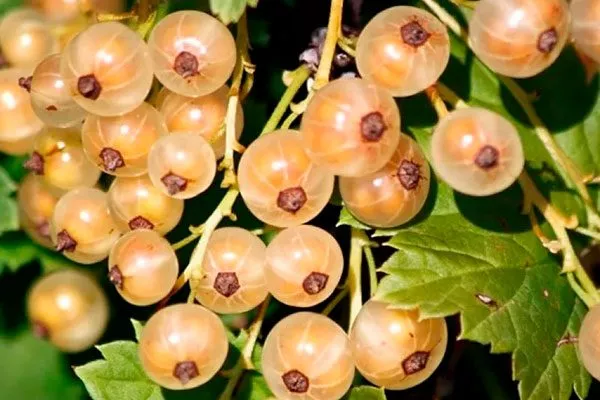
The flowers are small, pale, saucer-shaped, and 3-5-lobed. The central leaflet is longer than the sides. The translucent berries are borne on clusters, reaching 8-9 cm in length (including petioles). Nine to 13 fruits ripen on a single cluster. The berries are dry to detach.
Brief description of berries:
- Color: white.
- Form: rounded.
- Skin: thin, strong and shiny.
- Weight of one berry: 0.6-0.8 g.
History of creation
The White Fairy variety was bred by specialists from the Federal Scientific Center of Horticulture. Authors: V. M. Litvinova and N. K. Smolyaninova. The variety was approved for use in 2007. Its second official name is Almaznaya.
The taste and purpose of berries
The berries have a delicate, sweet and sour flavor, without any aroma. The pulp is juicy, and the seeds are small. The berries are used for desserts; they are eaten fresh, but also used to make jams, fillings, compotes, and other preserves. Tasting score: 4.
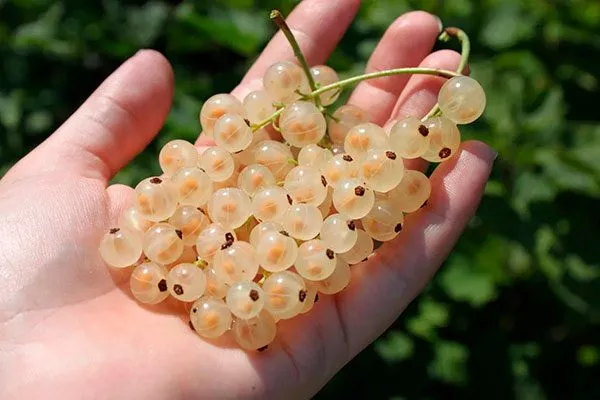
Chemical composition of berries:
- Sakharov - 6.8%.
- Titratable acid - 2.2%.
- Ascorbic acid - 41.9 mg/100 g.
Characteristics
The White Fairy currant is an early-ripening variety, producing fruit within 2-3 years of planting. This white variety has excellent characteristics and is zoned for the Central Russian region, but is suitable for cultivation in most regions of the country.
Ripening time
The berries are mid-season, beginning to form on the bushes as early as July and ripening around the beginning of August—the exact timing depends on the growing region.
Productivity
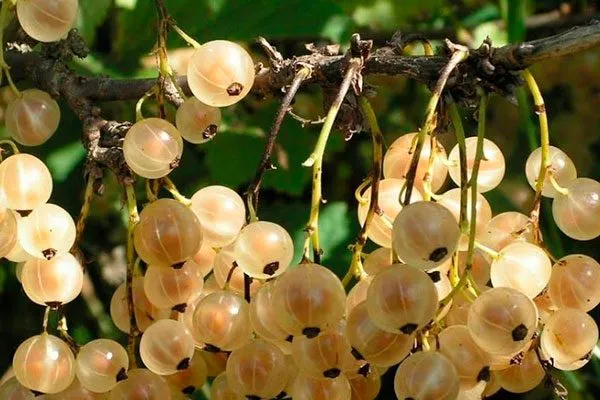
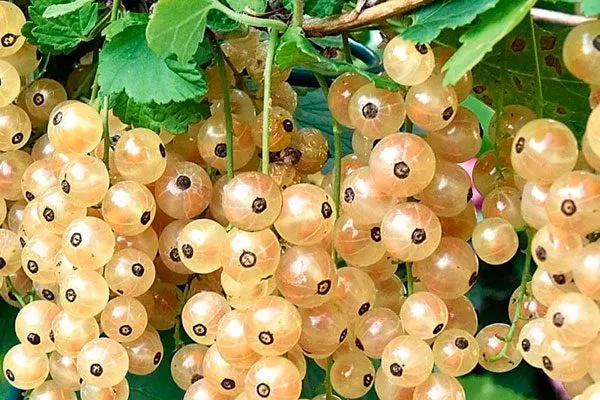
This is a high-yielding variety. With proper care, a single mature bush can yield up to 5.2 kg. When grown commercially, approximately 86 centners of berries are harvested per hectare.
Frost resistance
It is frost-hardy and tolerates harsh winters relatively well. However, its critical limit is -35°C, so in areas prone to harsher frosts, the bushes require insulation.
Drought resistance
It tolerates heat quite well and copes well with dry periods. However, leaving the bushes without water during drought is not recommended, especially during fruiting, as a lack of water will negatively impact both the quantity and quality of the harvest.
Immunity to diseases
It has relatively high immunity to pests and major disease pathogens. However, under unfavorable conditions, there is a risk of fungal and other infections, as well as insects, so the bushes require preventative spraying.
Pros and cons
The White Fairy currant has many advantages that gardeners immediately notice, but it also has a number of disadvantages that are worth knowing about in advance.
Landing features
To ensure that currant bushes grow well, develop, and begin bearing fruit quickly, it's important to plant them correctly. For currants, it's important to select a suitable planting site, properly prepare the seedlings, and plant them according to established agricultural practices.
Planting dates
Currants with a closed root system are planted in spring or fall. In southern regions, fall planting is preferred. Here, autumns are warm, allowing the seedlings to take root and easily survive the winter. In other regions, spring planting is preferred.
Requirements for seedlings
Half the success of growing berry crops is high-quality planting material, so be very careful when choosing seedlings. Purchase them only from reputable sources, such as nurseries and agricultural stores.
- ✓ Availability of a certificate of conformity to the variety.
- ✓ No visible damage to the root system and shoots.
What to look for when choosing a seedling:
- Age: 1-2 years. They take root best.
- The stems shouldn't be too wet. Excessive moisture indicates improper storage; such seedlings won't survive transplanting.
- The roots are well-developed, with numerous small rootlets. The roots should be at least 20 cm long. There should be no damaged, rotted, or dried roots.
- The seedling should have 3-4 strong shoots with healthy, clean bark. It should be free of damage, spots, or signs of disease.
- The buds are well developed but not swollen. If they are swollen, this means the seedling has already begun to emerge, which will reduce its survival rate after transplanting.
Selecting a site
White Fairy currants require a flat, sunny location. Currants can be grown at slightly elevated sites, but they absolutely do not thrive in damp or shaded areas. The bushes should receive at least six hours of sun per day. However, midday shade is preferable.
The soil in the area should be moderately moist or even slightly dry; waterlogging is contraindicated. Currants grow best in loamy and sandy loam soils that are loose and have low acidity.
The groundwater level should be no more than 1.2 meters. The site should be protected from cold winds and drafts. Currant bushes, in particular, are recommended to be planted along fences, where they will be protected from air currents.
Preparing the soil and planting hole
Soil preparation begins in the fall. Growing currants requires loose, fertile soil with a pH of 6–7.1. The soil is tilled, adding approximately 10 kg of humus or compost per square meter.
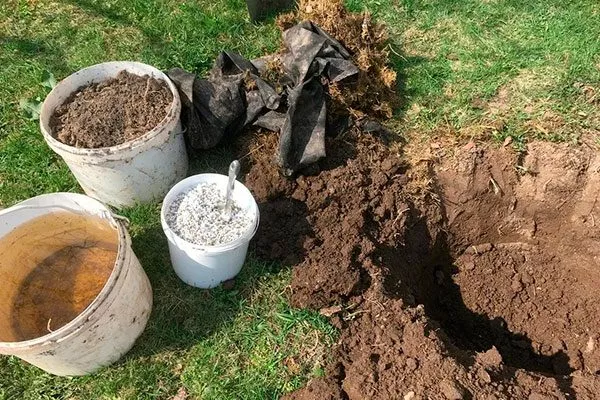
If the soil is heavy and clayey, add sawdust or sand at a rate of 3-5 kg per square meter. To increase fertility, add 8-10 kg of rotted manure. Slaked lime, dolomite flour, or wood ash are added to acidic soils, while high-moor peat is added to slightly acidic soils.
Features of preparing a planting hole for currants:
- Planting holes are dug approximately a month before planting. This allows the soil to settle and the fertilizer placed in the holes to dissolve.
- The distance between adjacent holes is 1–1.2 m, between rows – 2 m. The depth of the hole is 35–45 cm.
- 1015 cm of drainage material - gravel, pebbles, broken brick, etc. - are placed on the bottom.
- To fill the hole, prepare a soil mixture of 10–12 kg of rotted manure and the topsoil obtained from digging the hole. Add 40 g of potassium sulfate, 200 g of superphosphate, and 300 g of wood ash to the mixture.
- The resulting mixture is poured into the hole and 30 liters of water are added on top. The hole is then left to settle, covered with roofing felt.
Planting currants
It is recommended to plant white currants in dry, cloudy weather. They can also be planted in the morning or evening, as seedlings planted during the day will not take root well if exposed to direct sunlight. The optimal temperature for planting currants is 15 to 20°C.
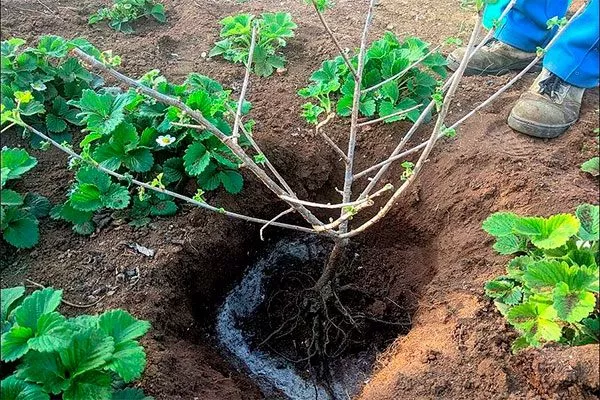
Features of planting White Fairy currant:
- If the weather is dry, the hole is generously moistened the day before planting.
- Before planting, the seedling (its roots) is soaked in water.
- The seedling is placed on a mound of earth, the roots are carefully spread out and covered with soil, compacted to remove all air pockets, and watered generously.
- After planting, the root collar of the seedling should be buried 5 cm deep.
- The planted seedlings are pruned to 3–4 buds, leaving 10–15 cm of shoot length.
Care Features
The White Fairy currant does not require much effort from gardeners; it is quite unpretentious and requires standard care for this crop.
Watering and loosening
It is recommended to water the bushes weekly. After watering, the soil should be moistened to a depth of 30-40 cm. Avoid watering the leaves during hot and sunny weather.
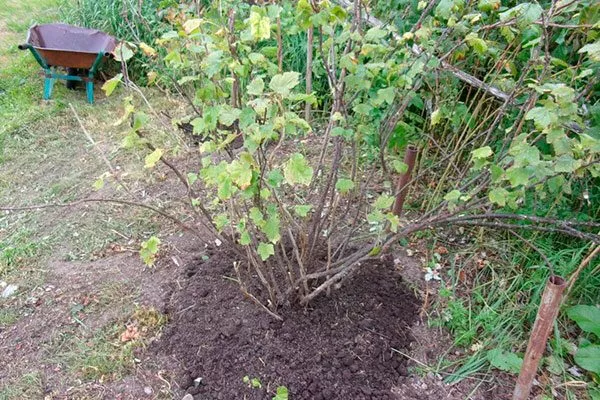
After watering and rain, the soil around the tree trunks is loosened to a depth of 5-6 cm, and weeds are removed along the way. To reduce the amount of loosening, weeding, and watering, the soil is mulched with wood ash, sawdust, compost, etc.
Top dressing
Fertilizing currants begins in their third year, alternating organic and mineral fertilizers. At bud break, apply 15–20 g of urea per bush. In the fall, apply 15 g of potassium sulfate, 50 g of superphosphate, and 4 kg of compost.
- In early spring, before the buds open, treat the bushes with a 3% solution of copper sulfate.
- After flowering, spray with Bordeaux mixture to prevent fungal diseases.
- In the fall, after harvesting, treat the bushes and the soil around them with a 5% solution of ferrous sulfate.
Disease prevention
To prevent the White Fairy currant from getting sick, preventative spraying with 3% copper sulfate, 5% iron sulfate, or 5% Bordeaux mixture is recommended.
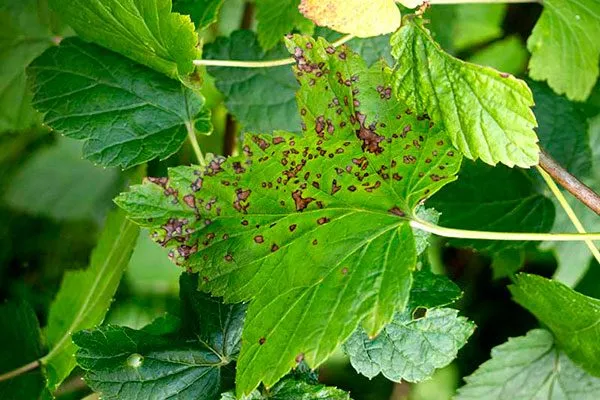
To prevent infection, it is also recommended to avoid overcrowding and shading of plantings, promptly remove all diseased and suspicious shoots, adhere to a watering and fertilizing regime, and use growth stimulants.
Pest control
During a pest infestation, the White Fairy can be attacked by various pests. To prevent damage to the bushes and reduced yield, it's important to regularly inspect them for pests.
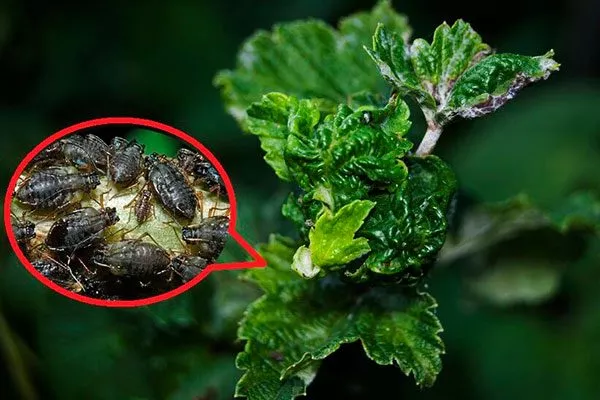
The most common insects that attack currants are:
- Gall aphid. Before bud break, treat the bushes with Actellic or Sumicidin. Spraying the trunks and soil with a 3% urea solution is also recommended for prevention.
- Currant glasshouse. Rovikurt or Fufanon are used against it. It's also important to dig in the fall and promptly collect and destroy fallen leaves.
- Yellow gooseberry sawfly. It is controlled using Actellic and Karbofos. To prevent damage, it is important to regularly loosen the soil, dig deeply in the fall, and remove weeds and plant debris from around the tree trunks.
Harvesting and storage
The berries begin to be harvested in the second half of July. They are picked by hand and placed in shallow containers with a capacity of 1–2 liters. The process typically takes a month, as this variety ripens gradually. The berries are stored at temperatures between 2 and 4°C and high humidity for 6–8 days.
Reviews
The White Fairy currant is an interesting and promising all-purpose variety that will definitely appeal to berry lovers. This white currant is guaranteed to provide its growers with delicious berries and consistently high yields.