
A warning sign for gardeners is yellowing sea buckthorn leaves compared to their original color. If the cause of the problem is identified promptly, the plant can be restored to normal. Learn about the factors that can cause yellowing of plant leaves and how to eliminate them.
Nitrogen deficiency
Nitrogen is essential for plants as a component of chlorophyll. Without it, photosynthesis is impossible. If sea buckthorn experiences a nitrogen deficiency, photosynthesis in the leaves slows, causing them to turn yellow.
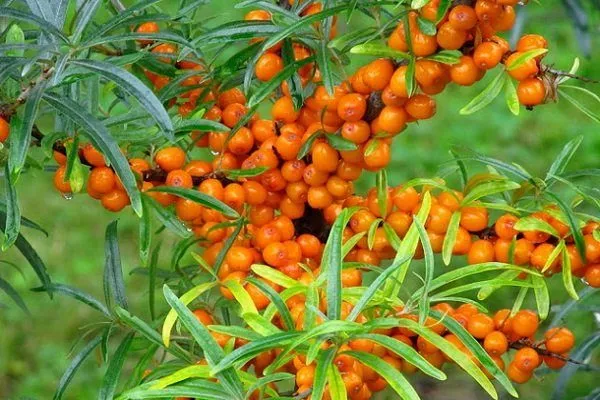
- ✓ Soil temperatures below 10°C significantly reduce nitrogen absorption.
- ✓ Soil pH outside the range of 6.0-7.5 can block nitrogen availability to plants.
A deficiency can occur even if there is sufficient nitrogen in the soil. Dry and cold weather in light and sandy loam soils makes it difficult for plants to absorb nutrients.
If weather conditions are normal, then nitrogen content can be replenished during the growing season by applying the following products under the roots:
- ammonium nitrate 20 g per 10 l of water;
- urea 120 g per 10 l of water.
Foliar feeding with urea at a rate of 30 g per 10 liters of water will also help.
To prevent nitrogen deficiency, 100 grams of urea is applied to a depth of 7-8 cm around tree trunks in the fall. In the spring, another 50 grams of urea is applied under the same tree. If compost or humus has been added to the soil, the amount of urea is halved.
Diseases and their control
Yellowing sea buckthorn leaves can be associated with disease. The gardener's task is to quickly identify the disease and implement treatment. If you respond quickly to the signs of an emerging threat, you can often successfully overcome the dangerous condition.
Scab
It is caused by a microscopic pathogenic fungus that attacks leaf tissue, shoots, and fruit. Initially, yellowish-brown bumpy spots appear, which gradually turn black and shiny. The foliage withers and turns yellow prematurely, and the fruit mummifies.
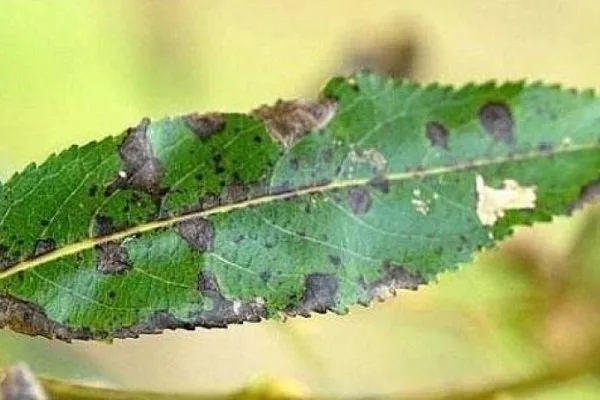
- ✓ Appearance of orange spots on the underside of leaves before turning black.
- ✓ Noticeable delay in the growth of affected shoots compared to healthy ones.
Diseased leaves and fruits are collected and burned. If left untreated, the pathogens will overwinter in fallen leaves and mummified fruits. In the spring, during wet weather, the fungus will quickly spread again.
Control measures:
- Spray the sea buckthorn with a copper-soap solution (8-10 g of copper sulfate + 2 tablespoons of neutral laundry detergent) per 10 liters of water. Repeat the treatment at least three times every other day.
- Treat the plant with Avixil once. (20-30 g per 10 l of water).
Verticillium wilt
This dangerous disease is caused by the fungus Verticillium dahliae, whose threads clog the sea buckthorn's vascular system. This leads to the death of the plants within one or two growing seasons. Fruiting specimens aged 5-8 years are most susceptible.
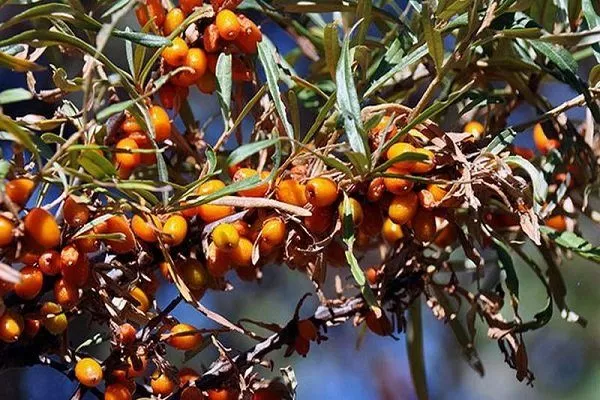
In early August, only the tips of shoots remain green on individual branches or the entire tree. The remaining leaves turn yellow and fall off. The fruits become brightly colored but fail to plump up, withering and shriveling. Blisters and then cracks appear on the bark.
What to do:
- remove and burn affected branches;
- do not allow sea buckthorn plantings to become too dense;
- carry out preventative spraying with Bordeaux mixture in spring and autumn;
- Spray during the summer period with any modern means against fungal diseases.
If the treatment fails, unfortunately, the tree will have to be completely removed and burned. Sea buckthorn can only be planted in the vacated area after five years.
Fusarium wilt (Fusarium)
This disease causes yellowing of trees or entire branches as early as July and August. It causes early leaf drop, drying of leaves, and premature fruit coloring. Infected sea buckthorn plants die the following season without having time to recover.
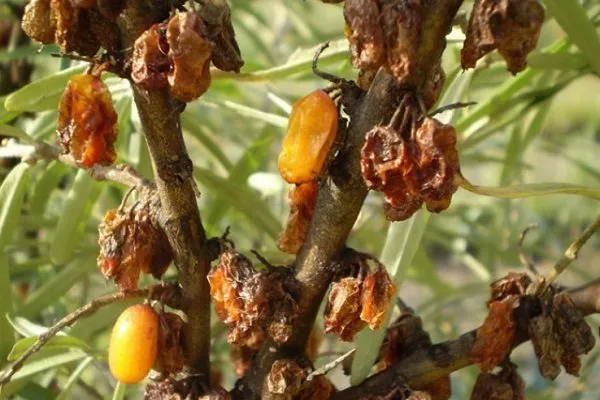
Fusarium wilt is one of the most widespread and dangerous plant diseases. It kills 10-20% of sea buckthorn trees each year, both seedlings and mature ones. Curing fusarium wilt is nearly impossible.
There is only one method to combat the disease: you must immediately remove and burn the affected branches.
Agricultural practices for disease prevention
Proper agricultural practices and disease prevention help protect sea buckthorn from various diseases.
What specifically should be taken into account when planting sea buckthorn to prevent diseases:
- Do not plant sea buckthorn in an area where strawberries were previously grown., because these plants have the same types of diseases.
- When planting, one-year-olds Place seedlings at a distance of 2 m from each otherMake a shallow hole in loose soil, add a small amount of humus and sand mixture to the bottom, spread the plant's roots over the mound, and cover them with sand. Water and top with 10-12 cm of soil.
- Timely get rid of diseased and broken branches.
- Fight weeds, remove root shoots.
- Loosen the soil in tree trunk circles to a depth of 10 cm.
- See you off preventive spraying.
Pests and their control
Sea buckthorn leaves can turn yellow due to pests. These insects move quickly, so to spot the problem early, you need to monitor your plants daily.
Sea buckthorn aphid
It spreads especially rapidly in moderately humid and warm years. Sea buckthorn aphid larvae overwinter on branches near buds. In late May, the larvae metamorphose into wingless females, which produce numerous offspring. They feed on the sap of young leaves.
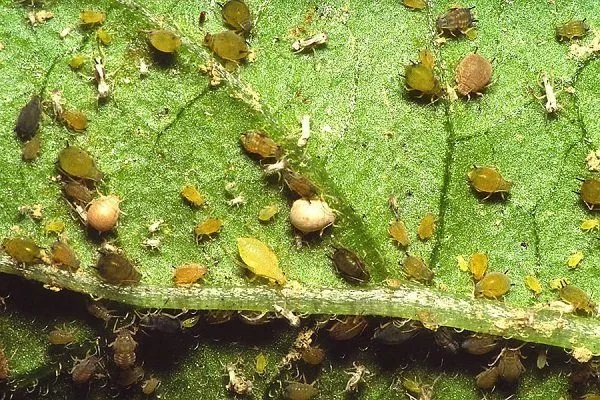
Leaves turn yellow prematurely, curl, and fall off. The plant becomes weakened and is unable to properly prepare for winter.
Control measures:
- Take a decoction or infusion Ash and tobacco, onion peels, garlic, tomato and potato tops, and dandelion leaves. Add 30 g of laundry soap to 10 liters of water. Spray with the resulting mixture.
- Spray with any modern insecticide. Use the dilution indicated in the instructions on the package.
Sea buckthorn leafhopper
A winged insect measuring 3 mm in length. In early August, the female lays spindle-shaped eggs in groups of 5-12. They overwinter in plant buds, and during bud break, the eggs hatch into larvae. As the leaves emerge, the larvae move to the undersides and feed on the sap of the sea buckthorn leaves.
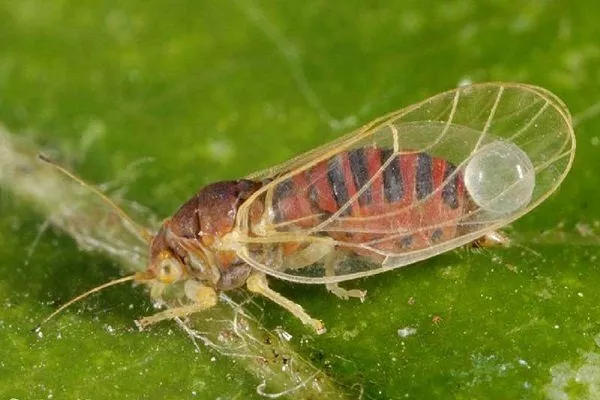
The leaves turn yellow, wither and fall off.
Control measures:
- at the end of May, spray the crown with a solution of malathion 20-30 g per 10 liters of water;
- Also in spring, spray with colloidal sulfur 100 g per 10 liters of water.
Prevention
Regular preventative spraying is the most effective way to protect plants from pests. Insects will inevitably attack your garden plants in their fight for survival, and chemicals adhering to sea buckthorn tissue make the environment unsuitable for pests.
To prevent pests:
- spray sea buckthorn in late autumn and early spring with Bordeaux mixture;
- spray the sea buckthorn with a solution of malathion 30 g per 10 liters of water at the end of May;
- Keep insecticides such as Confidor on hand to treat as soon as you notice pests.
If you notice your sea buckthorn leaves suddenly turning yellow, don't despair. The key is to identify the cause promptly, as then the plant will likely be cured. To avoid the need for future treatment, remember to take preventative measures and follow proper care.
My sea buckthorn, and all four trees at once, started turning yellow. It's early summer, so I was worried. There don't seem to be any diseases or pests, so I decided to follow your advice and feed them with nitrogen. And yes, literally a month later, the leaves turned green. Thank you so much for the helpful information!