
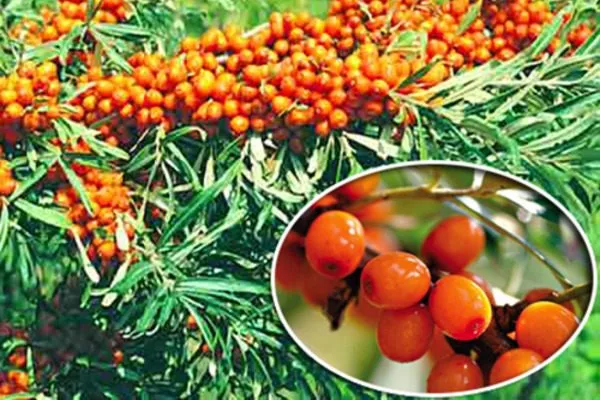
The Velikan sea buckthorn is completely thornless, making harvesting significantly easier. It is characterized by large fruits, sweet flesh, and tolerance to harsh climates. It is distinguished by its exclusively female flowers. Several other cultivars have been developed from this variety.
Origin
In 1961, a new sea buckthorn variety, Velikan, was developed at the Siberian Research Institute of Horticulture, named after M. A. Lisavenko. Its progenitors were the high-quality Katunskaya variety and the renowned Shcherbinka-1.
The development of this variety is attributed to the merits of such researchers as Elizaveta Ivanovna Panteleeva, Ida Pavlovna Kalinina, Olga Agafonovna Nikonova and Ekaterina Evgenievna Shishkina.
Main characteristics
The variety is quite frost-hardy, surviving temperatures down to -33-35 degrees Celsius without cover. It's considered undemanding regarding soil composition, but the best yields are achieved when planted in loamy and sandy loam soils.
Description of appearance
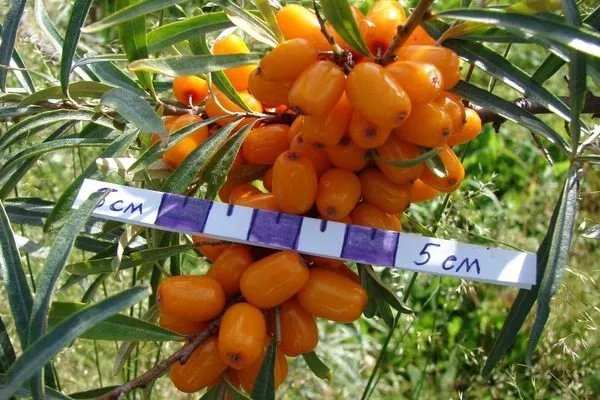
The giant is a tree-like shrub that has the following characteristics:
- standard – large and pronounced;
- height - about 200-350 cm;
- intensity of annual growth – average;
- crown shape – oval;
- dense branching – insignificant;
- leaves - dark green, pubescent, acquire a silvery tint as they mature;
- leaf blade type – curved, elongated and tapered.
Characteristics of fruits and their taste
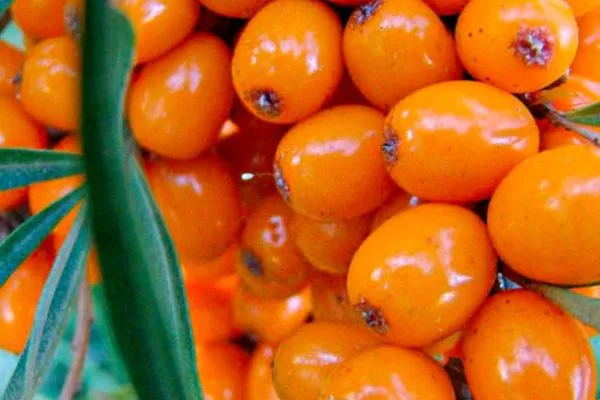
The berries are distinguished by a very bright orange hue and a sweet, rich flavor, but also a slight tartness. The sugar content is approximately 6.5%, and the acidity is 1.7%. A distinctive feature is the pineapple aroma.
Other features:
- weight - from 0.7 to 1.2 g;
- form - by cylinder type;
- peduncle – elongated (up to 0.4 cm);
- type of separation – dry;
- pulp – dense and juicy.
Fruiting period and yield
The bush begins to bear fruit as early as the third or fourth year after being planted as a one-year-old seedling. In its sixth or seventh year, the peak harvest is reached, when a bush can yield 7 to 10 kg of ripe berries. A single bush can yield 12 to 14 kg of sea buckthorn.
Application
The giant is on par with other well-known varieties in terms of nutritional content. Its berries are rich in vitamins C and B, as well as carotenoids, various organic acids, tannins, trace elements, and other valuable components. Experts recommend eating the fruit fresh to fully benefit from its unique properties.
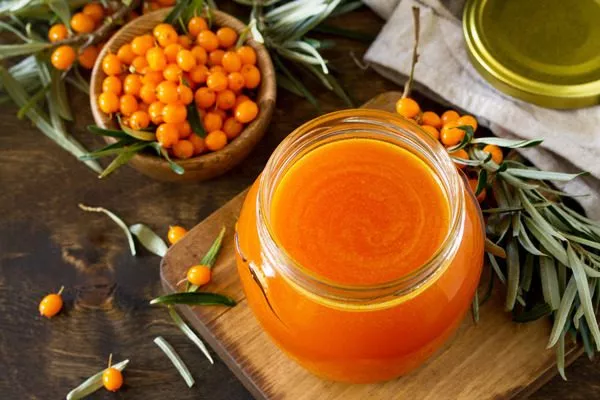
For further use, the berries can be frozen or made into jam with sugar. This variety produces delicious juice, oil, and wine.
Pollinators
Early May marks the time when sea buckthorn flowers open, adorning the tree for about a week. Sea buckthorn flowers appear before the leaves emerge on the branches, and they are either clustered together or found singly. To maximize the harvest, it's important to plant several bushes of different sexes to ensure pollination.
For the Velikan sea buckthorn, excellent male pollinator varieties are Gnome and Aley, which are distinguished by high productivity and sufficient frost resistance.
Features of cultivation
This giant is known for its resilience and undemanding growing conditions. However, to achieve maximum yield and volume, certain planting recommendations must be followed:
- Landing site. The most important criterion when choosing a location is direct sunlight. This plant thrives on light, and a lack of it can lead to a reduced yield. Sea buckthorn also requires sufficient moisture. The ideal planting location is sandy loam soil rich in phosphorus, where the groundwater level is no more than 2 meters below the surface.
- Time. The best time to plant is early spring, between April 20 and May 20. Spring planting promotes faster growth and development of the seedling, and also speeds up the fruiting process.
- Site preparation. The process involves deep tillage, weed removal, and debris removal. If the soil is excessively acidic, it is recommended to add 300-400 g of ground limestone per square meter. For spring planting, the soil should be prepared in the fall by adding approximately 10-15 kg of compost mixed with 200-300 g of superphosphate and 20-25 g of potassium salt.
The hole for the seedling should be dug in the spring, immediately before planting it.
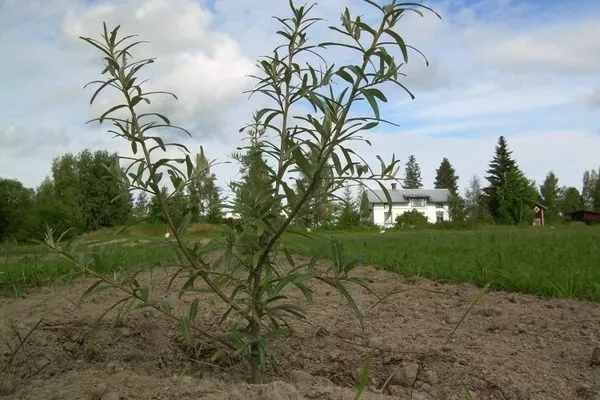
- Selection of seedlings. It's best to use two-year-old seedlings with a well-developed root system and high-quality above-ground growth. The seedling should be healthy and fresh in appearance, free of dry or damaged areas.
If dry roots are found, soak them in a bucket of water for 2-3 days to ensure they are fully hydrated. Before planting, dip the seedling in a clay solution to strengthen the roots. - The landing process. To do this, dig holes measuring 60x65 cm and place them at intervals of at least 2-2.5 m. A stake 100-150 cm high is driven into the center of each hole. A mound of fertile soil is created around it, on top of which the seedling is placed until the root collar is immersed to a depth of 3-4 cm.
The seedling is secured to a stake, and a trench 30 cm in diameter is formed around it. The tree is watered and mulched with peat and soil.
During the first month after planting, the seedling requires daily watering, after which you can move on to less frequent irrigation.
How to care?
Sea buckthorn care requires minimal effort. Optimal fertilization, regular watering, careful pruning, and disease prevention ensure rapid growth and continuous fruiting.
This variety requires careful pruning and shaping. Features:
- To ensure sea buckthorn takes on the shape of a tree rather than a bush, it's important to shape the trunk and four main branches. If the seedling has natural branching, pruning is not necessary for the first two years. If branches are absent, it should be shortened to 35 cm, and in the second year, begin shaping the skeletal branches and the main stem.
- The variety should be pruned in the spring, before the sap begins to flow, removing branches damaged over the winter, dried out, or diseased. In late fall, sanitary pruning is performed to help the tree prepare for winter. During this period, the same branches are removed, as well as those that are too densely covering the crown or growing abnormally.
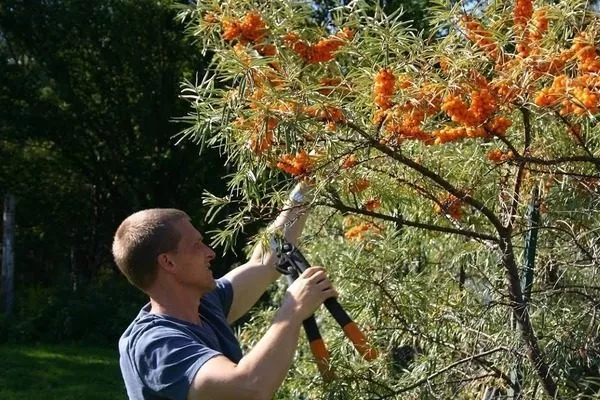
- The first rejuvenating pruning of sea buckthorn occurs six years after planting. This involves removing branches that have stopped bearing fruit. Rejuvenating pruning is performed in the spring, annually replacing branches with younger, stronger ones.
Other actions:
- During the active growing season, water the tree four times. A young plant requires 3 liters of water, while a mature tree will need about 7 liters. After harvesting, watering is critical to restore moisture.
- After each watering, it is necessary to carefully loosen the soil around the trunk to a depth of no more than 8-10 cm, avoiding damage to the root system, which is located vertically.
- Regular fertilizing begins in the sea buckthorn's third year. Use a liquid solution of potassium humate, ammonium nitrate, and Zeovit. In the fall, add charcoal and superphosphate.
Wintering
After pruning, applying the necessary mineral fertilizers, and watering, it's important to lay a thick layer of mulch to provide reliable insulation for the roots during the winter. It's equally important to apply lime to the trunk and branch tips. For additional warmth, wrap the trunks in spruce branches or burlap.
Pests and diseases
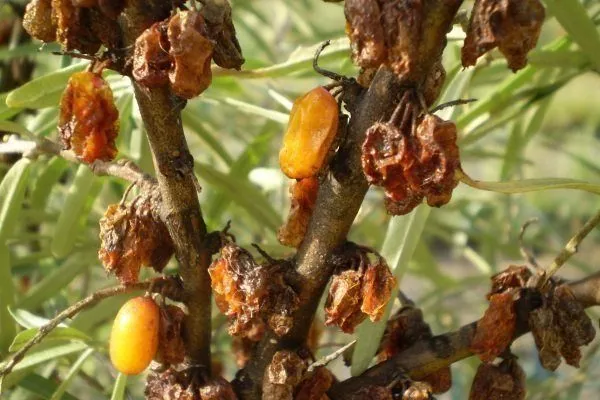
The Velikan sea buckthorn is highly resistant to diseases. This variety is resistant to fusarium and other fungal pathogens, such as septoria leaf spot and endomycosis. To prevent potential problems, sea buckthorn bushes are treated with fungicides before bud break and after the leaves fall.
Among the pests that can damage sea buckthorn, the most dangerous are the sea buckthorn fly, aphids, and moths. To prevent their attacks, it is important to promptly remove fallen leaves, especially those infested with pests. Insecticides are used to kill these pests.
Harvesting and storage
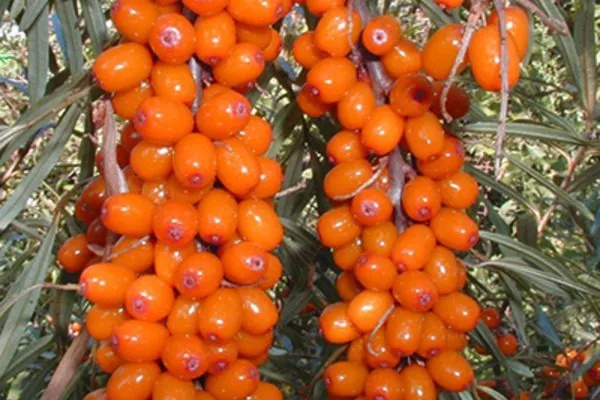
The berries ripen simultaneously, beginning around September 20th. They remain attached to the branches without falling off. This variety is ideal for storing in a cool, dark place or in the refrigerator. If placed in the freezer, sea buckthorn will retain its beneficial properties for a long time.
Pros and cons
In order to make an impartial conclusion about the quality of a variety, it is necessary to carefully study its positive and negative qualities.
Reviews
Velikan is a late-ripening sea buckthorn variety with large fruits that boast excellent flavor and nutritional qualities. Trees of this variety are moderately tall and have good winter hardiness. They require little maintenance and boast a compact crown, making them particularly attractive to summer cottage owners.