
Sea buckthorn is one of the most undemanding and hardy fruit crops, so planting and growing it is easy. Even a novice amateur gardener can grow and propagate it. Let's learn how to plant and care for sea buckthorn to ensure a bountiful harvest.
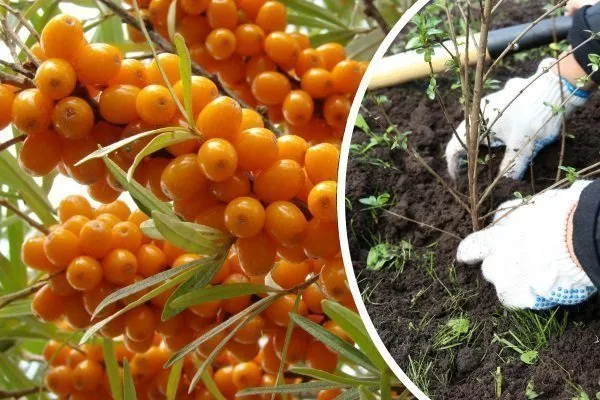
Principles of growing and caring for sea buckthorn
Features of cultivation and care:
- Paired landing. Sea buckthorn's main characteristic is its dioeciousness. It is not planted alone if berries are desired. A fruiting sea buckthorn is a beautiful sight and a true garden ornament.
- More female plants. There's no need to plant a male plant for every female plant. Each bush with male flowers can pollinate up to five female plants. Male plants die more often than females, so it's best to plant more to be on the safe side.
- Direction of pollination. Sea buckthorn is a wind-pollinated crop, so it is necessary to take into account its direction.
- Careful loosening. Sea buckthorn's root system is located close to the soil surface. This must be taken into account when digging and loosening the soil.
- After each watering – loosening. Due to the peculiarities of the sea buckthorn root system, the soil around the tree trunk must always be loosened.
How to distinguish male from female sea buckthorn?
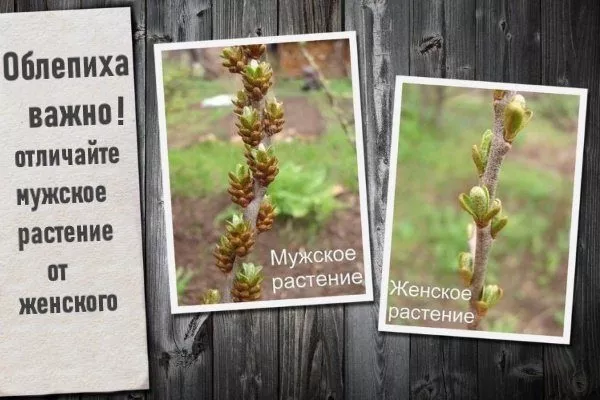
The sex of sea buckthorn bushes/trees growing in a garden can only be determined after the first flower buds appear. This can be done only after 4-5 years of growth.
Signs by which you can distinguish a female plant from a male one:
- Female plants have smaller buds, and there are fewer of them than on male bushes.
- Male buds are collected in spike-shaped inflorescences.
- In male plants the leaf blades are flat, while in female plants they are curved and cup-shaped.
- The female flowers are yellowish and gathered in inflorescences. The male flowers are greenish-silver.
- The crown of male plants is glaucous at the end of spring, while that of female plants is bright green.
At the seedling stage, it is very difficult to distinguish between male and female plants, but it is possible by the size of the buds (male ones are larger) and the color of the leaves.
Recommended varieties
| Name | Disease resistance | Soil requirements | Biochemical composition |
|---|---|---|---|
| Darling | High | Loams | High in vitamin C |
| Ruet | Average | Chernozems | Rich in antioxidants |
| Tenga | High | Sandy loam | High oil content |
| Muscovite | Average | Loams | Rich in vitamins |
| Nizhny Novgorod sweet | High | Chernozems | High sugar content |
| Moscow pineapple | Average | Sandy loam | Rich in vitamins |
| Claudia | High | Loams | High oil content |
Among the sea buckthorn there are varieties:
- Sweet. Sea buckthorn berries have always been a bit sour, but today varieties with increased sweetness have been developed – Lyubimaya, Ruet, Tenga, Moskvichka, Nizhegorodskaya Sladkaya, Moskovskaya Pineapple, Klavdiya.
- Without spikes. Thornless varieties make harvesting much easier. Popular thornless varieties include Solnechnaya, Zhivko, Sokratovskaya, Velikan, Podruga, Altayskaya, Prevoskhodnaya, and Chechek.
- Large-fruited. Sea buckthorn is covered in small berries. If the crop is being planted for berries, it's best to choose large-fruited varieties such as Elizaveta, Naran, Essel, Azhurnaya, Zlata, Avgustina, and Leykora.
- High-yieldingSea buckthorn is not only a highly ornamental plant but also has economic benefits. Some varieties yield 5-6 kg per plant, while others can produce 20-25 kg. High-yielding varieties include Obilnaya, Chuyskaya, Botanicheskaya Aromatnaya, Panteleevskaya, Podarok Sad, and Dar MGU (Gift of Moscow State University).
- Low-growing. Harvesting sea buckthorn by hand is labor-intensive. If the plant is tall, picking the berries is even more challenging. The easiest varieties to harvest are bushes no taller than 2.5 meters. Low-growing varieties include Yantarnaya, Thumbelina, Inya, Druzhina, Moskovskaya Krasavitsa, Baikalsky Rubin, Chulyshmanka, and Bayan Gol.
- Mororesistant. Sea buckthorn is naturally more prized in the north, while in the south, the fruit is preferred. To bear fruit in northern conditions, the plant must be very frost-hardy. Sea buckthorn varieties with increased winter hardiness include Dzhemovaya, Zolotoy Pochatok, Trofimovskaya, Perchik, Ayula, Dar Katuni, and Otradnaya.
- Men's. These varieties produce pollen, which is used to pollinate female plants. Breeders have developed special "male varieties" with improved pollination abilities—a single plant can pollinate up to 20 sea buckthorn bushes. These varieties include Gnome, Aley, Ogni Yenisei, Sayan, and Ayaganga.
- Red-fruited. Red fruits are rare among sea buckthorns. Breeders have only succeeded in developing a few red-fruited varieties: Ryabinovaya, Sibirsky Rumyants, Krasnoplodnaya, Krasny Fakel, and Yolochka.
Read more about our article on the best varieties of sea buckthorn.
Table 1 shows popular varieties of sea buckthorn and their comparative criteria.
Table 1
| Variety | Yield per bush, kg | Fruit weight, g | Oil content, % | Bush height, m | Crown | Ripening time |
| A gift to the garden | 10-15 | 0.8 | 4 | 3 | medium-compact | average |
| Golden Siberia | 12-22 | 0.8 | 4-6 | 3 | medium-compact | late |
| Nugget | 14-20 | 0.7 | 7 | 3 | medium-spreading | average |
| Orange | 6-8 | 0.6 | 4-6 | 3 | spreading | late |
| Chuiskaya | 10-17 | 0.6 | 4-6 | 3 | relatively compact | early |
| Abundant | 12-15 | 0.5 | 5 | 3 | medium-spreading | average |
| Gift of Katun | 10-12 | 0.4 | 3.5-7 | 3-3.5 | compact | average |
When and how is it best to plant sea buckthorn: in spring or autumn?
Sea buckthorn can be planted at any time – spring, fall, even summer. Gardeners debate the best time, but there's no definitive answer. However, there are situations where spring planting is the only viable option – it's safer and poses fewer risks to the seedlings.
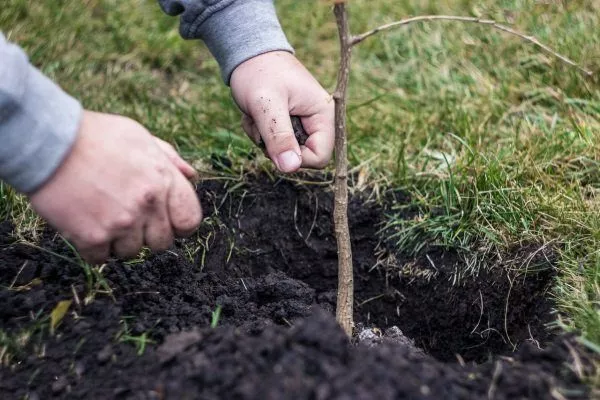
Planting sea buckthorn in autumn
Fall planting is best chosen if you know for sure that the seedling grew in the same area. If the planting material was brought from warmer regions, the tree may "wake up" in winter—in January or February—and frost is guaranteed to destroy it.
If planting is done in the fall, it must be done before the second half of October, as later the seedling simply won't have time to take root before the frost sets in. Fall planting is advisable if the autumn is long, and the seedling is strong, healthy, and meets all the requirements for planting material.
For fall planting, prepare a hole and fill it with potting soil. Ingredients:
- fertile land;
- a handful of double superphosphate;
- a bucket of humus;
- a glass of wood ash.
Further planting follows standard procedures. Preparing the soil mixture in the fall and filling it into the hole is one of the spring planting steps. In the spring, the seedlings can be planted in well-aerated and moist soil.
If you can't plant seedlings in the fall—for example, because the time is too short—then you can dig them in to preserve them until spring:
- Dig a trench 0.5 m deep;
- Place the seedlings in the ditch so that the crowns are facing south;
- bury the seedlings with soil so that only the tops remain visible;
- water the seedlings well;
- cover the top with spruce branches;
- When snow appears, cover the shelter with it.
How to plant sea buckthorn in spring?
Most gardeners believe that it's best to plant sea buckthorn in the spring, before the buds open. In reality, the planting time is determined by the climate and the variety's suitability to its conditions.
Spring planting is definitely safer for young plants. The seedling has time to firmly establish roots and grow strong before winter. Spring planting is done in late March or early April, while the plants are still dormant.
The planting area is prepared in the fall. The soil is dug to a spade's depth, adding the following per square meter:
- potassium sulfate – 20 g;
- superphosphate – 200 g;
- humus – 4-5 buckets.
In the spring, dig holes 65 cm deep and wide. Planting begins after 1.5-2 weeks.
Where to plant sea buckthorn in the garden?
Sea buckthorn has some unique root system characteristics that should be considered when choosing a planting site. Its roots spread outward, extending up to 5 meters from the tree. However, they are not very deep and can be easily damaged when digging the soil.
Sea buckthorn is sensitive to root damage. This is why it should not be planted near garden beds, as digging the soil can damage the roots. Preference is given to the edges of the plot, planting sea buckthorn along the perimeter, where digging is not planned.
What kind of soil does sea buckthorn like?
Sea buckthorn thrives on moisture—it's no wonder it prefers to grow near bodies of water. It requires soils that retain moisture well. The best options are black soil, loam, and sandy loam. These soils retain moisture longer than others.
But don't confuse moisture with waterlogging—sea buckthorn doesn't tolerate stagnant water. It's also unacceptable to plant this plant in areas with a high water table—less than 1 meter from the soil surface.
In nature, sea buckthorn prefers to grow on sandy and pebble soils, which is why it is so abundant in the coastal zone of rivers.
An experienced gardener will explain the six conditions necessary for growing sea buckthorn in the following video:
How to choose sea buckthorn for planting?
If sea buckthorn is being planted for fruit, cultivar-quality planting material is essential. Female plants should be purchased from a nursery. Male plants are easier to grow, as they can be wild. The optimal age for seedlings is two years.
Signs of a healthy seedling:
- there are 3 skeletal roots approximately 20 cm long, and a well-developed fibrous root system;
- seedling height – 30-50 cm, diameter – not less than 6 mm;
- the trunk must have several shoots;
- The bark is elastic, adheres tightly to the wood, and is light in color, not brown.
- ✓ Check for nodules on the roots – they indicate the plant’s ability to fix nitrogen.
- ✓ Make sure that the seedling has at least 3 skeletal roots at least 20 cm long.
The brown color of the bark of a sea buckthorn seedling indicates that it has been damaged by low temperatures.
Seedlings are selected from zoned varieties—this will protect them from premature awakening, which can be dangerous. Grafted seedlings with well-developed roots and crowns are selected for planting.
Find out how the planting material was obtained. If it was obtained by seed or rootstock, varietal traits may not be passed on. Seedlings grown from cuttings always retain the sex of the parent plant.
Landing requirements
Features of choosing a planting site for sea buckthorn:
- Sea buckthorn thrives in full sun, so it should be planted in sunny areas. Shade should be avoided. Sometimes, seedlings die in the first few years of life due to being shaded by weeds.
- Sea buckthorn is planted several meters away from fences and buildings. It also doesn't like being close to trees.
- The best location for sea buckthorn is the south side of the plot. It's planted at the very edge so it can catch the sun's rays without being obstructed.
Before planting sea buckthorn, the soil should be prepared. First, check its acidity. If the soil is acidic, add slaked lime. Apply 300-400 grams of lime per square meter of soil. After spreading the lime, dig the soil to the depth of a spade. Heavy clay soils can be lightened by adding sand—two buckets per square meter.
Two weeks after applying lime, you can fertilize the area. First, add organic matter—humus, manure, and compost. Then, add mineral fertilizers—superphosphate or complex fertilizers.
Fertilizers can be applied to the entire plot or to individual planting holes. The distance between planting holes is 2 meters.
Preparing seedlings for planting
The procedure for preparing sea buckthorn seedlings for planting:
- If there are leaves on the seedlings, pick them off.
- Place the roots of the seedling in water for 2-3 hours.
- Immediately before planting, dip the roots in a clay slurry.
How to plant sea buckthorn in spring: step-by-step instructions
By spring planting time, you should have the planting holes prepared—dug and fertilized. Over the winter, the soil will settle, absorb moisture, and oxygen—a favorable environment for the seedling's root system.
In the spring, all that remains is to plant the prepared seedlings. If you plan to plant several seedlings, keep them spaced 2 meters apart.
The procedure for planting a seedling in spring:
- Drive a stake into the center of the hole to support the seedling. Drive the stake deep into firm soil to ensure it resists winds.
- Rake the soil mixture into a mound to comfortably accommodate the seedling's roots. When placing the seedling in the hole, position it so that its root collar is 5-6 cm above the soil surface—never burying it in the soil.
- Spread them out and begin filling the hole with fertile soil mixed with humus, peat, or coarse sand in a 1:1 ratio. As you fill, shake the seedling and compact the soil with your hands to ensure there are no air pockets between the roots. Once the roots are covered, carefully compact the soil around the seedling.
- Tie the seedling to the support. Use a soft material that won't damage the tree's thin bark, such as twine.
- Water the seedlings – 2 buckets per seedling.
- Sprinkle the tree trunk circle with mulch – dry grass, sawdust or straw.
This video provides step-by-step instructions for planting sea buckthorn, as well as how to distinguish male from female sea buckthorn:
The male seedling is planted at the beginning of the row, on the windward side. Or in the center, surrounded by females.
When and how to transplant an adult sea buckthorn bush?
Replanting sea buckthorn is a labor-intensive and risky undertaking. Even when following the transplanting technique meticulously, gardeners often fail—the bush dies. Replanting is an undesirable procedure, so try to plant the seedling in the desired location immediately.
A painless and successful transplant is possible for seedlings under three years old. Sea buckthorn transplanting tips:
- Carefully dig up the plant, along with all the roots and the lump of earth.
- Transfer the sea buckthorn to its new location—into a pre-dug hole. It should be large enough to comfortably accommodate the root ball and roots. Most importantly, don't bury the root collar deep into the soil.
- Water the transplanted plant generously and mulch the soilTo help sea buckthorn take root better, add a rooting stimulator to the water.
- Trim off part of the crown so that the plant does not waste energy on feeding the shoots; its task is to take root faster.
- Spray the crown with Zircon or Epin (growth stimulants).
What can be planted next to sea buckthorn?
Nothing but lawn grass can be planted directly under sea buckthorn. Plants with shallow roots, such as strawberries, raspberries, and currants, should not be planted near sea buckthorn. Sea buckthorn will compete for nutrients and destroy them.
The best neighbor for sea buckthorn is sea buckthorn itself. Trees or shrubs should be planted 2-2.5 meters apart.
Caring for sea buckthorn after planting
Sea buckthorn is a useful and beautiful plant that will enhance any garden. It doesn't require much care from its owners—its cultivation techniques are simple and unremarkable.
The plant is resistant to pests and diseases, and the most important activity in the life of sea buckthorn is pruning – with its help, gardeners create a healthy and beautiful plant, removing excess and damaged branches.
We recommend reading the article about How to properly care for sea buckthorn in autumn.
Rules for proper watering
Sea buckthorn thrives on moisture and requires regular watering. During the growing season, especially in the first year after planting, water regularly, taking into account soil moisture and weather conditions. The recommended watering rate for a young plant is 3 buckets, and during the fruiting period, 5-6 buckets. Mature trees require more water – 7-8 buckets.
When watering, it is important to maintain the norm; over-watered soil prevents air from reaching the roots.
When watering sea buckthorn, ensure the entire trunk circle is saturated with moisture. As autumn approaches, increase the water by 1.5 times. Don't forget to water once before winter—this is essential for the plant's winter hardiness.
Loosening, weeding, mulching
After each rain or watering, the soil is loosened and weeds are removed. Sea buckthorn roots are covered in nodules, which harbor bacteria that absorb nitrogen from the air, enriching the soil with nitrogen compounds. These compounds are vital for the plant. If the soil becomes crusty, air will not reach the roots, resulting in undernutrition.
When loosening the soil, consider the characteristics of the sea buckthorn's root system. To avoid damaging the roots located close to the soil surface, do not loosen the soil deeper than 6-7 cm. Digging the soil around the tree trunk is not recommended.
To reduce the amount of loosening and the risk of damaging roots, apply mulch around the tree trunks. Compost or humus is suitable for this purpose; for example, it can be made from potato tops or birch leaves.
How to prune correctly?
Sea buckthorn can be pruned at any time except winter. However, early spring is considered the best time for pruning. Pruning should be done before the sap begins to flow.
Spring pruning
In spring, the plant requires sanitary pruning—removing all dead, damaged, and diseased branches. Young sea buckthorns also undergo formative pruning, with the gardener deciding how the plant will grow—as a tree or a bush.
Principles and features of sea buckthorn pruning in spring:
- The young seedling is immediately pruned to a height of 10-20 cm. The stump will sprout branches, and shoots will also grow from the root. The following year, the gardener selects four of the strongest shoots, and the remaining shoots are pruned. Root shoots can only be left on own-rooted seedlings.
- When training a tree, create a 30 cm tall trunk on the sapling, leaving 2-4 skeletal branches. If the sapling's branches are fully formed, there is no need to prune it. If they have no branches, they should be shortened to 30 cm.
- In the second year, 3-4 skeletal branches and a conductor are formed from the grown shoots - then they are cut at the same level.
- If after a year the shoots grow too vigorously, they are shortened by a third or a quarter.
- When the plant begins to bear fruit, pruning of the upper parts of the shoots stops – flower buds are forming on them.
Once the tree has been formed, all that remains is to regularly trim off excess shoots:
- growing inside the tree/shrub;
- plant thickening;
- shoots - they are cut off by digging up the shoots and carefully cutting them to a ring.
When sea buckthorn reaches 6 years of age, it will need rejuvenating pruning. This is also best done in the spring. Branches that have stopped producing fruit are removed and replaced with young, strong shoots. Replace 1-3 branches annually—no more than that.
Watch a video about proper sea buckthorn pruning:
Plants damaged by frost are cut down to the root collar. If the roots remain alive, a new bush or tree can be formed.
Pruning in autumn
In late autumn, when sea buckthorn begins its dormant period, sanitary pruning is performed. All old branches, thickening ones, abnormally grown ones, diseased ones, dry ones, etc. are removed. Pruning is performed with a sharp, disinfected tool.
How to fertilize sea buckthorn?
Fertilizing begins in the second year after planting. Organic fertilizer is added annually—one bucket of humus or compost per square meter. Mature plants' root systems provide nitrogen themselves, so they only require phosphorus and potassium fertilizers, which are applied to the soil. However, until they reach five years of age, sea buckthorn is fed with nitrogen by scattering ammonium nitrate around the trunk at a rate of 20 grams per square meter.
Fruiting sea buckthorn is given foliar feeding after flowering – spray it with a solution of potassium humate (1 tablespoon per 10 liters of water). Fertilize again after 20 days.
When fruit set begins, it's recommended to feed the plant with a nutrient mixture. Composition and dosage per 10 liters of water:
- wood ash – 100 g;
- superphosphate – 30 g;
- potassium salt – 25 g.
This amount is sufficient for 1 square meter of soil. Acidic soils are fertilized with a mixture in which superphosphate is replaced with rock phosphate – 50 g per 1 square meter.
It is recommended to feed sea buckthorn 4 times during the season:
- early in spring;
- during the flowering period (watered with a solution potassium humate);
- after flowering;
- 20 days after the last feeding.
Preparing crops for winter
Sea buckthorn is a frost-hardy plant, so gardeners typically avoid insulating it. However, there are measures that can help the plant survive severe frosts.
Winter preparation activities:
- insulation of the root zone with spruce branches and turf;
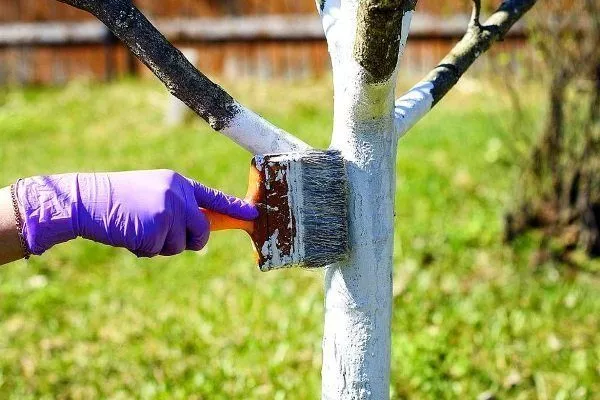
- whitewashing the trunk;
- protecting the trunk with a metal mesh – to protect against rodents.
Care depending on the region
Sea buckthorn grows in all regions of Russia—in the south, central Russia, north, and Siberia. Planting times and care requirements vary depending on climate conditions.
Planting and caring for sea buckthorn in the Moscow region
In the Moscow region, sea buckthorn is planted in late March or early April, depending on the weather. Planting should take place before the sap begins to flow, but temperatures should be above freezing. To minimize hassle and risk, only zoned varieties should be planted.
The Moscow region's climate is ideal for sea buckthorn. Around 60 varieties are zoned here, offering plenty to choose from. Insulation is not necessary for these sea buckthorns. Recommended varieties for the Moscow region are listed in Table 2.
Table 2
| Variety | Botanical form (bush/tree) | Number of spikes | Fruit | Yield per plant, kg |
| Moscow pineapple | compact bush | insignificant | dark orange, with a red spot on the tip | up to 14 |
| Lomonosovskaya | medium-sized tree | insignificant | large, orange-red | 14-16 |
| Botanical hobby | medium-sized tree | insignificant | large, yellow-orange | up to 20 |
| Botanical aromatic | a medium-sized, spreading tree | insignificant | orange-brown | 12-14 |
| Fragrant | medium-sized tree | average | large, red-orange | up to 16 |
Planting and caring for sea buckthorn in the Siberian region
In Siberia, sea buckthorn is planted in late April or early May, awaiting stable warmth. Numerous varieties of sea buckthorn have been bred for Siberia, easily tolerating the harsh climate. Growing techniques for this crop in Siberia are no different from those used in temperate climates. Popular sea buckthorn varieties for Siberia are listed in Table 3.
Table 3
| Variety | Botanical form (bush/tree) | Number of spikes | Fruit | Yield per plant, kg |
| Golden Siberia | medium-sized bush | very little | orange | 12-14 |
| Zhivko | medium-sized multi-stemmed bush | few | orange-yellow | up to 10 |
| Elizabeth | medium-sized bush | very little | orange | up to 12 |
| Jam | dwarf bush | No | orange-red | 12-15 |
| Giant | medium-sized bush | No | orange | 13-20 |
| Altai | medium-sized compact bush | No | bright orange | 12-14 |
Sea buckthorn propagation
Sea buckthorn propagates easily using various methods—seeds, cuttings, layering, suckers, grafting, and division. Each gardener decides for themselves how best to propagate the plant.
By vaccination
This is the most complex and labor-intensive method of propagation. It is used only by experienced gardeners. The goals of grafting are:
- A male cutting is grafted onto a female bush to avoid planting a new seedling.
- For growing varietal plants on viable rootstocks.
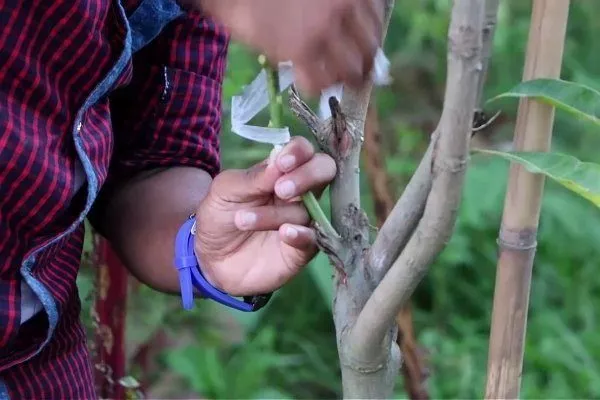
Features and procedure for grafting sea buckthorn:
- Start grafting in late April or early May.
- For rootstock, use a two-year-old seedling grown from seed.
- Cut the rootstock trunk 15 cm above the root collar. Leave one strong shoot 10 cm high on the rootstock, and cut off all the others.
- Over the summer, the remaining shoot should strengthen. Pinch it to encourage thickening and prevent upward growth. Remove any lower shoots up to 15 cm.
- By the following spring the shoot turns into a standard.
- By the third spring, the plant will reach a height of 50-60 cm and a diameter of 5-9 mm. Copulate at a height of 10 cm from the root collar.
Gardeners have noticed that cuttings taken from male plants and grafted onto rootstock take root worse than cuttings taken from female plants.
Seed propagation
If you're interested in growing a cultivar, seed propagation isn't the right method for you. A plant grown from seed doesn't carry the varietal characteristics of the parent plant (tree). Seedlings are typically used as rootstocks for grafting.
Features of propagation by seeds:
- Seed germination remains viable for at least 2 years.
- Before sowing, the seeds are kept in the refrigerator for 1.5 months - on the vegetable shelf.
- Sowing begins in late April. Don't plant the seeds too deeply. Cover the container with plastic wrap or glass and place it in a warm, bright location. Seedlings will appear within 1-2 weeks.
- In mid-July, the seedlings are transplanted to their permanent location. Before planting, their taproots are trimmed.
Cuttings
Cuttings are harvested in the fall—late November to early December—or in the spring—late March to early April. Two-year-old shoots at least 6 mm thick are used. The cuttings are 15-20 cm long. The autumn cuttings are tied into a bundle, wrapped in cloth and plastic, and stored, covered with soil, spruce branches, and snow.
The procedure for planting cuttings in spring:
- The cuttings are placed in water for three days, changing the water regularly. Many gardeners add a root growth stimulant to the water.
- The cuttings are planted in the ground at a slight angle. At least 2-3 buds should remain above ground. Most of the buds end up in the soil. By autumn, the cuttings will grow to 60 cm. In the third year, the plant will bear its first fruit.
Green cuttings are more difficult to root than hardwood cuttings. Special conditions must be created, including a loose soil mixture, sand, growth stimulants, misting, and so on.
Layering
This method requires a young sea buckthorn tree with flexible branches. The following is the procedure for propagation by layering:
- In spring, select branches with good growth.
- Bend the selected branch and place it in a shallow groove.
- Secure the branch. Fill the trench with soil.
- During the season, water, fertilize and loosen the soil.
By next spring, the cutting will have established itself. Dig it up, cutting it off from the mother plant, and transplant it to its permanent location.
Undergrowth
Features of propagation by shoots:
- For propagation, select shoots that are 1.5 m or more away from the mother plant – their root system is usually already formed.
- During the season, hill up the shoots, feed and water.
- In spring, cut off the shoots selected for propagation and plant them in a permanent location.
By dividing the bush
The procedure for propagating sea buckthorn by dividing the bush:
- Dig up the bush and cut off old branches.
- Use pruning shears to divide the bush into sections. Each section should have a developed root system.
- Sprinkle the cut area with charcoal.
- Plant the bush sections in the planting holes. Then care for them as you would for regular seedlings.
| Method | Time until the first harvest | Complexity |
|---|---|---|
| Cuttings | 3 years | Average |
| Layering | 4 years | Low |
| Seeds | 5-6 years | High |
Flowering and fruiting
Male plants produce male (staminate) flowers. Female plants produce female (pistillate) flowers. Staminate flowers are the source of pollen, which is necessary for fruiting. The pollen reaches the female plant through the air, where the fruit will grow. Male plants do not bear fruit.
Sea buckthorn blossom
Plants of different sexes should bloom simultaneously; otherwise, there's no point in planting them together. Weather conditions and climate influence flowering times. In temperate climates, the plant blooms in the second half of May and lasts for two weeks. In Siberia, sea buckthorn blooms in late May.
Sea buckthorn flowers have no nectaries. The plants rely primarily on the wind. If the weather is calm, gardeners must act as pollinators. To transfer pollen to the female flowers, they cut branches and fan the female plant with them.
In what year after planting does sea buckthorn bear fruit?
Sea buckthorn trees typically produce their first fruits by the fourth year. However, a full harvest isn't harvested until the sixth year. At this age, the plant (tree or shrub) has completed its development and is devoting all its energy to producing fruit.
Sea buckthorn growing business
The most valuable product made from sea buckthorn is sea buckthorn oil. It is prepared from the yellow (orange) berries that grow abundantly on female plants. Sea buckthorn oil is used for medicinal purposes and in cosmetology – it is a highly valuable product with regenerative properties.
Sea buckthorn is grown commercially primarily for oil production. Special industrial varieties are planted for this purpose; their fruits are not particularly flavorful, but they contain a high oil content of 6.2-6.8%. Dessert varieties contain 2-6% oil.
Today, medicinal crops are in high demand on the market. Exotic varieties are being replaced by proven, homegrown products. Sea buckthorn is undemanding, hardy, and labor-saving, making it a great business opportunity. Planting 1 hectare of sea buckthorn costs approximately €2,000. The investment pays for itself in three years. At least 15 tons can be harvested per hectare. The price per kg is 150 rubles.
Sea buckthorn oil isn't the only product derived from sea buckthorn berries. The market also offers:
- fresh sea buckthorn;
- dried fruits;
- frozen fruits;
- syrups;
- tinctures;
- jam;
- juice.
Sea buckthorn leaves are also beneficial—they can be dried and brewed into tea. The leaves can be dried, packaged, and sold. Another interesting idea is to establish an apiary next to a sea buckthorn plantation—this can produce valuable sea buckthorn honey.
Diseases and pests
Compared to other fruit crops, sea buckthorn rarely gets sick. However, there are several diseases that can be very dangerous. Table 4 lists common sea buckthorn diseases and pests and measures to control them.
Table 4
| Diseases/pests | Symptoms/damage caused | How to fight? |
| Verticillium wilt | A fungal disease that causes rapid wilting of leaves and fruits, and then the entire tree. | There is no cure. The diseased tree is uprooted. The growing site is quarantined for 2-3 years. |
| Endomycosis | A fungal disease that affects the fruits of a plant shortly before technical maturity. | Spray with copper oxychloride during the growing season. Repeat spraying is essential after fruit set. |
| Blackleg | A fungal disease that thins the stems of seedlings.
| The seedlings are watered with a solution of potassium permanganate once a week, and if necessary, if the disease has begun to appear, daily. |
| Sea buckthorn moth | Caterpillars eat buds and leaves. | Spraying with 0.5% Chlorophos during bud break. |
| Sea buckthorn fly | It affects the fruits, making them wrinkle and wither. | Treatment in July with a 0.2% Chlorophos solution. |
| Sea buckthorn aphid | It sucks the juices from the leaves. It weakens the plant, and death is possible. | Spray twice with 10% Karbofos - during bud break and again after 2 weeks. |
Sea buckthorn harvesting
Harvesting sea buckthorn is labor-intensive, especially when harvesting berries from thorny varieties. Therefore, gardeners have developed a wide variety of tools to make harvesting easier.
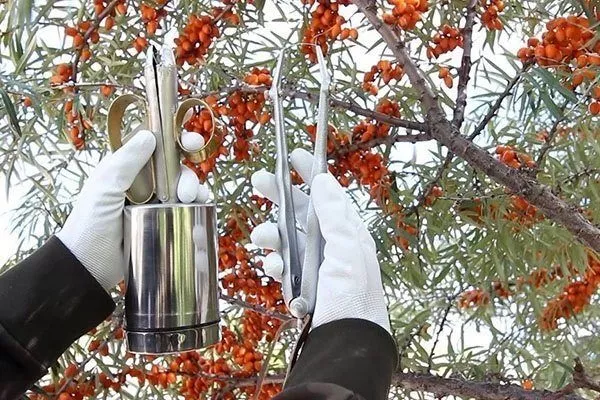
Hand-picking berries
Hand-picking from the tree is a grueling task, only suitable for small harvests. A simpler method:
- cut off branches with berries;
- Place the branches in the freezer;
- After 24 hours, remove the branches to collect the berries; just run your hand over them.
Prune branches carefully with pruning shears—breaking them is unacceptable. Only fruiting shoots should be pruned, and these should be treated with sanitation in the fall. You can wait until frost sets in and shake the branches. Fruits and leaves will fall—all that remains is to sort them.
In October, sea buckthorn is harvested for oil and juice, wearing rubber gloves. The berries are crushed directly on the branch, dropping the pulp and juice into a container. Before harvesting, the plant is watered with a hose to remove dust from the berries.
Mechanical berry picking
Harvesting sea buckthorn from a few trees or an entire plantation requires mechanical tools. A variety of them have been designed and manufactured:
- Forceps. They're sold in stores. Picking is quicker, but still time-consuming. The advantage is that it doesn't damage the tree. You can use tweezers to pick each berry individually. This method is suitable for 1-2 trees, no more.
- Slingshot. Berries are cut from the branches. The tool is made of wire stretched over a suitable tool, such as a vegetable peeler. The cut berries fall directly into a collection container. The downside is the risk of cutting off the fruit buds.
- Scraper. Quickly clears branches of berries. It resembles a slingshot with tongs. By grasping the branch, you pull the tool toward you, and the cut berries fall into a container.
- Combine harvester. This is an industrial tool made of plastic. It allows you to pick berries without damaging the plant. Harvesters come in various configurations, but they all operate on the same principle. A harvester consists of a hand-held attachment with a container for holding the berries. The fruit is cut using a comb-like working surface.
Sea buckthorn is one of the most undemanding and hardy fruit crops. It requires little care, propagates easily, and is virtually disease-free. The most challenging part of growing it is harvesting. Sea buckthorn is an ideal garden plant that can generate real commercial profits.
The article is good and useful, BUT... As for the loss of varietal qualities when propagated by layering - NONSENSE!
Where did you see this?! The article says that seed propagation degrades varietal quality…