
Sea buckthorn harvesting begins immediately after the fruit ripens. This should be done quickly, as the berries become softer and are easily crushed during harvesting.
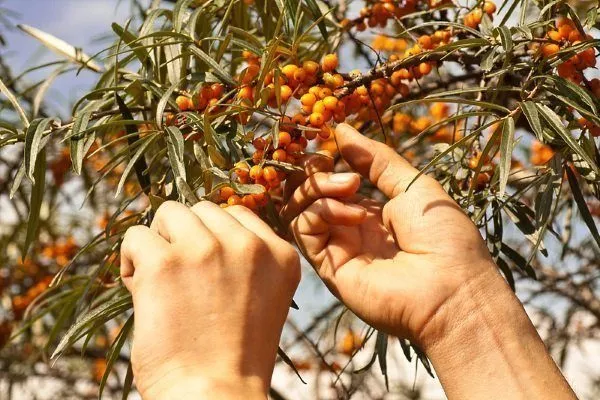
When does sea buckthorn begin to ripen?
Plant variety, growing region, and climate conditions all influence the timing of fruit harvest. These factors require special attention.
- ✓ Consider not only the variety, but also the current weather conditions, as early frosts can accelerate ripening.
- ✓ Check the berries for density: they should be firm, but not hard.
Variety
| Name | Ripening period | Growing region | Frost resistance |
|---|---|---|---|
| Early | The first days of August | Central Russia, South of Russia | High |
| Late | After September 15th | Urals and Siberia | Very high |
Accurately determining the harvesting period is important to facilitate labor and preserve important nutrients in sea buckthorn. To understand when to begin harvesting, it's important to understand the development and growth characteristics of different varieties:
- Early ones. They are harvested in early August. The exception is the Chuyskaya variety, whose berries are picked after August 25th.
- Late. Ready for harvesting after September 15th.
Read the article about the best varieties of sea buckthorn.
Weather conditions
Sea buckthorn berries are harvested on sunny days. The berries hang on the branches for a long time, so do everything carefully and slowly. Some gardeners deliberately wait until the first frost to pick the berries, as this makes them juicier and tastier, and, most importantly, much easier to remove from the branches.
During this period, you can use pruning shears to carefully cut the branches (pruning should be done in the fall), and the fruit can be safely picked at home. When severe frost sets in, shake the harvest onto a mat and collect it; in this case, the branches remain intact.
Growing region
| Name | Ripening period | Growing region | Frost resistance |
|---|---|---|---|
| Central Russia (Moscow region) | Last days of August - first days of September | Middle zone | Average |
| Urals and Siberia | The last week of September | Urals and Siberia | High |
| South of Russia | After July 25th | South of Russia | Low |
Because trees ripen at different times, there are no specific regional requirements. It all depends more on the climate and variety. However, based on regions, the approximate dates are as follows:
- Middle zone (Moscow region) – last days of August – first days of September.
- Urals and Siberia – last week of September.
- Southern Russia – after July 25th. Fruit is harvested locally as it ripens (some varieties bear fruit as early as early July).
How to pick berries correctly?
When working with sea buckthorn, remember to wear gloves and clothing you don't mind getting dirty. No one knows how human skin will react when in contact with the sap; you could develop an allergic reaction or irritation. It's not worth the risk. As for clothing, you won't be able to wash it off—the stains will remain, even when washed with chemical stain removers.
Hand-picking sea buckthorn
Want to pick the perfect berries? Then hand-picking is the way to go. It's best to pick the berries yourself when they're ripe, but still firm, so you don't crush the harvest.
Methods to speed up manual collection:
- Removing ripe cobs. These are first-year berry-bearing branches with dried shoots. The following year, the cobs will not grow and will not yield a harvest. Cut them off, freeze them, and pick them.
- The first frost is the benchmark. Place a plastic sheet under the plant and shake the bush. Almost the entire harvest will fall. You'll only need to pick and wash the berries.
- Juice collection. If for some reason you didn't manage to harvest the fruit by October 15th, you can still juice it. Rinse the fruit directly on the plant. Strain the juice and boil it.
Manual harvesting is a difficult and tedious process, but it will yield you a lot of high-quality, whole fruits.
Is it possible to cut sea buckthorn branches?
Of course, you can harvest by pruning the tree, but it should be minimal. Some gardeners remove branches they can't reach.
Several seasons of this treatment, and the plant begins to resemble a ripped-out tree, lacking any form. The plant begins to feel miserable, eventually ceasing to bear fruit, and eventually withers away.
The gardener's decision stems from the sound advice of gardeners: you can prune short branches without growth. They don't play a significant role in the tree's life anyway; they die off over time, and the cut marks are invisible.
Removing entire branches has a significant impact on the tree's health. Lost branches will not regrow, and wounds take a long time to heal. After such a procedure, the plant may not recover at all.
Sea buckthorn harvesting equipment
Sea buckthorn juice can damage clothing, so it's best to wear a raincoat. Harvesting should begin at the top of the tree and progress to the lower branches. To ensure quick and effective harvesting, use a variety of tools.
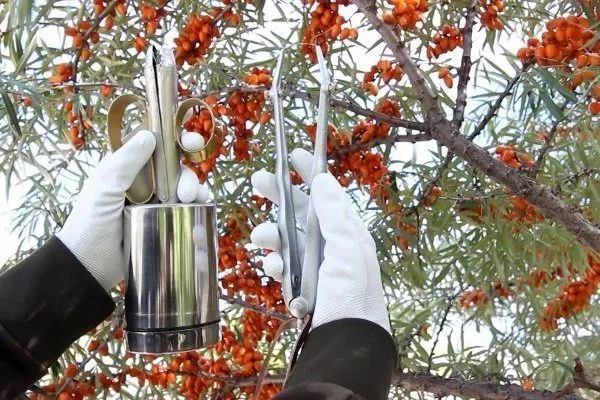
Forceps
You can make them yourself. The tongs are made from regular thick wire. The rod is bent at the center into a ring, creating a spring. You can also fold the wire into a triangle and bend the ends. The tongs are passed along the branches, and the harvest falls onto the woven material.
"Cobra"
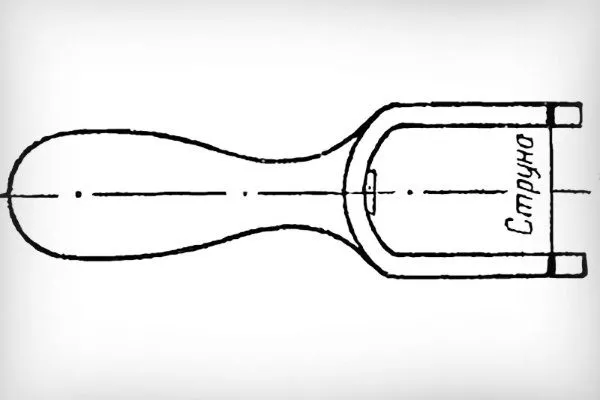
This device is renowned among gardeners as the best invention for harvesting crops. To create it, you need to take a small wooden branch, which will be shaped into a handle.
You'll also need steel wire. Create a loop out of it, similar to a candle wick. A spike connects the handle and the loop. From the side, the tool resembles a cobra. It can be used to harvest the fruit by grasping the stalks. This tool will help you reach even the most inaccessible areas.
This "Cobra" tool can be made by hand, as shown in the following video:
Slingshot
A slingshot can be made from wood or plastic. You can buy one ready-made or borrow one from a child. Stretch a strong fishing line along it. That's it – the slingshot is ready. Run it along the branch, and all the fruit falls onto the material. Fishing line breaks easily, so always have a new one on hand. Fishing line can be purchased at any sewing supply store.
Scraper for collecting sea buckthorn
To create this tool, take a steel wire about 0.5 m long. Make a spring-shaped curl in the center. You can wrap it around the bottle once. Straighten the ends of the tool and bend them at an angle. This method is used to press the branch and scrape the fruit by moving the scraper downwards.
The video below shows how to harvest sea buckthorn using a scraper and remove the leaves from the berries:
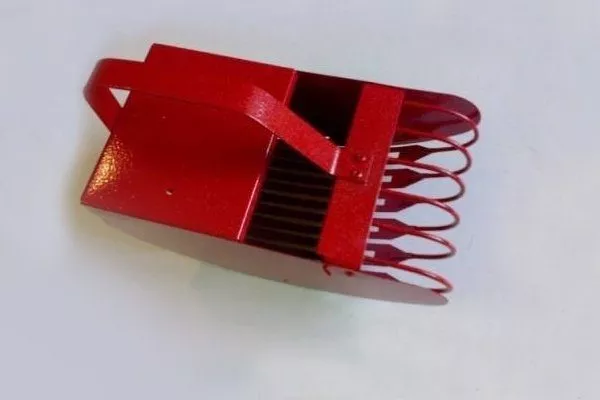
A knapsack or harvester for collecting sea buckthorn
The tool is sold at gardening stores. It can be made from any material. There are many variations of the tool, but the operating principle is the same. A knapsack is a special hand-held device with a section for picking berries. The harvest is cut using the working surface.
Other tools for quick sea buckthorn harvesting
A gardener boasts his own method and tool for harvesting sea buckthorn. A small number of berries can be harvested using nail scissors; it's time-consuming, but the result is excellent.
There are several other tools that help with harvesting. For example, people buy special gloves. They can be used as a scraper. The main idea behind the device is the special caps. These are what cut the fruit.
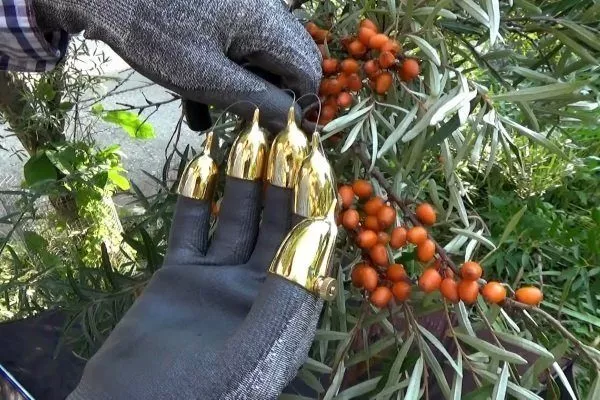
How to make a device for collecting sea buckthorn?
All the tools described previously can be made at home. To do this, you'll need to find some wire and figure out how to twist it correctly. A quick DIY option is a slingshot. Everyone has fishing line at home, and a slingshot can be made from simple branches.
Harvesting sea buckthorn using branch cuttings
Work on large plantations is carried out quickly and efficiently. There's no time for careful harvesting, as the fruits can become overripe and crushed when removed from the bush. Harvesting by cutting is painless and harmless to the bush, if done carefully and according to the rules.
Rules for cutting branches with sea buckthorn berries
To prevent damage to the plant, branches are cut with sharp pruning shears. Only thin shoots are selected, which are subject to pruning in the fall. Young, healthy, and thick shoots are left untouched. They should not be broken; the cut is made so that a stump about 50 mm in diameter remains at the base. This stump will sprout new shoots in the spring.
Watch the following video about harvesting sea buckthorn using branch pruning:
The branches are sent for processing. There's no need to wash them, otherwise the fruit will crack. This process is carried out before the branches are cut – the plant is doused with water, and then the fruit is harvested.
How to treat cut branches
Once the branches are brought home, quickly remove all the berries. While sitting in one place, you can carefully pick them by hand or use nail scissors. A scraper with a fishing line is also an option. The harvest can also be preserved on the branches, but you'll need a refrigerator or a room with a temperature around 0 degrees Celsius.
Collecting leaves for tea
Besides the berries, sea buckthorn is renowned for the medicinal properties of its leaves. They are traditionally used to brew infusions, herbs, and teas:
- Dry the leaves using the standard method, placing them on a tray.
- The special feature is that the trays are placed in the shade, not in the sun.
- To ensure that the leaves retain their medicinal properties after collection, they are picked after June 15th.
- The product is stored in a room with a temperature of about +17 degrees Celsius.
How to remove leaves from picked berries?
If you used special equipment during berry picking, you'll soon be faced with the question of how to clean the leaves that ended up in the containers. You can do it yourself, but it's time-consuming, but the results are superior. If you don't have time for that, you should consider simpler options.
The most popular method for clearing leaves from the harvest is to use a long vegetable board or similar device. It's placed at an angle, and the harvested fruit is poured onto it in small portions, causing the fruit to roll off and leaving debris on the board.
Another option is a cabbage shredder. It's positioned at an angle, with the blades facing upward. A container or box is placed under the base of the device. The cabbage is carefully poured onto the top edge and rolled down, with the stems caught by the shredder blade.
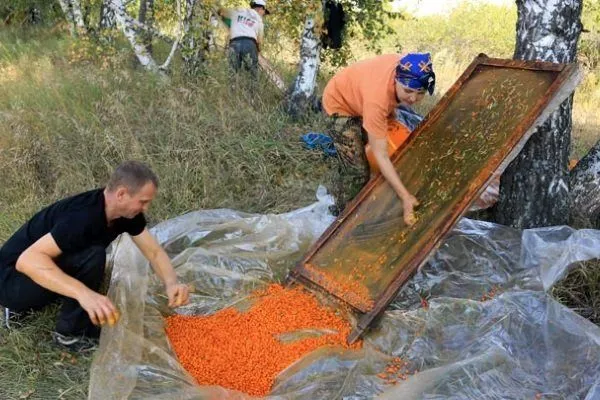
If you've already frozen the berries and leaves together, it's best to sort the harvest at a cool temperature. The fruit will bruise quickly in warmer temperatures.
How to preserve sea buckthorn for the winter?
Sea buckthorn berries are nutritious and help the body fight viruses and illnesses. Every gardener wants to preserve the berries for the winter.
Let's look at the main methods of storing berries:
- Placement of cut branches. They can be stored until March. To do this, place the branches in a cool place where the temperature does not rise above 0 degrees Celsius. Make sure the room is dry; a damp environment will cause the harvest to rot.
- Freezing. Place the washed and dried berries in bags or containers and place them in the freezer. Freezing them this way will help preserve a large amount of nutrients.
- Fruits covered with sugar. You can enjoy fresh sea buckthorn berries until early March. Mash them and spread them on a cloth. After a while, mix the harvest with sugar and store in sterilized jars. Use equal amounts of sugar and berries. Store the mixture only in the refrigerator; a basement or cellar is not suitable. This sweet preserve can be used to make compotes and fruit drinks.
- Puréed harvest. Perfectly ripe berries are ideal. Sort through the harvest and set aside the desired amount, rinse them, and let them dry. Mix with granulated sugar and mash with a wooden mortar. You can also use a food processor. Divide the mixture into sterilized glass jars and refrigerate. This mixture can be stored in a cellar or basement.
- Berries in water. This method has only recently emerged, so it's not very popular. However, this method allows sea buckthorn to be stored for a long time without affecting its flavor. Pour boiled water at room temperature over fresh berries and place them in the refrigerator, but not the freezer.
- Sea buckthorn juice. It's not only a source of vitamins but also a low-calorie product. It contains only 53 kcal per 100 g. It's very easy to prepare: simply run the fruit through a juicer and pour into prepared jars. Store the juice on basement shelves; you can add sugar or honey.
- Conservation. Heat treatment is also a good option for preserving fruits for the winter. They are used to make compotes, jams, preserves, marmalade, and butter. High temperatures are merciless, so it will destroy some of the beneficial nutrients, but natural sweets are always welcome. And they are much better than store-bought candies or cookies.
- Rinse the berries in cold water to remove dust and any chemicals.
- Dry the sea buckthorn in the air, spreading it in a thin layer on a cloth or paper.
- Sort the berries, removing damaged and unripe ones.
Sea buckthorn oil is another beneficial product, but it's used primarily in cosmetology. It helps hair and eyelashes grow faster and become stronger.
Helpful tips for collection and recycling
Harvesting, processing, and storing berries is much easier and more efficient if you follow certain rules:
- Start harvesting from the top and finish with the lower branches, but not vice versa. As for the branches, start at the base and finish with the tip.
- When handling wood, wear thick gloves and protective clothing. Sea buckthorn sap stains are permanent, and branches can injure you.
- You can use film or a regular umbrella as a material for collecting fruits.
- Do not cut young and strong branches for harvesting, otherwise the plant will die.
- Make convenient devices and you won't have to go through the hassle of picking berries by hand. Don't throw away the plant's leaves; you'll still need them. Use some of the harvest for preserving; the berries make wonderful nutritious compotes and jams.
Harvesting sea buckthorn is a tedious and time-consuming process. But the berries are healthy and nutritious, and in winter they can help cure the flu and alleviate vitamin deficiencies. Try to find effective harvesting methods that don't require a lot of time.