
Rose-leaved raspberries are a beautiful garden plant with vitamin-rich fruits. They are undemanding in terms of growing conditions and thrive in a variety of climates, but they often disappoint gardeners. Read on to learn about the variety's distinctive features and how to avoid being scammed by marketers when purchasing.
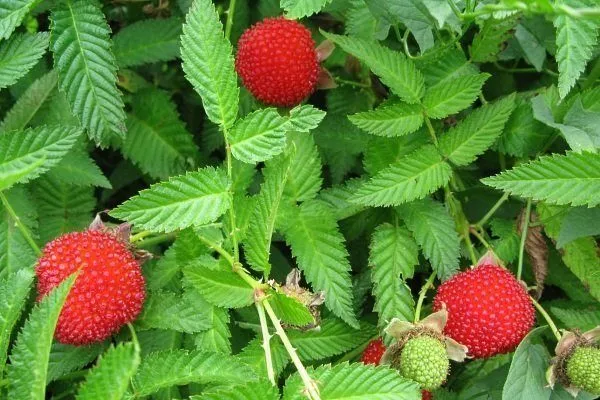
Tibetan raspberry
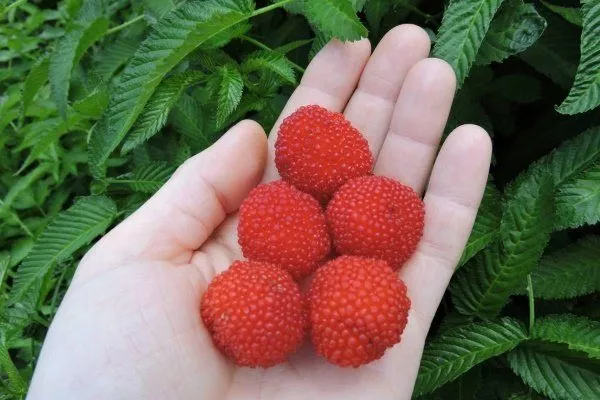
To preserve the healing properties, it is better to dry the fruits of Tibetan raspberries for the winter.
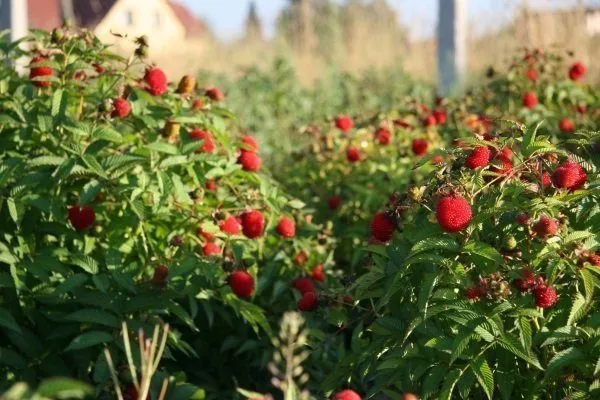
In our country, the Tibetan raspberry bush is often grown not as a fruit tree, but as an ornamental plant.
Origin of the variety
Tibetan raspberry is a wild variety. It was first mentioned in the 19th century as a garden plant in Japan, but its origins are believed to be in Northern China and the Himalayas.
Today, the plant is found in the wild in Australia, East Asia, and Africa. As a garden plant, it can be found in Poland, the Baltics, and China. Rose-leaved raspberries are not often found in our gardens.
Description of Tibetan raspberry
The plant belongs to the genus Rubus, family Rosaceae.
Different sources call it differently:
- Rosolin;
- Rose-leaved raspberry;
- Dwarf raspberry;
- Himalayan raspberry;
- Strawberry or Strawberry Raspberry;
- Tibetan raspberry;
- Norwegian;
- Miao Miao.
Varietal characteristics
Appearance of Rose-leaf Raspberry:
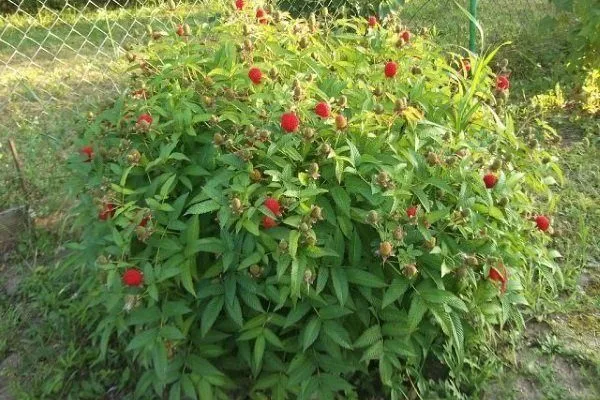
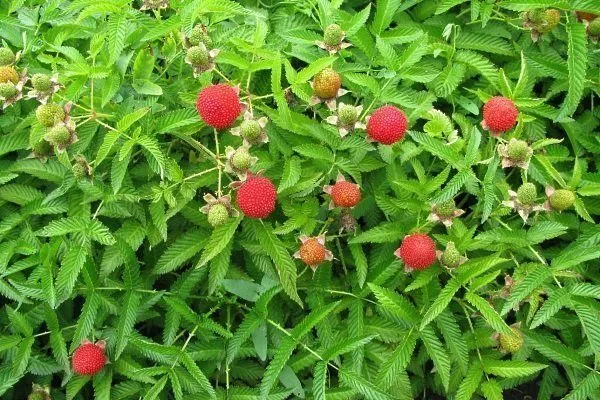
- Bushes. The crown is rounded. Wild shrubs can reach up to 3 m in height. Garden plants reach 0.4-1.0 m.
- Leaves. On one petiole there are 5-7 leaves, ranging from light to dark green in color with yellow veins, corrugated, oblong-lanceolate in shape, 3-8 cm in length, with small teeth along the edges.
- Branches. Thin, flexible, woody at the roots, herbaceous at the top, covered in thorns. Fruiting branches do not form clusters; flowers and fruits are evenly distributed throughout the bush.
- Spikes. They are densely located along the stems, curved and very sharp.
- FlowersRaspberry bushes bloom with single flowers from June-mid-July until mid-autumn. The flowers are large (up to 5 cm) with 5 petals.
- Berries. Large, up to 3-5 cm in size, coral-red or burgundy in color, juicy, and easily separated from the stalk, the berries are arranged upward on the bush. The taste is sweet and sour, with a strawberry-like aroma. Unripe fruits are bland.
Tibetan raspberries need to be well ripened before they begin to develop their flavor.
- RhizomeCreeping, superficial. At three years of age, the plant begins to spread rapidly, occupying ever larger areas and producing abundant shoots.
Purpose
Tibetan raspberry is used for its fruits and in garden design.
Use of fruits
The fruits are processed and used:
- for making tasty and healthy jam;
- as a filling for pies;
- fresh berries are added to vegetable salads;
- as part of protein dishes with cottage cheese, yogurt, sour cream, nuts.
Do not eat raspberries with fish, eggs, mushrooms, or legumes, as this may disrupt the digestive process.
- as part of fruit salads with apples, strawberries, plums, apricots, grapes, and tangerines.
It is not recommended to consume raspberries with bananas, as this can cause poisoning due to fermentation processes.
- as a component in compotes made from apples, apricots, pears, and peaches;
- the fruits are dried and a high-vitamin tea is brewed;
- eat it ground with sugar;
- frozen for the winter;
- Amateur winemakers make aromatic wine from it.
The taste of Tibetan raspberries is revealed after processing and has a strawberry-pineapple aroma.
Use in garden design
Bright green bushes with evenly scattered red berries and white flowers are of great value in garden design.
The bushes respond well to shaping throughout the entire growth period.
With the help of the plant you can:
- hide unsightly areas;
- strengthen the slopes;
- use as a hedge that will prevent uninvited guests and animals from entering the area;
- create alpine slides;
- design rock gardens and decorative compositions.
Fruiting and productivity
The first harvest can be expected 3-4 years after planting the seedling:
- 1st year only stems and foliage will develop on the bush;
- on the 2nd – you will be able to see several flowers and try the first harvested fruits;
- from the 3rd year It's already possible to collect a more or less good harvest.
Rose-leaved raspberries are not known for their high yields – up to 1 kg per bush per season.
The first ripe fruits appear in mid-July. The fruiting period ends with the first frosts in October.
Beneficial and harmful properties
Tibetan raspberries contain many beneficial substances (pectin, folic acid, copper, iron, potassium, vitamins E, C and P), which have a beneficial effect on the body:
- strengthens the cardiovascular system;
- increases hemoglobin;
- normalizes the functioning of the digestive system;
- improves metabolism;
- helps fight colds;
- has anti-aging properties;
- can be used as an antidepressant.
Rose-leaved raspberries can be consumed by pregnant and lactating women.
There are no absolute restrictions on consumption. People with the following conditions should exercise caution:
- diabetes mellitus;
- having a tendency to allergic reactions.
Pros and cons
The advantages of this variety include:
- long flowering and fruiting period – fresh fruits can be consumed for 2-3 months in a row;
- unusual taste is a plus for lovers of exotic food;
- unpretentiousness to growing conditions and care;
- raspberries are an excellent honey plant and attract bees;
- high decorative properties in landscape design;
- frost resistance and good tolerance to any weather conditions.
Cons:
- poor transportability of fruits, so it is difficult to find such raspberries on sale;
- poor shelf life (2-3 days in the refrigerator) – it is not possible to collect a lot of fruits at one time for processing;
- increased creeping of the root system - new shoots can appear at a distance of 1-2 m from the mother bush;
- very sharp and tenacious thorns.
Landing
Planting rose-leaved raspberries requires following these rules:
- Boarding time. The best time for planting is considered to be late September to early October. A seedling planted during this period is most likely to take root and thrive.
- Selecting a seedling. The seedlings should look healthy. Choose those without damage, curled, or yellowed leaves.
- Landing site. Depending on the region, raspberries can be planted in either sun or partial shade, but the sun-loving nature of the plant must be taken into account. Critical soil parameters for successful planting
- ✓ Soil pH level should be strictly between 6.0-6.5 for optimal growth.
- ✓ The depth of groundwater is at least 1.5 m from the surface.
Do not plant raspberries in places where water accumulates after rain and snow melt.
- Priming. The plant prefers fertile soils with a neutral or alkaline reaction.
- Landing plan. Plant the raspberries in rows, spacing them 80-120 cm apart. The hole for the seedling should be up to 50 cm deep.
- Protecting root growth. To prevent raspberries from spreading all over the area, restrict the growth of their roots by digging slate or another barrier into the ground to a depth of 1 m.
- Top dressing. Add 1 bucket of peat and 0.5 bucket of manure humus to each planting hole.
- Watering the seedling. After planting, cover the seedling with soil and water it generously with warm water.
Growing and care
Growing Tibetan raspberries is not particularly difficult and is not much different from growing other raspberry varieties.
When working with raspberries, remember to protect yourself from thorns, which not only injure but also break off after piercing the skin, remaining in the skin.
Watering
After spring planting, raspberries need to be watered all summer, after autumn planting – 2-3 times, and then – depending on the weather.
Follow these watering guidelines:
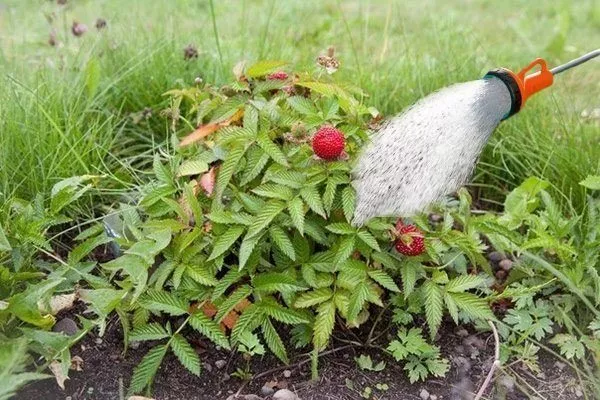
- Daily. Water the rose-leaf raspberry seedlings regularly, as they don't tolerate dry soil. Each plant requires about 10 liters of water.
- During hot and dry periods. In addition to watering at the roots, water using the sprinkler method.
If there is not enough moisture, the berries become smaller and fall off.
- During the rainy season. Do not water the plants at all.
If there is too much moisture, raspberries may become infected with fungal diseases.
- Mature bush. Water during periods of drought throughout the season.
After watering, loosen the soil. Do this very carefully, preferably by hand, to avoid damaging the shallow root system. Weeds should also be removed at this time.
Trimming
In summer, pruning is done to thin out the bushes. Excessive density prevents light and heat from entering the plant, impairing ventilation, which leads to berries and leaves losing their color and becoming smaller.
The following items are subject to pruning:
- branches without ovaries;
- branches with damage;
- weak, poorly developing branches.
Top dressing
Tibetan raspberries are not as demanding in terms of fertilizers as high-yielding industrial varieties.
Fertilizers are applied twice a year:
- In the spring. To promote bush growth and green mass accumulation in the root zone, add one fertilizer of your choice: mullein, saltpeter, wood ash, compost, or potassium-phosphorus complex.
- In autumn. Use nitrogen fertilizers in late fall.
The effectiveness of fertilizers will be greater if, after application, the root zone is covered with mulch made from manure, peat, or humus.
Reproduction
There are several ways to propagate the rose-leaved raspberry:
- shootsRaspberries grow well from the roots. Near mature bushes, you can find numerous young shoots. Dig them out with a sharp shovel.
The procedure can be performed twice a year:- in autumn - when the bushes are already dying off;
- in the spring - until they entered the phase of intensive growth.
- Cuttings. Dig up the bush and divide it into several parts, making sure that each of them has a bud.
Dig the seedling into the planting hole, and then cut off the stem, leaving a stump 3 cm high.
Propagation by cuttings is best done after harvesting. - Seeds. The most difficult method, suitable for patient gardeners.
Subsequence:- select overripe berries, crush them and leave for 2-3 days;
- rinse the pulp through a sieve, select the seeds and dry them;
- prepare a container with sand, place the seeds in it to a depth of 2-3 mm;
- Place the container in the refrigerator for 30 days;
- Move the container to room temperature conditions, moisten the soil well and create a mini greenhouse;
- In 3-4 weeks the first shoots will appear.
Preparing for winter
A characteristic of Tibetan raspberries is their complete renewal of branches each year. Therefore, after the upper part of the bush dies, cut it back completely, leaving stumps of about 4-5 cm.
- Reduce watering to a minimum 2 weeks before the first frost.
- After pruning, treat the cuts with garden pitch to prevent diseases.
- Insulate the root system with a layer of mulch at least 15 cm thick.
Cover the cut plants with a 10-15 cm layer of humus, peat or straw.
Cover young, newly planted plants with agrofibre and mulch on top.
See the video below for growing tips, winter preparation, an interesting method for protecting root growth, and what the bush and berry of the Rose-Leaf Raspberry look like.
Pests and diseases
Tibetan raspberries are no different from other varieties in terms of susceptibility to diseases and pests. The most common ones are:
- raspberry-strawberry weevil;
- raspberry beetle;
- anthracnose;
- yellow mosaic;
- root cancer;
- chlorosis.
If the disease could not be avoided:
- remove and burn affected leaves and stems;
- treat the plants:
- insecticide (in case of pest infestation);
- with a solution of copper sulfate or Bordeaux mixture (for fungal diseases).
To prevent infection you should:
- apply fertilizers in a timely manner;
- remove weeds;
- avoid over-watering the soil;
- remove dry leaves and branches.
How are buyers of this variety deceived?
Often, to sell Tibetan raspberry seedlings profitably, marketers resort to trickery and call it a hybrid of raspberry and strawberry, strawberry or blackberry, and greatly exaggerate the yield and taste qualities.
Often, the variety is referred to by names like "Raspberry-Strawberry," "Zemmalina," and "Blackberry-Raspberry Hybrid." The deception is facilitated by the visual similarity of the berries and flowers, which in the photograph resemble strawberries.
Hybridization of raspberries and strawberries is impossible due to the biological incompatibility of the plants.
Tips from experienced gardeners
Here are some gardening tips on choosing planting material, caring for, and growing rose-leaved raspberries:
- It is best to purchase seedlings from friends who have raspberries on their plot;
- The seeds of regular raspberries and Rose-leaved raspberries are not very different from each other, but the Rose-leaved ones are smaller, so you can protect yourself from being deceived when buying;
- When buying seeds, first grow the seedlings and then transfer them to the site;
- Dead branches can be pruned not only in autumn, but also in early spring, when new shoots reach 10 cm;
- To prevent raspberries from spreading too rapidly across the area, they should be planted in a shaded area;
- Buckets, basins, barrels and other containers can be used as barriers for the root system, in which raspberries can be planted and buried in the ground.
Some gardeners recommend using spruce branches as mulch, while others strongly advise against it, as the needles promote soil oxidation.
Tips for preserving fruits:
- For long-term storage, it is best to dry the fruits;
- When preparing homemade preserves, combine raspberries with other berries and fruits; this will give the product a unique flavor and aroma;
- Some gardeners recommend freezing raspberries and storing them this way for up to a year, while others advise against this, as the berries do not retain their shape.
In the following video, a gardener presented an unusual variety of Rose-leaved raspberry for review:
Where to buy? Prices
You can buy rose-leaved raspberries in online stores that offer both seedlings and seeds.
The price varies within the range:
- 390-550 rubles – for 1 seedling;
- about 28 rubles – 10 seeds.
Please be prepared to pay an additional fee for delivery of the goods to your location.
When purchasing a bush, you should clearly understand that the berry is not a garden variety of raspberry, and certainly not a hybrid with unusual taste qualities.
Similar varieties
A similar variety is the ornamental plant – Raspberry illecebrosus (Rubus illecebrosus).
This is a small shrub, reaching a height of 60 cm. The stems have stiff thorns, and the leaves have spines. The berries are round, scarlet, up to 3 cm in diameter, with a sweetish taste and no distinctive odor.
Its decorative appeal persists until late autumn. The plant is easy to care for and tolerates low temperatures well. It is used in landscape design.
There is an opinion that the Rose-leaved raspberry and the Seductive raspberry are two varieties of the same plant, differing in the size of the bush.
Reviews of Rose-Leaf Raspberry
The Tibetan raspberry, or rose-leaved raspberry, is a beautiful plant widely used in landscape design. The berries don't have a particularly distinctive flavor, but they do contain many nutrients. To avoid disappointment when growing this variety, experienced gardeners recommend strictly limiting root growth and eating the fruit processed.