
The Tatyana raspberry is not considered everbearing, so it bears fruit only once during the growing season. Despite this, the harvest takes a long time, producing berries with a pleasant dessert flavor, a powerful aroma, and large sizes. Ripening time is average, and cold tolerance is good. It is suitable for both home gardens and large-scale plantations.
History of selection
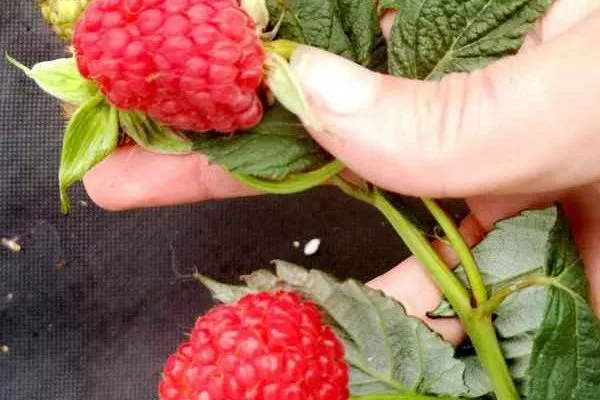
In 1993, the emergence of a raspberry variety named Tatyana was recorded. It was the result of intensive breeding research conducted by specialists at the Gorno-Altai Breeding Station.
During the development process, various parent lines were used, including the Patricia, Krasa Rossii, and some Scottish varieties, resulting in unique characteristics. The variety has not yet been included in the State Register of Varieties.
Introduction to the variety
The Tatyana variety was developed for cultivation in temperate regions typical of European Russia and the Central Black Earth Region. Although it was not assigned specific growing areas, it has proven versatile and adaptable to a variety of climatic conditions.
This raspberry variety is characterized by its rapid adaptation to a wide range of weather conditions, making it ideal for growing not only in the south of the country, but also in more northern regions such as Siberia and the Urals, where it exhibits significant resistance to drought and frost.
Description of the plant
This variety is determined by several key characteristics of appearance:
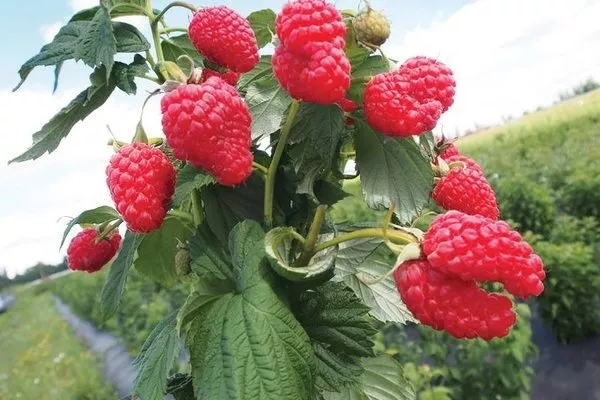
- Bush and branches. It consists of 10-15 young shoots, which in their second year acquire a dark brown hue, become firm, and grow vertically, reaching a height of 180-200 cm. Fruiting occurs only on stems that are two years old. A distinctive feature of the bush is the drooping ends of the shoots.
The bark of young branches is light green, becoming darker by autumn. A light waxy coating is visible on the surface of all shoots. The bush has a compact crown. The Tatyana variety is distinguished by its thornless shoots, making berry picking easier. - Leaves. The leaf blades are small, corrugated, and covered with pubescence on the underside. They are a rich green color, with serrated edges.
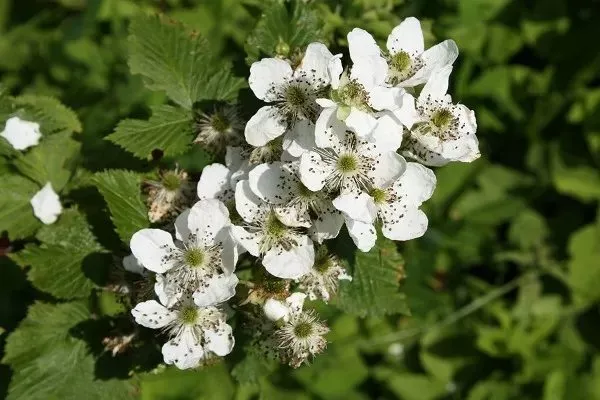
- Flowers. The buds are clusters of eight small, cream-colored flowers. Blooms are abundant, and after pollination, the flowers produce fruit vigorously. Tatiana is a self-pollinating variety, meaning each flower is highly likely to develop into a berry.
Fruit characteristics
Tatiana's berries deserve special attention:
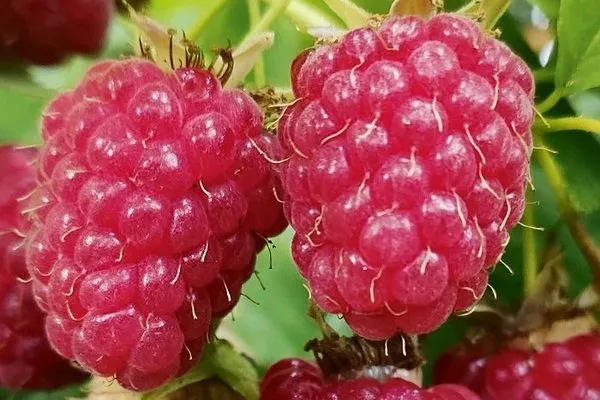
- Large fruits of a rich red hue, covered with small hairs and outlined by an oval shape with a pointed end, usually weigh from 7 to 10 g. Double specimens are often found, reaching 16-20 g.
- Their surface is characterized by graininess, but it is simultaneously soft and elastic.
- The berries impress with their sweet taste with a slight hint of acidity, contain a lot of juice, leaving a refreshing aftertaste, and have a distinct aroma with a typical raspberry hue.
- These fruits are not suitable for long-term storage, so after harvesting they should be consumed or processed immediately.
- Raspberries contain such beneficial substances as vitamins A, E, B, K and ascorbic acid in significant quantities, as well as micro- and macroelements, including potassium, calcium, phosphorus, iron and manganese.
- The calorie content of raspberries is 46 kcal, which makes them a source of healthy energy without the risk of accumulating excess calories.
- Inside each berry are inconspicuous, delicate-tasting seeds. Each of these, when ripe, is a potential seed for growing raspberries.
Characteristics
During testing of the new raspberry variety, named Tatyana, rigorous studies were conducted, covering both the plant's appearance and functional properties. The following findings were discovered:
- Ability to withstand frost. Plants easily withstand winter temperatures down to -25°C, provided there is sufficient snow cover. Raspberries, even covered in snow, survive the winter without any problems.
In areas with insufficient snow, it is recommended to bend bushes to the ground and protect them with a special covering before winter. Branches damaged by frost are able to recover. - Pollination process. Tatyana is a self-pollinating variety – it does not require additional insects or special methods of pollen transfer for pollination.
- Fruiting characteristics. The mid-early onset of fruiting and the prolonged ripening of the berries have led many to mistakenly consider this variety to be everbearing. However, Tatyana is not everbearing. Its fruiting period is comparable to that of varieties that are harvested twice per season.
- Performance. During the growing season, a single bush can yield up to 8-10 kg of berries. The first fruits appear in late June, and harvesting is completed by the end of August. Thanks to the long fruiting period during the warmer months, the harvested quantity is enormous.
- Harvesting. This is done gradually, as the fruit ripens. The berries hold well on the plants and do not fall off.
Methods for storing berries
To preserve the freshness of berries, they should be collected directly into storage containers. These containers are typically flat, low-profile packages with lids. The berries are stacked in a single layer (maximum two), allowing them to be stored for up to three days when refrigerated in the bottom section of the refrigerator.
Over time, even with proper storage, the flavor of berries can deteriorate: they become very soft and watery. To avoid this, eat them immediately. To extend their shelf life, you can use various processing methods:
- Making jam, jellies and confitures from berries.
- Add to compotes, fruit drinks and vitamin drinks to treat colds.
- Mixing with sugar.
- To obtain juice.
- Freezing berries for later use.
- Drying to keep them dry.
Thus, the shelf life of processed berries can be up to one to two years. Although heat treatment may slightly reduce the vitamin content, the overall beneficial properties of raspberries remain unchanged.

Landing
The soil under raspberries should not be depleted or contain too much acid or alkali, as this will negatively impact the plant and yield. Tatyana requires well-lit areas for raspberry plants.
It is important to ensure that groundwater is at least 120-180 cm from the surface of the beds to avoid over-watering and subsequent waterlogging, which can lead to the death of the plants.
The timing for planting raspberries depends on the type of roots:
- If you're planting bare-root raspberries, spring is the best time to plant them. This will allow the plant to establish roots well and gain strength before winter, ensuring it survives the cold.
- Seedlings with a closed root system can be planted at any time, including before the onset of cold weather, until the ground begins to freeze.
The procedure for planting the Tatyana raspberry variety is as follows:
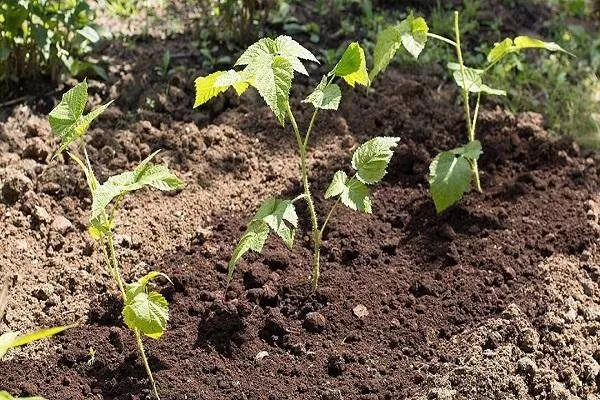
- Dig a pit measuring 40-45 x 40-45 cm. Make sure the distance between plantings is 120-150 cm. If you choose a row planting system, leave a gap of 150-170 cm between them.
- Add organic and mineral matter to the hole: manure (can be replaced with humus or compost), potassium chloride, and superphosphate. Mix them into the soil.
- Pour 15-20 liters of water into the hole and wait until it is completely absorbed.
- Place the seedling in the center of the hole, carefully spreading out the roots (if they are exposed), and add fertile soil around it.
- Create a ditch near the seedling to drain water.
- Water the planting generously again.
When choosing a site, keep in mind that berries in a shady spot will be too sour, and dampness can lead to fungal diseases. Avoid areas exposed to strong winds and direct sunlight throughout the day.
Care tips
When cultivating the Tatyana variety, care similar to traditional care is important:
- To prevent fungal diseases, be sure to remove weeds and loosen the trunk area.
- Apply mulch using humus, peat, sawdust or straw to prevent the soil from drying out and cracking.
- Raspberries don't require watering during rainy days. However, after the berry harvest begins, during periods of severe drought, irrigation becomes necessary. After harvesting, give the plants a generous, moisture-replenishing watering to protect them from the cold.
Autumn soil moistening around raspberries is especially beneficial for strengthening their health. - In spring, the plant needs mineral preparations with phosphorus and potassium, and in autumn, organic fertilizers such as compost, ash and bird droppings should be used.
- Pruning fruit-bearing branches in the fall and removing frost-damaged, wind-damaged, dead, or diseased branches in the spring are important care steps. Shorten young shoots by a few centimeters. If the bushes are too dense, thin out the crown to make picking easier and improve the flavor of the berries.
Preparing for winter
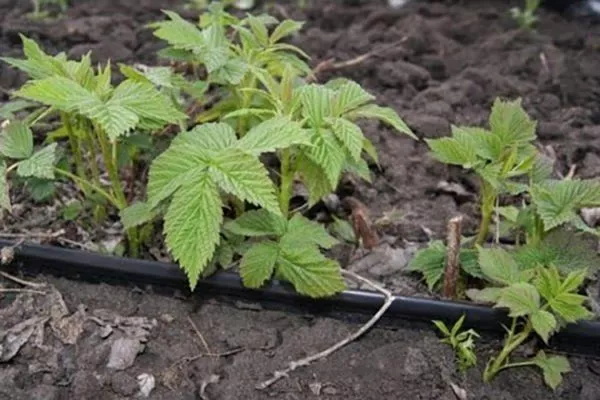
Pre-winter preparation begins with applying a layer of mulch to the root zone. Humus is a suitable material, which not only protects but also acts as an organic fertilizer for the plant. The surface of the raspberry plantings is covered with a protective layer of agrofilm.
Diseases and pests
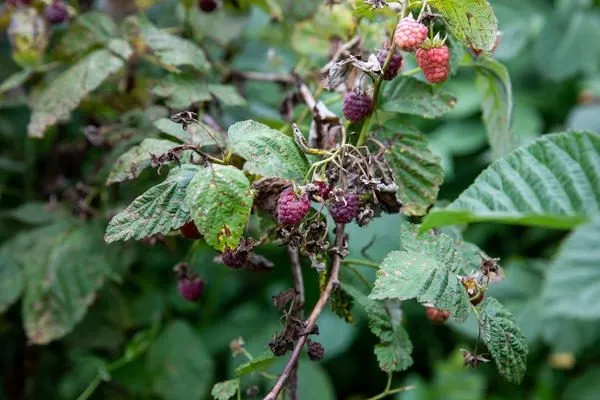
The Tatyana raspberry variety is highly resistant to diseases and pests, but if the immune system is weakened or exposed to unfavorable factors, a number of problems may arise. Some of the most common diseases include:
- Mosaic pattern – small spots on the leaves.
- Curl is a change in the shape of the tops of shoots and curvature of leaves.
- Stem gall midge is an insect infestation of the stem that causes the formation of blisters.
Treating infectious diseases can be difficult, but for minor infestations, fungicides such as Fundazol and Topaz can be used. Fufanon and Alatar are effective for insect control.
Reproduction
Propagating this raspberry variety is easy thanks to its ability to spread. First, purchase a few young bushes, plant them, and by the following year they will produce numerous new shoots. All that's left to do is carefully dig up these young plants and move them to a pre-prepared location.
Raspberry propagation by cuttings is also possible. In this case, proceed as follows:
- In autumn, prepare cuttings up to 12-16 cm long.
- Cut them off, treat them with fungicides, and then insert them into the ground, covering them with protective material such as film or spruce branches.
- Place in a dark place.
- In the spring, transplant the cuttings into a small greenhouse, where the soil should be moist.
- Wait until the cuttings sprout and form a root system.
What are the advantages and disadvantages?
Tatyana has one of its main advantages: its berries are marketable, large, and sweet. But this raspberry variety also has other advantages:
It is also important to know about some of the variety’s disadvantages:
Gardeners' reviews
For gardening novices, the Tatyana variety is an ideal choice due to its ease of care, tolerance to various conditions, and rapid establishment. This raspberry has the potential to be grown commercially on an industrial scale. Its varietal characteristics deserve a comprehensive evaluation.