
The "Skazka" raspberry is promoted by online publications as a standard variety with enticing agronomic characteristics. Unfortunately, there's a lot of inaccurate and contradictory information about this raspberry. Let's learn about the characteristics of "Skazka" and whether this variety actually exists.
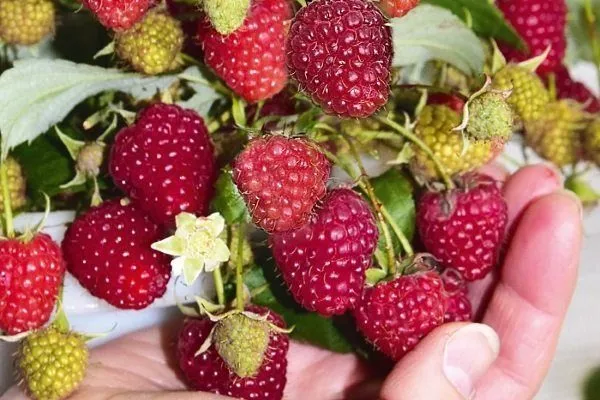
raspberry variety "Skazka"
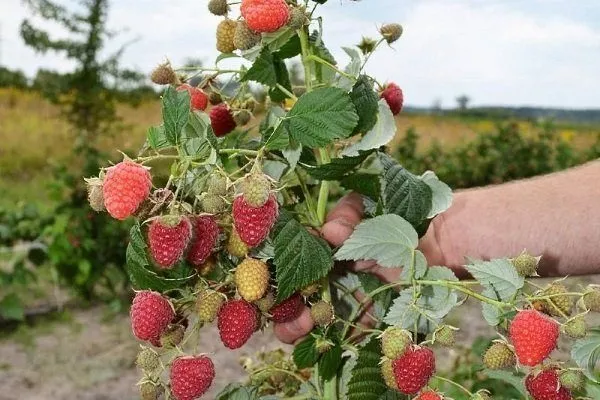
non-remontant variety "Skazka"
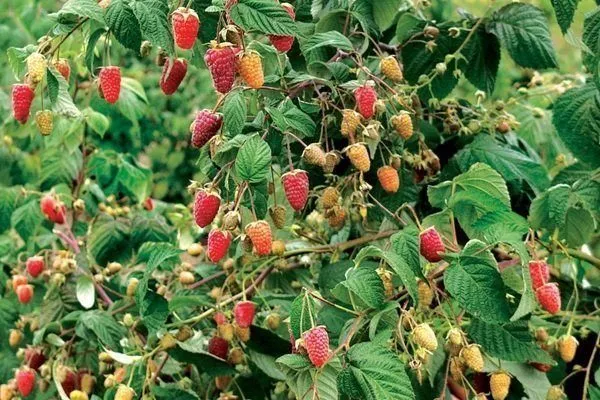
The fruits of the Skazka variety do not fall off the bush, are transportable, and are resistant to rotting.
How did the variety appear?
It's not known for certain who, where, or when developed the "Skazka" raspberry. Many gardeners doubt the variety even exists. It is known that online stores offer it as a standard variety derived from the famous "Tarus" raspberry, bred by Professor V.V. Kichina.
Standard raspberries are those with thick, woody shoots. These varieties require regular pinching to shape the crown.
Description of bushes and berries
Brief botanical description of "Fairy Tale":
- Bushes. Vigorous, with thick, woody shoots. Height: 1.5-3 m. Can bear fruit without staking – thick shoots do not bend to the ground, supporting the weight of the harvest.
- Fruit. Large, shiny berries weighing from 8 to 15 g. Color – bright red. Shape – elongated-conical.
The name "raspberry tree", often used by sellers for standard varieties, is associated only with the similarity of the crown of the bush to the crown of a tree, nothing more.
Characteristics
"Skazka" is a non-remontant variety with a fruiting period extending from mid-July until autumn. The variety's key characteristics are listed in Table 1.
Table 1
| Characteristics/parameters | Description/Meaning |
| Ripening period | mid-season |
| Productivity | 5-10 kg per bush |
| Taste and aroma | sweet, with a rich raspberry aroma (tasting score: 4.6 out of 5) |
| Frost resistance | average, up to minus 23 °C |
| Drought resistance | high |
| Resistance to pests and diseases | high |
| Purpose | universal |
The stated characteristics are tempting, but gardeners understand that to obtain the promised harvest—a bucket of berries per bush—a considerable amount of labor will have to be invested in growing the berry bushes.
What else is known about the Skazka variety:
- Bushes can bear fruit in one place for up to 15 years.
- Does not tolerate over-watering - do not allow water to stagnate.
- It grows and bears fruit well in loose, nutritious soils.
- The stated frost resistance precludes cultivation in regions with harsh winters. Recommended regions are central and southern. In other regions, insulation is necessary.
- Few replacement shoots are formed.
- The height of the bushes directly depends on growing conditions – climate and soil composition.
- The plantings are not prone to spreading across the plot. There is no need to prune shoots that clog the space between rows.
Upon closer examination of the variety, one can conclude that the Skazka variety is extremely similar to the Tartus raspberry, which many consider to be its ancestor.
A review of the raspberry bushes of the "Skazka" variety can be seen in the video below:
Where can I buy seedlings?
Many specialized nurseries and online stores offer "Skazka" seedlings. Standard raspberry varieties are well-advertised, so demand is high. The demand is matched by the price – standard raspberry seedlings are more expensive than standard varieties. The price of one seedling is 250-300 rubles.
How to choose the right healthy specimen?
When purchasing seedlings, pay attention to their external characteristics:
- The branches and stems should be light brown or yellowish, but not black.
- There should be no spots on the leaves - gray, orange and brown, indicating that the plant is infected with spotting or another disease.
- The roots are strong, powerful, and fibrous. There should be no breaks or rot.
Buying seedlings at the market is dangerous. If you buy seedlings from such places, ask for documentation.
Does this variety really exist?
The most authoritative source of information on varieties is the website of the State Commission of the Russian Federation for Testing and Protection of Selection Achievements. "Skazka" is not listed on its list of raspberry varieties. Therefore, officially, this variety does not exist.
The raspberries sold by retailers as the standard variety "Skazka" are, at best, derivatives of the Tartus variety and lack strictly defined varietal characteristics. At worst, gardeners are being sold any number of seedlings under the guise of the advertised raspberries. Unofficially, the variety continues to exist. Time will tell how resilient it is.
Pros and cons of the Skazka variety
Advantages:
- There are no thorns on the shoots, making it easy to harvest.
- High yield.
- Large-fruited.
- Long fruiting period.
- No garter required.
- The berries tolerate transportation well.
- Highly decorative.
- Compactness of the plant.
- Absence of aggressive growth.
Flaws:
- Like all standard varieties, the shoots of 'Skazka' quickly become woody. Because of this, they cannot be bent or covered. The key is to choose a time when the shoots have grown but not become woody.
- If it is not possible to bend and cover the shoots, they may freeze in severe frosts.
- Low frost resistance.
- Regular shaping pruning is necessary – in autumn and in spring.
- Productivity is highly dependent on care.
Landing features
Like any standard variety, 'Skazka' can be planted in spring or fall. In colder regions, spring (April) is preferred, while in warmer regions, fall (September-October) is preferred.
ABOUT spring planting of raspberries You can find out more from the following article.
Site requirements:
- Standard varieties require a lot of light and space, so choose a sunny, wind-protected spot for the berry bush. This will most likely be found at an elevated site.
- The best soils for raspberries are loose and nutritious.
- It is advisable to place the raspberry patch near a fence to reduce damage from winds.
- Berry gardens shouldn't be planted in low-lying areas, as this will lead to root rot. The best location is on slopes with neutral or slightly acidic soil.
- You can’t plant raspberries immediately after potatoes and tomatoes.
- ✓ Soil pH should be between 5.5-6.5 for optimal nutrient absorption.
- ✓ The depth of groundwater is at least 1.5 m to prevent root rot.
Prepare the soil in advance. For spring planting, do this in the fall; for autumn planting, do this a month before planting. Soil preparation:
- Dig up the soil and add humus – 5-6 kg per 1 sq. m.
- They dig holes or trenches for planting.
- If the groundwater level is high, sand and crushed stone are poured into the bottom of the depressions.
- A mixture of fertile soil and compost is poured over the drainage.
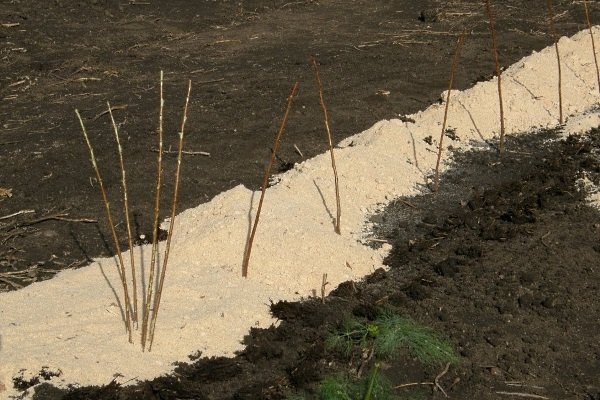
After raspberry bushes, the soil takes five years to recover. Legumes are best planted after raspberries.
Planting methods:
- Ribbon. Long trenches called "ribbons" are dug. The width and depth of the trenches are 40 cm. The distance between bushes is 50-70 cm, and between rows, 2 m.
- Bushy. They dig holes with a diameter of 50 cm. The distance between adjacent bushes (hole centers) is 1 m, between rows – 1.7-2 m.
The procedure for planting standard raspberry seedlings:
- To help the seedling take root faster, its roots are dipped in a mixture of cow dung and clay.
- Fertilizer is poured into the depressions (holes or trenches). Per plant:
- compost bucket;
- a glass of ash;
- 40 g nitroammophoska (if planting in spring);
- 30 g of superphosphate and potassium salt (if planting in autumn).
- The seedling is carefully placed into the hole, spreading the roots in different directions.
- The roots are covered with soil, shaking the seedling occasionally to ensure there are no air pockets between the roots. Once the roots are covered, compact the soil by hand.
- The seedlings are watered at the roots.
Caring for raspberries
Procedure for caring for standard raspberries:
- Watering. The maximum frequency of watering is once a week. The exception is the first week after planting and during extreme heat. Water raspberries in the morning or evening to ensure the water penetrates the soil and prevents evaporation.
- Top dressing. In spring, the bushes are watered with a nitroammophoska solution at a rate of 20 g per 10 liters. Until mid-July, add a weed infusion or liquid mullein (1:10). From the second half of summer, avoid adding organic matter, as it contains nitrogen, which stimulates shoot growth. At the end of August, apply autumn mineral fertilizers—the manufacturer labels these fertilizers "autumn." Alternatively, water with potassium salt or superphosphate, diluted in a bucket of water at a rate of 10 g and 20 g, respectively.
- LooseningDuring the summer, weeds are periodically removed and the soil is loosened. Hilling the bushes is also recommended. These tasks are recommended in May and in the fall, after the harvest.
- Mulching. A 5-7 cm layer of mulch helps retain moisture and prevent weeds from growing. Suitable mulches include peat, humus, and straw.
Preparing for winter
Young branches are usually tied and bent to the ground before winter to cover them with agrofibre. Fruiting shoots are pruned, leaving no stumps. Woody shoots would be impossible to bend anyway—they don't bend. In the spring, as soon as the first warm days arrive, the agrofibre is removed.
Gardeners often debate whether the branches of the "Skazka" raspberry bend or not. Some believe there are two types of this variety: regular and everbearing. In areas with cold winters, the everbearing variety is recommended—all shoots are removed for the winter, only the roots are protected from frost. In temperate climates, the shoots of non-everbearing raspberries are bent and covered with mats or non-woven material.
How to propagate a variety?
"Skazka", like any standard raspberry, is propagated most often by three methods:
- By root cuttings. While digging around the bush, locate areas of roots with buds. Take roots with 1-2 buds and plant them in loose soil in seedling beds. Until seedlings emerge, shade and moisten the beds. Cover the seedlings with agrofibre for the winter, and in the spring, transplant the seedling to its permanent location.
- By the undergrowth. This is the simplest method of propagation: the daughter plant is dug up and placed in a prepared place.
- Green cuttings. Young shoots 6-8 cm long are cut off. After dusting the cuts with Kornevin, the cuttings are placed in a mixture of soil and sand, mixed in a 1:1 ratio. After a month, the cuttings will root. While the cuttings are growing, they are watered and provided with a favorable temperature regime – they are usually grown in a greenhouse.
| Method | Rooting time | Success rate |
|---|---|---|
| Root cuttings | 4-6 weeks | 70-80% |
| Overgrowth | 2-3 weeks | 90-95% |
| Green cuttings | 3-4 weeks | 60-70% |
Trimming
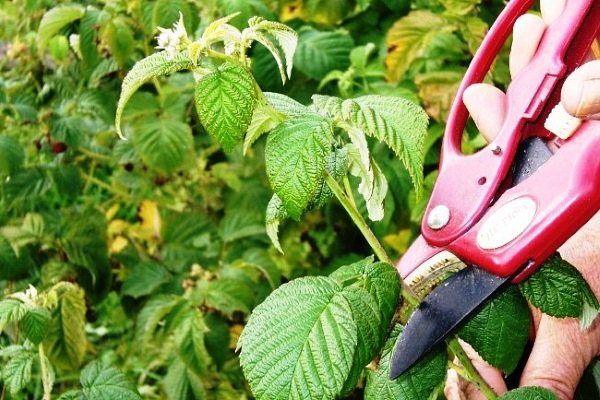
Pruning is essential for tree raspberry varieties. It is recommended to perform it in two stages:
- At the end of spring, prune branches that have already produced fruit. Don't be stingy—these branches take away nutrients needed by new shoots.
- The second pruning is done in September. It's practically the same as pruning for regular varieties. All old and diseased shoots are removed.
Some gardeners use a double pruning method, leaving only one replacement shoot. At the end of May, the shoots are shortened by 10-15 cm, and by early fall, a compact plant with 5-6 lateral branches has formed. In this form, the bush is sent into winter.
Diseases, pests and their control
The main danger is fungal diseases that occur when air and soil humidity are high. Raspberries require special attention during cool summers. Common diseases and pests of the "Skazka" variety are listed in Tables 2 and 3, respectively.
Table 2
| Disease | Symptoms | How to fight? |
| Curly hair | The fruits are sour, the leaves are twisted into tubes. | The disease is incurable. Destroy affected bushes. Treat with Bordeaux mixture. |
| Anthracnose | Drying of flowers, shoots, and stem tips. Gray spots surrounded by a red border appear. | Plant healthy seedlings. Spray with Fundazol every 10 days. |
| Gray mold | The berries are rotting and there are brown rings on the stems. | Affected areas are pruned and burned. The bushes are treated with Fundazol or Bordeaux mixture. |
| Rust | Gray ulcers bordered with red appear. The fruits are dark inside. | Similar to gray rot, and also treatment with copper-containing preparations - for example, Bayleton. |
You can see what a raspberry bush affected by a particular disease looks like in this article.
It's recommended to eliminate raspberry pests before they cause damage to the raspberry bushes. This can be accomplished by using standard preventative measures, such as hoeing, spraying, etc.
Table 3
| Pests | Damage caused | How to fight? |
| Raspberry beetle | The larvae eat away the receptacle and spoil the berries. | During the budding period, cover the raspberries with non-woven material; remove it after the flowers open. Also, spray with tansy infusion: 300 g of dried tansy or 1 kg of fresh tansy per 5 liters. |
| Raspberry stem fly | Shoots affected by larvae turn black and wither. | Damaged shoots are cut out and burned. The soil is loosened, destroying the larvae that enter it. Chemical pesticides are not recommended. |
| Spider mite | It can destroy up to 70% of the crop. Leaves curl, turn yellow, and fall off. | In spring, spray with 6-7% urea. For severe infestations, use Fufanon (10 ml per bucket). In autumn, use Actellic (20 g per bucket). |
Reviews from gardeners about "Skazka"
If you believe in "Skazka," then buy its seedlings only from the most reliable and trusted nurseries. With proper cultivation practices, this standard variety will provide you with sweet berries for at least two months.