
The Rubinovoe Ozhelezhie raspberry is most often used for commercial mass cultivation. It boasts excellent yields, as well as shelf life and transportability. It is a remontant variety, meaning the berries are harvested twice during the growing season—in summer and fall. It is a mid-season variety.
History of selection
The everbearing raspberry variety "Rubinovoe ozherelie" (Rubin Necklace) was developed by our specialists, I.V. Kozakov and S.N. Evdokimenko, at the All-Russian Scientific Research Institute of Horticulture and Fruit Growing in the early 2000s. In 2005, the scientists submitted the new variety for state variety testing.
Where can it be grown?
This variety is popular among gardeners in Belarus and Ukraine. In Russia, it is prized in the southern and central regions. Despite its northern origins, Rubinovoe Ozhelezhiya can also be successfully grown in the Urals and further north, provided insulating structures such as tunnels and canopies are used to protect against adverse weather conditions.
Introduction to the variety
Ruby Necklace is distinguished by its name, which it received due to its attractive appearance during ripening. The bush, covered with bright, large berries, resembles a necklace of rubies. This variety possesses a number of botanical characteristics.
Bush, branches, leaves
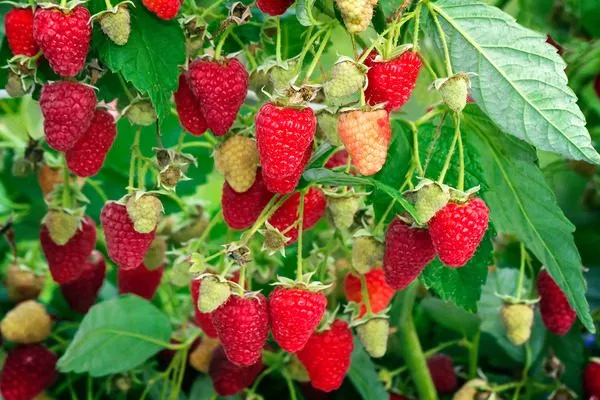
This variety is medium-sized. The bush is compact and well-groomed, typically reaching no more than 160 cm in height, though shorter specimens, as low as 120-130 cm, are also common.
Other varietal characteristics:
- Thanks to its vigorous growth, the bush produces long, graceful shoots, the number of which can vary from 5 to 7 per replacement branch. These shoots are moderately drooping, forming an arched shape adorned with small, pointed spines along their entire length.
- The fruit-bearing branches located on the sides are covered with a white waxy coating and have a light fluff.
- The fruiting zone occupies two-thirds of the stem's length. During periods of intense berry production, it is necessary to tie the shoots to a supporting structure, as they tend to droop under the weight of their own fruit.
- The leaves are numerous, with a rich greenish hue. The leaf blade is slightly corrugated, slightly curved, and rounded with a pointed, elongated tip.
- The lower surface of the leaf is light, almost whitish in color, and the size can vary from 8 to 12 cm in length and from 5 to 7 cm in width.
Flowers, fruits, seeds
In early spring, the bush is covered in shiny, whitish buds. Although small, they possess a special grace, creating the impression that their petals barely touch the ground. At this time, the ovaries that will later develop into berries begin to form on the racemose inflorescences. These buds have the following characteristics:
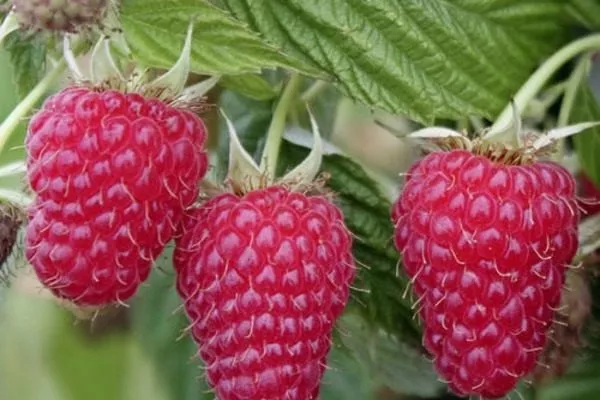
- the shape resembles an elongated cylinder;
- color - rich ruby, which attracts the eye;
- the sizes are quite large, reaching 4-6 cm;
- the weight of one berry ranges from 4.5 to 5.5 g, and in some cases can be 8-8.5 g;
- the drupes are not too large and are firmly connected to each other;
- the skin is thin, but quite strong;
- the pulp has a tender and at the same time dense structure;
- the seeds are very small;
- the aroma of the fruit is pleasant, with notes of raspberry;
- The taste is sweet and sour and unique.
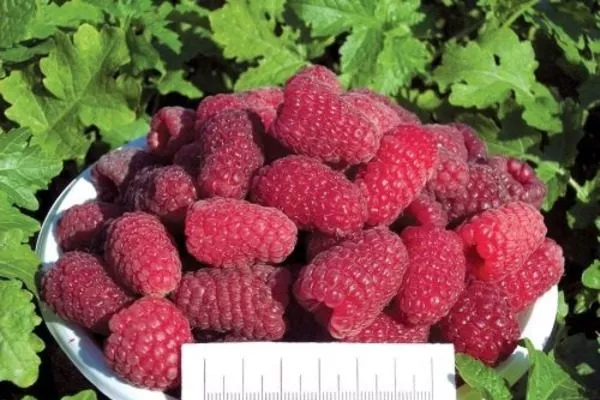
These berries can be transported short distances. Their quality rating on a five-point scale ranges from 3.9 to 4 points, reflecting a predominance of acidity over sweetness.
Beneficial properties
Ruby Necklace raspberries aren't just a delicious fruit, they're also a source of essential micronutrients. Per 100g, they contain the following ingredients:
- carbohydrates – 7.2-8.8 g;
- protein – 0.6 g;
- fats – 0.4 g;
- fibrin substances – 3.5 g.
Raspberries' low calorie content (only 48 kcal per 100 grams) makes them an ideal choice for a diet. Among the beneficial substances found in raspberries, minerals (magnesium, iron, potassium, silver, etc.), amino acids, and vitamins (including B, A, PP, C, E, etc.) are particularly noteworthy.
Resistance to frost and drought
The Rubin Necklace is highly winter-hardy and can survive temperatures down to -20-25°C without damage. This variety has moderate drought tolerance, allowing it to survive short periods without moisture.
Pollination and fruiting methods
This variety doesn't require neighboring plants for pollination, as it is self-pollinating. Fruit on this variety begins to ripen in August and continues to mature until late autumn.
Before the onset of cold weather, at least 75-85% of the crop usually manages to ripen and be harvested, while in warmer climate zones this figure can reach 90-93%.
Yield and storage
This raspberry variety is highly productive, yielding 2.5-3.0 kg per bush or a maximum of 17 tons per hectare. Harvesting equipment can be either manual or mechanized, as the ripe berries are easily separated from the bush, remaining whole and undamaged.
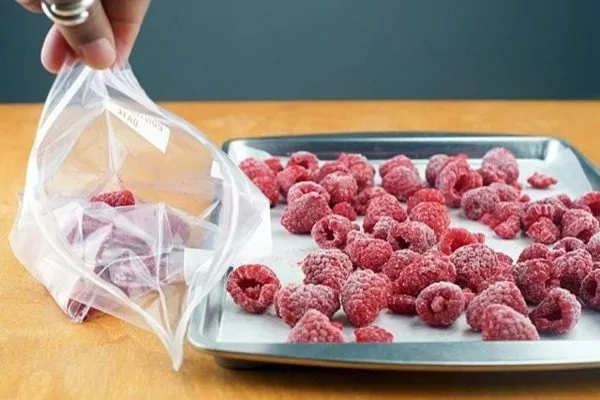
To keep raspberries fresh, certain conditions must be met:
- It is recommended to store in a refrigerator or a cool room, such as a cellar, at a temperature of +3 to +80 degrees;
- humidity should not be higher than 70-80%;
- a prerequisite is to ensure adequate air flow;
- Storage containers should be wide and not too deep, preferably perforated.
Raspberries are best stored in a dark place, away from direct sunlight. Freezing can be used, which extends their shelf life to 14-17 months. Raspberries can also be dried, which expands their culinary and canning applications. Although the fruit is suitable for transportation, it is not suitable for long-distance shipping.
Landing rules
When choosing a landing site, rely on the following key requirements:
- the place should have good sunlight and be warm;
- Some shading is acceptable, but should be kept to a minimum to avoid reducing yield and sweetness;
- It is best to choose a space near walls or fences so that the bushes are protected from wind and cold (in summer, more heat usually accumulates in such places, which accelerates the ripening of the fruits).
Regarding soil, this variety can yield fruit in a variety of soil types. However, to ensure adequate fruiting, it is recommended to enrich the soil with organic mixtures such as compost or manure. If the soil is highly acidic, ash or lime should be used to neutralize it. In areas with stagnant water, drainage is essential.
The time for planting raspberries depends heavily on weather conditions:
- In northern regions, the ideal time for planting is in the spring, when warm temperatures and abundant rainfall promote successful rooting of the Ruby Necklace.
- In southern regions, where springs are short and hot, seedlings often don't have time to establish themselves. Therefore, for southern climates, it's recommended to plant raspberries in the fall, about a month before temperatures drop.
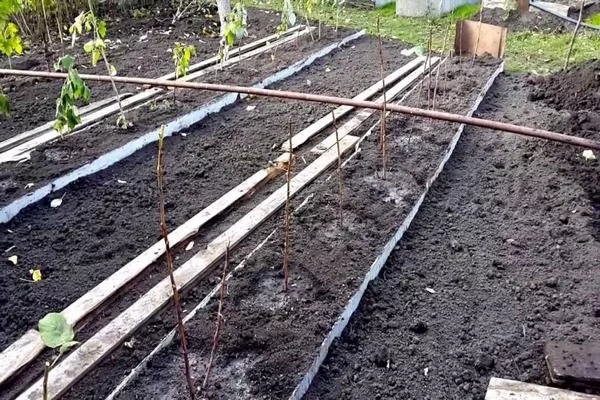
There are two main methods:
- Bush planting method. It is considered one of the most effective, but it is necessary to leave at least 70-80 cm between bushes.
- Tape method. With this method, the interval between plantings should be approximately 50-60 cm. When calculating the row spacing, it should be taken into account that the optimal distance should be 250-280 cm.
The choice of planting material is critical, as the quality of the future harvest and the health of the shrub depend on the seedlings:
- Before planting, carefully inspect the plants for pests and diseases.
- Check the root system with the root ball through the drainage holes in the container.
- When purchasing stems without soil, it is important that they are free of leaves but have healthy buds.
- Before planting, prune back and treat with fungicides to prevent diseases.
- Soak the roots in a Kornevin nutrient solution for 3 hours to ensure an optimal start to growth.
The tree planting process involves a number of stages:
- First, dig holes or trenches at least 35-45 cm deep; if necessary, they can be even deeper, depending on the parameters of the seedling and its age.
- Place mineral and organic fertilizers in them.
- Then moisturize.
- Cover with fertile soil. The root collar of the seedling should be level with the surface of the bed.
- Compact the soil and spray with water again.
- Apply mulch to prevent excessive weed growth and reduce water evaporation.
Care
Growing this type of raspberry does not require complex skills, but it is necessary to follow certain recommendations – a careless attitude towards care will lead to a decrease in yield:
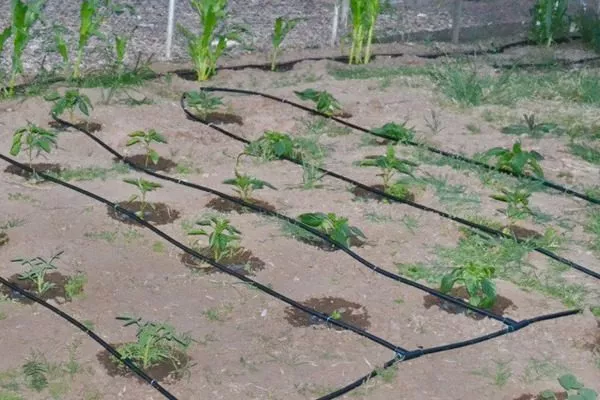
- Watering. During the first year of cultivation, raspberries require regular watering—at least once a week. In the second year, water intensively, especially during the development of new shoots and during flowering/fruit ripening. In the south, drought can be a problem, so watering should begin immediately after the first shoots emerge.
It is important to water the bushes before each feeding, and then cover the soil with a layer of mulch. - Trimming. In the fall, raspberry bushes are pruned to ground level. This variety is ideal for annual cultivation. Complete pruning helps protect the crop from pests and various diseases.
- Fertilizer. During preparation for planting, as well as when plants reach three years of age, it is especially important to provide them with nutrients:
- In spring, use mullein or ammonium nitrate to feed the Ruby Necklace.
- During the budding period, the plant needs mineral fertilizers, ash, as well as organic components such as bird droppings, humus and compost.
- In autumn, add fresh manure.
Preparing remontant raspberries for winter
Despite the variety's good winter hardiness, measures must be taken to protect the plant from cold. First, the bushes are pruned, the foliage removed, and the spaces between the plants filled with humus or peat. If the bushes are not pruned, their shoots should be lowered using arches for support.
Diseases and pests
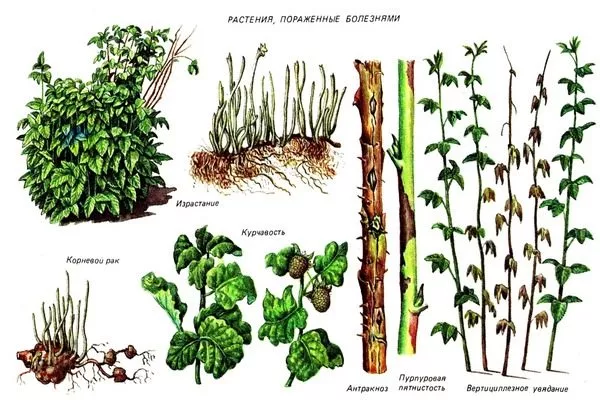
This variety is disease-resistant, but in rainy summer conditions, poorly chosen planting locations (for example, in a lowland), or excessive waterlogging during watering, it may suffer from the following problems:
- Gray mold fungus – It appears during the ripening period of the fruits and spreads quickly throughout the bush in conditions of high humidity, which requires the destruction of the affected plant and treatment of the soil with Bordeaux mixture.
- Powdery mildew fungus – requires similar measures.
- Rust fungus – Affecting the leaves with yellow spots, it requires spring preventative watering of the bushes with copper sulfate; when the disease appears, the plants are destroyed.
- Raspberry and spider mites, as well as aphids – Those that affect foliage are usually destroyed using Kemif, Fufanon, and Fitoverm.
Reproduction
The Rubin Necklace variety can be propagated by root suckers or from green shoots. The latter method is used by experienced gardeners who have access to greenhouses or hotbeds.
A simple root division method can also be used to propagate the variety. Follow these steps:
- the bush is dug up;
- his condition is checked for signs of disease;
- the bush is divided into two parts;
- cuts on the roots are treated with activated carbon;
- The seedlings are planted in a pre-prepared place, taking into account the recommendations for planting this raspberry variety.
Pros and cons
The variety is sensitive to the quality of care, but with proper agricultural technology, its shortcomings can be completely eliminated.
Gardeners' reviews
The Rubin Necklace raspberry is characterized by its compact size, disease resistance, and self-pollination. With proper care, it guarantees abundant harvests, and in southern regions, it can bear fruit twice a season. The berries are large, richly aromatic, and have a unique dessert flavor. This versatile variety boasts high yields.