
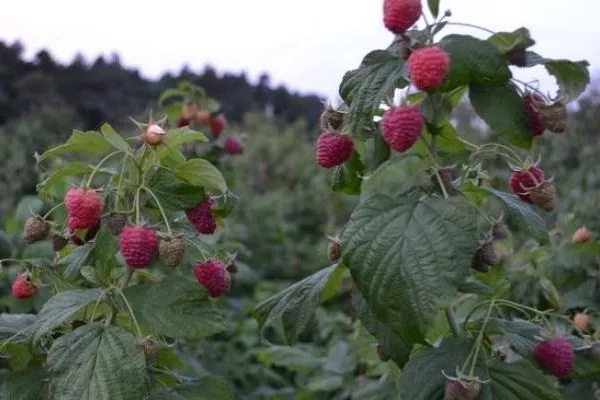
The Polana raspberry is everbearing, meaning it can bear fruit twice during the growing season. It is suitable for cultivation in private gardens and large agricultural plantations. This variety is characterized by high yields, excellent transportability, shelf life, and resistance to diseases and pests. However, the harvest period depends on weather conditions and the region.
How was the variety obtained?
In 1991, the Polish Plant Research Center introduced the everbearing raspberry variety Polana. It was bred from the American variety Heritage and the Swiss variety Zev.
Polana is often confused with another Polish variety, Polka (Polka), but they are different crops. The main differences between them are the shorter and less dense thorns on the Polana stems, as well as the smaller, slightly tart berries. This raspberry requires less care.
Where can it be grown?
Polana is ideal for planting in northern European climates, where winters are mild and summers are cool and often rainy. In Russia, this perennial shrub thrives in the European part of the country and in the south. It survives winter under snow well, even in the Far East, thanks to autumn pruning of fruiting branches.
Introduction to the variety
To choose a specific raspberry variety, it's important to study all its characteristics and determine whether the plant is suitable for cultivation in your region. The berries' appearance, taste, and size are also important.
External characteristics of the bush and berries, their taste and purpose
The shrub is considered medium-sized, reaching a height of 160-170 cm. It is distinguished by a significant number of skeletal shoots—almost 17. The variety also has other characteristics:
- the stems are thickened – their diameter varies from 20 to 40 m;
- shoots are erect, with many branches forming on them;
- their structure is strong, so they do not bend towards the ground;
- many ovaries are formed - on average 60% of the entire length of the stem;
- the thorns are dark, but there are few of them;
- the bark on the shoots is yellowish with a purple tint;
- there is little root growth;
- the leaf blades are large and dark green on the outside (very light green inside), with a wrinkled surface, without pubescence;
- the racemose inflorescence contains about 17-20 buds with snow-white petals;
- flowers are large;
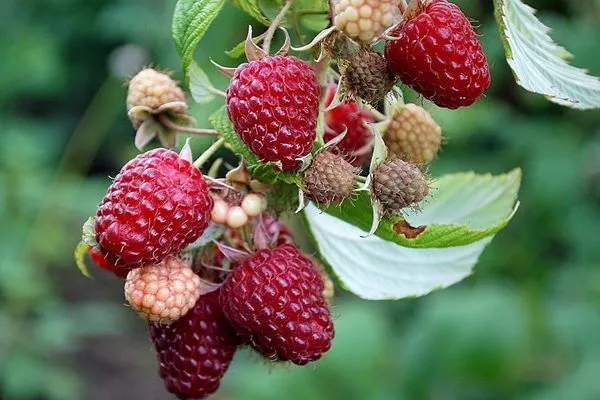
- the fruits are conical and large – 3.5-4 cm in length, weighing 4.5-5 g;
- the color of the berries is raspberry-dark, rich;
- the pulp is dense, with a medium degree of juiciness;
- the drupes are small and fit tightly together, preventing the berry from falling apart;
- the aroma is weakly expressed;
- the taste is more sour than sweet.
Polana raspberries are used freshly picked, canned, made into jam, wine, and desserts. They can also be frozen and dried.
Frost resistance
Breeding experts claim that Polana raspberries can withstand temperatures as low as -25 degrees Celsius. In climates with lower temperatures, it is recommended to protect the base of the bushes with mulch to preserve the root system from frost.
Pollination
Raspberry pollination is carried out using insects, which eliminates the need to use replants of a different variety.
Fruiting method, ripening period
The Polana variety is remontant, meaning it can produce fruit not only in the fall but also in the summer, provided the bushes are pruned correctly. Raspberries also boast a long fruiting period. The berries retain their freshness and do not fall off, remaining on the vines even after they are fully ripe. The average harvest period is from midsummer to early October.
Productivity
This raspberry variety is known for its excellent yield: a single bush can yield approximately 4.8-5 kg of berries. A 1 square meter area yields 11-11.5 kg, but this figure can vary depending on the quality of care.
If all agronomic recommendations are followed, yields of up to 19-20 tons per hectare can be obtained in a single season. Particular attention to care is required to preserve the berries' exquisite flavor. The sweetness of the berries may diminish somewhat in the fall.
Storing berries
To properly preserve raspberries, they should be picked early in the morning, after the dew has disappeared. The berries are carefully separated from their stems and carefully packed into shallow plastic or wooden boxes lined with paper or thoroughly dried straw. The berry layer should be no more than 6-7 cm thick.
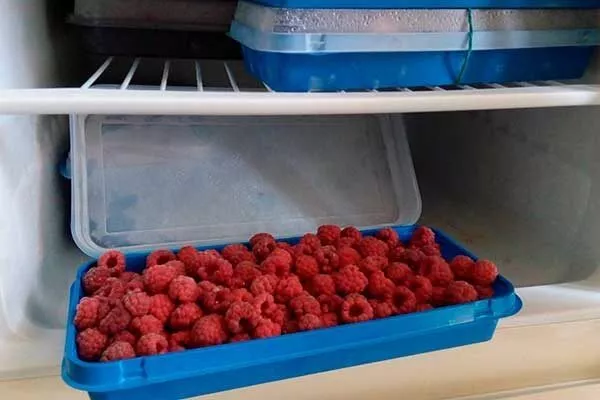
For storage, place the berries in a cool, dark room with a temperature of 5-8 degrees Celsius and humidity of 70-80%. At home, you can use the refrigerator, placing the raspberries in the vegetable compartment.
| Region | Features of cultivation | Recommendations |
|---|---|---|
| Northern Europe | Ideal conditions | Does not require shelter |
| Central Russia | Good adaptation | Autumn pruning is essential |
| South of Russia | Risk of drying out | Drip irrigation is essential |
| Urals/Siberia | Greenhouse cultivation | Early awakening in spring |
| Far East | Wintering under the snow | Mulching the roots |
Landing rules
This raspberry variety is tolerant of various soil types and produces a bountiful harvest. However, to obtain the largest berries, it's important to select a suitable location, providing protection from northern winds. The flavor and quality of the berries depend on the site, soil quality, light, and humidity. Sandy loam and loamy soils, not too acidic, are suitable.
Other aspects of planting work:
- In low-lying areas, ensure drainage, and if the soil is highly acidic, add chalk. Clay soil can be improved with compost, sand, peat, and ash.
- Prepare the soil in advance to allow the fertilizers to dissolve and mix with the soil.
- Create holes filled with a mixture of organic and mineral fertilizers. If planted correctly, the cuttings will root quickly, and shoots will appear within the first season.
- The depth of the holes for planting raspberries should be from 30 to 40 cm so that the root system is close to the surface.
- When planting seedlings in strips, the distance between them should be about 50-55 cm, and when planting in bushes, no less than 80-90 cm.
- Row spacing is not less than 150 cm.
- The root collar should be at soil level to prevent rotting.
After planting, the hole should be watered and fertilized.
In the southern regions, planting is done in the fall, and in others - in the spring.
Care Features
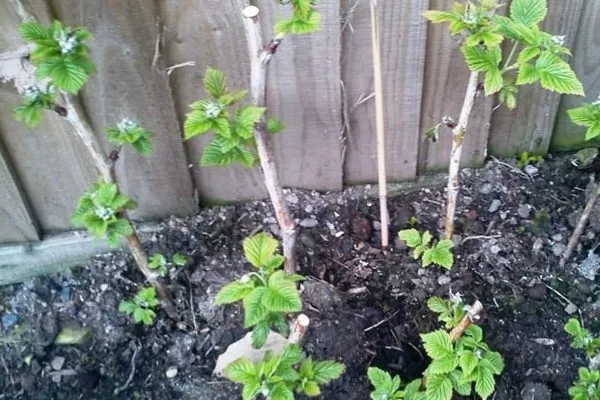
Care measures for this remontant variety are standard, but there are some varietal nuances.
Watering
Polana raspberry requires maintaining a certain level of moisture in the soil:
- The soil in the root zone (at a depth of 25 to 35 cm) should remain moderately moist. If water is insufficient, raspberry berries will shrink in size and begin to fall off.
- The most critical period for humidity occurs during the flowering and fruit set phases, during which it is recommended to water raspberries once a week, using 10 to 15 liters per 1 square meter of planting area.
- Once the berries begin to color, watering is stopped so as not to disrupt the process of sugar accumulation in the fruit.
Top dressing
All raspberry varieties, including the Polana variety, prefer organic fertilizers. In the spring, immediately after the snow melts, it's beneficial to fertilize the beds with rotted cow or horse manure. Alternatively, you can use vermicompost or plant compost.
During flowering and fruit ripening, raspberries require potassium. During this time, use Gumi-Omi, Potassium Humate, Potassium Sulfate, Fertika, or Hera. It's important to apply a single feeding with a bread or yeast solution.
Feeding schedule
- March: 40 g of urea per 10 liters of water
- May: 3 kg of rotted manure per 1 m²
- June: 20 g of potassium sulfate per bush
- August: 100 g of ash per plant
- October: 5 kg of compost for mulch
Pruning and tying to a trellis
To ensure large raspberries, avoid overcrowding the bush. Typically, on three- to four-year-old plants, about 15 of the strongest shoots are left. For young bushes, seven branches are sufficient.
Other features:
- If the goal is to harvest only in the fall, then completely remove the stems that have already produced fruit, without leaving a single shoot.
- In the spring, after the bush has renewed itself, thin it out, keeping only the strongest shoots.
- To stimulate the formation of more fruit branches, shorten the shoots by a maximum of 20 cm in July.
- To get two harvests of berries on one bush, leave the shoots from last year and add an additional 8 stems from the current year.
- ✓ Remove shoots less than 5 mm thick
- ✓ Leave 8-10 buds on the shoot during summer pruning
- ✓ Disinfect pruning shears before use
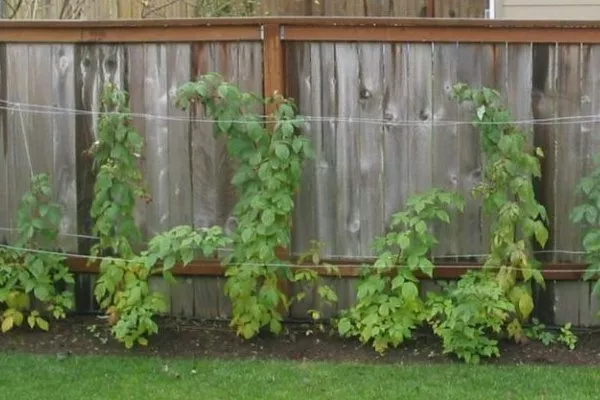
- ✓ Tie to the trellis at an angle of 45°
- ✓ Trellis height: 1.8 m
Although raspberry trunks are thick and do not require staking, for ease of care and berry picking, it is recommended to grow the bush on a trellis.
Preparing for winter
When completely removing the above-ground part of the bush, preparation for winter involves the following actions:
- removal of old mulch;
- Soil treatment against fungal diseases and pests.
In areas with harsh winters and little snow cover, protect raspberry beds with mats of spruce straw, sacks, etc. Remove wintering shoots from the trellis and lower them to the ground, covering them in accordance with generally accepted insulation methods for this crop.
Diseases and pests
| Problem | Preparation | Processing time |
|---|---|---|
| Aphid | Aktara 1.4 g/10 l | Before flowering |
| Bug | Karbofos 90 g/10 l | Budding |
| Mite | Akarin 6 ml/1 l | At the first signs |
| Gray mold | HOM 40 g/10 l | After harvesting |
| Septoria | 1% Bordeaux mixture | Early spring |
This type of raspberry has decent resistance to pests, but you should be on guard, as sometimes an insect infestation cannot be avoided:
- Raspberry aphid – Aphids are localized at the tips of shoots and leaves, which curl as a result of their attack. Aphids can be controlled by using fertilizers containing phosphorus and potassium, as well as by keeping the garden free of weeds and excess vegetation.
- Raspberry beetle – attacks buds and flower buds, resulting in reduced yields. To avoid this, apply Karbofos during budding.
- Spider mite – It surrounds the plant with a web and causes damage, causing dry leaves. To combat it, use specialized products according to the instructions, such as Akarin or Antikleshch.
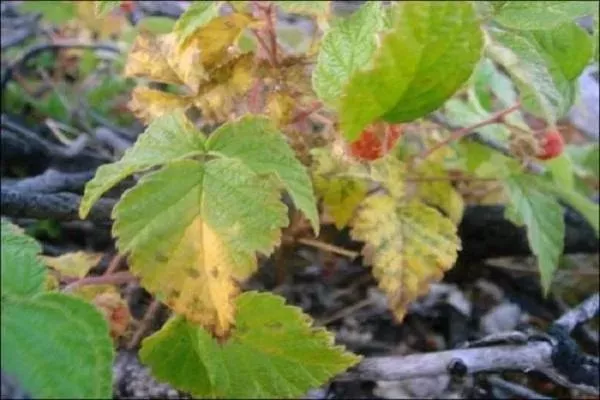
In terms of diseases, gardeners most often encounter gray mold, which manifests as a grayish coating on the foliage and rotting of the fruit. To treat raspberries, use a special HOM solution. However, bushes affected by chlorosis cannot be treated and must be destroyed.
Septoria, which appears as rusty spots and white dots on leaves, can be prevented by using a copper oxychloride solution during bud formation.
Pros and cons
The Polana variety has a number of significant advantages:
However, one should also take into account some disadvantages of this raspberry variety:
Gardeners' reviews
The Polana raspberry is particularly suitable for cultivation in the central part of the country, but can easily tolerate lower temperatures. One of the key features of this variety is its early fruiting compared to other everbearing raspberry varieties. According to experienced gardeners, caring for this raspberry requires only standard care.