
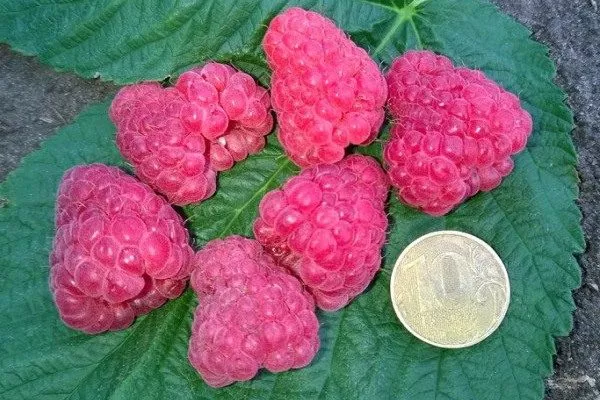
The Patricia raspberry is a versatile, non-everbearing variety bred domestically with very large berries. This dessert raspberry has excellent flavor, but is not suitable for transportation or storage, making it of interest only to amateur gardeners and not for commercial cultivation.
Who bred the Patricia variety?
The Patricia raspberry is a large-fruited variety bred in Russia at the Moscow Institute of Horticulture (VSTISP) by Professor V.V. Kichina. The British variety Patricia was used for the selection. The Russian version was registered in 1992.
Thanks to the presence of the "large-fruit gene" (L1) in the source material, the resulting variety significantly surpasses its competitors in berry size. Like all varieties with the L1 gene, it is distinguished not only by its large fruit, but also by the intensive growth of fruit-bearing lateral branches and very small seeds.
Description of the plant
The Patricia raspberry bush is medium-sized, compact, and semi-spreading. Its maximum height is 180 cm. The shoots are medium thick, smooth, thornless, straight, and pubescent. Shoot production is moderate, with each bush producing about a dozen new stems (replacement shoots) and 6-7 root suckers.
The leaves are flat, large, and light green. The fruiting branches are long and strong, running along the entire length of the stems. Each branch produces about two dozen berries.
Description of berries
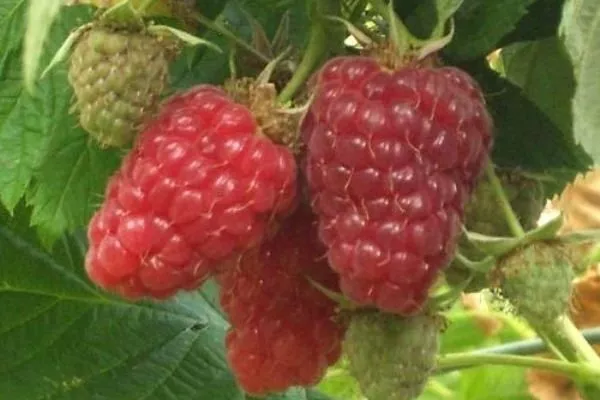
The berries are large, elongated-conical, and dark crimson in color. They are medium-dense, with small seeds that are barely noticeable when eaten. The average berry weight is 8 to 12 grams, with some specimens reaching 14 grams.
Taste and purpose
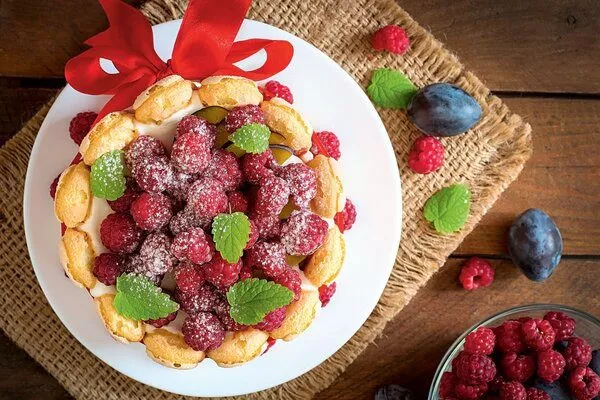
The fruits have a sweet-tart flavor and a distinctive raspberry aroma. This variety is ideal for fresh consumption. The berries are suitable for all types of processing, including freezing and drying, and they make excellent compotes, preserves, and jams. Tasting score: 4-4.2 (out of 5).
Ripening time and yield
The Patricia variety is self-fertile, high-yielding, moderately frost-resistant, and early-ripening. The average yield per bush is 4-5 kg, with a maximum of 8 kg. When grown in large quantities for processing, the yield can reach 250 kg per 100 square meters.
The Patricia raspberry begins bearing fruit in the second year after planting, but abundant harvests begin in the third year. The berries begin to ripen in early July. Fruiting lasts 3-4 weeks. During this time, at least 5 harvests are made.
Growing regions
The Patricia raspberry is zoned for the Moscow region. It is also successfully grown throughout the central part of the Russian Far East and the Central Black Earth Region. The variety is suitable for harsh climates, provided winter shelter is used. In such regions, the harvest ripens closer to autumn.
Pros and cons
The Patricia raspberry has quite a few advantages, thanks to which it has gained recognition and popularity among our amateur gardeners.
Pros:
Cons:
Landing features
Raspberry Patricia is not capricious regarding the planting location, but to obtain good harvests, it is recommended to take into account some nuances.
How to plant raspberries correctly:
- It is not recommended to place the Patricia bush near strawberries, sea buckthorn and black currants, as they have common diseases.
- The best neighbors for raspberries are plum, apple, and pear.
- You cannot plant raspberries where there was a raspberry patch less than 5 years ago.
- The variety grows best in black soil or sandy loam, with slightly acidic soils being preferred. Heavy loams are unsuitable, as raspberries will not grow there. Sandy soils are undesirable, as they do not retain moisture, and clay soils are also unsuitable, as they tend to stagnate.
- The planting site should be open, sunny, without shade or drafts.
- The soil is prepared taking into account its specific characteristics. If necessary, any missing components and fertilizers are added. For sandy soils, nitrogen-rich organic matter, such as manure, chicken manure, or humus, is added. These are scattered over the area, which is then dug to the depth of a spade. This work is carried out six months before planting the raspberry seedlings.
- Pits are dug at intervals of 70 cm, with a distance of 1.5 m between rows. This variety should not be planted more densely, as Patricia's bushes are tall, and denser plants will result in reduced yields.
The holes should be 40-50 cm deep. A mixture of fertilizer, organic matter, fertile soil, and wood ash is placed at the bottom. Planting takes place in the fall, around the first ten days of October.
Care
Raspberry Patricia can thrive in one location for two decades. Proper care is essential for successful cultivation.
Features of caring for the Patricia variety:
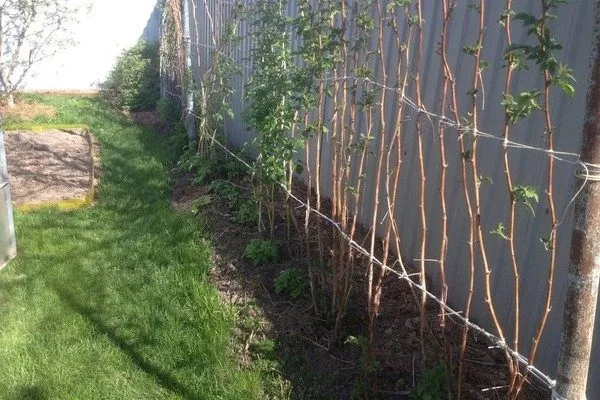
- The bushes are tied to trellises to prevent shoots from drooping and to increase the yield.
- Last year's shoots are pruned to 0.8-1.2 m. New growth is regularly removed, leaving 6 to 10 main stems. Without this procedure, the bush will spend its energy on growing foliage rather than on berry production.
- The main pruning is done in the fall, removing shoots that have borne fruit. In the spring, all frozen and dead branches are trimmed. Healthy bushes are topped. Pruning is also done in the summer, with branches shortened to trellis level.
- This variety thrives on moisture and requires regular watering. However, stagnant water is undesirable, as it leads to root rot. During fruit formation and plant growth, the recommended watering rate is 10 liters per square meter. As the berries ripen, the watering amount doubles. In late summer, raspberries are watered only during droughts.
- For watering, dig furrows on either side of the bush. Water is added to these furrows, then covered with dry soil. This variety can also be sprinkled, but only in the evening to prevent the sun from scorching the leaves.
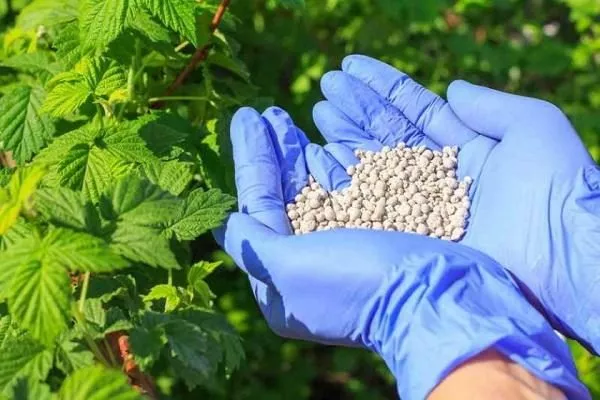
- When fertilizing raspberries, it's important to avoid soil acidification, so the best option for the Patricia variety is organic fertilizer. For example, rabbit and goat manure diluted 1:10 with water are suitable. You can also use green manure made from an infusion of tops and herbs.
- If raspberry bushes slow down in growth, fertilize the beds with nitrogen-containing fertilizers at a rate of no more than 15 g per square meter. Three additional applications are carried out per season: early in the spring, before flowering, and after fall pruning.
- This variety thrives in moderate and cold climates and is quite frost-resistant, withstanding temperatures down to -35°C. Young shoots, however, require additional protection. The greatest danger for them comes from sudden frosts after the spring thaw.
How to fight pests and diseases?
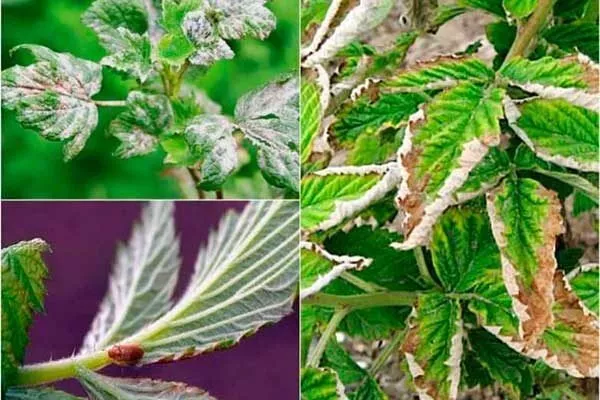
The Patricia variety has fairly good immunity. Specifically, it is resistant to anthracnose and purple spot. However, under unfavorable conditions, this raspberry can be susceptible to various diseases and pests.
The main diseases and insect pests that threaten the Patricia variety:
- Phytophthora. It is accompanied by darkening of the lower part of the shoots and root rot. Diseased plants are dug up and stored, and the soil is treated with ammonium nitrate.
- Gray rot. The fruit's contact areas turn brown. The fungus eventually completely destroys the fruit. Fungicides, such as Fundazol, help combat the disease.
- Raspberry fly. Its larvae penetrate the stems, causing the plants to wilt. To control the pest, use Malathion, a pesticide applied to the bushes before flowering. After flowering, spray the raspberries with Fitoverm.
- Raspberry beetle. The larvae develop directly in the berries, causing them to spoil and reducing raspberry yields. Agravertin and Fitoverm are used to control the pest.
Reproduction
The Patricia raspberry is primarily propagated by cuttings. Healthy shoots with 3-4 buds at the base are taken from the bushes. Cuttings are taken in early spring, before the leaves appear. In the fall, the cuttings are planted a month before the first frost.
Collection and storage
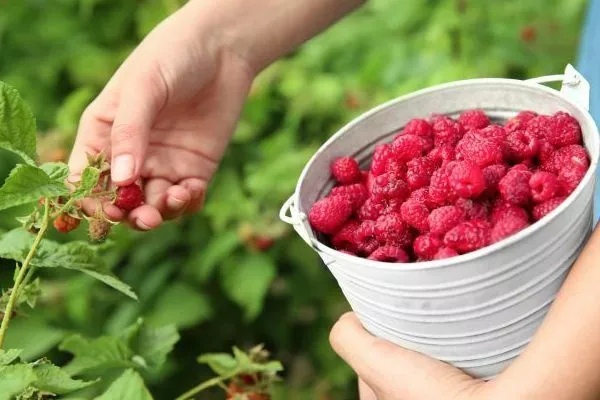
Raspberries should only be picked in dry weather. If the berries are picked wet, they will quickly become moldy. Raspberries don't store well. For longer storage, it's recommended to pick them with the stems attached. This will keep the berries in the refrigerator for 2-3 days.
Reviews
The Patricia raspberry is a variety worthy of the attention of gardeners with experience growing this crop. This large-fruited raspberry requires some effort on the part of the gardener, but with proper cultivation techniques, it will surely reward you with large berries and a bountiful harvest.