
Fall pruning of raspberries—proper and timely—is one of the key factors for a good harvest. This agricultural practice is essential, but the technique and timing may vary depending on the variety, climate, and other circumstances. Let's learn how to prune regular and everbearing raspberries in the fall.
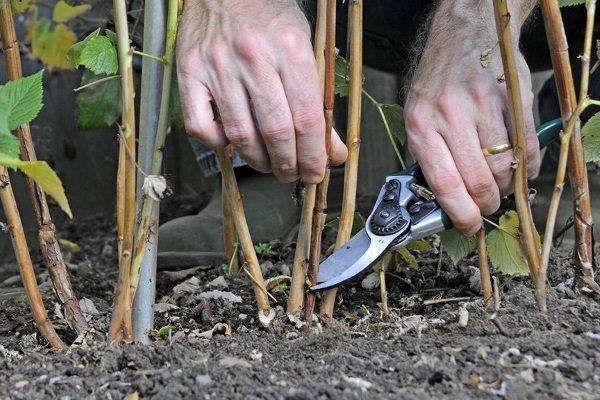
Why prune raspberries in the fall?
Non-everbearing raspberry varieties typically have a two-year growth cycle—young shoots bear fruit only in their second year. Only two-year-old shoots produce flower buds, and only these will produce berries. One-year-old shoots bear only leaves. Branches that bear fruit in their second year produce significantly fewer berries in their third year, with many drying up and dying.
A gardener's job is to promptly remove spent fruiting branches. Why is pruning them in the fall important?
- The young growth that grows to replace the old branches will receive the required amount of light and nutrients – this will allow them to grow stronger before winter and survive the winter without freezing.
- The number of pests that migrate to wintering grounds not only in the soil and fallen leaves, but also in dead stems, which often become a source of mold and fungi, is reduced.
Autumn pruning also aims to control shoots—if left untreated, the raspberry bush will quickly become overgrown and overgrown. Shoots that emerge from the rhizomes grow rapidly during warm weather. A single bush can produce up to 20 shoots, which draw sap from the plant, preventing normal fruiting.
Reasons for fighting against undergrowth:
- It is difficult to pick berries in the raspberry thickets.
- The number of berries becomes smaller and fewer, and the yield of the bushes decreases.
- An obstacle is created to the free circulation of air and the penetration of sunlight, which promotes the development of diseases and causes the appearance of pests.
- Root shoots can move away from the mother bush by 3 m or more, which leads to the “spreading” of plantings.
Exact timing and conditions for pruning
Autumn is considered the best time to prune raspberries. The key is to not delay this task until frost sets in. Once the harvest is over, the bushes become infested with pests—now's the time to eliminate them by pruning and burning excess branches. Otherwise, these shoots will become a breeding ground for insects, feeding on their food sources before winter.
Deadlines by region
After pruning, there's still a month or a month and a half left before frost, during which time the plants have time to accumulate nutrients for the next harvest. Table 1 shows the timing of autumn pruning for different regions of Russia.
Table 1
| Region | Pruning times |
| Middle zone | from the second ten days of August to the second ten days of September |
| Urals and Siberia | throughout August |
| South of Russia | from mid-July to mid-October |
Raspberries are pruned no later than three weeks before the onset of sub-zero temperatures.
When choosing a pruning time, consider the weather forecast for your region. You may need to adjust the timing due to an early cold snap.
The timing of pruning also depends on the type of raspberry:
- On regular raspberries, pruning is carried out after the berries have been picked – it is difficult to determine the exact timing in advance; the onset of frost must be taken into account.
- Everbearing raspberries don't need to be pruned—they continue to bear fruit until late autumn. Pruning is usually done after the leaves have fallen.
Dates according to the lunar calendar
Raspberry bushes are pruned during the waning moon, in the 3rd and 4th phases. During this period, the sap in the plants moves from the growing point toward the roots, making pruning most favorable under these conditions. It is not recommended to prune raspberries during the full moon, the new moon, or on the 23rd lunar day.
In autumn 2019, it is best to prune raspberries on the following days:
- September 2, 5, 7, 9, 20 and 28;
- 1, 4, 5, 10, 29, 31 October;
- November 3, 7, 8, 11, 28, 30.
The 3rd, 6th and 8th lunar days are favorable for any work, including pruning shrubs.
It is not recommended to trim bushes:
- October 1 and 28;
- November 1 and 26.
The best days of the Moon for pruning shrubs are in Aries, Leo and Sagittarius.
Necessary equipment
All tools are prepared in advance – sharpened and disinfected. Dull cutting edges will damage branches, reducing the bushes' frost resistance. Undisinfected tools can transmit various diseases, infecting the raspberry bushes.
- ✓ Make sure that pruning tools are not only sharp, but also disinfected with a solution of potassium permanganate or alcohol to prevent plant infection.
- ✓ Check the weather forecast for the next 3 weeks after pruning to avoid damage to plants from early frosts.
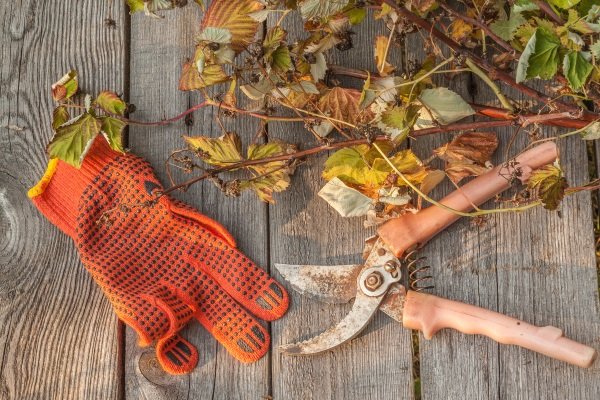
Tools needed for trimming:
- Secateurs. A basic tool for removing excess branches and undergrowth. It can be replaced with pruning shears for thorny shrubs.
- Loppers. Can be useful for trimming thick stems.
- Garden knife. Necessary for correcting unsuccessful, uneven trimming.
- Rake. They are used to remove cut branches and leaves.
Basic rules
Autumn pruning involves removing infected, damaged, broken, and dead shoots, as well as completely eliminating new growth. This process follows several technical guidelines, which are the same for any raspberry variety.
Technique
When pruning in autumn, it is important to follow these rules:
- To avoid dense plantings and excessive foliage, pruning is planned so that the branches do not overlap each other, but are arranged in a fan shape.
- First, remove all two-year-old shoots. This is done immediately after harvesting. They are cut right down to the root.
- Broken and damaged branches are also removed right down to the roots, leaving no stumps. If left, damaged branches will drain the plant, and the berries will still be small and tasteless.
- Whether to remove annual shoots depends on the climate. In mild winters, they can be left in bundles to prevent them from blowing in the wind. In regions with harsh winters, young shoots are pruned and the plantings are covered. Young shoots, before they have time to harden, often freeze and die.
- Shoots that grew in midsummer are removed - they are too weak to survive the frost.
To what height do you prune?
How to determine the cutting height:
- The tops of young shoots are trimmed so that the height of the shoots is 1.2-1.5 m.
- If young shoots are poorly developed, they can be pruned to 1 m.
- Weak tops are cut off to the first healthy bud.
- Approximately 25 cm is removed from each branch.
The result will be a planting in which all the bushes will be of equal height.
Raspberry pruning methods
Raspberry varieties They differ in their fruiting patterns, shoot growth rate, frost resistance, and other varietal characteristics. The optimal pruning method is selected based on these characteristics.
In fast-growing raspberries, shoots are shortened more than in varieties with normal growth.
Regular pruning
In raspberry patches not pruned in the summer, all pruning is done in the fall. Pruning of common raspberry varieties consists of removing shoots:
- broken;
- damaged diseases and insects;
- two-year-olds;
- parts of annual shoots - to thin out the berry bush.
All the above mentioned branches are removed completely – to the root.
An overview of autumn raspberry pruning can be seen in the video below:
Pruning remontant raspberries
Everbearing varieties, unlike regular varieties, produce multiple harvests per season. They bear fruit not only on two-year-old shoots but also on one-year-old shoots. These characteristics must be taken into account when pruning. Sobolev's method is used here after the last harvest. However, fall pruning is only performed in southern regions; in northern regions and Siberia, everbearing raspberries are pruned in the spring.
Autumn pruning of everbearing raspberries is carried out only after the last wave of fruiting has ceased. It's not always possible to have three weeks between the end of fruiting and the first frost, as everbearing varieties tend to bear fruit until late autumn.
Autumn pruning of remontant raspberries:
- Two-year-old branches that have borne fruit are cut to the ground surface.
- Annual shoots are shortened by 20 cm. The cut parts are raked and burned, and the bushes themselves are sprayed with Bordeaux mixture.
- In the spring, before the buds open, sanitary pruning is carried out, cutting out all frozen, dry and broken branches.
There are two types of pruning for remontant raspberries:
- For one harvest. This method is usually chosen for commercial cultivation—when the gardener wants a single, but extremely abundant, harvest. The essence of the method:
- Wait until the first frost and cut all the bushes back to the ground. If pruning is done earlier, the young shoots will sprout, freeze, and the raspberry bush will die.
- In spring, young plants are carefully thinned out, leaving 3-4 stems per bush.
- For two harvests. Since remontant varieties produce fruit on one- and two-year-old shoots, pruning for two harvests is carried out in two stages:
- First, after the first berry harvest, two-year-old fruit-bearing branches are pruned to the roots. They won't produce much fruit next year anyway.
- After the second fruiting wave, in late autumn, regular pruning is carried out, the same as for all other varieties. This prevents the annual stems from drying out, and after overwintering, they will begin to branch and bear fruit.
If you combine the two harvests, it will be comparable to the productivity of standard varieties that produce a single harvest. Moreover, the shelf life of the fruit is improved.
Pruning the Cumberland variety
Cumberland is a black raspberry variety with exceptionally fast shoot growth. This means that standard pruning methods for Cumberland and similar raspberries are insufficient. A standard approach will result in dense plantings, the bushes will appear overgrown, and their vigor and yield will decline. To maintain healthy bushes, this black raspberry will require two prunings per season.
After watching this video, you will learn how to prune the Cumberland raspberry variety:
Cumberland pruning pattern:
- The first pruning is summer. Its purpose is to increase yield. The optimal time is late June. Young shoots are pruned at their growth point. Their place the following summer will be taken not by a single new branch, but by several fresh shoots. Experience has proven that a single bush can produce an excellent harvest—without losing the size and flavor of the berries—from 10-12 fruiting shoots. Stems over 2 m tall are pruned by 10%. This must be done promptly, as if pruning is delayed, the growing side shoots will not have time to fully develop and will die in the winter.
- Second cut - autumn. This is sanitary pruning, which begins when the plant enters dormancy. Depending on the region, this period occurs from mid-October to early November. The fall pruning procedure is as follows:
- cut off broken, damaged, diseased and dry shoots;
- thin and weak shoots growing into the bush or downwards are also removed;
- excessively long shoots that exceed the height of the trellis are trimmed to its size (remove up to 1/3 of the length of the branch, no more);
- last year's lateral shoots are shortened by 20-30 cm - they will produce berries next year;
- branches aged 2-3 years are cut as close to the ground as possible, leaving no more than 10-12 shoots.
Gardeners are often wary of cutting Cumberland down to the stumps, but this method allows for a good harvest.
Sobolev's pruning scheme
The method of Sobolev, a well-known amateur gardener from Kurgan, became known in the 1980s. The enthusiast wrote about it in the magazine "Priusadebnoe Khozyaistvo" (Household Farm). The method increased yields—135 kg of berries were harvested from a 50-hectare (0.5 acres) test plot, a significant amount for the time.
Sobolev improved the double crop, making some adjustments to it:
- According to Sobolev's method, the tops of the shoots are also pruned in May, leaving stems 1 m long. The roots will easily cope with the nutrition of the above-ground part, and the shoots will not break under the force of the wind.
- The following spring, two operations are performed in one go: the tops of young shoots and lateral shoots that grew last year are cut off.
- By July, the raspberry patch, processed using Sobolev’s method, consists of:
- annual flowering stems;
- branching two-year-old shoots with many flowers, ovaries and berries;
- young growth.
- By the end of the second growing year, two-year-old stems are removed. In the spring, side shoots are pruned again on two-year-old stems, and one-year-old stems are trimmed. Then, the current year's shoots are thinned out. The same pruning procedure is repeated annually.
The following video demonstrates pruning raspberries using Sobolev's method:
A disadvantage of this method is the intensive overgrowth of bushes, which leads to dense plantings. Ventilation of the raspberry patch is reduced, most branches are shaded, and the risk of pest and disease infestation increases. To prevent overgrowth, a 1-meter spacing is maintained between bushes and a 2-meter spacing between rows.
Formative pruning is carried out as follows:
- In the first year, no more than ten branches are left on the bush.
- In the second year, the fruiting shoots are replaced with fresh ones, but the number of branches is reduced to 8.
- Every year the number of replacement stems is reduced by 2 pieces.
- The final stage of bush formation involves 4 young branches.
Sobolev's method increases productivity, but requires thorough thinning of the berry bush throughout the growing season—excess shoots must be trimmed off promptly.
Sobolev's method allows harvesting up to 6 kg of berries from one raspberry bush.
What to do after pruning?
After pruning, the bushes need support in the form of fertilizer and watering to help them cope with stress. Actions to take after fall pruning of raspberries:
- Top dressing. Add compost, peat, and a solution of bird droppings. You can also add superphosphate (50 g) and potassium sulfate (40 g) per plant.
- Watering. After fertilizing, water the raspberry bushes generously. The recommended watering rate is 50-60 liters per bush.
- Spraying. Everbearing varieties are sprayed with Bordeaux mixture for disinfection. Regular raspberries are sprayed with fungicides in the spring.
- Mulching. After the moisture has been absorbed, the plantings are covered with a thick layer of mulch. Any organic matter can be used, but for the winter, it's best to sprinkle the soil with pine needles—they will not only protect the plantings from frost but also from rodents.
- Shelter for the winter. Gardeners in the southern regions and the Middle Volga region may not need to cover their raspberry patches for the winter, provided the variety is zoned for these regions. In areas with harsh winters, covering the berry patch is recommended. To do this, tie the branches into bundles and bend them to the ground. If winters are light on snow, cover the plantings with leaves—a 30-cm layer. If covering the raspberry patches with plastic film, be sure to make ventilation holes in it.
- Mulch the soil around the bushes with a layer of organic material at least 5 cm thick to protect the roots from frost.
- Treat the bushes with a 3% solution of Bordeaux mixture to prevent fungal diseases.
- Install windbreaks around your raspberry patch if your area is exposed to strong winds.
Don't cover raspberries too early, as they risk rotting. If you wait too long, the branches will become brittle and impossible to bend.
Should I prune remontant raspberries before winter?
In regions with harsh winters, it is recommended to prune all shoots—one- and two-year-old—taking care not to leave stumps. This will ensure the fall harvest is as abundant as possible. If the gardener desires uniform fruiting—in two stages—then the one-year-old shoots are left over the winter.
However, in regions with harsh winters, they must be covered. If you don't want to bother with covering, then it's better to prune everything—both biennial and annual shoots. Only in the south is it better to leave annual shoots unpruned over the winter.
In the video below, a gardener shares his experience preparing everbearing raspberries for winter:
Gardeners' mistakes
Most novice gardeners often make mistakes when pruning raspberries. The most common mistakes are:
- It's a shame to cut off the strong young growth. Beginners feel that by pruning, they're depriving themselves of a future harvest. This "psychological barrier" must be overcome: without pruning, the plants will become diseased, the berries will become smaller, and the yield will decline. This is the biggest and most common mistake made by beginning gardeners.
- Not all branches are removed, which need to be pruned. Beginners often start pruning from the outer branches. When removing young shoots, they primarily remove the outer shoots, without going deep into the berry patch. This results in a dense center of the raspberry patch, which leads to reduced yields and the introduction of diseases. It's essential to exercise patience and remove shoots in the center of the planting.
- Do not remove intertwined branchesBy failing to prune closely spaced and intertwined branches, gardeners increase the risk of disease. Branches touching each other lose their protective layer and become vulnerable to microbes.
- Incorrect cutting patternGardeners often only shorten shoots that should be completely pruned. They remove only dead and broken branches and leave the rest. Sanitary pruning isn't enough—formative pruning is also necessary, as the future harvest depends on it.
- Buds are damaged during pruningTo prevent this from happening, it's important to follow a pruning schedule. First, remove all the large branches, then the smaller ones. This allows for faster pruning and less damage to the buds.
When is it better to prune, in autumn or spring?
Fall pruning can be substituted for spring pruning in regions with relatively warm winters. However, it's important to ensure adequate snow cover to prevent young shoots left over the winter from freezing. If they do, the gardener will suffer losses. From a raspberry bush safety standpoint, fall pruning appears to be a more reliable agricultural measure.
Raspberries are generally pruned several times per season. During the growing season, a single root can produce up to two dozen new shoots. In spring, pruning is done for sanitary purposes and to awaken buds. In autumn, it is done to shape the bush and prevent frost damage. Therefore, both options are important for raspberry bushes.
Why is spring pruning necessary?
- This is a continuation and addition to the pruning done in the fall.
- Pruning begins immediately after the snow melts. All shoots that are unnecessary for the bush are removed—weak, diseased, frozen over the winter, or broken. They are pruned as low as possible, without stumps.
- Then, the tops are pruned—if shoots were left over the winter, by 20 cm, down to healthy buds. This stimulates the awakening of the upper buds, which form 3-6 shoots bearing berries. If the tops are not pruned in the spring, the berries will be small.
As we can see, spring pruning has its own purpose and should not be abandoned. Moreover, it is recommended to prune raspberries in the summer as well. By trimming wilted or diseased tops during flowering, gardeners prevent infection of neighboring bushes. Also, in the summer, they remove suckers to prevent raspberry bushes from becoming depleted.
How does autumn pruning differ in different regions?
Differences in pruning are related to climate, which is what makes adjustments to its technique:
- In central Russia, and in the Moscow region in particular, young shoots don't need to be pruned for the winter. Simply tie them up and cover them. This method allows you to use snow as a natural insulator. However, using artificial covering materials can be harmful, as condensation often forms underneath them, which encourages fungal diseases.
- In Siberia, fall pruning is a mandatory agricultural practice. Winters there are so cold that shelter is essential, and pruned bushes make it quick and easy to cover raspberry patches.
- In the Krasnodar region, pruning is done in late autumn. Gardeners have time to get another autumn harvest. True, autumn raspberries are small and there are very few of them, but it's still nice to see the bushes continue to bear fruit at such a late time.
Raspberries are easy to grow and produce fruit under any conditions, but if you're looking for a good harvest of large, sugary berries, don't be lazy about pruning them on time. Fall pruning should be especially careful – it's important to time it correctly and follow the correct technique for this crucial agricultural practice.