
The Maravilla raspberry is a remontant variety, meaning it can bear fruit twice during the growing season. It is grown both in open beds and greenhouses. This American variety, known internationally as Driscoll Maravilla, produces very large berries, which distinguishes it from other raspberry varieties.
History of selection
Maravilla is a variety that is the result of years of meticulous work by California specialists, particularly those from the renowned agronomist Driscoll's. It was developed back in 1996. The American company quickly secured a patent and the privilege to cultivate this unique crop, meaning that its cultivation is exclusively handled by the aforementioned agronomist.
Seeking to expand their market, the Americans began exporting Maravilla to European countries, particularly the UK, under strict licensing conditions with a limited duration of three years.
Despite the established restrictions, individual specimens of the variety quickly spread from Europe to Eastern European countries—Belarus, Ukraine, and Russia—where local breeders began cultivating Maravilla in their gardens. This began in 2011.
Regions for cultivation
Originally developed for US agricultural needs, this variety is considered typical of California. However, thanks to the efforts of breeders, it has sufficient frost resistance and rapid ripening, allowing it to be cultivated in the more northern regions of the United States, even as far north as the Canadian border.
In Russia, this variety successfully survives winter in central regions, provided the plants are protected from the cold after harvest. It is well acclimated in Crimea, the Caucasus, and the Krasnodar Territory.
Description of the variety
The cultivar's developers were focused on commercial sales, so they set strict quality criteria: creating an attractive presentation of the berries, minimizing problems during transportation, and ensuring the durability of the fruit's appearance when stored in a variety of conditions.
Bush and branches
This raspberry variety is distinguished by large bushes with strong stems up to 1 cm in diameter. The main trunks of the bush are strong and flexible due to elastic fibers and a high moisture content inside.
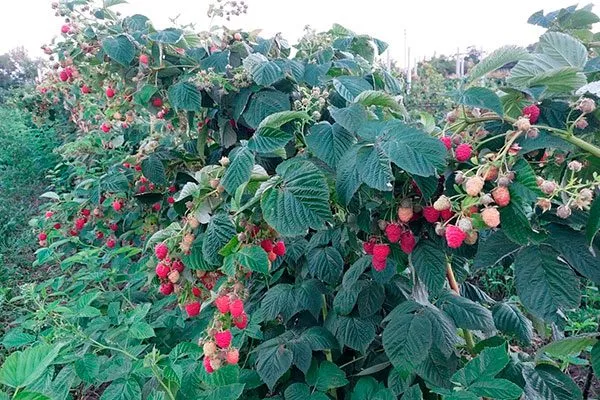
The bushes require support, as the berries are forced to bend toward the ground due to their own weight, and without controlled top shaping, the plant can grow chaotically, which will ultimately reduce yield.
Other varietal characteristics:
- The height of the bushes varies from 200 to 230 cm, but in greenhouse conditions it can reach 250 and even 300 cm.
- The crown is medium-sized and neat. This contributes to a higher yield per hectare. With proper planting and shaping, the crown averages 50 to 65 cm in diameter.
- Every spring, new shoots with a reddish tint and purple highlights emerge from the woody trunks. The young tips of the lateral branches are tinted light green.
- A small number of short thorns on the shoots.
Leaves
After the first green shoots emerge and buds begin to swell, the leaves unfurl. Leaf blades have their own characteristics:
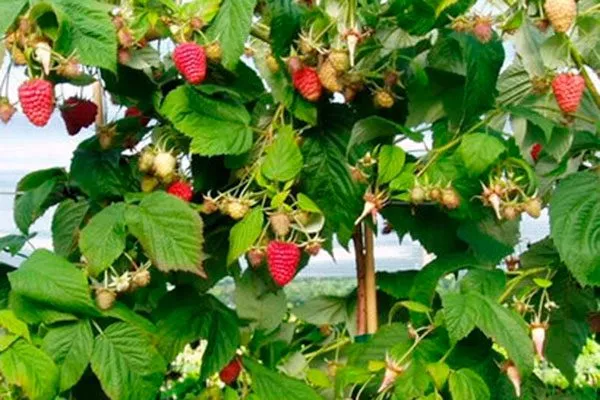
- Their large size causes them to droop downwards. They attach to the nodes via long, thin petioles.
- Each node produces 2 to 4 leaf blades of approximately equal size. They are distinguished by pronounced venation, moderate wrinkling, and virtually devoid of serrations along the edges.
- The leaf's shape resembles an elongated oval with a pointed tip resembling an arrow with an obtuse angle exceeding 90 degrees. The leaf's tip is almost identical to its base, where it attaches to the petiole.
- The leaves are a rich light green, with a shiny sheen on their outer surface, imparted by natural resins. The undersides of the leaves have a light yellowish tint with a slight grayish tint, due to their dense pubescence.
- The length of the leaves ranges from 9 to 11 cm, reaching their maximum size during the flowering period, which occurs in the 3rd to 4th year of the bush’s development.
- The width of the leaf blades reaches from 4 to 5 cm, but it narrows closer to the base and to the top due to their arrow-shaped configuration.
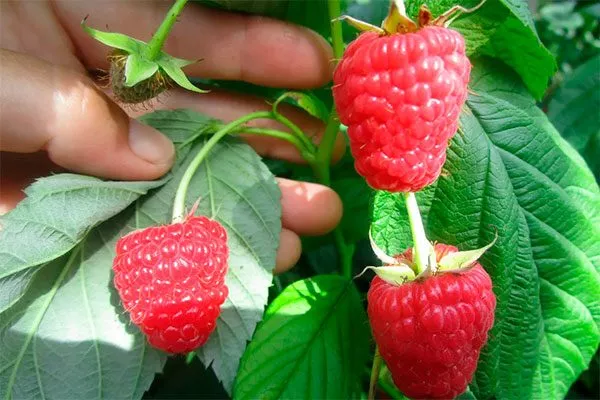
Due to the dense pubescence on the underside of the leaf, especially noticeable early in the season and during the ripening of the secondary crop, the plant has good thermoregulation, allowing it to withstand hot summer days and drought. As the season ends and the leaves begin to wither, the pubescence gradually disappears.
Flowers
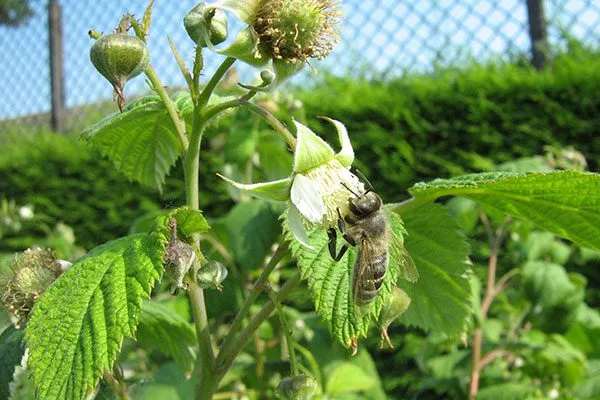
Flowering bushes produce 3 to 5 buds, each connected by a narrow stem that will later develop into a peduncle. Compared to other raspberry varieties, this variety is characterized by a more relaxed growth habit and a quick start to flowering.
Peculiarities:
- The flower has a radial shape, resembling a cup with a center formed by anthers and 5-6 petals evenly distributed around its circumference.
- This species is characterized by flowers with a greenish-yellow base, petals with a slight yellowish tint and an unusual color, decorated with brown veins and pollen spots.
- The size of the inflorescence does not exceed 1.2-1.5 cm, and its height, including the inner bend of each petal, reaches 0.6-0.38 cm.
- The length of the stem connecting the flowers to the branch varies from 3 to 5 cm.
- The receptacle is large, massive, with a regular hemispherical shape and a small diameter, no more than 0.7 cm, giving it a very dense feel. After flowering, it gradually transforms into green berries.
- The petals are small—no more than 0.5-0.6 cm long, and varying in width from 0.4 to 0.5 cm. They have a regular, teardrop-shaped shape with rounded edges and gradually decreasing thickness at the point of attachment to the peduncle. The petals are distinctive in that they taper from one end, where they form a thin plate, to the other, where they terminate in a thicker, fleshier node from which fibers emerge, gathered into a ball.
- Stamens are thin, thread-like elements, barely visible at first glance, with a greenish or yellowish tint. They are randomly arranged on the peduncle, forming a smooth, velvety surface in the center of the flower, around which the diameter reaches 0.61 cm.
Pollen sacs form at their ends. During flowering, these sacs fall off and settle in the stigma of the pistil, facilitating self-pollination of this everbearing raspberry variety.
Fruit
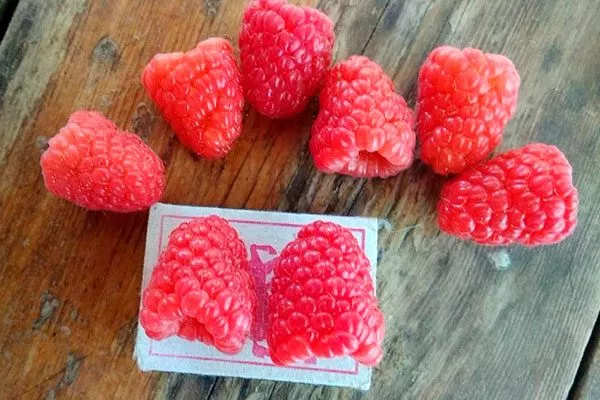
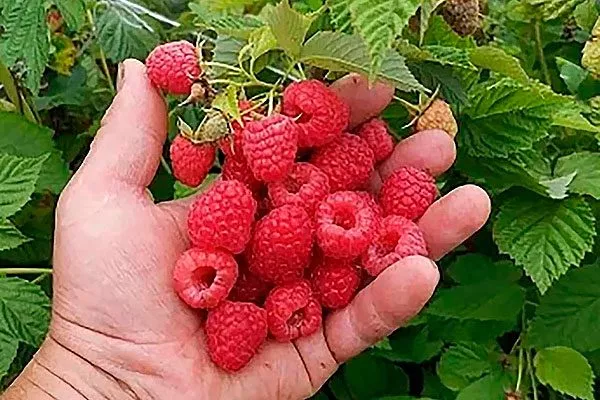
A distinctive feature is the almost synchronous ripening of the berries, which simultaneously acquire a vibrant red hue, creating a magnificent spectacle. The fruits of this variety are distinguished by their uniformity: consistent size and shape, the drupes are perfectly round and smooth, with a velvety skin, and their flesh is full of elasticity.
Other parameters:
- The length of the berries reaches 3-4 cm, and the diameter at the widest part can be 2-2.5 cm.
- After harvesting, the internal opening of the berry can be up to 1-1.3 cm, and the depth – up to 2-2.2 cm.
- In open ground conditions, raspberries produce fruits weighing up to 12-13 g, but under favorable conditions in greenhouses, the weight of berries can reach 15-20 g.
- The shape of the berries is conical, with a rounded top, while the angle formed by the cone does not exceed 20 degrees.
- The berries are bright scarlet and remain attached to the stem even when fully ripe. Determining ripeness is difficult, so farmers rely on visual and taste impressions. Unlike other everbearing raspberry varieties, this one does not develop a ruby hue over time.
- Taste characteristics: Experts evaluate the quality of the tested variety on a five-point scale, awarding it 4 points. The berries have a slightly tart taste, but their flavor is sweet and pleasantly aromatic, reminiscent of wild raspberries growing in the forest.
- One of the key advantages of these raspberries is their rich and recognizable aroma, characteristic of this type of crop.
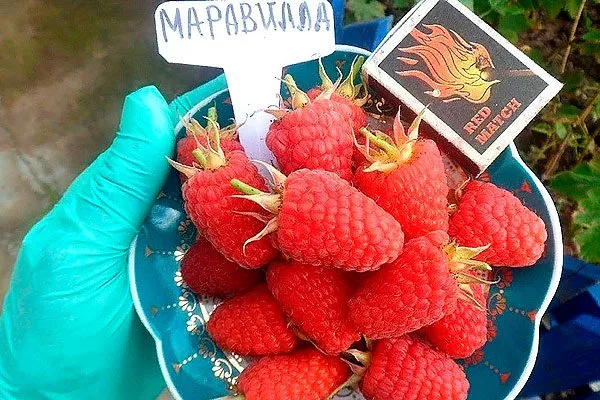
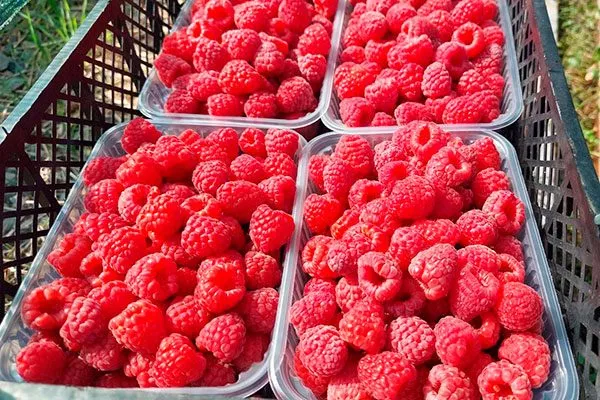
These berries are characterized by excellent shelf life, thanks to their dense flesh and low juice content. The protective shell does not burst under pressure, allowing the fruit to withstand transportation and retain its original flavor and quality for a long time.
Compound:
- The berries contain up to 9-10% pentoses, fructose, glucose and other natural sugars.
- The mucous part of the pulp, which contains up to 6-8% fiber.
- Acids, including tartaric, citric and malic, make up to 2.5-3.0%, and their quantity depends on the type of harvest (primary or secondary).
- The berry seeds contain up to 0.8% tannins.
- Proteins account for up to 1.3%.
- Fats – up to 0.3%.
- Carbohydrates – up to 5.0%.
Bones
Each angular part of the drupe, covered by pulp, conceals a small stone, so small that it's barely noticeable when eaten. It's easy to chew, has a very thin shell, and a flavor reminiscent of the slightly viscous aftertaste of essential oils, which make up at least 30% of its mass.
Breeders have officially registered this variety internationally. Biochemical analysis revealed that no toxins were found in the Maravilla drupes, making this raspberry suitable for fresh consumption without any restrictions.
Characteristics
The variety shares many common traits with earlier varieties of this berry crop, evident in their morphological characteristics and key characteristics. However, Maravilla also possesses unique features not found in other everbearing raspberries, even those that also ripen early.
Frost resistance
Although the variety is frost-hardy, it cannot withstand extremely low temperatures for long. According to observations by specialists and farmers growing this berry crop commercially, as well as gardening enthusiasts, the minimum temperature at which the bushes can survive the winter without damage without protective covering is -20 degrees Celsius.
When the temperature drops below this level, given that in the central regions of Russia the normal soil freezing depth reaches 120-150 cm, the roots begin to die off, and young shoots lose their elasticity, which leads to their rapid drying out and the absence of buds in the following season.
Pollination
Raspberry bushes ripen berries without the help of pollinating insects or donor plants, as pollen from the stamens moves independently to the pistil, ensuring complete fertilization and the formation of berries with characteristic appearance and taste.
However, buyers and farmers note that while raspberries meet quality standards in the first year after planting, yields decline in subsequent seasons due to a lack of genetic diversity. In such cases, it is recommended to supplement the raspberry patch with other everbearing varieties that bloom and fruit at the same time.
Fruiting method
This raspberry variety is characterized by its remontant nature, allowing fruit to form on all shoots, regardless of their age—be they first-, second-, or third-year branches. Fruiting begins immediately after flowering, when pollination occurs.
The first harvest is in May in the south, June in the central part of the country, and July in the north when grown in open beds. The second harvest begins in September and ends with frost.
Productivity
This variety is particularly productive, which is key to the success of farmers. To achieve maximum results, it requires adequate care, protection from insect pests, and winter protection from low temperatures.
When grown outdoors, Maravilla can yield 3.5 to 5 kg per bush, while in greenhouse conditions, this figure can increase to 5.56 kg. Greenhouse cultivation allows for harvesting two weeks earlier than when grown outdoors.
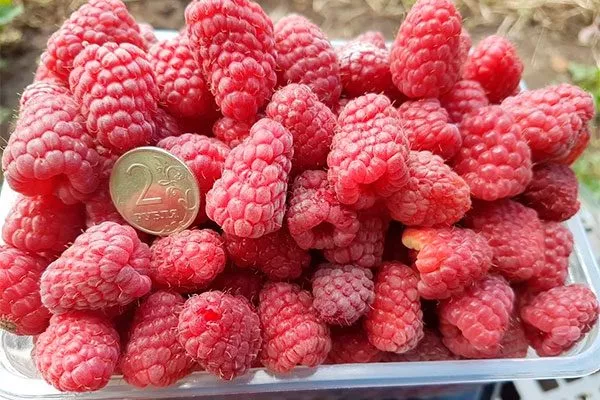
Experts claim that when cultivating the variety indoors, yields reach 45-50 tons per hectare, but to achieve such results, farmers must consider the significant costs of creating optimal conditions for the plants, including microclimate, lighting, automated irrigation, and other technical details.
Storing berries
Maravilla is one of the longest-lasting varieties, thanks to its dense, firm flesh, minimal juice content, and the tough skin of each fruit. The length of time the fruit retains its flavor and appearance depends on storage conditions:
- At room temperature, berries stay fresh for up to one week, provided they are placed in ventilated wooden boxes or laid on cloth/paper.
- If the berries are placed in a cold cellar with good air exchange and a temperature no higher than +12-15 degrees, their shelf life increases to 1.5-2 weeks.
- To ensure that berries retain all their beneficial components and do not change appearance for 3-5 weeks, it is recommended to store them in the refrigerator at a temperature of +3 to +5 degrees.
- For long-term storage, berries need to be preserved to prevent them from rotting.
- If the goal is to sell fresh berries in winter, freezing is the optimal solution.

Landing rules
To successfully grow Maravilla, choose a sunny, level site away from strong winds. The soil should be at least 1 meter deep. This variety thrives in fertile, light, and slightly acidic soil. The ideal pH is 5.7-6.6. Peppers, potatoes, tomatoes, eggplants, and strawberries are undesirable companions for this raspberry.
Growing methods
Maravilla they are planting in two ways. Each has its own characteristics.
In open ground
Plant in the fall (October or November) or early spring, before the buds swell. Before planting, dip the roots in a clay-manure slurry.
Procedure algorithm:
- Clear the area of weeds and dig it over thoroughly.
- Add 15-20 kg of humus, 150-200 g of potassium sulfate and superphosphate per 1 sq. m.
- Dig planting holes 45-55 cm deep, spacing them 70-80 cm apart. Leave 150-200 cm between rows.
- Spread the roots of the seedling and place it in the hole.
- Fill the hole with soil so that the root collar remains at the level of the garden bed.
- Compact the soil around the bush and water with 5-7 liters of water.
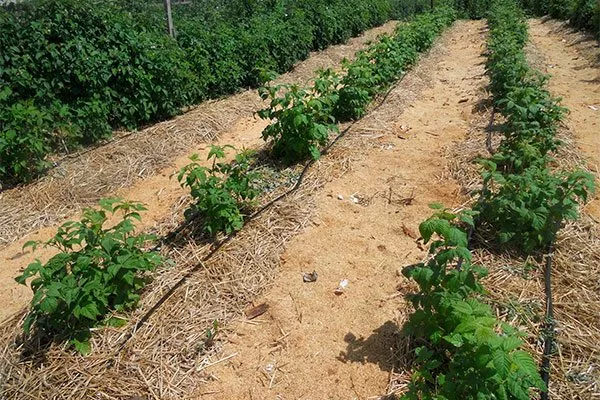
To maintain moisture around the roots, it is recommended to cover the raspberry trunk circle with sawdust, straw, branches or other plant debris.
In film tunnels
Maravilla is grown in tunnels using the long-cane technique. Before planting, the raspberry seedlings are stored in a cool environment—at temperatures between 0 and 1 degrees Celsius.
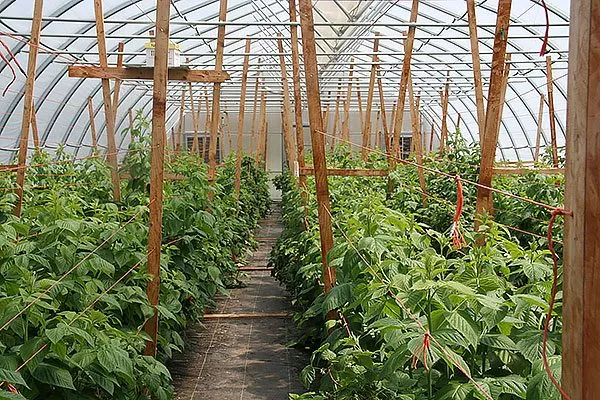
How to plant:
- In March, plant the seedlings in round containers with a capacity of 10-15 liters, filled with light substrate.
- Place containers in rows with a minimum spacing of 150 cm between them.
- Raise pots 8-10 cm above ground level to minimize the risk of infection by rot and other diseases.
- Due to the fact that the variety is characterized by high growth capacity, supporting structures are installed in the rows.
Care instructions
In order for raspberries to bear fruit, they require careful care:
- Remove weeds regularly and loosen the soil around the bush.
- Water your raspberries once a week using warm, settled water. On hot days, water the soil more frequently.
- Fertilize in the third year. Apply nitrogen-based fertilizers in the spring, and then complex mineral fertilizers 15 days later. Potassium fertilizers are recommended after flowering. Cow manure is applied twice a season.
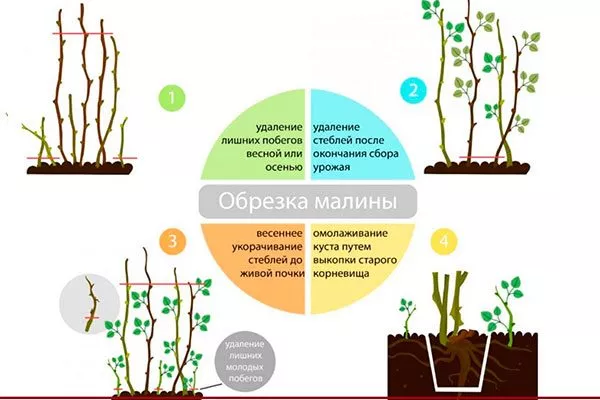
- IN In April, carry out sanitary pruning, removing damaged and dried shoots. After harvesting, shorten the tops of the shoots to 150 cm. Complete pruning conduct it in the second year.
- Since branches may break under the weight of berries, install supports or trellises.
Caring for raspberries grown in a greenhouse has its own specific features: regularly ventilate the room and mulch the soil with sawdust or nut shells.
Diseases and pests
Maravilla at risk of infection late blight, thrips attack, spotted drosophila infestation, etc. Therefore, carry out preventative treatments in a timely manner:
- At the beginning of spring, treat with Bordeaux mixture or Nitrafen.
- To protect raspberries from pests, use Karbofos or Actellic.
- Remove damaged branches promptly and clear the ground of fallen leaves.
Wintering in open ground
When growing Maravilla in the north of the country, it is recommended to protect it from low temperatures by using a cover. Before the onset of cold weather, mulch the trunk area with straw, sawdust, or rotted manure. Cover the bushes with agrofibre.
Pros and cons
The Maravilla variety finds its place in the hearts of gardeners thanks to a number of advantages:
Gardeners' reviews
The Maravilla variety attracts gardening enthusiasts because it produces two harvests per season. This allows for control over the ripening time of the fruit, which is an advantage. This allows raspberries to be harvested during periods when they are unavailable on the market, increasing their value and price. The berries are highly transportable and have a long shelf life.