
The Krepysh raspberry is a standard variety of domestic selection, whose distinctive feature is the thickness and strength of the stem, which allows the crop to be grown without tying or supports.
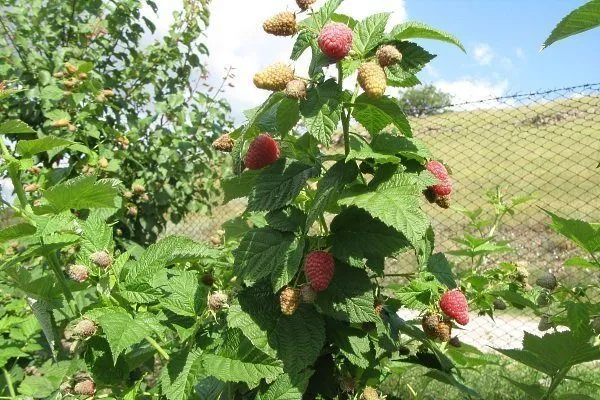
Raspberry variety "Krepysh"
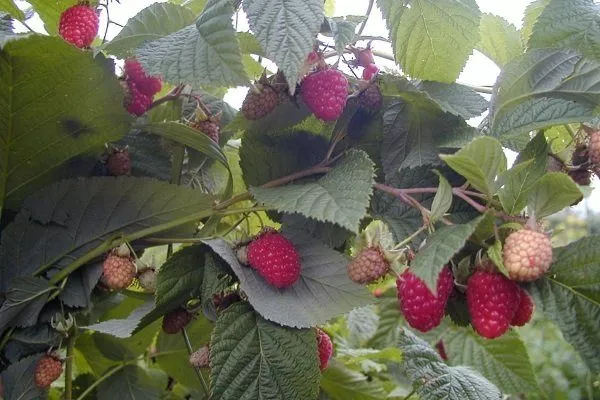
Large, beautiful raspberries "Krepysh" are juicy and sweet
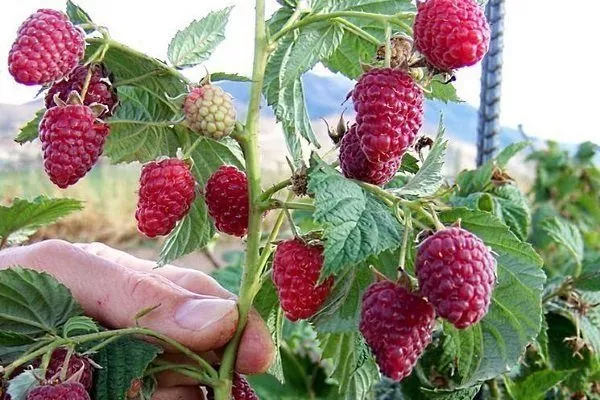
The highlight of the “Krepysh” variety is that its bushes do not need garters and are completely thornless.
Origin of the variety
The variety was developed as a result of work with large-fruited Scottish hybrids in 2000 by breeders from the Institute of Horticulture and Nursery (VSTISP) under the guidance of Professor V. V. Kichina.
Description of Krepysh
Standard raspberries are commonly called "raspberry trees." Indeed, a fully grown, mature plant vaguely resembles a small tree, but it is a bush like all other raspberry varieties.
Bushes
This variety lives up to its name—it's a strong, stocky plant. Not only the main trunk, but also the remaining shoots are thick and firm. The standard-type bush, 1.8 m tall, can reach 2 m. The strong, thornless shoots (up to 2 cm thick) have short internodes and numerous lateral branches.
In the first year after planting, the stems are green, turning yellow-brown in the second year. The leaves are deeply corrugated and dark green. Fruiting branches form only at the top of the plant. They are quite numerous, short, and compact.
Berries
The fruits are a rich crimson-red color, without shine, beautifully blunt-conical in shape, large, weighing up to 10 g. A big advantage is the dense pulp of the berries, thanks to which they have a dry surface, while remaining juicy inside.
The Krepysh raspberry has an interesting characteristic: immediately before ripening, literally 1-2 days before, the berries rapidly increase in size and weight.
Ripe berries separate easily from their stems and remain undamaged during harvesting and transportation. Overripe berries do not fall off, but gradually dry out, remaining on the branches.
Advantages and disadvantages of the variety
The advantages of the Krepysh variety include:
- stable, generous harvests with proper agricultural practices;
- large beautiful berries;
- the absence of thorns on the stems, which makes picking berries more convenient;
- high frost resistance;
- stem strength;
- increased resistance to diseases and pests;
- no need for supports;
- long-term fruiting;
- the bush has weak thickening of shoots, does not grow;
- The dense structure of the fruit allows it to maintain high commercial qualities during transportation and storage.
Weaknesses of the variety:
- a long wait for the first berries and full fruiting;
- uneven ripening (for commercial growing);
- the bush does not tolerate mechanical damage well;
- sensitive to transplantation, long period of survival in a new location.
Watch a review of the raspberry variety "Krepysh" in the video below:
Ripening time and yield
The Krepysh raspberry is cultivated in the Central and Central Black Earth regions, in Kuban and in central Russia.
This is a mid-early variety. Krepysh ripens between June and August. Ripening times may shift slightly depending on weather conditions. The berries ripen more rapidly in full sun than during prolonged rainfall.
The harvest ripens unevenly on last year's shoots. This has its pros and cons. The advantage is that fresh berries can be enjoyed for a long time, but the disadvantage is more relevant to commercial gardening. This uneven ripening is a serious obstacle to harvesting and marketing.
In one bunch of 6-9 berries, only one may be ripe; the rest will take 1-2 weeks to ripen.
The Krepysh raspberry has a high yield. With proper cultivation techniques, a bush can yield up to 4 kg of berries.
Sustainability
It tolerates low temperatures well; frost resistance of this variety is down to -30º C. It can be grown in almost any region.
A significant advantage of Krepysh is its good resistance to pests and most viral and fungal diseases.
Selecting a seedling
Buying a seedling should be approached responsibly; good harvests can only be expected from high-quality planting material:
- for a seedling, a branched root system with an abundance of small roots is important;
- the stem diameter of a young standard seedling is not less than 1 cm;
- the stem is woody, strong;
- absence of swellings on the stem.
- ✓ Check for active root buds, which are not visible to the naked eye but are critical for successful rooting.
- ✓ Make sure that the root system of the seedling has been treated with a growth stimulant before sale, which significantly increases the chances of survival.
A woody stem and a well-developed root system will allow the plant to adapt more easily to its new location. Stem length is unimportant; it will be shortened during planting anyway; its diameter is what matters. Seedlings with thin stems have a poor survival rate.
A plant purchased from a nursery usually has its buds removed from the roots to a certain height. This will become the raspberry trunk. The seedling is already prepared for proper development and formation. Higher up the stem, buds should be located, from which fruiting shoots will later grow.
In the air, especially in the sun, raspberry roots dry out quickly, so the root system of the purchased seedling is wrapped in a wet cloth and placed in a plastic bag.
Fruiting characteristics and taste
Don't expect quick results after planting. Krepysh begins bearing fruit in the 2nd or 3rd year, and a full harvest isn't until the 4th or 5th year. However, the long wait is compensated by abundant yields and a longer ripening period.
Ripe fruits have a pleasant aroma and a juicy, sweet, and tart flavor. The berries are eaten fresh, frozen, and dried, strained with sugar, and used to make juices, sweet homemade liqueurs and wines, jams, compotes, and preserves.
Choosing a landing site
For planting standard raspberries, choose a sunny, level site protected from northern winds. The site should not be flooded by rain or meltwater. The plant does not tolerate excess moisture.
For good fruiting, Krepysh requires slightly acidic or neutral soil that is fertile and permeable. Groundwater levels should not be higher than 1.5-2 meters above the soil surface.
When planting raspberries along the property line, keep a distance of about a meter from the fence. However, the best option is compact planting in rows or a square.
Good predecessors for raspberries include cucumbers, zucchini, onions, garlic, and parsley. Avoid planting raspberries where tomatoes, peppers, potatoes, strawberries, or eggplants were grown.
Preparatory work
Raspberries prefer light, well-drained soils rich in organic matter and mineral nutrients.
- Two months before planting, test the soil for pH and essential nutrient content.
- Add corrective amendments (lime to raise pH or sulfur to lower it) according to the test results.
- A month before planting, add organic fertilizer (compost or rotted manure) and work it into the top layer of soil.
If the soil in the area chosen for planting is not fertile enough, it can be cultivated. Apply 10-12 kg of organic fertilizer, 50 g of potassium sulfate, and 100 g of superphosphate per square meter during tillage.
When preparing a plot for autumn planting, it is advisable to sow it with legumes (beans, alfalfa, peas) or mustard, rapeseed in early spring.
Before flowering, green manure is mown and incorporated into the soil. By autumn, green manure will enrich the soil under the raspberry patch with essential nutrients and improve its structure. However, this doesn't replace the need to add organic and mineral fertilizers to the holes or furrows during planting.
If the soil acidity is high, it is deacidified in the fall by adding chalk, dolomite flour or lime.
Planting the Krepysh raspberry
Truly generous harvests can be obtained when the plant is planted on time and correctly, and the necessary nutrients are added to ensure better rooting and development.
Deadlines
The most suitable time for planting Krepysh raspberries is March-April or late September-October.
Planting patterns
Atspring planting Pits or trenches are prepared in the fall, and for autumn raspberries, at least three weeks in advance. Standard raspberries, such as Krepysh, can be planted using either bush or trench methods.
Bush planting
It consists of the following stages:
- Pre-dig holes for each plant – 50x50 cm. The depth depends on the size of the seedling's root system; 40-50 cm is usually sufficient. The distance between seedlings should be at least 0.5 m.
- Fill each hole with one bucket of compost or add rotted manure (peat moss and manure) to the bottom. Be sure to add phosphorus fertilizer – 1/3 to 1/2 of a matchbox. If you don't have manure, you can add mineral nitrogen fertilizer, such as ammonium nitrate – 1 tablespoon per 10 liters of water.
- Mix the fertilizers thoroughly with the soil in the planting holes.
- A couple of hours before planting, soak the plant roots in water with the addition of the stimulant Kornevin or Heteroauxin.
- Place the seedling in the planting hole, straighten the roots, sprinkle with fertile soil, compact and water well (5-6 liters of water per bush).
- After watering, when the soil has settled slightly, the seedling should be planted 1.5-3 cm below the level at which it grew in the nursery.
- Cut the plant back to a height of 30 cm.
- Create a hole around the seedling and mulch the surface with rotted sawdust, straw, compost, peat, or other organic matter. Apply a mulch layer 8-10 cm thick.
Trench method
The trench method is virtually identical to the bush planting method. The only difference is that instead of individual holes, one long furrow is dug and then filled with fertilizer.
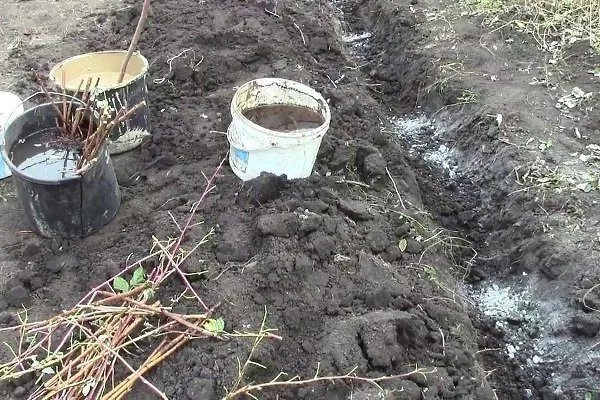
For every linear meter of trench, add 5-6 kg of humus, 30-40 g of potassium sulfate or other chlorine-free potassium fertilizer, and 60 g of superphosphate. Potassium fertilizers can be replaced with wood ash – 200-300 g.
When planting using the trench method, the distance between plants is 0.6-1 m. If there are several rows, the distance between them is at least 2 m.
When planting in autumn, the lower buds of the plant are hilled up.
Caring for raspberries
Caring for the standard raspberry Krepysh is exactly the same as for any other type of this plant and consists of loosening the soil, weeding, watering and fertilizing:
- Watering. This variety produces a higher yield, so the raspberries require more moisture. Water at least once a week. Standard raspberries are moisture-loving but do not tolerate stagnant water. Avoid watering during rainy or cloudy weather to prevent root rot.
- Top dressing. During the season, carry out at least 3 additional feedings, it is better to combine them with watering:
- First – In spring, feed with nitrogen fertilizers during leaf bud break. Use a mullein infusion (which must be allowed to ferment) or mineral nitrogen fertilizers, such as urea (50 g per 10 liters of water). This amount is enough for three raspberry bushes. Ammonium nitrate can also be used.
Nitrogen fertilization is practiced over snow. A mixture of ammonium nitrate (10 g) and urea (8 g) is spread over each square meter of raspberry patch. When the snow melts, the fertilizer is carried by the meltwater to the plant's root system. - Second - During the budding phase, apply a complete fertilizer containing potassium, phosphorus, and nitrogen. Nitroammophoska (NAP) is suitable; dilute 10 g in 10 liters of water.
- Third – carried out in the fall, at the end of the growing season, phosphorus-potassium fertilizers are added.
- First – In spring, feed with nitrogen fertilizers during leaf bud break. Use a mullein infusion (which must be allowed to ferment) or mineral nitrogen fertilizers, such as urea (50 g per 10 liters of water). This amount is enough for three raspberry bushes. Ammonium nitrate can also be used.
- Weeding. Throughout the growing season, it's necessary to remove weeds and young root shoots. You can leave one or two of the strongest shoots for propagation, and prune out the rest.
- Loosening. Periodically, after watering, perform surface loosening, being careful not to damage the roots. This helps control weeds, eliminates insect larvae, and enriches the roots with oxygen. After loosening, apply a layer of mulch under the bush.
Preparing for winter
The high frost resistance of the Krepysh raspberry allows it to grow without winter cover in regions without prolonged, severe frosts. Temperatures as low as -20ºC are not harmful to the plant. However, in strong winter winds, the Krepysh needs to be bent to the ground.
The winter hardiness of the crop increases if in the fall, at the end of October – beginning of November, a moisture-recharging irrigation is carried out – 50 liters of water per each square meter of raspberry.
In regions with harsh climates, raspberries are bent to the ground and covered with agrofibre when preparing for winter. It's best if the bushes are covered with a thick layer of snow.
Support
The Krepysh raspberry requires virtually no support; the dense and strong wood of its canes should prevent them from bending in strong winds or under the weight of the fruit. However, judging by the feedback from people who grow this variety, unsupported bushes can even break in strong winds when the site is unprotected.
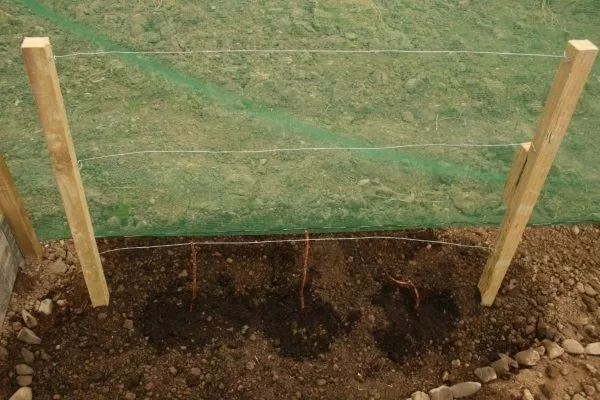
Although this variety does not require staking, stakes driven into the ground with wire stretched between them can be used to support the stems.
Pruning and crown shaping
It's usually recommended to pinch the tips of one-year-old shoots when they reach a height of 1.5 m. However, the stems don't reach this height until late summer. As a result, few lateral shoots form, and they don't have time to mature by winter.
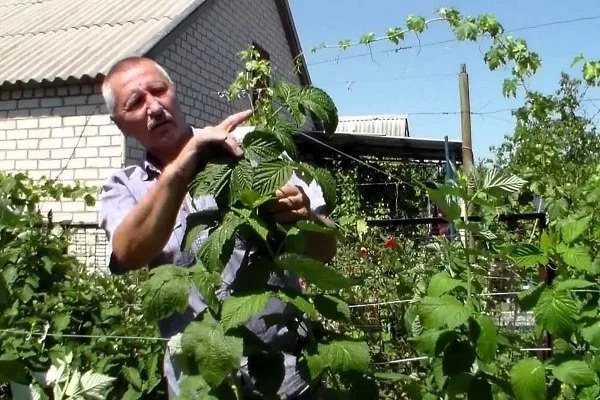
There's a more practical approach to shaping standard raspberries, proven by gardeners. This involves a double pruning method. In late May or early June, the top is pinched at a height of 50 cm.
Pinching stimulates the active growth of lateral shoots. During this period, the bush has plenty of energy and time for their formation and growth. When the lateral shoots growing on the main stem reach 50 cm in length, they are also pinched.
With this method of plant formation, the shoots have time to strengthen before winter. The following year, they will produce numerous fruiting branches.
Once the harvest is complete, the fruiting shoots are cut off. It's best to do this in August rather than wait until spring. This will give the replacement shoots time to ripen well.
In subsequent years, shaping involves removing dead branches in the spring. In the summer (June), the top is pinched, and in July, the side shoots are shortened.
Read articles on how to do it right prune raspberries in autumn And in the spring.
How to propagate a variety?
The Krepysh raspberry can be propagated by shoots, green cuttings, and root cuttings.
Undergrowth
The easiest way is propagation by root shoots that appear in the spring near raspberry bushes.
The strongest and most robust ones are selected, left for the summer, and in the fall, when they have developed normally, they are dug up and transplanted with a lump of earth to a prepared place.
Green cuttings
This is the second most popular method, used in both spring and fall. The key is to allow at least a month between planting the rooted cuttings and the onset of cold weather.
The optimal time for taking cuttings is late May to early June. In the spring, young shoots serve as the source of cuttings, while in the fall, healthy one-year-old shoots are used.
Propagation of raspberries by green cuttings:
- Cut the young shoot into 8-15 cm pieces (each with at least 2-3 buds). To stimulate root formation, make several shallow longitudinal cuts 2-3 cm long along the bottom of the cutting with a sharp knife.
- Cut off the top and leave 1-2 leaves on each cutting.
- Then, tie the cuttings into bundles and soak them in a rooting stimulant (Heteroauxin, Kornevin) for about 24 hours. Only the tips (cut ends) of the cuttings should remain in the solution.
- Plant the cuttings in the soil, burying them 1/3 of the way down, at a 45-degree angle, with 5-7 cm between plants and 7-10 cm between rows. A greenhouse or small plastic shelter is suitable for this purpose.
- Water. Keep the soil consistently moist.
- After 4-5 weeks, transfer the rooted cuttings to a permanent location.
Root cuttings
This method is optimal for propagating raspberry varieties that produce few shoots. Krepysh is one such variety. This propagation method is suitable for plants whose above-ground parts are affected by disease.
This is done in the fall or early spring, before the roots have released green shoots:
- Dig up the bush and shake the soil off the rhizome. You can take cuttings from both annual and perennial plants.
- Select roots with a diameter of 2-3 mm and bearing renewal buds. The length of the cuttings should be 10-15 cm. Avoid the upper fibrous roots, as they do not bear replacement buds.
- If cuttings are made in the fall and there is a risk that the cuttings planted in the ground will freeze in winter, store them in a basement in damp sand or peat until spring.
- Plant in furrows to a depth of no more than 5 cm. When planting in autumn, be sure to plant well for the winter. mulch the soil peat, rotted manure or other breathable material.
- Transplant to a permanent location in warm weather (April-May).
Diseases, pests and their control
Under unfavorable conditions, insufficient light, and dense plantings, pathogens and pests accumulate on the plants. However, even with proper care and all agricultural practices, raspberry plants are not immune to diseases, many of which are carried by insect pests.
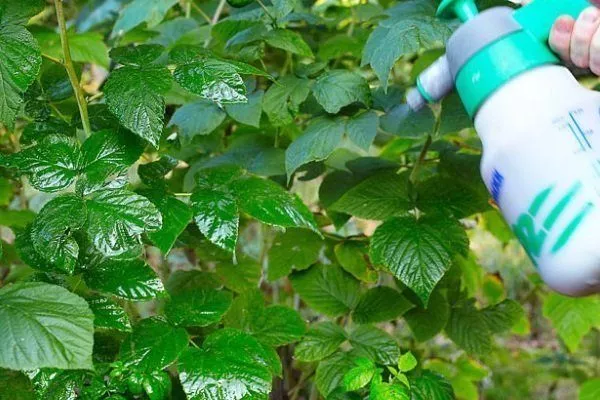
Tables 1 and 2 show pests and diseases that pose a threat to the Krepysh raspberry, as well as control and prevention measures.
Table 1
| Pests | Damage caused | Control measures |
| Raspberry and strawberry weevil | It gnaws at the flower stalks, causing the buds to fall off or break off and wither. | Treatment before and after flowering with Fufanon, Kemifos or Alatar (according to instructions). |
| Raspberry beetle | Beetle larvae damage fruits (wormy berries). | 1. Loosening the soil in early spring and during the growing season, weeding.
2. Spraying at the beginning of June with 1% malathion during the period of blooming of the first flowers. |
| Raspberry stem midge | Galls form on the stems, containing orange larvae. The shoots crack and weaken. Above the swelling, the stem dries up and breaks off. | Affected shoots are cut off 3-4 cm below the swelling and burned.
Spraying before flowering with insecticides: BI-58, Actellik, Alatar, Inta-Vir, etc. |
Table 2
| Disease | Symptoms | Treatment |
| Anthracnose
| Grayish-white spots with a purple border. The entire above-ground portion of the bush is affected. The bark peels off, and the leaves dry out. | Infected bushes are removed, and the raspberry patch is treated three times per season with copper-containing preparations: Oxychom, HOM, and a solution of copper sulfate. |
| Gray mold | It attacks leaves, shoots, and fruit. The berries become covered with a fluffy coating and rot. | Diseased plants are immediately disposed of, healthy ones are treated with fungicides. |
A proven method for protecting shrubs from fungal diseases is spraying with Bordeaux mixture. A 3% solution is used in early spring, before the leaves emerge, and a 1% solution during the budding stage. These treatments also help prevent bacterial diseases.
Reviews from gardeners about the Krepysh raspberry
The standard raspberry variety Krepysh boasts large berries, is resistant to diseases and frosty winters, and produces a bountiful harvest with little care. These advantages set it apart from other varieties, making it worth taking advantage of when growing raspberries in your garden.