
The Kolokolchik raspberry was developed specifically for regions with long, cold winters. Where other raspberries freeze, Kolokolchik thrives and bears fruit. Learn about the planting and cultivation of this frost-resistant variety.
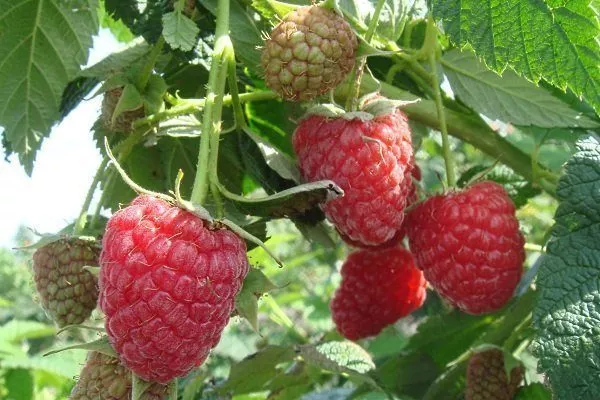
Raspberry variety "Bell"
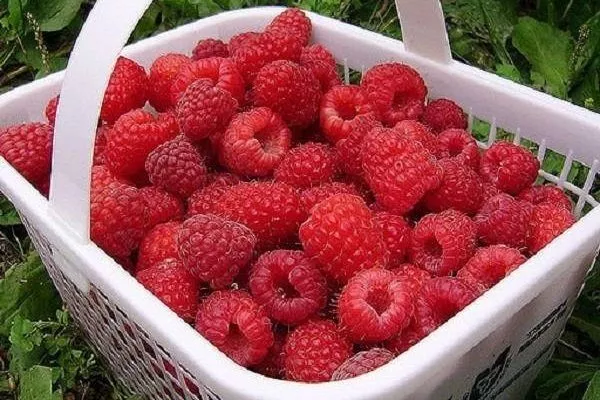
The fruits of the raspberry "Bell" are distinguished by their juiciness with a pronounced raspberry aroma
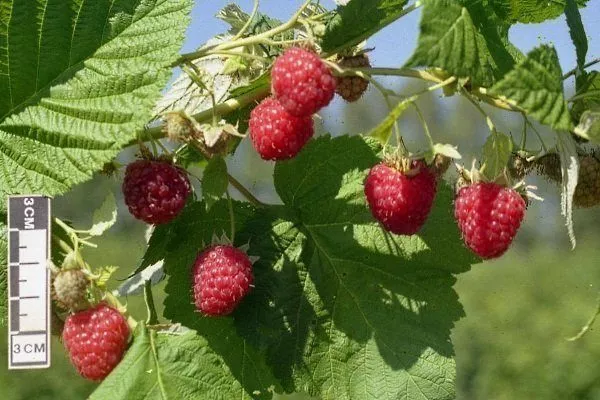
The advantage of the Kolokolchik variety is that ripe berries do not fall off.
History of selection
This variety was developed in Siberia. Open-pollinated raspberries of the "Carnival" variety were used for selection. It has been in variety testing since 1982 and registered in the West Siberian region since 1991. Over time, the variety has spread to other regions of Russia.
Description of the raspberry "Bell"
Brief botanical description of the "Bellflower":
- Bushes. Medium-sized, dense, and spreading. They resemble bushy trees. They grow up to 2 m in height. The stems are strong and upright. The first-year shoots have many thorns, but in the second year, these thorns become fewer, and the shoots themselves become woody.
- Leaves. Oval, green, petiolate, slightly covered with hairs.
- Roots. Powerful and dense, they go down to 40 cm deep.
- Flowers. White in color, up to 1 cm in diameter, this variety is a generous honey plant.
- Fruit. The bright red, beautiful berries are conical in shape and resemble a bell.
The aboveground portion of the shrub has a limited life cycle, but new shoots always grow to replace old, dead stems. Raspberry rhizomes produce two types of shoots: replacement and propagation.
Characteristics
"Kolokolchik" is successfully cultivated in temperate and northern latitudes. The variety's key characteristics are listed in Table 1.
Raspberries are 80% water.
Table 1
| Characteristics/parameters | Description/Meaning |
| Pollination | self-fertile |
| Ripening time | mid-season |
| Fruiting | continuous |
| The first harvest of the season | July |
| Winter hardiness | high, up to minus 27°C |
| Drought resistance | high |
| Flowering period | starting in May, flowering lasts until August |
| Resistance to diseases and pests | under favorable conditions, the variety is resistant to all berry diseases and pests |
| Transportability and storage | They travel well and can be stored in the refrigerator for about a week without losing their flavor or appearance. |
| Productivity | 2-7 kg per bush, 110 c per 1 ha |
| Weight of berries | 3-6 g |
| Taste and aroma | sweet and sour taste with a delicate aroma, tasting score – 4.2 |
| Purpose | fresh consumption and processing – desserts, jam, freezing, liqueurs, wines, liqueurs |
| Recommended regions | Central regions, Volga-Vyatka region, Volga region North-West, Western Siberia, Ural |
A gardener provides an overview of the Kolokolchik raspberry variety in the following video:
Selecting a seedling
To avoid buying wild raspberry bushes or bushes dug up from an abandoned dacha instead of the variety you want, buy raspberry seedlings only from nurseries. Hobby gardeners often don't ensure the purity of the variety, and their seedlings can also be infected with diseases and pests.
How to choose good seedlings:
- The root system should be powerful, branched, and fibrous.
- Roots are elastic, dense, and saturated with moisture. Unacceptable signs include rot, wilted appearance, and curling.
- The best option is container-grown seedlings with a closed root system. These raspberries take root better and can be planted at any time except winter.
- There should be 2-5 shoots—this sign indicates the plant is ready for active growth. The thickness and length of the stems aren't particularly important—they still need to be trimmed to 10-30 cm.
- The seedling must have at least three buds at the base.
- ✓ Check for at least three buds at the base of the seedling to ensure vigorous growth.
- ✓ Make sure that the root system of the seedling is fibrous and branched, which indicates its health.
Advantages and disadvantages
Advantages of the Kolokolchik variety:
- The berries, when ripe, do not fall off.
- They are easily transported and stored, and do not lose their marketable appearance for a long time.
- It bears fruit in the second year after planting the seedlings.
- High productivity. Fruiting is almost continuous, with the variety producing 6-7 harvests per season.
- Small number of spikes.
- Large and tasty berries with excellent marketable appearance.
- Resistant to spider mites and purple spot.
Flaws:
- Increased requirements for lighting.
- Increased foliage of plants.
- Under the weight of the fruit, the shoots bend downwards – they need to be tied to supports.
- Insufficient resistance to fungi.
- Does not tolerate prolonged waterlogging of the soil.
- Regular pruning and thinning is required.
- Does not tolerate drafts well.
Rules and conditions for boarding
To ensure that the Bellflower grows and bears fruit successfully, you need to start by following the planting rules:
- The berry patch is set up in a well-lit area, protected from wind and drafts.
- Raspberries should not be planted in areas with a high water table. The maximum water table should be 1.5 meters from the surface. Lowlands where water, such as meltwater or rainwater, accumulates are also unsuitable.
- It's not recommended to plant raspberry patches near fences, sheds, or other buildings. Even slight shade for 2-3 hours negatively impacts the yield and quality of the berries.
- Any soil is suitable, the main thing is that it is loose, fertile, and has a neutral acidity.
- The soil prepared for planting seedlings is dug up, removing weed roots, and fertilisers are added.
- Seedlings are planted in the spring, at the beginning of April, or in the fall, a month before frost. Fall planting occurs in the first half of October.
- The seedlings are planted in pre-dug trenches or holes, each 40 cm wide and deep.
- Kolokolchik raspberries are planted in rows, using the ribbon method. The distance between rows is 2-2.5 m. The distance between bushes is 1-1.5 cm.
- It's best to arrange the rows from east to west. This ensures good sunlight exposure for the shoots, and berries form at a height of 60 cm or more above the ground.
- Trellis with two thick wires are installed along the rows to tie the shoots to them. The distance from the ground to the bottom wire is 60 cm, and to the top wire is 150 cm.
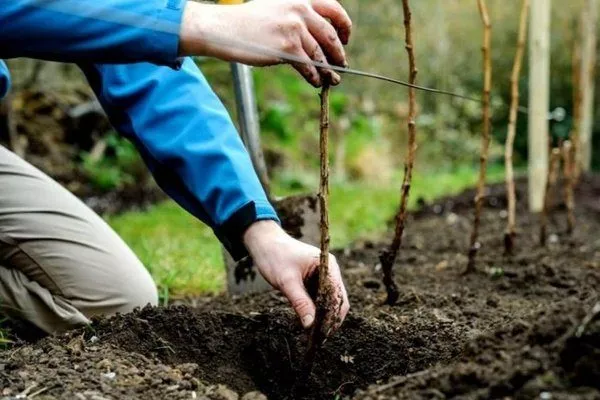
Step-by-step instructions for planting the Bellflower
The order of planting raspberry seedlings "Bell":
- The area is dug up, adding the following for each square meter:
- 2 buckets of compost or rotted manure;
- half a bucket of wood ash;
- 50-60 g double superphosphate;
- 80-100 g potassium sulfate;
- 2 buckets of sand – for clay soils.
Soil preparation plan before planting- A month before planting, add compost or rotted manure to the soil at a rate of 2 buckets per square meter.
- Add half a bucket of wood ash and 50-60 g of double superphosphate to the same area.
- They dig holes or trenches.
- Slate or metal sheets are buried around the perimeter to prevent the growth of shoots.
- A mixture of fertile soil and fertilizer is poured into the holes or trenches (the excavated soil is mixed with humus, rotted cow manure, potassium sulfate, and superphosphate). The holes are filled halfway.
The amount and composition of fertilizers depends on soil characteristics and planting time. For each bush, apply 5 kg of humus/compost, 10 g of potassium sulfate, 20 g of double superphosphate, and 250 g of wood ash. - The seedlings are placed in holes or trenches. The roots are carefully spread out so they face in different directions. The seedling is shaken as it is dug in to ensure the soil fills all the voids. The roots are covered with soil and compacted by hand.
- The plantings are watered and then sprinkled with suitable mulch - humus or peat.
When planting, the replacement bud should be several centimeters above the ground surface; it cannot be buried deep into the soil.
Aftercare of raspberries
The Bellflower is cared for using standard agricultural practices for this crop. In addition to watering, weeding, fertilizing, and pruning, mulchingand loosening, this variety benefits from garter.
Irrigation scheme
Raspberries should not be overwatered; they are watered as the soil dries out. Approximately 5-7 waterings are required per season, depending on the weather. Table 2 provides a sample watering schedule for raspberries.
Table 2
| Period | Number of waterings |
| Before flowering | 1 |
| During the filling of berries and their ripening. | 2 |
| After fruiting. | 2 (plus 2 more as needed in case of heat and drought) |
When watering, the soil should be moistened to a depth of 20-40 cm. For 1 square meter of berry bush, 30-40 liters of water are used.
Weeding, loosening and mulching
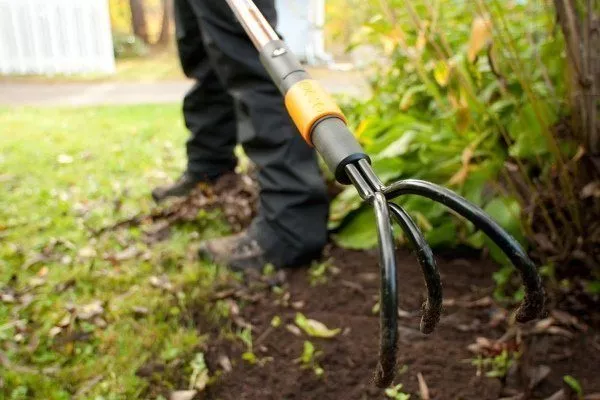
Loosen and weed the "Bell" raspberry patch at least 2-3 times per season. Loosen the soil to a depth of 6-7 cm. Leave a 1 meter gap from the bush. Mulch the raspberry patch once or twice a month by adding a layer of compost between the rows. This is beneficial for the roots and promotes active bud formation.
Top dressing
During the first year after planting, raspberry bushes don't require any additional fertilizer. From the second year onward, fertilizer is applied according to the standard raspberry schedule:
- Every spring, add rotted manure at a rate of 5-6 kg per square meter. Urea is also added at 4 tablespoons per bucket of water. This is enough for two bushes. A suitable fertilizer is 60 g of superphosphate, 40 g of potassium salt, and 30 g of ammonium nitrate.
- In summer, you can apply the following complex of fertilizers: 40-50 g of urea, 200-250 g of superphosphate, 60-70 g of potassium sulfate.
- One year they feed organic fertilizer, the next year they feed mineral fertilizer. A fall fertilizer option is 50 g of superphosphate and a glass of wood ash. A second option is 300 g each of ash, sugar, and manure, and three school chalks.
Raspberries are fed 3 times per season – in spring, summer and autumn.
Garter
This variety produces large fruits, so the branches are subject to significant stress, bending toward the ground and often breaking. To prevent this, the bushes are tied to trellises. The staking also ensures uniform exposure to light, ensuring uniform ripening of the fruit.
Trimming
Raspberry bushes are pruned:
- Leaves. If raspberry bushes are very dense, thin out the foliage with pruning shears – it prevents the berries from ripening.
- Stems. When fruiting ends, the shoots are untied from the trellises and pruned to a height of 6-8 cm from the ground. One-year-old shoots are also pruned, leaving no more than 4-6 shoots per bush.
Preparing for winter
Bellflower bushes do not require any winter cover. In southern regions, winter preparation is limited to pruning the stems. In regions with harsh winters (-40°C), young shoots are bent to the ground and covered. However, a 10 cm thick layer of mulch—compost or peat—would be helpful.
How to propagate a variety?
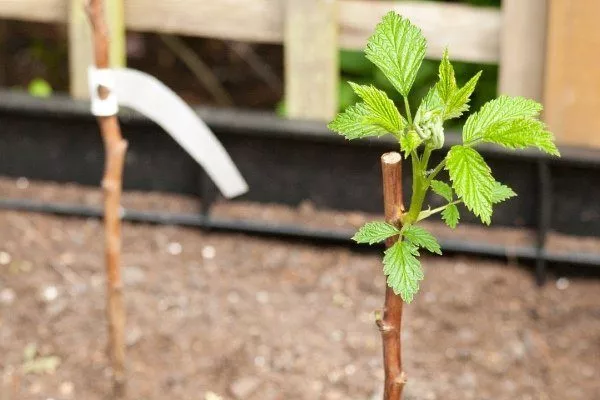
The Bellflower is propagated mainly vegetatively:
- cuttings;
- basal shoots;
- by dividing the bush.
Propagation by seeds is rarely used – it is a labor-intensive, time-consuming and therefore unpopular method.
Diseases, pests and their control
"Kolokolchik" has earned a reputation for being disease- and pest-resistant. However, under unfavorable conditions and poor agricultural practices, it is susceptible to common raspberry diseases. It can also be affected by common raspberry pests. Tables 1 and 2 list the diseases and pests that pose the greatest threat to "Kolokolchik," respectively, along with measures to control them.
Table 1
| Disease | Symptoms | How to fight? |
| Gray mold | The fungus affects all above-ground parts, and a grey coating appears. | Treating shrubs and soil with HOM. 40 g per 10 liters. The solution is sufficient for 100 square meters. |
| Anthracnose | A fungal disease. White-gray spots bordered in red appear on the stems and leaves. | Spraying bushes and soil with 1% Bordeaux mixture. |
Table 2
| Pests | Damage caused | How to fight? |
| Raspberry beetle | The larvae deform flowers and can completely destroy the crop. | In May, berry bushes are sprayed with Fufanon. |
| Raspberry fly | The larvae gnaw through leaves and stems. | Two weeks after spraying with Fufanon, the berry bush is treated with Iskra. Insecticides are applied when 50% of the plants are affected. |
Storage and transportability
Kolokolchik berries can be stored in the refrigerator without losing their marketable quality for approximately 7 days. They transport well without bruising or leaking if properly packaged. It's recommended to line the bottom of the boxes with raspberry leaves, and also place leaves between the layers of berries. When harvesting, place the berries immediately in the appropriate storage/transportation containers to avoid unnecessary handling.
Using berries
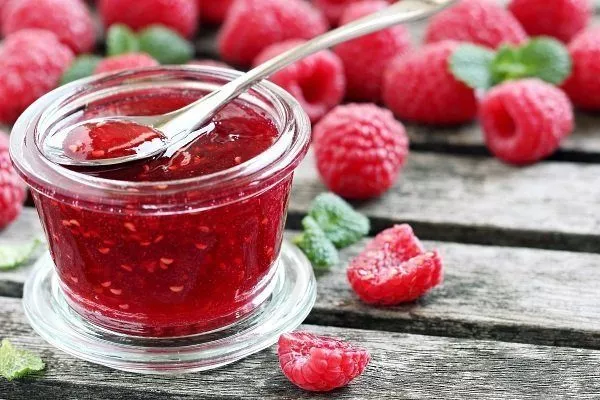
"Kolokolchik" is a versatile variety—its berries are eaten fresh, used to decorate various dishes and baked goods, and used in desserts, compotes, jams, preserves, and kissels. Raspberries are also used in sauces for meat dishes, added to cakes, pie fillings, and used to make alcoholic beverages (wines, liqueurs, liqueurs) and non-alcoholic drinks (fruit drinks, lemonades, cocktails). Raspberry jam is the most delicious of its kind.
Dried raspberries are a powerful cold remedy. They are brewed and drunk to treat the flu and to prevent cardiovascular disease. Raspberry decoctions and infusions are beneficial for the kidneys and liver, and are helpful for rheumatism and gout.
Similar varieties
Raspberries are classified by various characteristics—fruit size, fruiting type, berry color, and many other attributes. Compared to other raspberries, "Kolokolchik" shares similarities with the following varieties:
- By region. In the Urals and Siberia, along with Kolokolchik, the best varieties are considered to be:
- Amateur Sverdlovsk;
- Biryulevskaya;
- Zorenka Altai.
- By fruit size. Varieties with berries weighing 3.5-4.7 g:
- For Health;
- Coral;
- Shiny;
- Abundant and many others.
- By ripening time. Mid-season varieties:
- Zorenka Altai;
- Shiny;
- Red rain;
- Balm.
As we can see, two varieties – Blestyashchaya and Zorenkaya Altaya – matched each other in two ways.
Reviews from gardeners about the "Bell" variety
For three decades, the "Kolokolchik" variety has proven that its low maintenance and high yield are always in fashion. Gardeners, appreciating the variety's positive qualities, are actively growing it in various regions of Russia.