
Glen Ample raspberry is one of the imported standard varieties, known for its sturdy, tall stems. Among gardeners, such varieties are often referred to as "standard" raspberries. Let's find out what makes this exotic variety so special and whether it can be grown in our climate.
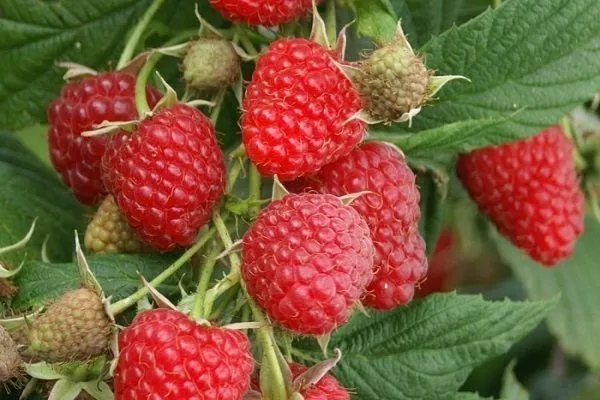
raspberry variety 'Glen Ample'
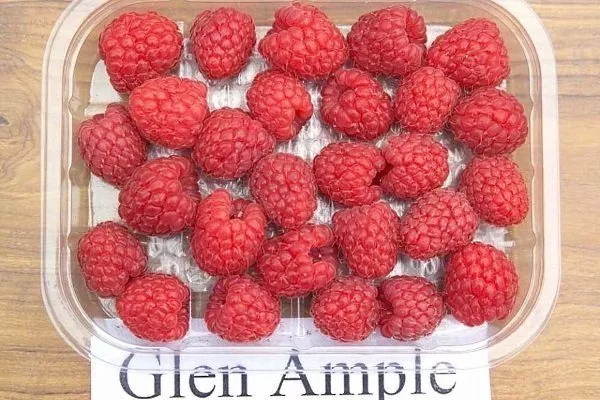
The Glen Ample variety is classified as a general-purpose raspberry.
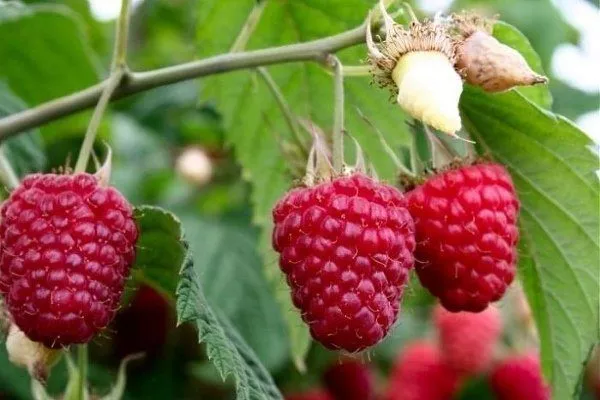
Glen Ample raspberry flavor ratings reach 9 points on a ten-point scale
Description of Glen Ample raspberries
The Glen Ample hybrid was developed by Scottish breeders in 1996. It was created by crossing two other foreign varieties, Meeker and Glen Prosen. The variety is popular in Europe, especially in the UK, where rainy and cloudy summers make it difficult to grow regular raspberries.
Features of the variety:
- Fruiting is not remontant. It bears fruit abundantly and regularly.
- It is considered a mid-season variety. In some regions with shorter summers, it is considered a mid-late variety.
- This versatile variety grows both outdoors and under cover. It's suitable for both amateur and commercial cultivation. Mechanical harvesting is possible.
Shoots and bushes
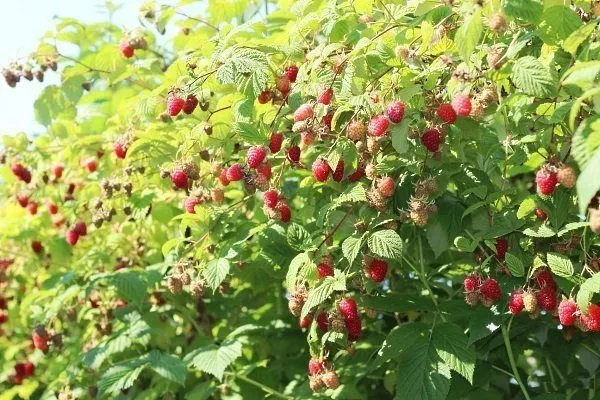
The main characteristic of this variety is its tall stems. The bushes are upright, typically reaching a height of about 2 m. With proper care and a hot summer, the plant can grow up to 3.5 m in height.
Other features of the bushes:
- The base of the bush is one central shoot, from which 20-30 side (lateral) branches branch off.
- Each lateral shoot produces approximately 20 berries. The bush is subject to heavy strain and requires support with a trellis.
- The root system is well developed.
- In the first year, the central stem has a green surface; in the second year, as it becomes woody, it takes on a brownish-red hue. Often, the brown stems are covered with a whitish coating.
- The leaves are arranged alternately on the shoots and are dark green, whitish on the underside. The leaves are slightly wrinkled and covered with white hairs.
- The shoots have a smooth surface, and there are almost no thorns on the central and lateral shoots.
- The bushes have spreading branches. The plant reaches 2 m in width, so there should be sufficient space between the bushes.
- The flowers are white, large, reaching 2.2 cm in diameter.
- The bushes produce a lot of root shoots, which simplifies the propagation of the variety.
Berries
Description of fruits:
- The berries are large, weighing between 2 and 10 g.
- The aroma is rich, raspberry.
- Colour: bright red.
- The pulp is juicy.
- Sweet to the taste. A hint of sourness can be felt if the berries are slightly unripe.
- Taste rating: 9 out of 10.
- The berries have a regular conical shape.
- Once ripe, the berries don't fall off immediately. Moreover, once ripe, they retain their marketable appearance for 2-3 days on the branches.
A gardener reviews the Glen Ample raspberry variety in the video below:
Pros and cons of the variety
Glen Ample raspberries are considered very promising. Among its advantages, both amateur gardeners and experts note:
- the ability to withstand low temperatures and lack of moisture for a long time;
- good preservation of berries – the variety is suitable for commercial purposes;
- high taste characteristics of berries;
- standard agricultural technology - nothing special is required for cultivation;
- thornlessness – makes picking berries easier;
- large-fruited;
- high immunity to diseases and pests;
- low cost of seedlings.
The variety doesn't have any serious drawbacks, but rather some characteristics that are useful to know about in advance:
- the size, taste and structure of the berries depend on the composition of the soil – the amount of phosphorus and potassium in it;
- average disease resistance;
- The size of the bushes makes it difficult to pick berries.
Productivity and fruiting
This variety is characterized by consistently high yields. Fruiting characteristics:
- The berries ripen along the entire length of the stem.
- One shoot yields 1.2-1.7 kg, 4-6 kg are collected from one bush, 22-30 tons from 1 hectare.
- In the southern regions of the Russian Federation, berry picking begins in mid-June, in the central regions – in July.
- The fruiting period lasts one month.
To get a good harvest, the plant requires shaping through proper pruning. We recommend reading the article about How to properly prune raspberries in the fall.
Sustainability
This undemanding and hardy variety tolerates temperature fluctuations and adapts well to various climates. Glen Ample's growing characteristics include:
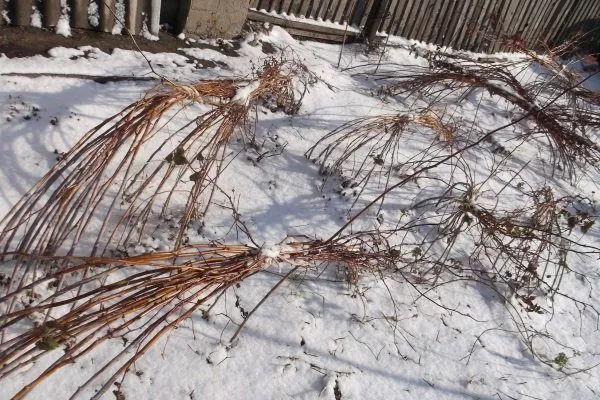
- Frost resistance. This variety is frost-hardy. The bushes can withstand temperatures as low as -30-35°C without harm. However, in regions with harsh winters, it's best to avoid risking this—insulate the plantings in case of a snowless winter. Raspberry stems are bent down, tied or braided horizontally, and secured. Spruce branches are laid over the shoots.
- Drought resistance. The variety tolerates short periods of lack of watering well.
- Resistance to pests and infections. This variety is resistant to raspberry aphids and most berry diseases. It can be susceptible to gray mold and rust. It is also susceptible to the dwarf virus.
Landing rules
This variety, with its excellent growing characteristics, produces large yields in most climate zones. Understanding the nuances of Glen Ample cultivation techniques allows us to achieve the maximum possible yield from the variety.
Soil requirements
Glen Ample will grow in any soil, but only in fertile soils does it produce large yields. Special soil requirements:
- The best option is loamy soil.
- The soil should be light, loose, and well-drained. Peat and sand are added to heavier soils.
- When planting, make a drainage layer.
- You cannot plant seedlings in lowlands, marshy or damp areas.
- The soil should contain sufficient humus. Fertilizer applied during planting is sufficient for two years of growth. After that, the plants should be fed regularly.
- ✓ Soil pH should be between 5.5-6.5 for optimal nutrient absorption.
- ✓ The organic matter content of the soil should be at least 4% to ensure good structure and water-holding capacity.
Lighting
The Glen Ample variety, like all raspberries, prefers well-lit areas. However, too much sun can damage the plants, causing them to burn. A site with good morning light is best.
In the afternoon, the plantings can be in shade or partial shade. The bushes are planted so that the sun reaches all parts of them evenly. The recommended distance between bushes is at least 60 cm. The distance between rows is 2.5-3 m.
Excessive sun can cause Glen Ample raspberries to not only burn, but also develop rust.
Preparing the soil and planting material
The procedure for preparing a site for planting:
- Dig over the soil, removing weeds.
- When digging, add organic matter - 2-3 buckets of humus or compost per 1 sq. m, as well as superphosphate - 200-400 g, and potassium sulfate - 100-200 g per 1 sq. m.
- Prepare a hole for each bush. The diameter should be approximately 60 cm, and the depth should be at least 25 cm. You can plant the bushes along a hedge.
The best time to plant is spring, when the risk of frost has passed and the soil has warmed sufficiently. Raspberries can also be planted in the fall. The exact planting time varies by region. Gardeners believe that planting raspberries in the fall is more effective. Seedlings are planted a month to a month and a half before the first frost to allow them to establish proper roots.
You can learn how to plant raspberries in spring from this article.
Planting material is purchased from specialized nurseries or prepared in the fall. The planting material is stored in a cool place, such as a cellar, until spring.
When purchasing seedlings, inspect them carefully. The roots should be strong, elastic, and not dry. There should be three buds near the base of the seedling. The optimal height is 20 cm, and the diameter is 1 cm.
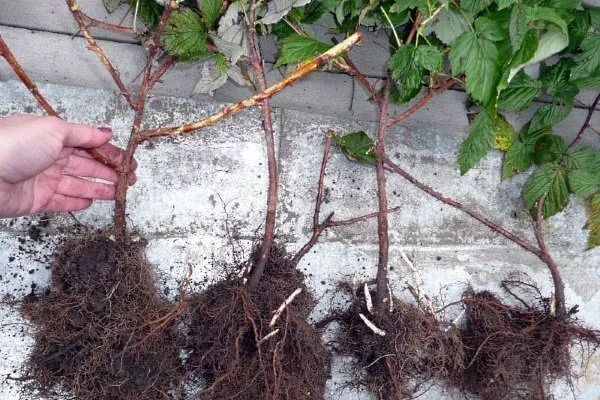
It is not recommended to purchase seedlings with roots wrapped in plastic, especially if they are to be transported for a long time.
Planting patterns
Glen Ample is a powerful plant that reveals its potential when two conditions are met:
- Uniform sunlight from top to bottom.
- Tying up stems with minimal pruning of the tops.
Taking these requirements into account, a single-line landing looks more advantageous.
Planting order:
- Regardless of planting method—bush or linear, single or double row—it's important to maintain a distance of 2.5-3 m between rows. Prepare holes for the seedlings:
- planting pattern for single-line planting – 3x0.3 m;
- with two-line - 3.5x0.5x0.3 m.
- Fill the holes one-third full with fertile soil mixed with fertilizer. Add a bucket of compost/humus, 400 g of wood ash, and 50 g of potassium sulfate to each hole.
- Place the seedling in the hole so that the replacement bud is 2-3 cm below the soil level. Spread the roots out in different directions and cover them with fertile soil. Firm the soil with your hands.
- Make a shallow trench around the seedling and pour water into it. Once the moisture has been absorbed, cover the hole with mulch—compost, straw, or sawdust.
- Cut the seedlings to a height of 20-30 cm from ground level.
- If there is no rain for a couple of days after planting, water the young raspberry bush.
Caring for Glen Ample
Care instructions:
- Top dressing. Bushes require especially high amounts of organic matter and nitrogen, which are added in the spring. In the summer, the plants are fed with complex fertilizers containing potassium and microelements, and in the fall, phosphorus-potassium fertilizers are applied.
- Watering. Abundant watering is necessary in early spring, during budding and flowering. During fruit formation, water 2-3 times at weekly intervals. Insufficient moisture will cause the berries to become small. The recommended watering rate is 30-40 liters per bush.
- Loosening, weeding, mulching. During the planting season, weed a couple of times and loosen the spaces between the rows. To prevent weed growth and retain moisture, the soil is sprinkled with humus, peat, and straw.
- Tying up. The shoots are very tall, so they must be tied to trellises – this is a key feature of the variety.
- Trimming. To facilitate fruit harvesting, tall shoots are double-pruned. This method allows each shoot to be shaped into a raspberry "tree." To achieve this, replacement shoots are pruned to 1 meter in early summer. In July, the side shoots that have grown over the past month are pinched. This creates a 1.5-meter-long shoot with branches, each of which will bear berries the following summer.
- Braiding. This maintenance method also aims to facilitate berry picking. The tops of the stems are wrapped around the top wire of the trellis, which should be at a height of 1 m. This ensures that all fruit-bearing branches are easily accessible.
- Spraying. In spring, preventative spraying is carried out – against diseases with fungicides, against pests with insecticides.
- Preparing for winter. In regions with harsh winters, shoots are tied, bent down, and covered with agrofibre.
- At the beginning of the growing season, apply nitrogen fertilizer at a rate of 30 g per bush to stimulate shoot growth.
- During the budding period, add potassium-phosphorus fertilizers (20 g of superphosphate and 15 g of potassium sulfate per bush) to improve the quality of the fruit.
- After harvesting, add organic fertilizers (humus or compost) to restore soil fertility.
Diseases and pests
The variety's immunity is quite high—experts gave it an 8 on a 10-point scale. Rust and powdery mildew can be triggered by dense plantings.
The main diseases and pests of Glen Ample Raspberry:
| Disease/pests | Symptoms/damage caused | How to fight? |
| Gray mold | The leaves and shoots are covered with a grey fluffy coating. | Spraying bushes and soil with HOM. 40 g per 10 liters. This amount is enough for 10 square meters. |
| Powdery mildew | The berries, growing points, shoots, and leaves become covered with a light gray, web-like coating. The fruit becomes unfit for consumption. | The crops are sprayed with environmentally friendly biofungicides. Chemical preparations such as Topaz, Quadris, and others are also used. |
| Rust | Yellow-orange raised spots and gray ulcers with a reddish border appear on the upper side of the leaves. The leaves dry out, and yields decline. | Spray with Bordeaux mixture and fungicides - Cuproxat, Poliram DF, etc. |
| Raspberry beetle | Beetle larvae deform flowers, reducing crop yields. | Spraying with Fufanon in spring. |
| Raspberry fly | The larvae gnaw out the stems and eat the leaves. | Spraying with Iskra – 2 weeks after treatment with Fufanon. |
You can see photos and descriptions of these and other diseases here.
Transportability
Glen Ample berries are not only sweet and large, but also firm and dense. This makes them easy to transport. For transport, it's recommended to use 30x30 cm containers. The maximum layer of berries should not exceed 20 cm. To ensure the berries survive the journey, they are picked at the technical ripeness stage.
Uses of berries
Glen Ample is a versatile raspberry variety—it's eaten fresh and processed. The berries, picked from the bush, are dry and firm, ideal for freezing. After defrosting, they retain their shape and flavor.
The berries are ideal for jam—the seeds are barely noticeable. Due to their high sweetness, a minimum amount of sugar is added to sweet preserves. The fruits are especially good uncooked—chopped and mixed with sugar.
Glen Ample Raspberry Reviews
Glen Ample, a Scottish raspberry, thrives and produces fruit in our climate. This standard variety doesn't require any special growing conditions, is highly productive, and is hardy and easy to grow. The key is to ensure proper trellising and proper staking of its long stems.