
The Plum gooseberry is an old, proven variety bred domestically, which has proven itself among both our gardeners and large agricultural producers. The former are primarily attracted by the excellent taste of the Plum gooseberry, while the latter are attracted by the high yield combined with the ease and hardiness of this popular variety.
History of creation
The Plum gooseberry was developed at the Michurin All-Russian Research Institute of Horticulture by breeder K.D. Sergeeva. The variety was obtained by crossing the Malachite variety with a mixture of pollen from weakly spiny seedlings.
The Plum gooseberry has been undergoing variety testing since 1964. It was only included in the State Register in 1986. The variety is recommended for cultivation in the Central Black Earth, Middle Volga, and Ural regions.
Description of the plant
The Plum gooseberry has a classic appearance typical of this crop. It also has external characteristics and features that distinguish it from other gooseberry varieties.
Brief description of the plant:
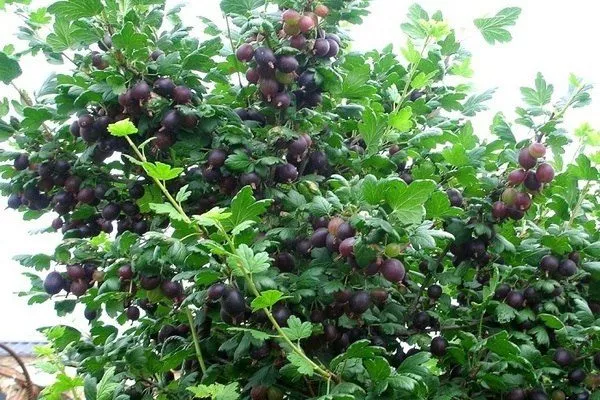
- Bushes Plum gooseberries are vigorous and compact, with medium branching. They have a medium-density crown, and the branches grow vertically. Young shoots are straight, dark green, with pink tips; woody shoots are lighter.
- Escapes Covered with numerous spines, single, double, and triple, they are thick and light-colored, medium in length, and evenly distributed along the entire length of the shoot.
- Kidneys light, ovoid, small in size, with blunt tips, glabrous, pressed to the shoots.
- Leaves Large, five-lobed, dark green, matte or slightly shiny. They are glabrous, folded, leathery, slightly wavy or concave.
- Flowers bright, medium-sized, with large and pale sepals, collected in one- or two-flowered, rarely three-flowered inflorescences.
Description of fruits
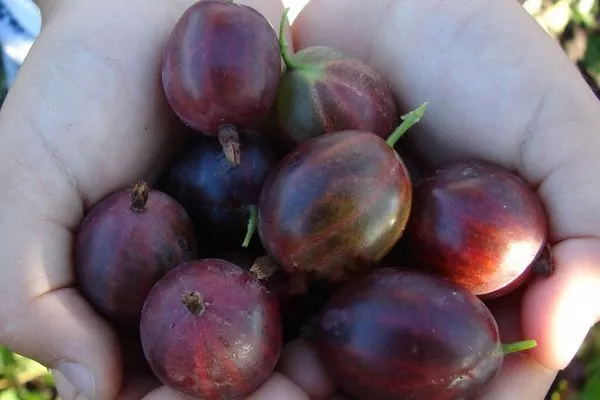
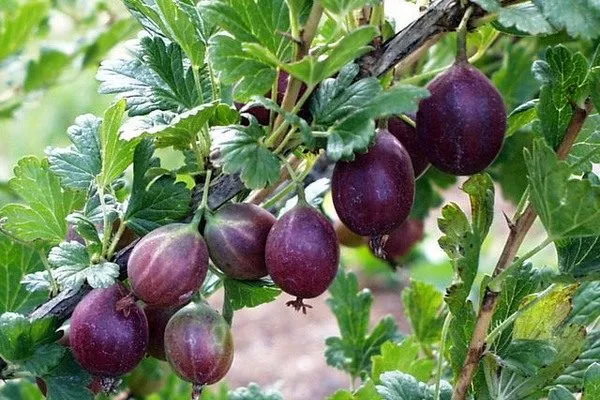
The fruits are large, oval or broadly oval. The average weight of one fruit is 4.0-6.5 g. The color is dark red. As they ripen, the berries acquire an almost black hue. The surface of the berries is glabrous, covered with a waxy coating.
Taste, composition and application
The fruit has juicy and tender flesh. It has a sweet and sour taste and a distinctive plum aroma. The tasting score is 4.2.
Chemical composition:
- sugar - 10.2%;
- titratable acidity - 1.6%;
- ascorbic acid - 21.1-42 mg/100 g.
The fruit is rich in vitamins A, B, and C, and contains ample amounts of manganese, phosphorus, potassium, and copper. However, plum gooseberries are relatively low in calories—44 kcal per 100 g. The berries can be consumed as part of a diet.
The fruits are suitable for a variety of purposes, not only eaten fresh but also processed. Ripe berries are used to make a variety of winter preserves, including jams, compotes, and preserves. They are also used to make fillings, jellies, kissels, and various desserts.
Characteristics of the variety
The Plum gooseberry is not only delicious and productive, but also has excellent agronomic characteristics. Thanks to these characteristics, the variety can be grown in regions with challenging climatic conditions.
Characteristics of the Plum variety:
- Winter hardiness is high.
- Drought resistance is high.
- Ripening period: mid-early.
- Yield: 4.5 kg per bush or 15.2 t/ha.
- Resistance to diseases and pests is high.
Pros and cons:
Before planting the Plum gooseberry, it's helpful to evaluate all its advantages and disadvantages. It may not be suitable for your needs, and you'll need to look for a different variety.
Pros:
The Plum variety has one drawback: a large number of sharp thorns.
Landing
Gooseberries should be planted in adequately moist soil, but avoid overwatering. Swampy areas and lowlands are not recommended for this crop. Gooseberries should also not be planted in areas with high groundwater levels, as this can cause root rot.
Landing features:
- The best time to plant gooseberries is autumn.
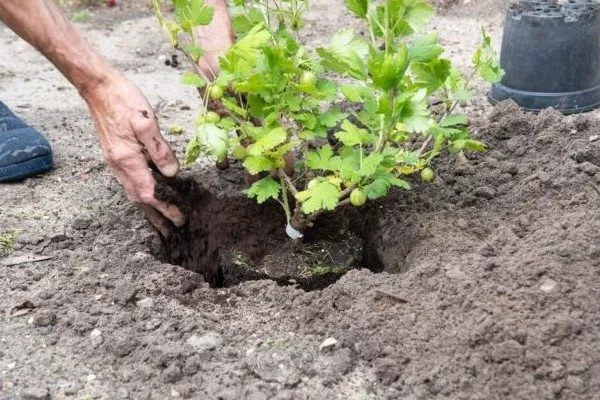
- The area is prepared for planting in advance: the soil is dug and fertilized, and then small planting holes are dug. The recommended depth is 40-50 cm.
- A drainage layer of crushed stone or broken brick is placed at the bottom of the holes. A nutrient mixture is poured on top of the drainage. It is prepared from several shovels of fertile soil, 5 kg of manure, 30 g of superphosphate, and 25 g of potassium salt.
- Select healthy seedlings, without damage or dry roots, 1-2 years old.
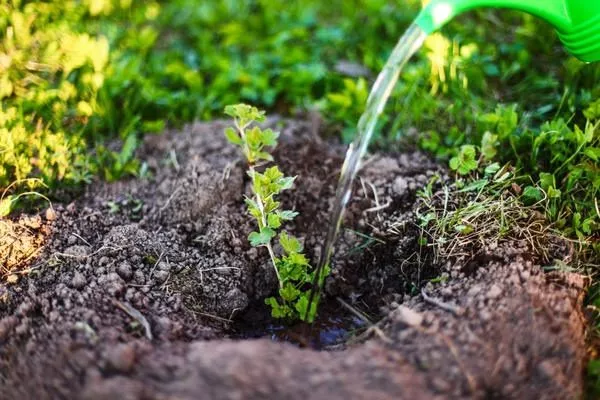
- Planting is done according to the standard scheme: the seedling is placed in a hole, covered with soil, compacted and watered generously, mulched with peat, sawdust, etc.
Care Features
The Plum gooseberry is an easy-to-grow variety that can grow and bear fruit even in the challenging Kamchatka climate. However, to achieve a high-quality and abundant harvest, it requires some care.
How to care for Plum Gooseberry:
- After planting, apply 10-12 liters of water per bush. Watering should be regular thereafter, increasing the amount during the fruit set and ripening stages. Insufficient moisture negatively impacts the flavor of the berries and can even lead to the loss of the entire harvest.
- In spring, organic fertilizers are added under the bushes, for example, 6-7 kg of manure or compost.
- Bushes are pruned regularly to create a neat crown. It is also necessary to remove all dry, frozen, damaged, and inward-growing shoots. It is recommended to leave 3-5 branches each year. Branches over 10 years old are cut back to the ground.
Prevention of diseases and pests
The variety is resistant to powdery mildew, but under unfavorable conditions it can be susceptible to various fungal, bacterial, and viral infections. This usually occurs when poor weather combines with severe agricultural practices.
In particular, plum gooseberry bushes may be susceptible to rust, anthracnose, and septoria leaf spot. To combat these diseases, copper sulfate, Bordeaux mixture, and various fungicides are used preventively.
The most common pests that plague bushes are gooseberry moth larvae, aphids, glassworms, and various caterpillars. Insecticides are used only for severe infestations; simple agricultural practices, such as removing plant debris and treating plants with hot water in early spring, can usually help prevent pests.
Collection
Harvesting plum gooseberries is complicated by the sharp thorns that densely cover the branches. The harvest is from June to August. Ripening time depends on light, wind, humidity, and regional climate conditions.
Reviews
The Plum gooseberry is a very interesting variety that has remained popular for over half a century and continues to attract gardeners. What attracts gardeners to this gooseberry is its berries' flavor and the plant's resilience.