
Planting and caring for gooseberries is almost the same as for other garden crops, but it does have its own unique characteristics. With proper cultivation practices, gooseberries can bear fruit for 20-30 years. Let's look at how to grow a strong, productive bush.
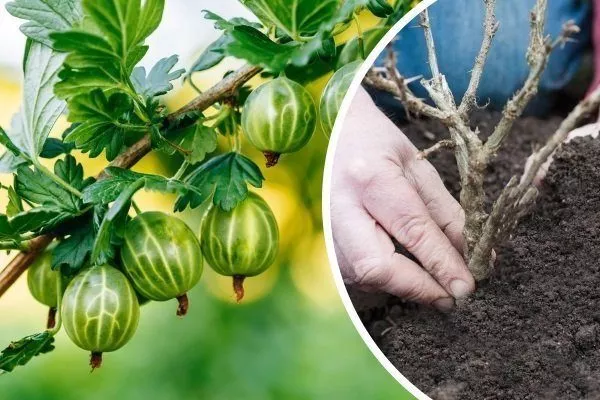
Selection of planting material
Seedlings are selected from standard varietals. Learn about the best gooseberry varieties for growing in this article.
To ensure that young gooseberries take root, the following requirements are taken into account:
- the root system should have at least 3 skeletal roots 20-25 cm long;
- the aboveground part should contain 2-3 strong branches about 30 cm in size;
- seedlings are selected without mechanical damage.
- ✓ Check for the presence of at least 3 skeletal roots 20-25 cm long.
- ✓ Make sure that the above-ground part contains 2-3 strong branches of about 30 cm in size.
- ✓ Select seedlings without mechanical damage.
Plants with an open root system are taken without leaves (except for the top), and bushes with a closed root system, on the contrary, are taken with foliage.
Autumn planting
Autumn is a favorable time for planting. The shrub will establish itself and take root well over the winter.
Optimal timing
Gooseberries are planted in late September to mid-October (depending on the climate). This should be done a month before the first freezing temperatures. The roots begin to penetrate the soil when daytime temperatures reach 10 to 15°C. If early frosts occur, planting should be postponed until spring, as the plants will not have time to establish roots and will freeze.
Soil preparation
The shrub prefers fertile, loose soil in well-lit, well-ventilated areas, but does not tolerate waterlogging. Therefore, it should not be planted in swampy areas or near groundwater.
- Check the soil acidity using indicator plants.
- Add limestone or dolomite if the soil is acidic.
- Dig over the area and clear it of weeds 2-3 weeks before planting.
Gooseberry bushes prefer neutral or slightly acidic soil. If the soil is acidic, add limestone or dolomite flour. Before planting, dig over the area and clear it of weeds.
You can determine increased soil acidity this way: if moss, sorrel, and horsetail grow in the area, the acidity is high.
To allow the soil to settle, dig holes 2-3 weeks before planting. The optimal depth is 50-55 cm, and the width is 55-60 cm. Fill the holes two-thirds full with fertilizer (superphosphate, ash, rotted manure).
Step-by-step planting instructions
Autumn planting of gooseberries is carried out in several steps:
- They inspect the bush for damage, remove unhealthy parts and broken roots with pruning shears.
- The plant is placed at a depth of no more than 5 cm at the root collar.
- Sprinkle the roots with soil so that there are no voids between them.
- Compact the soil with your feet (not too much) to secure the bush to the soil surface.
- The tree trunk circle is watered with 5 liters of water.
- Mulch the soil with peat or humus.
The seedlings are watered every 4-5 days (if there is no rain).
Gardeners recommend treating the bushes for pests and fungi 10 days after planting as a preventative measure. Don't prune the seedlings in the fall.
In this video, a gardener shares his experience planting gooseberries in the fall:
Do you need to insulate for winter?
Gooseberries are a frost-resistant crop. Mature plants don't require special winter cover; snow cover is sufficient to retain heat. Seedlings, especially in regions with cold winters, are protected from freezing. Plants are covered with spruce branches, fallen leaves, or agrofibre.
Spring planting
In spring, gooseberries are planted before the sap begins to flow. If you neglect the timing, you may not get a bountiful harvest, and the bush will grow weak.
Optimal timing
The best time to plant in spring varies by region. In warmer climates, gooseberries are planted in March, while in northern regions, they can be planted before the end of April. Plant before the buds swell.
Soil preparation
It's best to fertilize the soil in the fall. Fertilizing in the spring is difficult due to high soil moisture. Selecting a planting site and soil acidity are the same as for fall planting.
Gooseberries should not be planted where raspberries, other gooseberry varieties, or currants were previously grown, as these plants are susceptible to common diseases and pests. Locations where peas, potatoes, and beets were previously grown are considered favorable for planting.
Step-by-step planting instructions
Spring planting of seedlings consists of the following steps:
- The seedlings are inspected for damage. Diseased, dry, or rotten roots are removed.
- The bushes are treated with a biostimulant solution (Zircon, Epin). This will help the root system take root better.
- To help the basal shoots grow and take root faster, the plant is placed in the hole at a 45-degree angle.
- The soil around the seedling is compacted (not tightly) and watered.
- Aboveground shoots are cut to 15-20 cm, leaving 3-4 buds.
After planting, water the shrubs once a week (until the roots become established). Weed the area around the trunk regularly. To protect against weeds, mulch the soil with peat and leaves.
Watch the following video on how to plant gooseberries in spring:
Different ways to grow gooseberries
In addition to standard bush training, gooseberries are grown on standard stems and trellises. Let's consider these cultivation methods.
On the trellis
Growing berry bushes on a trellis has its advantages:
- Evenly spaced branches of the bush increase illumination, which promotes the uniform ripening of berries;
- vertical planting has a positive effect on the quality of the harvest: the fruits grow large and sweet;
- The bushes are less likely to become contaminated and infected with fungal infections.
Trellis—reinforced concrete, wood, or plastic poles (or pipes) approximately 2 meters in length—are placed on both sides of the row. Wire is stretched between the poles at three levels. Several bushes (5-6) are planted at a distance of 0.5 to 1 meter from each other, with branches arranged in a fan shape. The plant is then tied to the bottom wire of the structure and trained vertically. The seedlings are pruned back to 3-4 buds.
Shoots growing from the root collar are removed in the second year to establish the thickness and density of the shoot wall. Lateral shoots growing on the main bushes are shortened above the fifth leaf.
Care for the shrub as you would with a regular planting: mulch, water, and prune. Fertilize in the spring.
Thornless gooseberry
Breeders have developed thornless gooseberry varieties that are in high demand among gardeners. These varieties are characterized by early and abundant fruiting. A good harvest is harvested in the second year after planting, and a mature bush produces up to 1.5 kg of fruit.
Thornless gooseberries prefer fertile soil. Fertilize with organic matter in the fall and with ammonium nitrate or urea in the spring.
A characteristic of these varieties is that the bushes cross-pollinate poorly, so they are planted at least a meter apart. Otherwise, planting and pruning are no different from other varieties.
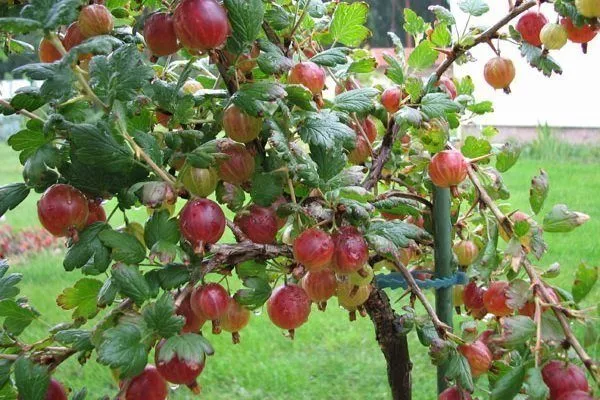
Growing standard gooseberries
Gooseberry bushes, planted in a standard manner, not only serve as a garden decoration, but also have their own advantages:
- the plant receives more light, due to which the berries ripen evenly and grow large and sweet;
- It is more convenient to harvest and care for a bush in the form of a tree;
- In small areas, standard planting saves space.
The standard method is used to grow bushes with or without grafting. A goldencurrant scion is used as the rootstock and is cared for throughout the summer. To thicken the trunk, the apical shoots are removed. Once the trunk is prepared, mature gooseberry shoots are selected, thorns and leaves are removed. Then, the shoot is shortened above the third bud and grafted using the "behind the bark" method.
When growing without grafting, prune a strong gooseberry bush's above-ground branches, leaving only one shoot to form the trunk. Periodically remove side branches to a height of 70-80 cm from the ground. Leave 5-6 upper shoots to form the crown.
The best gooseberry varieties for growing as standard plants:
- "Krasnoslavyansky";
- "Generous";
- "Spring";
- Redball;
- "Kolobok";
- "Sadko" and others.
Gooseberry care is the same as for conventional planting. In colder regions, it's recommended to insulate standard bushes for the winter, for example, with frame shelters.
Growing characteristics in different regions
Climate conditions are taken into account when growing fruit and berry crops. Breeders have developed regionalized gooseberry varieties for each region:
- Residents of the northern regions You should pay attention to frost-resistant varieties ('Northern Captain,' 'Yarkiy,' 'Severyanin,' 'Grushenka,' 'Belye Nochi,' 'Finskiy,' etc.). In northern regions, large-fruited and late-ripening varieties are planted in a warmer location, protected from the winds. Fences, trees, and buildings can provide protection.
- For central Russia, Moscow region, Northwest recommend growing winter-hardy varieties, varieties with a strong root system and resistance to diseases ("Grushenka", "Malachite", "Cossack", "Lefora", "Senator", "Seedling", "Harlequin", etc.).
- In the South It's best to plant drought-resistant, mid-season, early-ripening varieties ('Kubanets,' 'Grossular,' 'Krasnoslavyansky,' 'Kuibyshevsky'). Cool, open locations are suitable for early-ripening and small-fruited varieties from southern regions.
Caring for gooseberries in different seasons
In the springAfter the snow melts, the rows and spaces between rows are loosened, as the soil is heavily compacted at this time. To avoid damaging the roots, the soil around the tree trunks is loosened to a depth of no more than 5 cm. Spring is the time for fertilizing, treating shrubs for pests, and performing sanitary and formative pruning.
In summer The soil is loosened as needed, usually 3-4 times per season. In early August, loosening between rows and within rows is stopped to avoid stimulating the growth of new shoots.
To promote growth, protect against weeds, and retain moisture in the summer, mulch around tree trunks. This is done in the fall after tilling the soil.
Autumn – time to prepare gooseberries for winter and time for pruning.
We recommend reading the article about How to care for gooseberries after harvesting.
Regularity of watering
Without moisture, bushes often become diseased, the berries become smaller, and the yield declines. In dry weather, gooseberries are watered during the formation of young shoots and fruit sets. The bushes are also watered during the ripening period. Once the fruit softens, watering is stopped to allow them to absorb sugar.
If autumn is rainy, gooseberries don't need to be watered. If rainfall is scanty, a moisture-replenishing irrigation is given in October to prepare the root system for winter.
When and what to feed?
In spring, gooseberries are fed with manure or compost, spreading it on the dug-up soil around the bush. During bud break, 40-50 g of ammonium nitrate or urea are added under each bush. Four years after planting, fertilize each spring with nitrogen, phosphorus, and potassium compounds.
When the berries begin to set, water them with slurry or a solution of mineral fertilizers (1-1.5 kg of ammonium sulfate or saltpeter is added to a hundred-liter barrel of water).
You can prepare the following mixture: dilute 4 kg of manure and 200 g of ash in 10 liters of water and let it steep for 5-6 hours. Water the bushes with this solution in the evening after loosening the soil. Repeat the fertilizing after 1-2 weeks. Fertilize the bushes 2-3 times before the berries ripen.
In the fall, the plant is fertilized with potassium nitrate or double superphosphate. Before turning the soil, add manure, ash, peat, or compost.
Pruning: rules and methods
To ensure proper growth and fruiting, gooseberry bushes are pruned regularly. Depending on the desired outcome, pruning can be formative, rejuvenating, or sanitary.
Formative pruning serves to create the correct crown and has its own subtleties:
- in the first year of planting, the branches are cut by half, in the second - by a third, in the third - the tops and horizontal branches are cut off;
- An adult bush is cleared of non-viable and crooked branches and young shoots are cut off from overgrowing.
The bush is trained for up to 8 years. By this time, the bush should have 22-25 strong shoots.
Rejuvenating pruning is carried out after 7 years of planting as follows:
- old, diseased, twisted shoots are cut off, leaving only strong basal stems;
- For plants older than 10 years, only 5 strong branches are left, and the remaining branches are removed from the base.
Sanitary pruning Used to combat overgrowth and prevent disease and pest infestations. Old, diseased, and discolored branches and horizontal shoots are removed.
In the following video, a gardener explains in detail how to properly prune gooseberries:
In the spring, carry out sanitary pruning before the buds open. Large cuts are treated with garden pitch. In the fall, carry out formative, sanitary, and rejuvenating pruning. The best time is November, after the leaves have fallen.
Fighting diseases
Diseases have a devastating impact on both the harvest and the plant itself. Let's look at the main gooseberry diseases and how to combat them.
Anthracnose – a fungal disease that affects gooseberries, currants, raspberries, and other crops. The infection spreads in damp, dense, and poorly ventilated areas. Symptoms:
- the appearance of brown spots on leaf blades;
- leaf fall.
Affected plants are sprayed with Bordeaux mixture (300 g of copper sulfate and 400 g of lime per 10 liters of water) before flowering. After flowering and harvest, the solution concentration is reduced (100 g of copper sulfate and 100 g of lime per 10 liters of water).
In the fall, fallen leaves from diseased plants are burned. If infected leaves are not removed, the shrub will become infected again in the spring.
Septoria Develops in warm weather. Pathogens are fungal spores. Symptoms of the disease:
- Brownish spots appear on the leaves, which turn white over time, and a brown border appears at the edges;
- leaf fall.
Treat contaminated soil with copper sulfate, Bordeaux mixture, or nitrafen. Spray the plant before bud break.
Spheroteka (American powdery mildew) is a dangerous fungal disease.
Symptoms:
- In spring the leaves become covered with a white coating;
- the shoots become twisted and dry out.
This disease is difficult to eradicate, as the fungus overwinters not only on leaves but also on shoots. In the spring, the tops of the bushes are watered with hot water as a preventative measure.
The control methods are the same as for anthracnose and septoria.
Mosaic – a viral disease spread by insects. Symptoms:
- a yellow pattern appears on the veins of the leaves;
- shoots stop growing;
- the leaves become smaller and wrinkled.
Mosaic is difficult to treat, so it's best to remove diseased bushes. As a preventative measure, spray the bushes with insecticides.
Pest control
In addition to dangerous viruses and fungal diseases, berry crops are threatened by pests.
Currant glasshouse – a wasp-like butterfly with transparent wings. The insect lays eggs on branches. After 10 days, caterpillars emerge from the eggs and penetrate the core of the branches, disrupting the plant's physiological processes.
Control measures:
- In autumn, sanitary pruning is carried out followed by destruction of affected branches;
- In spring, gooseberries are treated with Iskra M, Kemifos, and Fufanon.
To repel glassworms, folk remedies are used: infusions of onions, wormwood, tansy, and garlic.
Firefly – the grey-winged butterfly lays eggs inside inflorescences and on ovaries. The caterpillars eat the flowers and berries. In mid-June, they pupate in the soil and overwinter.
Control measures:
- when caterpillars appear, the plant is sprayed with lepidocide (5-6 tablets per 1 liter of water), after a week the procedure is repeated;
- A solution of fufanon (110 ml per 10 liters of water) will destroy not only the moth, but also geometer moths and sawflies.
Shoot aphid They parasitize the tips of shoots, sucking the sap from the leaves. The aphid eggs remain on the bark until spring. After the buds open, the larvae emerge from the eggs.
Control measures:
- in early spring the bushes are watered with hot water;
- treated with a three-day infusion of onion feathers or onion peel;
- spray with an infusion of wood ash (350 g per 10 l of water);
- In case of severe damage before bud break, use the following preparations: "Aktara", "Rovikurt", "Fovatox", etc.
Regular inspections and preventative spraying with insecticides will protect shrubs from damage and death.
Gooseberry sawfly – a fly-like insect of yellow or blackish-red color. It lays eggs on leaves.
Control measures:
- infected leaves are burned in the fall;
- in early spring, the soil is loosened, a mixture of ground pepper (1 tbsp), dry mustard (1 tbsp), ash (2 tbsp) is added and covered with film to destroy the pest;
- larvae (caterpillars) are collected by hand and destroyed;
- Insecticides are applied during bud opening and after flowering.
Regular inspection and preventative treatment with insecticides will protect the plant from damage and death.
How to propagate gooseberries?
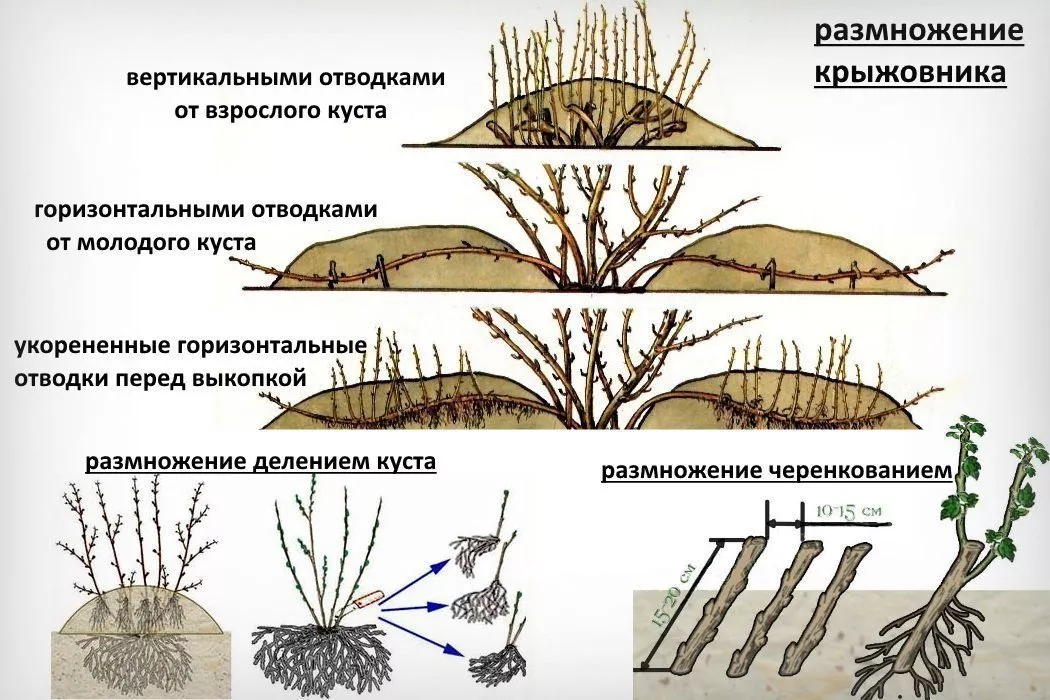
Propagation by cuttings and layering is easy for amateur gardeners, but there are some methods that require specialized knowledge or expert advice. Let's look at the most popular propagation methods.
Horizontal layering Gooseberries are propagated in March–April (before bud break) and in October. Propagation is carried out in several stages:
- From a healthy 5-6 year old bush, take developed branches (from 1 to 3 years old) growing near the ground.
- One-year-old shoots are cut off by a third from the branches.
- The branches are bent to the ground and placed in holes.
- The holes are lightly covered with soil, watered and mulched.
- Once the shoots reach 10 cm, they are hilled up. When the shoots reach 20 cm, the tips are pinched off.
Horizontal propagation produces numerous young shoots. In spring, the shoots become one-year-old seedlings.
Arc-shaped layers The plant is propagated in early spring. The propagation stages are as follows:
- One-year-old shoots located low to the ground are placed in furrows up to 25 cm deep.
- The layers are pinned down and covered with soil.
- The tops are brought out in the shape of an arc, shortened and hilled up.
In the fall, separate the shoot from the mother plant and plant it. The arching method yields only one shoot.
Vertical layering The plantings are rejuvenated. In the spring, old branches are removed and young ones are pruned. In the summer, as the shoots grow, the gooseberries are hilled. To shape the bush, the tops are pinched in June.
By dividing the bush Propagation is done in the fall after the leaves have fallen or in early spring. This method is usually used when relocating a shrub. Young bushes are dug up and divided. Branches with developed root systems are planted in pre-dug holes.
Cuttings Gooseberries are propagated in the fall, spring, and summer. The cutting technique varies depending on the season. In summer, gooseberries are propagated using green cuttings, while in the fall and spring, they are propagated using woody or combined cuttings.
Requirements for propagation by cuttings:
- the cutting must contain at least two buds and two leaves above them;
- the cut on the upper section should be straight and horizontal, and on the lower section – oblique;
- After cutting, the cuttings are kept in a growth stimulator for several hours.
In addition to the methods mentioned above, gooseberries are propagated by seeds, shoots, and branches. The choice of method depends not only on the gardener's personal preferences but also on the characteristics of the variety.
Collection and proper storage
Gooseberries for processing are harvested two weeks before consumer maturity, when the berries are still green and firm, but have reached their full size.
For fresh consumption, the berries are picked when they are fully ripe, sweet in taste, and have the characteristic color of the variety.
Berries harvested at the technical ripeness stage (10-14 days before consumption) can be stored in a cool place for up to 10 days. It's important to keep the berries undamaged. Berries harvested at the consumer ripeness stage are stored in small baskets for up to 4-5 days.
The fruits are picked from the bush in dry weather. In damp weather, gooseberries don't keep for long. Before storing, the berries are spread out in a thin layer to dry.
Common mistakes gardeners make
If your gooseberry is frequently sick, produces little, or appears frail, it's likely due to mistakes made during planting and care. Common gardening mistakes:
- Wrong place. Planting in shaded, poorly ventilated, or waterlogged areas results in poor growth of the shrub and exposure to diseases and pests.
- Mistakes when watering. Overwatering the shrub encourages fungal infections. Water only the area around the trunk.
- Root damage. The roots are located close to the soil surface. Deep digging and loosening can damage their integrity.
- Neglect of fertilizing and preventative treatment. If you don't fertilize the plant, the quality and quantity of berries will suffer.
Gooseberries aren't necessarily a fussy crop, but proper cultivation practices are essential. With proper care, they can be grown in any climate, and fortunately, there are plenty of varieties available.