
Adherence to proper agricultural practices during the autumn and winter guarantees long-lasting fruiting and high yields, so preparing gooseberries for winter is essential. It must be well-thought-out and comprehensive.
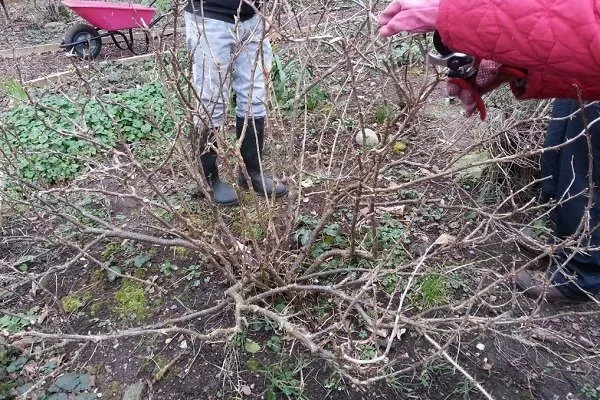
Autumn soil cultivation in the bush zone
Providing the crop with optimal conditions requires careful cultivation not only of the plant but also of the soil around it. In the fall, after the berries are picked, gooseberries begin to form buds for future flowering, so special care is required.
Soil cultivation is also necessary to protect gooseberries from the development of diseases in the spring and pest infestations (some insects easily survive the winter in the soil and remaining plants).
Removal of weeds and fallen leaves
The best habitat for pests is debris and weeds, which experienced gardeners recommend removing. In the fall, collect fallen leaves, then remove the weeds by hand.
If you can't pull out the weeds by hand, weed them, especially if they are deeply rooted (they will draw juices from the gooseberry rhizomes).
Pay special attention to crushed and rotten berries that have fallen off – do not leave them under the bush, otherwise fungal diseases will develop.
Digging and loosening
Loosening the soil around the bush is essential to saturate the soil and root system with oxygen. Otherwise, if there's not enough oxygen, the roots will begin to grow upward in the winter, leading to freezing.
Digging is important because it eliminates pests and prevents soil compaction. When performing this agricultural procedure, it's important to follow these tips:
- do not break up the clods as you do in the spring – just turn the pitchfork/shovel over;
- depth in the tree trunk circle – minimum 5, maximum 7 cm;
- the depth between rows is up to 15 cm;
- apply fertilizers while loosening the soil;
- work carefully so as not to damage the gooseberry roots;
- You can also dig during the first frosts.
Mulching and hilling
Gooseberries are susceptible to frost, so mulching is used to protect the roots from the cold. Mulch maintains the soil's porous structure and maintains proper water and air circulation.
First, hill up the bush with a 10-12 cm layer of soil, especially if the bush is infested with moths. The soil is raked away in the spring immediately after flowering ends.
Various materials are used as mulch:
- peat raw materials;
- thoroughly dried leaves;
- rotted sawdust.
Mulching involves laying down a 10 to 15 cm layer of material. Peat mixed half with wood ash is considered the optimal mulch. This enriches the soil with nutrients, allows it to breathe, and maintains the desired temperature.
- ✓ The mulch layer thickness should be at least 10 cm for effective protection against frost.
- ✓ Use only well-rotted organic materials to prevent pathogen development.
Fertilization
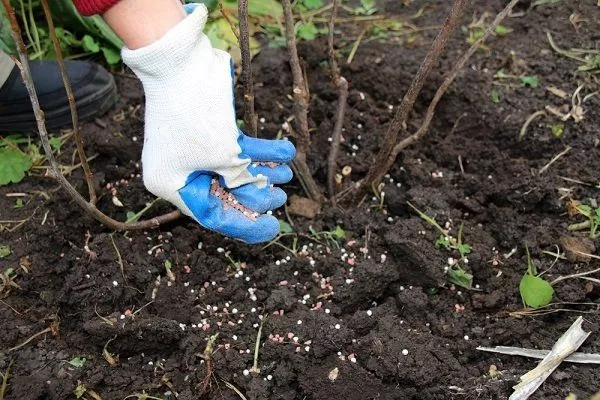
Due to its abundant annual fruiting, gooseberries require enriched soil. To achieve this, nutrient-rich fertilizers are essential in the fall:
- Phosphorus substance – enhances winter hardiness, branching, and growth. Signs of phosphorus deficiency include leaf spots, thinning shoots, and poor bud formation. It's best to use Double Superphosphate—30 g per plant.
- Potassium supplements Without potassium, the berries are small and underdeveloped, and the leaves die. One bush will require 20 g of potassium sulfate.
- Ash – enriches with nutrients, helps resist diseases and pests. Scatter 300g under the bush.
- Compost – strengthens the plant's immune system. Apply rotted fertilizer at a rate of 6 to 12 kg per plant, depending on the plant's age.
Other pre-winter fertilizers:
- Experts recommend foliar feeding. For this, use 220-230 g of superphosphate, 110-120 g of potassium salt, and 9-10 liters of water. Spray the bush with the solution.
- As a mineral fertilizer, a solution or dry mixture of 100 g of ash, 15-20 g of potassium sulfate, 25-30 g of superphosphate (8-10 l of water) is used.
- A store-bought product called "Autumn Fertilizer" is used. One bush will require 320-350 g.
Watering gooseberries in autumn
Gooseberries thrive on moisture, so watering requires special attention. If you don't water them in the fall, the roots and branches will dry out and freeze when exposed to frost.
Rules for moistening the soil before wintering gooseberries:
- in case of heavy autumn rainfall, watering is not carried out;
- in dry and warm weather, 30 to 60 liters of water are added under each bush (depending on the age - the older the plant, the more liquid);
- water is poured into the grooves around the trunk or directly under the root;
- Moistening is carried out 3-4 days before digging the soil.
Autumn gooseberry pruning rules
Since gooseberries are a berry crop, they grow rapidly, which leads to self-shading. This results in reduced yields and fruit production.
The bush formation procedure has the following advantages:
- improves the flow of light and air to the internal branches of the bush;
- the risk of pest infestation and disease development is reduced;
- maintenance is simplified;
- the quantity and quality of the harvest improves, the fruits become larger;
- Gooseberries bear fruit every year.
Untimely and improper pruning weakens the plant and reduces its immune system. Pruning is carried out in two stages: after harvest (sanitary pruning, from late July to September) and after leaf fall, from October to November (slightly earlier in the North, depending on the climate).
When carrying out sanitary pruning gooseberries in autumn, the following parts need to be removed:
- dry and damaged branches;
- elements affected by pests and diseases (burned after pruning);
- branches lying almost on the ground are cut down to the stumps (they are always in the shade, and infection occurs through them);
- shoots that get tangled with others grow inward or towards the center of the bush – up to the branching point;
- shoots aged 5 years or more;
- young weakened growth;
- thin sprouts.
Branches growing horizontally or downwards are shortened to buds that are directed towards vertical growth.
Formative and rejuvenating autumn pruning (after leaf fall) has the main rule: the strongest branches are left, which will be located evenly relative to each other.
Step-by-step diagram for autumn pruning of gooseberries:
- Inspect the bush and remove any leaves that remain on it.
- Use pruning shears to trim branches with cracks, lichen, and blackened areas. This also applies to branches older than 5 years, as their fruiting declines after this age.
- Remove shoots lying on the soil surface. They produce virtually no crop, but they can harbor pathogens.
- Trim off any broken, dry, diseased, or insect-damaged shoots.
- Practice shaping – use your hands to push apart the center of the bush and remove branches that cross with others or grow horizontally, as well as those that thicken the plant.
- Do not remove strong branches that have the wrong direction of growth, but turn them in the other direction, securing them with wire or rope.
- Treat the cut areas with a special insulating paste and remove the cuttings from under the bush.

Pre-winter treatment against diseases and pests
To increase yield and ensure healthy plant development, protect the plant from pathogenic insects and diseases in the fall. Treatment is carried out from the last ten days of October to the first week of November.
The following drugs are used for the procedure:
- Insecticides. Dilute at the rate of 10 liters of water - Bitoxibacillin (100 g), Lepidocide (one package), Actellic (15 ml).
- Fungicides. Topaz preparation – 1 ampoule per 9-10 liters of water, Fundazol – 10 g per 9-10 liters of liquid.
Other means of combating diseases and pests in autumn:
- Ferrous sulfate (3%) and Bordeaux mixture (2-3%). Shrubs should be sprayed after the leaves fall. These products are used against various insects and diseases.
- Oxychloride. Protects against cup-leaf rust, anthracnose, and septoria leaf spot. Use 40 g of product per 9-10 liters of water.
- Karbofos. Essential for protection against moths, sawflies, and aphids. 20 g of the product is required for 9-10 liters of water.
- Ash mixture. It's used to protect against various diseases and insect attacks. A mixture of equal parts onion peels, ash, potato tops, and garlic (1 kg) is added to 10 liters of water.
Covering gooseberries for the winter
For residents of the central and southern regions of the country, covering gooseberries is optional, but for those in the northern regions, it is essential. Gooseberries do not tolerate temperatures below -35-40°C.
Not all materials are approved for bush insulation. Ideal shelter options include:
- spruce branches;
- polypropylene fabric;
- spunbond;
- agrofibre;
- polycarbonate;
- sackcloth;
- lutrasil, etc.
- ✓ The material must allow air to pass through to prevent the bush from rotting.
- ✓ Make sure the material is strong enough to support the weight of snow without tearing.
The insulation procedure is carried out when cool weather stabilizes. If a thaw is expected, the bushes should not be covered.
The scheme for insulating gooseberries is very simple to implement:
- Hill up and mulch the root zone.
- Wrap all the branches with twine to form one bundle.
- Press the bunch to the ground surface and cover the branches with the chosen material.
- Sprinkle soil around the edges of the material to prevent it from blowing off in the wind.
If the bush has very stiff branches due to age, you can use a simplified covering method: simply cover it with material without tying or tilting it. Place heavy objects (bricks, stones) along the edges and cover with soil.
If the winter is snowy, the best option is to cover the branches with a layer of snow over the non-woven material. In very severe frosts, gardeners recommend additionally covering the wrapped branches with a 5-8 cm layer of dry grass to prevent cold penetration.
Rules for preparing gooseberries for winter, depending on the region
The timing and rules for preparing crops for winter depend on climatic conditions:
- South of Russia. Work continues until the first ten days of November at the latest. Watering is emphasized, as the climate is considered arid, so a minimum of 50 liters of water per plant is used.
- Moscow region and the Central Belt. Preparations must be completed by October 15th. Since the soil here is podzolic and acidic, additional liming and the addition of minerals and organic matter in large quantities are recommended.
- North, Siberia, Urals. Preparatory work should begin in mid-September. Formative pruning should not be performed in the fall (this is done in the spring), but sanitary pruning is necessary.
On flat, wind-blown landscapes, snow retention is provided (snowdrifts are created next to bushes for protection).
Common mistakes gardeners make
If a gardener makes mistakes in their gooseberry care, they risk a minimal harvest and small berries. In some cases, these mistakes lead to the death of the plants.
Most often, novice gardeners make the following mistakes:
- Excessively deep digging around the bush, which leads to damage to the root shoots;
- neglect of pruning and shaping or excessive manipulation;
- exceeding the dosage of nitrogen-containing fertilizers in the autumn (nitrogen is applied at the latest at the end of July);
- top dressing with unrotted manure;
- lack of mulch and cover;
- pruning shrubs during frosts;
- complete removal of shoots that are not older than one year.
An experienced gardener will tell you about preparing gooseberries for winter:
Gooseberries are a long-lived plant in any garden, but only if all care guidelines are followed. Since the plant is intolerant of severe frosts, it's essential to strictly adhere to the winter preparation guidelines. Only then will you be able to reap a rewarding harvest of large berries.