
The Pax gooseberry is one of the most popular varieties due to its abundant yield, excellent berry flavor, and ease of cultivation. This crop is renowned for its reliability, disease resistance, and abundant fruit production. Basic farming practices are essential to ensure high-quality fruit.
Description of the Pax variety
When choosing gooseberries for gardening, one important criterion is the level of thorns. Thornless varieties, such as Pax, are particularly popular. It boasts large, brightly colored berries, making it particularly appealing to gardeners.
History of creation
Pax is a hybrid gooseberry variety with a long history. Native to Canada, it was developed by Elizabeth Keep. Its parents are the Winam Industry variety and a seedling from a cross between Captivator and Lancashire Lad.
The variety was registered in 1989 and gained its greatest popularity in Canada, North America, and Europe. It is only just beginning to gain popularity in Russia, Belarus, and Ukraine.
Distinctive features of the shrub
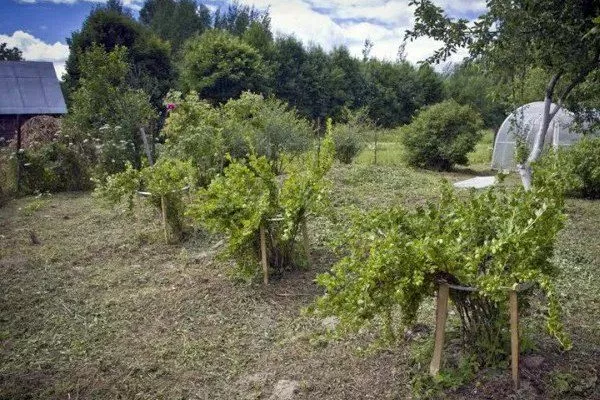
A perennial shrub reaching a height of 1-1.2 m. Characteristic features:
- The skeletal branches are covered with thin, peeling, slightly glossy grey-brown bark.
- Flexible annual shoots have a rich gray hue and are covered with numerous gray dots along their entire length.
- On the shoots there are brown scaly buds.
- Thorns begin to develop on young shoots, but fall off over time.
- Dark green wrinkled leaves with 2-5 ovate lobes reach a length of up to 6 cm.
- The leaf blade has a blunt margin. The leaf axils contain 2-3 single red-green flowers, each consisting of 5 rounded petals.
- Bisexual flowers make gooseberry a self-pollinating crop.
Gooseberry bushes are among the first among berry plants to bloom – in late April or early May.
Characteristics of berries
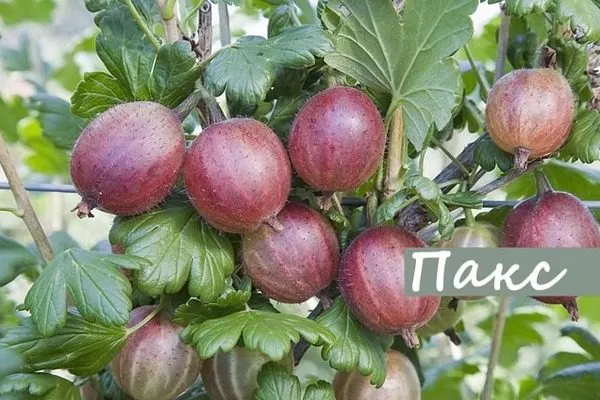
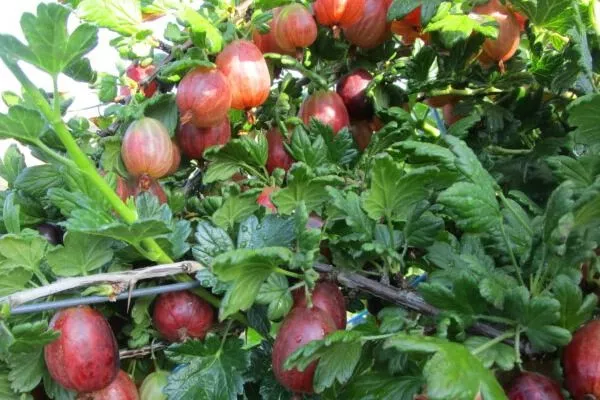
Pax is known for its large fruits. The berries have the following distinctive characteristics:
- They reach a weight of up to 14 g and have a regular round-oval shape and a smooth surface.
- The skin is strong and dense, with a distinct shine, perfect smoothness and light fluff.
- The veins are visible under the skin, as they are lighter than the main color.
- They are attached to thin stalks and do not fall off even after full ripening.
- At the technical maturity stage, the fruits are a soft pink color. Fully ripe, the fruits acquire a rich red-pink hue with burgundy-white veining.
- Under the skin lies fleshy, juicy, tender pulp with small seeds.
Use of Pax gooseberry fruits
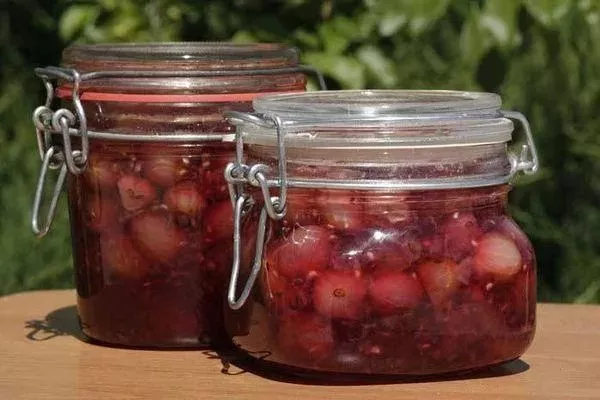
The berries of the hybrid Pax variety are often eaten fresh. They are excellent for making compotes, flavorful preserves, and jams. They can be frozen fresh or in sugar syrup, pickled, and used in fruit salads, purees, pastilles, and marmalades.
Ripening period and yield
It is distinguished by its early fruiting, allowing for a decent harvest as early as the second year after planting. This variety is considered early, with berries ripening in the third ten days of June. The mass fruiting period lasts for about two weeks, as they ripen simultaneously.
Productivity is impressive: a single bush can produce 12-15 kg of fruit. The harvest withstands transportation well thanks to its strong skin and dry picking. The fruit also keeps well, which is an advantage for early varieties.
Winter hardiness
It has high frost resistance, so mature plants do not require protection from cold. Mulching the area around the trunk with sawdust is sufficient to protect the root system.
Advantages and disadvantages
This crop will delight you with high and stable yields over a long period. This plant doesn't require constant attention, as it's unpretentious and resistant to adverse environmental influences.
Advantages:
Among the disadvantages, gardeners highlight:
Landing features
Planting gooseberry bushes doesn't require any special skills or knowledge. Simply follow these guidelines to grow a healthy and productive plant:
- Place and time of landing. Saplings are usually planted in the fall. In the southern and central regions, this can be done in late October or early November, and in the northern regions, mid-October. This allows the plants to accumulate enough wood to safely overwinter.
- Soil requirements. Gooseberries are undemanding and can grow in any type of soil. For a high-quality harvest, choose a sunny location to avoid fungal diseases and maintain the plant's resilience to adverse conditions.
- Selection of planting material. When purchasing seedlings, pay attention to the condition of the bark and root system. The bark of a young plant should be dark gray or gray-brown, and the roots should be firm and well-developed.
- Site preparation. Before planting, dig over the area to remove weeds. Dig the planting hole ahead of time and fill it with fertilizer.
Before planting gooseberry seedlings, immerse the root system in a clay or soil mixture with the consistency of sour cream. Dig planting holes 0.5-0.8 m deep and 0.8-1 m wide. Leave at least 0.7-1 m of space between individual holes, and for mass plantings, widen the row spacing to 2-2.5 m.
Step-by-step instructions:
- Place the seedling at the bottom of the hole, carefully spreading out its roots.
- Cover it with the remaining soil or a pre-prepared mixture of soil for seedlings, black soil and sand in proportions of 1:1:1.
- To increase the temperature in the hole, you can add coarse river sand or some pebbles, which will promote faster plant establishment.
After planting, water the plant with 5-10 liters of water and mulch the soil with a layer of sawdust, dry soil or grass.
Plant care
Adhering to a proper agricultural schedule when growing gooseberries guarantees a high-quality and abundant harvest for 15-18 years. Follow these simple care procedures:
- Watering. In spring and early summer, limit yourself to rain or drip irrigation. Drip irrigation is especially effective if plants are planted in rows. You can also use trench irrigation to pour water around the base of the plant. After each watering, mulch the soil to retain moisture.
Stop watering before the berries ripen to prevent loss of sugar content. Pre-winter watering is important to replenish moisture in the plants before winter. - Top dressing. Regular application of organic and mineral fertilizers promotes plant resilience and high yields. In early spring (before bud break): apply 25 g of ammonium nitrate or 30 g of urea. Apply liquid fertilizers only to moist soil to prevent root burn.
To spray the plant and the soil around the bush, use a solution consisting of 3 g of potassium permanganate and 1-2 g of boric acid per 10 liters of water. Consumption is 2-3 liters per bush.
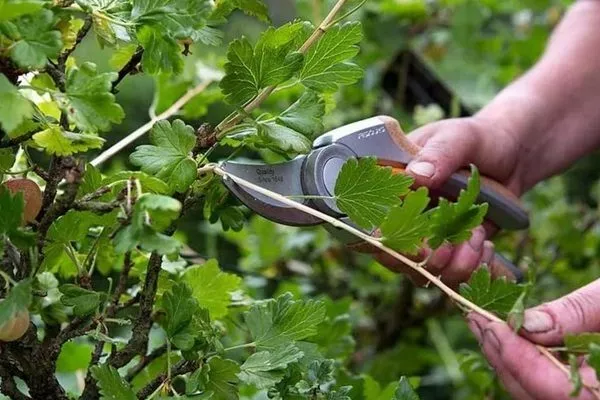
In late autumn: 5 kg of organic matter (rotted manure or compost), 15 g of potassium chloride or 100 g of wood ash, and 45 g of superphosphate, spread evenly over the soil within a 2 m radius of the bush. Work the fertilizer into the soil to a depth of 10–20 cm. - Trimming. Essential for maintaining health and yield. It's recommended to leave 3-4 strong one-year-old shoots on the bush and regularly perform rejuvenating pruning. Perform these procedures in different seasons and use specialized tools.
Adherence to agricultural practices will make growing gooseberries an effective and enjoyable activity, ensuring a stable, high-quality harvest for many years.
Preparing for winter
Concerns about the condition of bushes in winter may arise only in steppe regions, where there is little snow or it is constantly blown away by strong winds, leaving the ground bare. This can lead to freezing of the plant's surface roots.
In such cases, it's important to preserve the snow cover by regularly packing down the snow around the bushes or covering it with soil or wood chips. In forested and forest-steppe zones, such problems don't arise. It's enough to water the plant in the fall to saturate it with moisture and apply the recommended fertilizers in a timely manner.
Diseases and pests of the Pax gooseberry variety
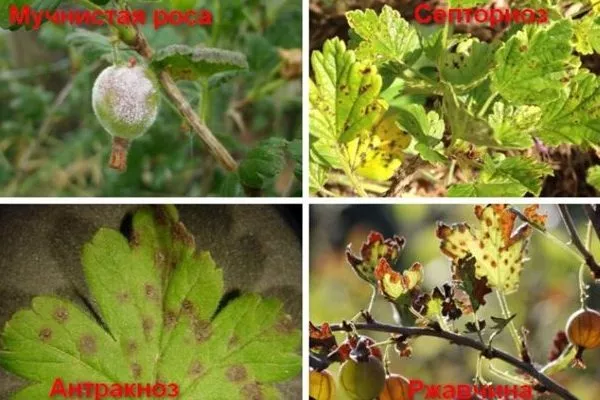
Gooseberry Pax has good disease resistance. Here are some common diseases and pests and how to control them:
- White spot (septoria). A fungal disease whose spores are spread by wind or rain. In winter, spores are found on diseased and fallen leaves and in the surface soil. Brown, round or irregular spots appear on leaves and fruit.
Spray the bushes with 1% Bordeaux mixture before flowering and after harvest. Clear the space between the rows of fallen leaves and burn them to prevent infestation. - Powdery mildew. A fungal disease that affects all green parts of the fruit and berries. Spores are spread by wind, rain, and insects. It appears as a loose white coating on the ovary, petioles, leaves, and fruit.
Water the bushes with hot water, spray with a fungicide or a solution of wood ash. - Anthracnose. A fungal disease that attacks plants in the spring, with spores overwintering on the affected foliage. It appears as small brown spots on young leaves that gradually merge into a single spot.
Spray the bushes with a solution of Oxydichloride or Skor before flowering and after harvesting. Completely clear the spaces between the rows of fallen leaves. - Gooseberry shoot aphid. A light green, ovoid insect up to 2 mm in size. It lays black eggs at the base of buds. It causes buds and young leaves to dry out.
Spray the bushes with a tobacco water solution or cut off and burn the tops of the shoots containing colonies. - Gooseberry moth. A yellow butterfly up to 45 mm in size with large black spots on its wings. The gray caterpillars have black square spots on their bodies. The pest feeds on young leaves.
Spray the plants with Kinmix and clear the area of fallen leaves. - Pale-legged gooseberry sawfly. A black insect with light spots up to 6 mm long. The female lays yellow eggs on the underside of leaves. The larvae chew numerous holes in the leaves and eat around the edges.
Treat plants with Kinmix and other products. Spray after the leaves emerge and as needed throughout the summer.
Harvesting
Fruiting begins approximately 2-3 years after planting. In the southern and central regions of the country, the first fruits can be harvested as early as early or mid-June. A single young bush can yield up to 20 kg of berries.
The fruits ripen simultaneously, allowing for a single harvest, saving time and effort. They remain firmly attached to the branches even after heavy summer rains, maintaining their flavor and shape.
Transportation and storage
By harvesting the berries 5-7 days before they're fully ripe, they can be safely transported over long distances. Their strong, dense skin allows them to be transported in open containers, minimizing the risk of leaks.
Fresh gooseberries can be stored in the refrigerator for up to two weeks. To do this, it's recommended to sort the berries, remove the leaves and sepals, wash them under running water, and store them in perforated plastic bags, 200–300 g at a time.
Gardeners' reviews
The Pax gooseberry is an ideal choice for those looking for a bountiful harvest of juicy, sweet berries without the hassle. Its advantages include high disease resistance, ease of care, and tough skin for long-lasting storage. Suitable for both beginner and experienced gardeners.