
Gooseberry "Honey" is an old, tried-and-true variety with a unique honey flavor. It attracts gardeners with its large, sweet berries and productive bushes. Let's learn how to plant this gooseberry and what problems might arise when growing it.
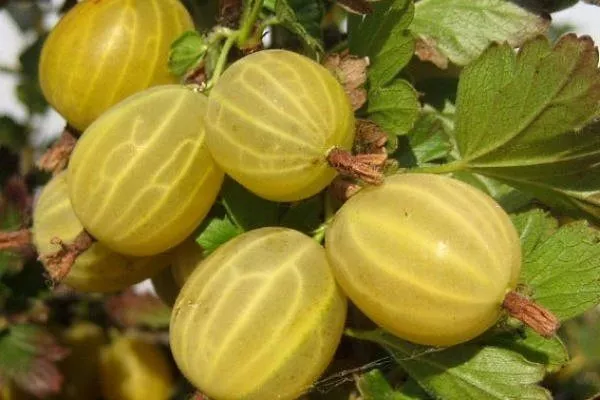
Honey gooseberry variety
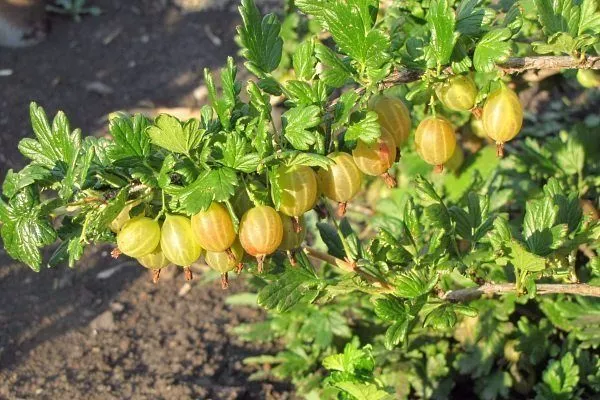
The speed of growth and fruiting of the gooseberry bushes "Honey" makes it a leader among other varieties
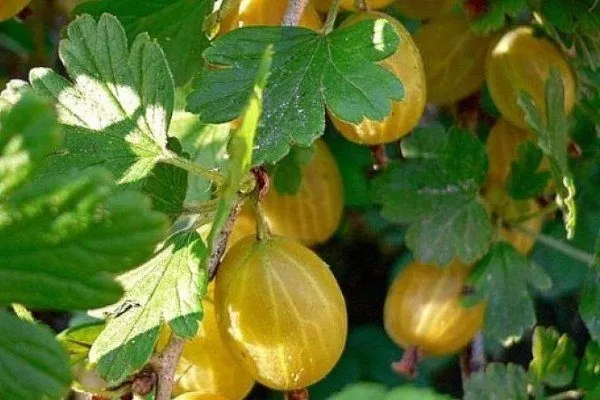
The taste and appearance of the berries fully justify the name of the variety "Honey"
History of the variety's development
The variety was developed during the Soviet era at the Michurin All-Russian Research Institute of Horticulture. Honey gooseberry was obtained by pollinating the American variety Purman. Pollen from European varieties—Industria, Green Bottle, Finik, and Kareless—was used.
Despite its popularity among gardeners, this variety is not listed in the State Register. Information on its varietal properties and characteristics is based on brief official sources and gardener reviews.
Gooseberries are known to have been cultivated in Kievan Rus' since the 11th century, where the berries were known as "agryz" or "bersen." The berry arrived in Europe in the 16th century.
Botanical description of the Honey gooseberry
The variety's main distinguishing feature is its yellow fruit. Its color, flavor, and aroma are reminiscent of honey, making it easy to see why it's called Honey Gooseberry.
Bushes
The bush is vigorous but not spreading. Height: 1.5 m. Branches are covered with mixed thorns. The bark is gray. Basal shoots are few and grow upright. Leaves are small, green, slightly glossy, and moderately wrinkled. The shape is trilobate.
Berries
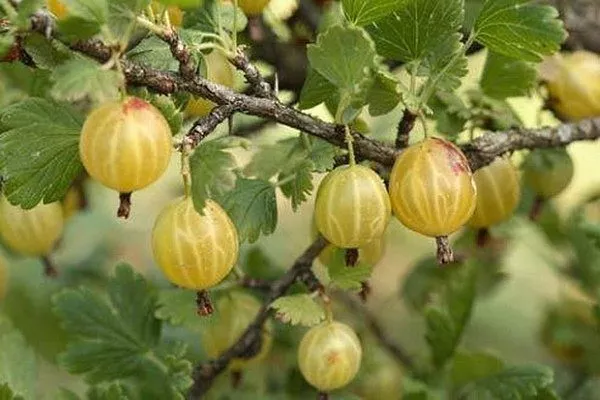
Honey gooseberries produce large fruits. The average weight is 4.3 g, with a maximum of 6 g. The fruits are round or pear-shaped, with thin skin. The flesh is tender and juicy, with few seeds. The color is green at first, turning a honey-golden color when ripe. The sun-exposed side is tanned.
Features of honey gooseberry
Honey gooseberry is a dessert variety. The fruits are very sweet, with honey notes in their flavor and aroma. This variety can surpass one of the sweetest gooseberries, the English yellow, in sweetness.
Honey berries contain between 9.9 and 17% sugar—the sweetness depends on the weather, sun exposure, and other factors. With proper care, the bushes can live and bear fruit for 20 years.
Ripening time
This variety belongs to the mid-season group. Ripening in the temperate zone occurs in mid-July. Ripening time is influenced by the region's climate and specific weather conditions. Technical maturity occurs two weeks before consumption.
Productivity
Honey is a high-yielding variety. With proper cultivation, one bush produces about 4 kg of berries. 10-11 tons can be harvested per hectare.
The video below provides an overview of the 'Honey' gooseberry variety:
Sustainability
A variety's popularity among gardeners is rarely explained by its consumer qualities alone. Popular varieties are typically undemanding and hardy. Honey is one such variety, distinguished by its enviable resilience to environmental challenges.
Towards drought
The variety has average drought resistance – it can withstand short-term droughts without significant consequences for yield.
Towards frost
The variety tolerates frost very well, especially in snowy winters. It can withstand temperatures down to -30°C. If temperatures drop to -40°C and the gooseberry bushes are uncovered, there's a high risk of them freezing.
To diseases
Like most older varieties, Medovyi isn't particularly immune. However, it is fairly resistant to powdery mildew, with berry damage rates of 1-3% and vegetative damage rates of 0.3-0.7%. However, this only applies to mature bushes; young plants can be seriously damaged by powdery mildew.
- ✓ Yellowing of leaves between the veins may indicate a magnesium deficiency.
- ✓ Stunted growth and small leaves may be a sign of nitrogen deficiency.
Among the diseases dangerous for Honey are gray mold and anthracnose.
To pests
The variety isn't particularly resistant to pests or diseases. It's particularly susceptible to:
- Firefly – a butterfly that lays eggs on flowers. When the berries appear, they turn red and rot.
- Shoot aphid – sucks the juices from the above-ground parts of the plant. Shoots become deformed, leaves curl.
- Sawfly – an insect that lays eggs on leaves. The larvae eat the leaves, leaving only the veins.
Growing conditions
The Honey gooseberry, like most varieties, is grown primarily in temperate regions. Here, it is prized for its early ripening, sweet fruit, consistent fruiting, and high winter hardiness. This variety can be grown uncovered in regions with moderately cold winters; in northern climates, the bush requires winter insulation.
Quality of transportation
At the technical ripeness stage, the berries tolerate transportation well. Under favorable conditions, the fruits can be stored for 1.5 weeks. At normal temperatures, the Medovyi gooseberry fruit will not last more than 2-3 days; after this period, it begins to spoil. Gooseberries are transported in shallow boxes, lined with paper.
Advantages and disadvantages
Advantages of the variety:
- early ripening – by mid-summer the berries reach consumer ripeness;
- large and sweet berries;
- winter hardiness;
- productivity;
- The fruits contain a lot of sugar and vitamin C.
Flaws:
- weak resistance to many gooseberry diseases;
- thorny shoots - difficult to harvest;
- demanding of light, soil and care;
- the need for regular pruning.
Planting recommendations
The growth, development, and fruiting of a gooseberry bush largely depend on planting conditions. To ensure that the gooseberry takes root and thrives, it's necessary to prepare the hole and seedling, and then plant it according to planting guidelines.
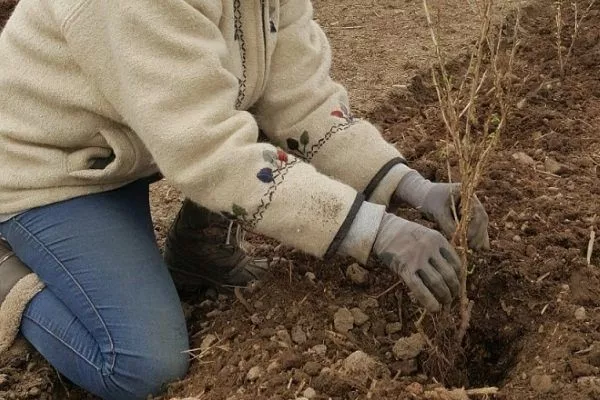
Selecting a location, timing and preparing the site
Optimal conditions for growing the Honey gooseberry:
- no drafts;
- flat or elevated terrain;
- good natural lighting;
- lack of shading from buildings and plantings;
- soils – neutral or slightly acidic, preferably light sandy and sandy loam.
- ✓ Soil pH should be between 6.0-6.5 for optimal growth.
- ✓ The depth of groundwater is at least 1.5 m to prevent root rot.
It is advisable to plant gooseberries near a fence, wall, or on a hillside – this reduces the likelihood of powdery mildew.
It is not recommended to plant gooseberries:
- on clay and loamy soils - here the plant survives only with constant loosening;
- in lowlands and marshy areas - due to constant moisture, the roots rot and the bush dies;
- on silty, peaty and loamy soils;
- in areas with high groundwater levels – less than 1.5 m.
For heavy clay soils, it is necessary to add sand (1/2 bucket per 1 sq. m) and humus (1/3 bucket per 1 sq. m).
Preparing a site for planting gooseberries:
- Dig the soil to the depth of a shovel blade. Remove weeds and their roots as you dig.
- Add organic and mineral fertilizers during digging. Per square meter: 3-5 kg of humus, compost, or rotted manure, 200 g of wood ash, 50-60 g of superphosphate, 30 g of urea, and 15 g of potassium nitrate or potassium chloride.
A single gooseberry bush requires an area of 4-6 square meters. If the soil is poorly nutritious, add a mixture of mineral fertilizers and humus (compost, manure) to the bottom of the planting hole.
Gooseberries can be planted in early March, before the buds open, or in the fall. The optimal time for fall planting is the third ten days of September. The seedlings should have time to take root before the frost sets in.
Selecting and preparing a seedling
When purchasing seedlings, pay attention to the following points:
- The seedling should have 3-4 taproots 30 cm long. The root system is fibrous and well developed.
- The seedling should have 2-3 branches 20-25 cm long. It's advisable to trim one to check the cut—it should be white-green. If the cut is beige or white-brown, the seedling is not suitable.
- The bark is smooth and even, without damage, spots, or signs of disease.
The best age for a seedling is 1-2 years. Before planting, remove all dry and damaged branches, and soak the roots for 12-24 hours in a Humate solution (4 tablespoons of fertilizer per half a bucket of water). This soaking stimulates root formation.
You can also soak the seedling in a weak solution of potassium permanganate or Barrier to disinfect the roots. Before planting, dip the roots in a clay-manure slurry, prepared in a 1:1 ratio. The consistency is a thick paste. Allow the slurry to dry thoroughly before planting.
Planting hole
The hole is prepared a week to a week and a half before planting. Specific features of the hole for gooseberry seedlings:
- The size of the hole depends on the soil characteristics. In loam, sand, and sandy loam soils, the hole depth is 35-40 cm and the width is 50-55 cm. In heavy clay soils, the hole depth increases to 50-55 cm and the width to 70 cm.
- If the soil is clayey or loamy, place coarse river sand or gravel at the bottom of the pit. The layer should be 7-8 cm thick. If the pit is dug in sandy soil, place a layer of clay at the bottom.
Step-by-step planting instructions
If you are planting several gooseberry seedlings, keep the intervals:
- between rows – 1.5-2 m;
- between seedlings – 1-1.5 m.
Planting a gooseberry seedling – step-by-step instructions:
- Trim the seedling prepared for planting by soaking – shorten the roots to 20 cm, and also remove any defective branches, if any.
- Place the seedling in the planting hole so that its root collar is 5-6 cm below the hole's rim. This position promotes accelerated growth and root formation. If the soil is light, place the seedling upright; if the soil is clayey, place it at a slight angle to promote rooting.
- Spread the roots out in different directions. Fill the hole with soil, right up to the top edge. Add soil little by little, compacting it with your hands from time to time to prevent air pockets. Once the hole is filled, compact the soil firmly.
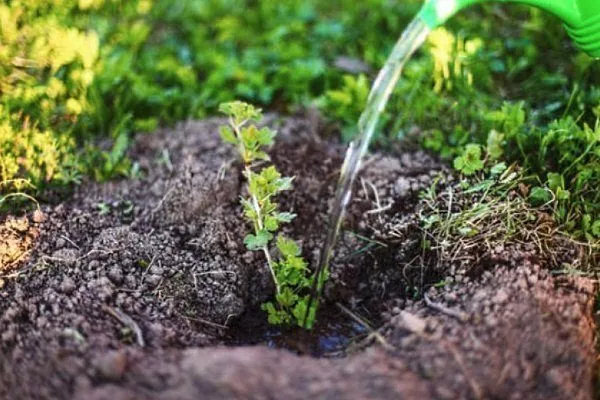
- Water the gooseberries, placing a bucket of water under each seedling.
- After the water has been absorbed, sprinkle the area around the tree trunk with humus or peat. Apply a layer 6-7 cm thick.
- Prune the shoots, leaving 3-4 buds on each. If there are any weak shoots, it's best to cut them off as they still risk freezing in winter (if planted in the fall).
- Two weeks after planting, the seedlings will need to be hilled up. Rake the soil up to the trunk. Create a mound 10 cm high. Sprinkle the top of the mound with fine sawdust, a 10-12 cm layer.
Gooseberry care
Gooseberries are easy to care for; a few basic farming practices are all that's needed. This berry crop requires watering, fertilizing, pruning, loosening, and pest and disease control.
You can read more information about how to care for gooseberries in the fall. Here.
Watering
Bushes are watered only at the roots; overhead irrigation is unacceptable for both seedlings and mature bushes. The bulk of the roots are located 35-40 cm below the surface. Water the bush infrequently but thoroughly. Overwatering is unacceptable.
The need for watering increases:
- during the formation of fruits and flower buds for the next year - this period lasts from the second half of May to the second half of June;
- when the fruits ripen – from the second ten days of July;
- in preparation for winter - from the third ten days of September.
One mature bush requires 3-5 buckets of water. Watering frequency is once a week. Water is poured into grooves dug half a meter from the trunk. The grooves are 12-15 cm deep. In hot weather, the root zone is lined with grass and sprinkled with peat or compost to retain moisture evaporation.
Top dressing
Gooseberries are fed through both root and foliar application, such as spraying. Table 1 lists the timing, composition, and rates of fertilizers applied to the soil and sprayed onto the plant's surface.
Table 1
| Period | How often? | What and how much to contribute? |
| Spring. Before the buds open. | Annually | Add urea (20-30 g per square meter) when digging. Alternatively, dilute 60 g of urea and 30 g of boric acid in a bucket of water. Or, dilute fresh manure in water at a ratio of 1:4. |
| Spring. Before flowering. | Once every two years | Enter per 1 sq. m:
A double dose of mineral fertilizers can be dissolved in 20 liters of water and watered at the root of the bush. If the bush is lagging behind in development, apply organic fertilizers annually. |
| Summer. During fruit setting. | Annually | For 10 liters of water:
For one bush – 25-30 liters of solution. Or add biofertilizers such as Yagodka, Biohumus, and others. |
| Autumn. After picking berries. | Annually | Apply potassium-phosphorus fertilizers or superphosphate at a rate of 20 g per square meter, and potassium sulfate at a rate of 30 g. Organic fertilizers, such as fresh cow manure (1:10), are also recommended. Bird droppings can be added in the third year of the plant's life. |
Nitrogen should not be applied in the fall, as it stimulates the growth of green mass. The plant will not have time to "go dormant" and store nutrients for the winter.
Support
To prevent berries from getting dirty or rotting, keep them from touching the ground. Supports—wooden poles or wire stretched between two posts—help prevent branches from touching the ground. The optimal distance from the support to the ground is 30 cm.
Trimming
Mature Honey gooseberry bushes reach 1.5 m in height and 1.2 m in width. It is recommended to prune the bush every spring and fall in order to:
- thinning out rapidly thickening crowns;
- facilitating harvesting;
- removal of all dried branches, dead shoots and shoots damaged by diseases;
- maintaining high yields.
Features and important points of gooseberry pruning:
- The most berries are produced by branches 5-7 years old, up to the third branching point. One-year-old trees also produce a lot of fruit. Therefore, branches older than 7 years and their fourth branching point are pruned.
- Young shoots 2-3 years old don't have their tops pruned, unless they produce small, deformed, or unsweetened gooseberries.
- Branches aged 8-10 years are cut off at the very base - they will be replaced by new skeletal shoots that will bear fruit.
- In the fall, sanitary pruning is necessary. The bush's crown quickly becomes dense, blocking light penetration. Excessive shade and humidity can make the plant susceptible to fungal and viral diseases.
- It is necessary to trim all weak, deformed, curved branches, as well as shoots growing towards the center of the bush.
Pruning is carried out with a sharp, disinfected tool. Immediately after pruning, the cuts are treated with copper sulfate dissolved in water (10 g per 1 liter of water), and then coated with garden pitch.
Loosening and weeding
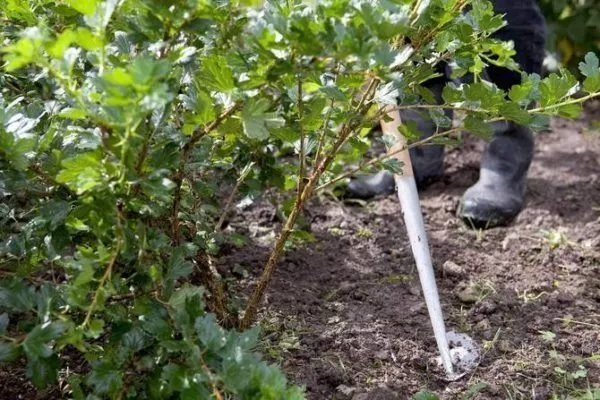
Loosen and weed the soil around the gooseberry bushes after each watering. This should be done very carefully to avoid damaging the roots, which are located close to the surface. While loosening the soil, remove all weeds from the tree trunks.
Preparing for winter
Winter preparation procedure:
- Clear the tree trunk area of fallen leaves, fruit, and dry grass. Remove broken and dried branches. Burn plant debris—this is necessary to kill larvae, fungi, and microbes.
- Dig and loosen the soil. Large clods of soil are not broken up.
- If the soil is acidic, add dolomite flour (250 g) per 1 square meter. m.
- Sprinkle the tree trunk circles with humus, peat, and sawdust.
- The branches of mature bushes are tied into a "broom"—one or more. This will prevent branches from breaking off during snowy winters.
- At the end of October, spruce branches or straw are laid around the base of the bush. The base is wrapped in covering material and tied with twine. This precaution will protect the bush – rodents will not be able to feast on the bark.
Covering is done in late autumn. If you rush and cover the bush in warm weather, it can be damaged. Moisture will accumulate under the cover, and the plant will begin to rot.
Reproduction
Methods of propagation of Honey gooseberry:
- Layers. This is the most common propagation method. Ditches 15 cm deep are dug from the trunk of the bush. Young gooseberry branches are placed in these trenches and then pressed down with staples. There's no need to lift the tops above the soil. Offshoots will appear very quickly.
- Cuttings. The time for this procedure is mid-July. Cuttings with five buds are taken from this year's growth. The cuttings are planted at an acute angle.
- Dividing the bush. Propagation is in the fall. The bush's parts often grow separately, and division does not harm the plant in the least.
Pest and disease control
Susceptibility to most diseases isn't a barrier to growing this delicious gooseberry. Timely spraying of the bushes can prevent viruses, fungi, and pests. Table 2 lists diseases that threaten Honey Gooseberry and how to control them, and Table 3 lists pests.
Table 2
| Diseases | Symptoms | What to do? |
| Mosaic disease | Light green or yellow stripes appear near the veins. The leaves stop growing and fall off. | There is no effective control. Diseased plants are uprooted. Prevention helps: purchasing healthy planting material and disinfecting cutting tools with a potassium permanganate solution. |
| Septoria (white spot) | There are brown spots on the leaves and berries. Over time, they turn white. | Before bud break, spray with Nitrafen (50 ml per bucket), Bordeaux mixture (100 ml), or copper sulfate (120 ml). Repeat after flowering. |
| Anthracnose | Gray and brown spots appear on shoots and leaves. Berries and leaves fall off. | Before the buds open, the bush and soil are sprayed with Nitrafen (50 g per bucket) or Bordeaux mixture (100 ml). |
| American powdery mildew | The leaves and shoots develop a white coating, which then turns gray. The shoots stop growing, and the berries fall off. | Before the buds open, the bush is sprayed with copper sulfate (120 g per bucket), iron sulfate (300 g), colloidal sulfur (150 g), soda ash (40-50 g), as well as Fitosporin or other effective preparations. |
Table 3
| Pests | Damage caused | How to fight? |
| Spider mite | The mite lives on the underside of leaves. It weaves a web around the leaves. Greenish-yellow spots appear on them, eventually merging into spots. The leaves dry out and fall off. | Spray with specialized anti-tick agents—acaracides. Ticks quickly develop immunity, so the agents are changed. Treatments can include Akaratan, Zolon, Metaphos, and others. |
| Shoot aphid | The leaves curl and dry out. The shoots become deformed and stop growing. | At the end of May – treatment with Actellic, Karbofos, Vofatox. |
| Sawfly | Caterpillars eat leaves, shoots and ovaries. | Burn fallen leaves. Dig and loosen the soil. In May, spray with a tar solution (30 g per bucket) or pine needle extract (50 ml) with grated soap.
Spraying during flowering – Gladiator, Lightning, other insecticides. |
| Gooseberry moth | The butterfly lays eggs in the buds. The caterpillars entangle the ovaries in cocoons. The fruits turn yellow and fall off. | Zircon treatment – to boost immunity. Remove and destroy damaged fruit. After flowering, treat with Actellik or Karbofos. Repeat after a week, if necessary. |
Harvesting: timing and nuances
Technical maturity occurs two weeks before full ripening. Berries for compotes and jams are harvested from July 10th to 15th. For fresh eating, berries are picked in the morning or evening, during dry weather.
If rain is expected soon, gooseberries are picked early. This will prevent the berries from falling off, rotting, or cracking. The fruits are harvested all at once. The berries, picked with their stems, are placed in a small wicker container, holding up to 3 liters.
Honey berries are versatile – when ripe, they're delicious fresh, unripe, greenish berries are used to make compotes, and green-yellow ones are used to make jam. The berries are also suitable for freezing.
Gooseberries contain pectin, which helps cleanse the body of toxins and waste.
Gooseberries to be transported long distances are dried in a single layer. Any damaged berries are sorted out.
The fruit has a fairly thin skin, so gooseberries that have reached consumer ripeness are picked with the stems—they're about 5 mm long. Otherwise, the skin often tears, causing the fruit to burst, making it unsuitable for storage and transportation.
When picking gooseberries, wear leather or canvas gloves—they're placed on the hand you use to part the branches. When picking gooseberries from thorny bushes, follow these steps:
- Remove gooseberries from all outer branches that you can reach without removing the support or garter.
- Remove the support to allow the bush to “fall apart” – then the internal branches will become accessible.
- To pick berries from the middle of the bush, use a pitchfork.
Picking gooseberries is a complex task. To make it easier, gardeners come up with various tools. For example, they cut a pot or ladle in half. Attach prongs to the cut end. After lifting the branch, they run these prongs along it. The downside of this method is the risk of damaging vegetative and flower buds. If these are damaged, there will be no harvest next year.
Storing gooseberries
The harvested crop is immediately placed in a cool place—berries can be stored in the refrigerator, cellar, or basement. However, even under the most favorable conditions, berries should not be stored longer than 2-3 days.
Features of storing gooseberries:
- To extend the shelf life of berries to 12 days, they are harvested 4-5 days before full ripeness. The fruits ripen within 2-3 days.
- At 0°C and 90% humidity, gooseberries can be stored for up to 1.5 months. The berries are spread thinly in cardboard boxes or wooden crates.
- Berries stored in plastic bags in the fruit and vegetable drawers of refrigerators can last for 3-4 months. To prevent condensation, pre-chill the berries. Before eating, place them in a place with a temperature of 8 to 10°C for 8 hours.
Reviews of Honey Gooseberry from gardeners and vineyards
The main problem with growing Honey Gooseberry is the bushes' susceptibility to disease and pests. This excellent variety lacks the immunity of modern counterparts, but the honey-like flavor of its amber-colored berries still captivates gardeners—and they're willing to fight for a harvest just for it.