
Given the medicinal and flavorful properties of gooseberries, many gardeners are tempted to propagate their gooseberry bushes. With careful adherence to the proper growing techniques, this is a simple process, even for a novice gardener.
The best time to propagate a shrub
The optimal time for propagation depends on the chosen method, the gooseberry variety, the plant's age, and the gardener's ultimate goals. Most often, this is autumn or spring. For example, layering is done in early spring. Green cuttings are planted in early summer, and dry ones in mid-autumn. Division is done in autumn and spring; the exact timing also depends on the regional climate.
In addition to choosing the right time of year, it's important to follow planting care recommendations and create favorable conditions for shoot growth. For active root development, young gooseberries require warmth, moisture, fertilizer, and regular hilling.
- ✓ No spots on leaves and stems.
- ✓ Flexibility of shoots, indicating their viability.
For gooseberry propagation, select only healthy plants free of bark defects, deformations, and signs of fungal or viral infections. This is determined by visual inspection. It is recommended to perform this procedure before the growing season, otherwise there will be no harvest during the season.
Methods of propagating gooseberries in summer and autumn
The process is simple, and the results depend on the planting material. Gooseberries are propagated by seeds, cuttings, layering, and by dividing the mature bush. Each method has its own subtleties, but the end result is between 1 and 10 strong seedlings ready for transplanting into the ground.
Layering
This is the simplest and most accessible method of propagating gooseberries. The procedure doesn't stress the bush, as the shoots are already developed and rooted, like independent plants.
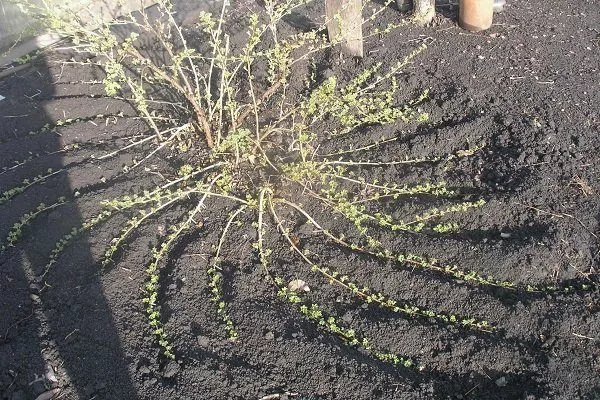
Gooseberry branches can droop to the ground on their own, become buried in soil under the wind, and begin to root. Noticing this, a gardener can only tend to the shoots or prudently separate them from the parent plant.
Gooseberry plants are grown using arched, vertical, and horizontal layering. It's best to choose a mother plant that's 2-6 years old and has branched roots and shoots. The soil should be dug over first and fertilized with manure and compost.
For information on how to propagate gooseberries by layering, watch the following video:
Horizontal
This method ensures that gooseberry fruiting does not slow down. In addition to a good harvest, you can obtain a large number of shoots. For propagation, use 1-2-year-old shoots. Mature gooseberries should not be older than 2-3 years. Using older plants reduces the number of mature seedlings.
Preparation for gooseberry propagation begins one year in advance. Old and diseased shoots are removed, and the bushes are pruned. This ensures healthy seedlings with strong root systems. This method is suitable when a large number of shoots are needed in a single season.
Technology of propagation of gooseberries by horizontal layering:
- Select 5-7 healthy shoots, exclude the presence of infection.
- Dig a hole 10 cm deep near the mother bush.
- Place the branch at the bottom of the hole and secure it with wire or staples.
- Cover the shoot with soil, do not trample it down.
- Water generously with warm water.
All that's left to do is care for the shoots and wait for the young plant to take root. To do this:
- Water the shoots moderately to prevent the root system from rotting.
- When branches emerge from the ground, apply a layer of humus as fertilizer.
- After 2 weeks, hill up the shoots to a height of 5 cm.
- When young leaves fall, cut the shoot from the mother bush.
- Transplant to a permanent growing location.
With proper care, the mother bush will continue to bear fruit, and the harvest from the young plant can be collected the following season.
Vertical
This propagation method is more suitable for 4-6 year-old plants. Mature gooseberries are rejuvenated and do not bear fruit for the next two years. The resulting shoots are 3 to 7 young shoots.
Technology of propagation of gooseberries by vertical layering:
- Remove shoots from the mother bush in the fall.
- When the height of the young shoot is 20 cm, fill it halfway with soil.
- Use a vertical peg as a support.
- Hill up the soil throughout the season.
- When watering, use the ditch method to avoid damaging the hilling.
- In the fall, dig up a branch with leaves and a strong root system.
- Transplant the young plant to its future growth location.
Arc-shaped layers
To obtain strong seedlings, propagate gooseberries using arc-shaped layering. This method differs from horizontal layering in the shoot shape, the method of planting them in the soil, and the number of seedlings.
Sequence of actions:
- Bend a cutting from an adult bush into an arc.
- Dig in some soil in the middle (in one place) so that the top is visible from the ground.
- Trim the end of the stem to encourage better branching of the young plant.
- When a strong seedling appears in the fall, divide it from the mother plant.
- Dig it up and transplant it to its permanent location.
Cuttings
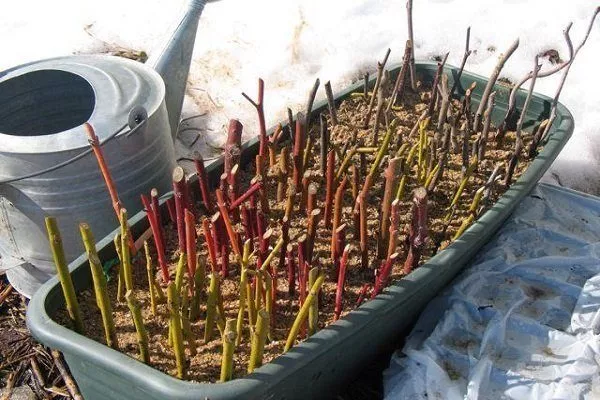
Cuttings are taken in spring, summer, and fall, depending on the gardener's goals. Large quantities of planting material can be obtained at once. Cuttings are often necessary if the desired plant is located elsewhere, or if the gardener wants to diversify the gooseberry varieties in their garden.
- ✓ The presence of at least two buds to ensure growth.
- ✓ No signs of disease on the cut.
The mother plant should be no more than 8-10 years old, otherwise the gooseberry cuttings will root poorly. Choose a healthy plant—free from defects and obvious signs of disease. Propagation by cuttings is labor-intensive; layering is easier.
General rules:
- the lower cut of the cutting is oblique, the upper one is horizontal;
- the root system is formed after 1 month of cuttings;
- a cutting with 2 buds and 2 leaves (at least) is selected;
- the cut is treated with a growth stimulator;
- The cutting needs its first abundant watering.
Green cuttings
Choose young shoots that haven't yet developed bark. To obtain strong shoots, take cuttings in the fall.
Green stem propagation technology:
- In mid-summer, cut a 15 cm high cutting with 6-8 leaves.
- Place the lower part of the shoot in a solution with a growth stimulator for 12 hours.
- In the greenhouse, dig holes 5 cm deep and plant the cuttings in them.
- Plant the cuttings at a distance of 5-7 cm from each other so that the root system does not become intertwined.
- Maintain the temperature in the greenhouse at 30-35 degrees.
- After 2 weeks, use nitrogen fertilizer to strengthen the roots.
- In spring, transplant the young branches to a permanent location.
Cuttings can also be taken in open ground, but in this case the plant must be well wrapped for the winter, otherwise the root system will freeze and the plant will die.
Lignified cuttings
The older the gooseberry shoots, the more difficult it is to root them. Therefore, woody cuttings are used less often than green shoots. Propagation is carried out at the end of the gooseberry growing season – in September and October.
Sequence of actions:
- From woody stems, cut a cutting 15-20 cm long.
- Tie 20 prepared branches with thick material, but do not squeeze.
- Place a bunch of branches in a mixture of peat and sand.
- Leave it on, moisturize periodically.
- After a month, divide the bunch and dry it on sawdust until spring.
- Tilt the cuttings and plant them at a distance of 5-7 cm from each other.
- Leave 3 buds above the soil surface.
- Plant the rooted cuttings in open ground in the fall.
Combined cuttings
If young shoots have grown to 10-15 cm in length, propagation is carried out using combined cuttings. This method is quick, has a good survival rate, and is not much different from planting green stems.
Sequence of actions:
- Cut off a young shoot with some of last year's bark.
- Place in water, use a growth stimulant.
- When roots appear (after 15 days), transplant the cutting into wet sand in a greenhouse.
Branches
For propagation, a branch from a mature plant with a well-established root system is used. To ensure this, the roots are partially dug up and visually inspected. To avoid damaging the entire root system, a lateral branch is selected.
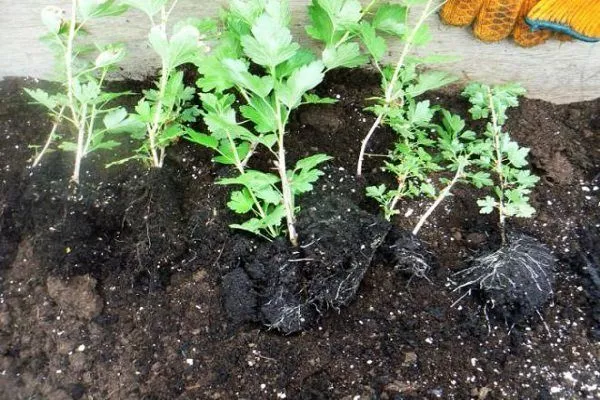
Sequence of actions:
- Use a wide shovel to cut off part of the mother bush.
- Cut back to half the growth (about 25 cm).
- Make a hole 20-30 cm deep, fertilize the soil.
- Place the cuttings in the hole at an angle.
- Fill the hole with soil, mulch, and water generously.
- Sprinkle with soil again and compact the soil.
- After 2 weeks, feed the bush with nitrogen fertilizer.
- Transfer the young plant to its permanent planting site in the fall.
By dividing the bush
This method is reliable and is performed at the beginning or end of the growing season. The best time to divide the bush is from mid-October to April. This method of propagating gooseberries is necessary in three situations:
- The plant is over 10 years old, and its fruiting has noticeably deteriorated.
- The bush has grown a lot and is a nuisance on the site.
- There was a need to transplant an adult bush to another location.
Since young shoots produce branching roots, divide the bush only if these branches are present (into approximately 3-4 parts). Follow these steps:
- Dig up a mature bush.
- Rinse off the root system with a strong stream of water.
- Divide the root system so that 2-3 young shoots, the majority of the roots, remain on one part.
- Sprinkle the cuts with crushed charcoal.
- Chop the old bush with an axe, divide the younger one with a sharp knife.
- Remove damaged and underdeveloped parts of the root system.
- Transplant the updated plant to a permanent location.
- Hill up the soil and shorten the branches by a third.
It's best to carry out this procedure in the fall, as this will increase the chances of a good harvest the following season. To ensure fruiting, regular hilling of the soil under the bush and adequate watering are necessary.
If the bush has grown too large, this will negatively impact the yield. A good solution is to divide the mature bush.
Sowing seeds
Propagating gooseberries by seed isn't always successful due to cross-pollination. The transfer of pollen from one variety to another results in the loss of the mother plant's characteristics. Furthermore, the quality of seeds from some producers leaves much to be desired. It's recommended to use seeds from mature plants.
When propagating gooseberries by seeds, the gardener's sequence of actions is as follows:
- Divide the ripe fruit and remove the seeds.
- Rinse in water to remove pulp and let dry naturally.
- Prepare a container, fertile soil and drainage.
- Place gravel, expanded clay, and brick on the bottom of the container.
- Enrich the soil with humus and sand.
- Make small indentations 5 cm apart.
- Place the seeds in them and lightly sprinkle with soil.
- Water the soil in the container and cover with cling film or glass.
- Maintain the temperature at 3-5 degrees.
- When seedlings with 2 leaves form, transplant them into open ground.
One container yields 5-7 strong seedlings. It's best to remove weak and defective shoots immediately. Water the soil as it dries out, otherwise the root system will rot. Even healthy seedlings don't always produce the desired gooseberry variety, and fruiting is also questionable. This is the main drawback of seed propagation.
For information on various gooseberry propagation methods and care features, watch the following video:
Peculiarities of propagating thornless gooseberries
Thornless gooseberry varieties are propagated by green cuttings or all types of layering. When planting, follow these guidelines:
- The upper cut of the cutting is straight, the lower one is oblique.
- Select shoots 15 cm long.
- Before planting, dip the cuttings in a solution to stimulate root growth.
- Plant in a greenhouse at a 45 degree angle, moisten the soil beforehand.
- Hill up the beds and treat them with peat and humus.
- Wrap the cuttings in dry leaves for the winter.
- When the seedling reaches 20 cm, transplant it into open ground.
The choice of gooseberry propagation method is individual. The determining factors are the plant variety, climate conditions, and the desired result. Overall, the procedure is simple; the main thing is to strictly follow the recommendations outlined in this article.