
The Beryl gooseberry is a winter-hardy variety bred for harsh northern conditions. It is prized for its hardiness, undemanding nature, and the superb dessert flavor of its juicy, light-green berries. Let's learn how to plant and grow this frost-resistant gooseberry.
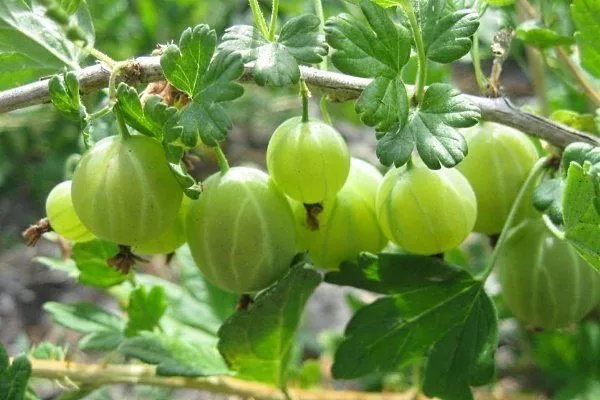
gooseberry variety "Beryl"
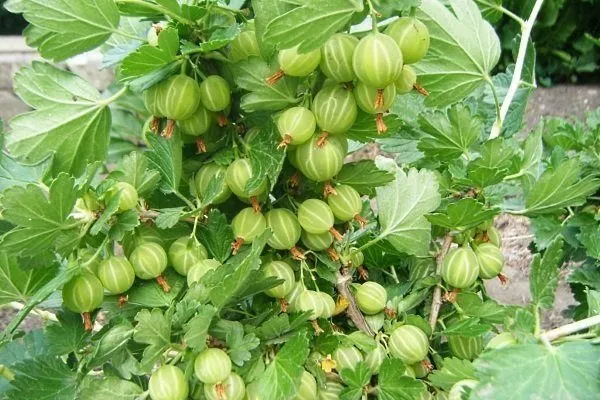
It is very convenient to harvest from the 'Beryl' gooseberry bushes, as they have a minimal number of needles
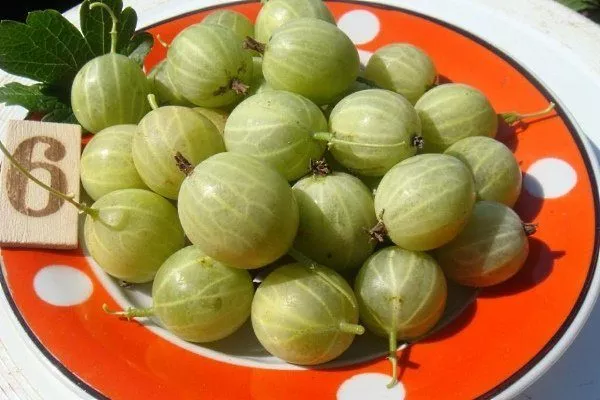
The Beryl gooseberry is highly productive, yielding 3-10 kg of berries per season.
How did the Beryl variety come about?
The variety was developed about half a century ago by the Soviet breeder V.S. Ilyin. The parent pair is the Samorodok gooseberry and MalachiteThe resulting variety, taking the best from its ancestors, became one of the most productive and hardy varieties of its time.
The variety was developed at the South Ural Research Institute of Fruit, Vegetable, and Potato Growing. It is zoned for use in the Ural and West Siberian regions.
Brief description of gooseberry
Brief botanical description of the Beryl gooseberry:
- Bush. Medium height and spreading habit, with a dense but neat crown. Thorns are few and downward-facing, usually located at the base of the shoot. No thorns are present on the shoots.
- Leaves. Large, green, glabrous, soft, five-lobed. The surface is slightly wrinkled.
- Flowers. Large, goblet-shaped, brightly colored, with two-flowered inflorescences.
- Fruit. Large, yellow-green or light green, they weigh 4-9 g. Sometimes the berries have a reddish blush. These gooseberries often grow twice as large as cherries. The skin is thin, smooth, and pubescent. The flesh is juicy and contains few seeds. The stalks are long and slender.
Advantages and disadvantages of the variety
Benefits of Beryl gooseberry:
- high self-fertility – natural pollination guarantees 50% of the harvest;
- ability to withstand short-term droughts without loss of yield;
- good transportability during the period of technical maturity;
- the versatility of the fruits – they are eaten fresh, used to make preserves, desserts, and liqueurs;
- high frost resistance – in many regions the bushes do not even need to be covered for the winter;
- large and tasty fruits;
- high yield – the variety is profitable to grow for commercial purposes.
Flaws:
- may be affected by septoria;
- affected by sawflies;
- drop in yield due to violation of agricultural practices;
- poor shelf life of ripe berries.
Varietal characteristics
This variety was bred specifically for the harshest growing conditions. Let's learn more about the key agronomic characteristics of Beryl.
Productivity
This variety is considered high-yielding. A single bush yields 8-10 kg. This gooseberry is suitable for any type of cultivation, whether amateur or commercial. An average yield of 10 tons of berries is obtained per hectare, with a maximum yield of 30 tons.
Beryl gooseberries are sweet and sour, juicy. They have a dessert-like flavor. Experts rate the berries a 5-star rating, while the State Register assigns them a 4.3-star rating. 100 grams of fresh gooseberries contain 8-9.9% sugar, 0.5-2.2% acid, and 17 mg vitamin C.
Watch a video review of the gooseberry variety "Beryl" below:
Ripening time and fruiting characteristics
This variety is mid-late. The berries ripen around mid-July. The bush begins to bear fruit actively in the fifth year after planting.
Drought resistance and winter hardiness
This variety is frost-hardy, withstanding temperatures down to -38°C, so it can grow uncovered in regions with harsh winters. It doesn't tolerate excessive moisture and is also highly drought-tolerant.
Resistance to diseases and pests
The variety has moderate immunity to common diseases of gooseberries and other berry crops. Beryl has moderate resistance to powdery mildew and fruit rot, but is susceptible to septoria leaf spot. Fungal infections cause stunted growth and, if left untreated, demise.
The most dangerous sawflies for Beryl are the pale-legged and yellow gooseberry sawflies. Their larvae eat the leaves, destroying all green parts of the bush.
Transportation Features
To extend the shelf life of berries, they are picked slightly underripe—at the technical maturity stage. This keeps the fruit fresh for three days and makes it easy to transport.
Berries picked at full ripeness are much more difficult to transport; ripe Beryl gooseberries are not transported over long distances.
Growing conditions
Growing conditions requirements:
- There are no special soil requirements. Loamy, sandy, and sandy loam soils with a medium pH are suitable.
- Swampy areas and highly acidic soils are not suitable.
- Choose a sunny area – the taste of the berries depends on the amount of sun.
- There should be no drafts or strong winds on the site.
- The groundwater level is moderate, not less than 1.5 m.
- ✓ Soil pH should be between 6.0-6.5 for optimal nutrient absorption.
- ✓ The groundwater depth must be at least 1.5 m to prevent root rot.
Selecting a seedling
For planting, select seedlings at least two years old. They should have a well-developed root system and woody trunks—these types take root better. The seedling should have two to three shoots 20 cm long.
What else should you pay attention to when choosing gooseberry seedlings:
- take planting material with a closed root system - in containers, pots, film bags;
- the shoots must be strong and trimmed;
- The buds should be healthy, the leaves should be free of spots, and the bark should be fresh.
Detailed planting instructions
The entire subsequent life of a gooseberry bush—its immunity, productivity, growth, and development—depends on planting conditions. Let's learn how to properly prepare for planting and how to carry it out.
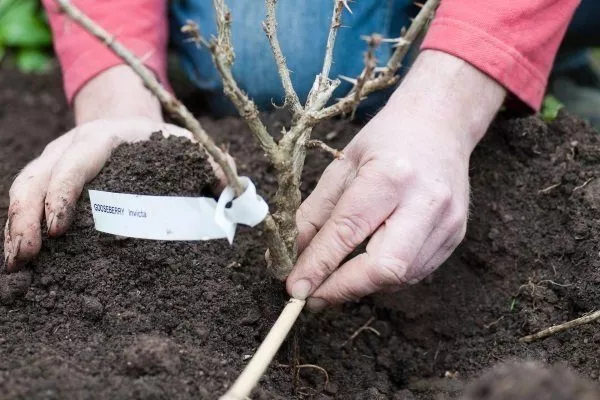
Preparing the landing site
Before planting gooseberries, prepare the soil and planting hole:
- Determine the soil's acidity. If it's high, deacidify the soil with dolomite flour. Apply 300 g per plant.
- Dig over the area where the seedling will be planted, removing all weeds and their roots. Add phosphates and ash during the digging process; for heavy soils, add fertilizer, compost, and sand.
- Dig a hole 35-40 cm deep and wide.
- Add a well-mixed potting soil mixture to the bottom. It's made from topsoil, two buckets of compost, and mineral fertilizers—for example, 30 g of superphosphate and 20 g of potassium phosphate. If the soil is heavy, add river sand, humus, and peat to the mixture.
Landing plan
Gooseberries are often planted between rows of trees growing in elevated, sunny areas. Here, the bushes will experience partial shade, which is acceptable for gooseberries. The trees will also protect the bushes from drafts.
To ensure the gooseberry bush has enough space to grow and form a bush, leave at least 1.5 m between holes. The depth and width of the hole take into account the size of the root system.
Step-by-step instructions
The best time to plant gooseberries is early spring or fall (late September - early October). In fall, gooseberries are planted a month to a month and a half before the first frost to allow the root system to develop. Temperatures, including nighttime temperatures, should not drop below 5°C.
Before planting, you should have the seedlings and a hole prepared taking into account the soil characteristics and the planting time. If planting in the spring, organic fertilizer can be added to the hole. Fall planting should be done without organic fertilizer, as it often harbors larvae, beetles, and other pests that can damage the plant's roots.
- Before planting, soak the seedling for half an hour in a solution of HB-101 - you will need only 2 drops of the preparation per 1 liter of water.
- Place the seedling upright in the planting hole. When positioning the seedling, keep in mind that the core of the gooseberry should be 6-8 cm deep in the soil.
- Spread the roots evenly over the loose soil mixture.
- Cover the roots with fertile soil, shaking the seedling from time to time and compacting the layers with your hands so that there are no voids between the roots.
- After planting the seedling, trim it, leaving 4-5 growth buds on each branch.
- Water the seedling – one bucket is enough.
- Once the moisture has been absorbed, sprinkle the tree trunk circle with sawdust, hay or fallen leaves.
Basic Beryl Care
There's nothing complicated or unusual about caring for the Beryl gooseberry. Standard care—watering, fertilizing, spraying, and pruning—is sufficient for this variety's successful growth, development, and fruiting.
Read more about How to care for gooseberries in autumn.
When and how to prune?
Gooseberry pruning is done in early spring, before bud break, or late fall. On mature bushes, it's recommended to prune two-thirds of the older branches at ground level—this will rejuvenate the plant and encourage new growth.
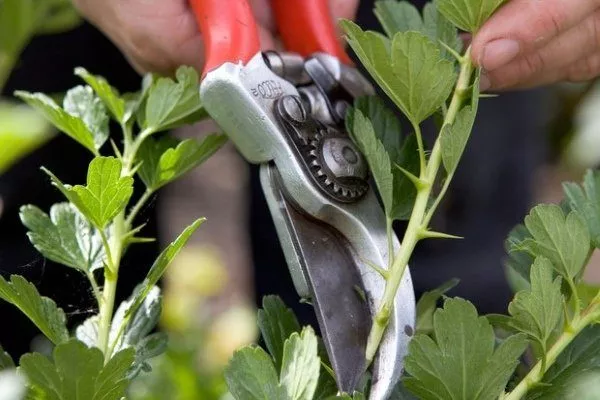
Beryl gooseberry bushes require regular pruning, as they tend to develop excessive shoots that thicken the plant. A lack of nutrients caused by overgrowth hinders the development of new shoots, resulting in reduced yields and smaller berries.
Principles of pruning:
- In the spring, immediately after the snow melts, they begin pruning.
- Sanitary pruning is carried out – all old, diseased and damaged branches are removed.
- One-year-old shoots are shortened.
- Thin out the basal branches, leaving 4-5 of the healthiest and strongest ones.
- The bush's crown is formed. The main branches are shortened by 50%. No more than 20 branches of different ages are left.
- In older bushes, all weak and thickening branches are cut out.
- In summer, the ends of fruiting branches are pinched to produce larger berries.
How many times and in what volume should I water?
If the summer is hot and dry, artificial irrigation will be necessary. It's especially important to water gooseberries during key growing periods—flowering, fruit set, and ripening. Stop watering 2-3 weeks before harvest.
The recommended watering frequency is approximately once a week. Water should be applied at the roots, avoiding shoots and leaves. One bucket of water should be poured into the trunk circle. If the summer is rainy, additional watering is not necessary – excess moisture will cause the berries to lose flavor and other quality.
The gooseberry bushes' trunks are regularly loosened, removing weeds along the way. Loosening improves soil aeration, and mulching is applied to slow weed growth and moisture evaporation. Loosening is performed 4-5 times per season.
Feeding schedule
Fertilization is essential for harvesting Beryl. The fertilizing sequence is shown in Table 1.
Table 1
| Period of contribution | Composition of the fertilizer |
| Early spring | Humus is scattered under the bush. |
| The end of spring | Mineral fertilizers, including nitrogen, are added to promote shoot and foliage growth. 20 grams of ammonium nitrate or organic matter, such as bird droppings or manure, are added per square meter. |
| End of June. Flowering is in its final stages. | Phosphorus-potassium fertilizers are applied – potassium phosphate or superphosphate, 20 g per 1 sq. m. This is necessary for successful formation of ovaries. |
To ensure a good harvest next year, do not leave berries on the branches – all the fruit must be picked.
Application of support
Gooseberry supports are small fences made of wooden beams, metal or plastic pipes.
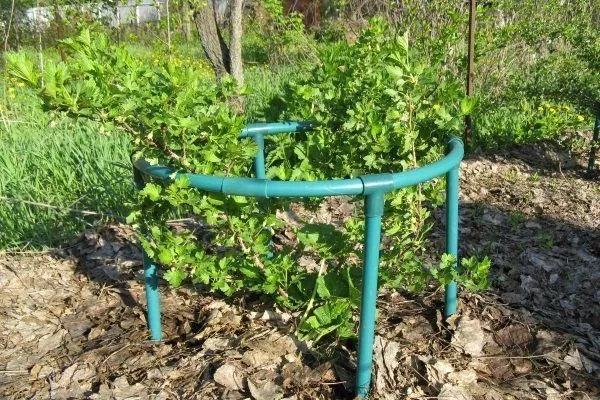
Why are supports needed:
- maintaining the compactness of the bush;
- preventing lodging of branches;
- branches do not break in wind and snow;
- the berries don't get dirty from the ground;
- It makes caring for the bush easier – it’s easier to water and loosen the soil, mulching.
Reproduction
The Beryl variety can be propagated using any traditional shrub propagation method. Each gardener chooses the method best suited to their specific situation.
Methods of propagation of gooseberry Beryl:
- By dividing the bush. Apply in the fall. The bush is easily divided into sections without causing stress.
- Cuttings. This method is used in the summer. Cuttings with five buds are taken from new growth. The resulting material is planted in the ground at a 45-degree angle.
- By layering. A simple and convenient method of propagation. Layers are placed in trenches dug near the trunk. The layers are secured so they can root.
- By vaccination. The scion is grafted onto the rootstock—an old gooseberry bush. The old branches are cut off, and a split is made in the stump, into which the scion is inserted.
Preparing for winter
Bushes are prepared for winter when the average daily temperature drops below 0°C. Winter preparation procedure:
- Water the bush generously—5-6 buckets of water. This is a moisture-replenishing watering for the winter.
- Bend the bush's branches down to the ground and secure them. The branches shouldn't lie completely on the ground. Leave 8-10 cm between them and the ground.
- Apply mulch to the soil around the bush with a 7-8 cm layer. If temperatures drop below -15°C, increase the layer thickness to 20 cm. If winter is snowy, cover the gooseberries with snow, piling it on top of the bushes.
To prevent premature bud development and freezing due to recurrent frosts, all coverings are removed early in the spring.
Pests, signs and control
Beryl isn't particularly vulnerable to pests. It's fairly resistant to mites and other chewing and sucking insects. The most dangerous pests for beryl are moths, sawflies, and aphids.
Table 2
| Pests | Damage caused | How to fight? |
| Aphid | Leaves curl, dry out, and fall off. Shoots become deformed and stunted. | At the end of spring, the bushes are sprayed with Karbofos or Vofatox. |
| Firefly | Butterflies lay eggs in the buds. The hatched larvae spin cocoons around the buds. The fruits grow poorly and fall off. | When the bush has finished flowering, it is sprayed with Actellic or Karbofos. |
| Sawfly | Caterpillars gnaw through leaves, ovaries and shoots. | In spring, in May, spray with insecticides or folk remedies - pine extract or soap solution. |
Diseases, symptoms and treatment
The better the growing conditions, the greater the chance of gooseberry avoiding diseases. Table 3 lists the diseases that pose a threat to the Beryl variety.
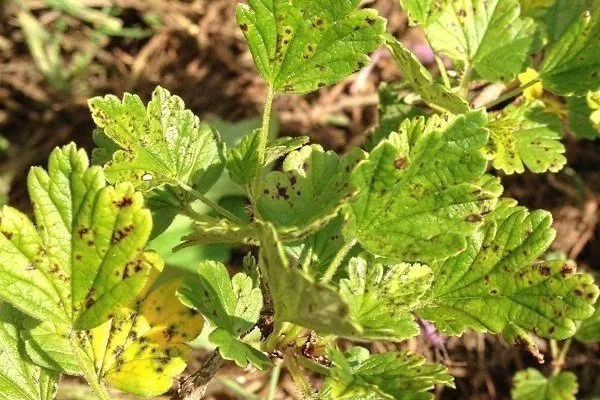
Table 3
| Diseases | Symptoms | How to fight? |
| Septoria (white spot) | The fungus attacks the entire bush. Small gray spots with a brown border appear on the leaves. The leaves curl and fall off. The bush may die. | Fungicides and Bordeaux mixture are used, and spraying the bushes with potassium permanganate, boron, and zinc is also recommended. Bushes are treated twice per season – in the fall and spring. |
| Powdery mildew | This disease affects bushes in conditions of high humidity and the absence of preventative spraying. This fungal infection is accompanied by the appearance of a whitish, powdery coating on the leaves and branch tips. | Before the buds open, spray with copper sulfate (120 g per 10 l) or colloidal sulfur (150 g). |
| Anthracosis | Brown spots appear on the leaves. Leaves and shoots turn yellow and fall off. | Treatable. Spray with Bordeaux mixture (100 ml per 10 liters). Treat the bushes four times per season, at 20-day intervals. |
Basics of prevention
The biggest threat to the Beryl gooseberry is septoria leaf spot. To prevent septoria leaf spot and other diseases, take the following preventative measures:
- In autumn and spring, the soil in the tree trunk circle is dug up.
- Fallen leaves are raked and burned to destroy pests.
- Fertilizers are applied in a timely manner.
- Remove weeds and loosen the soil – this destroys powdery mildew mycelium.
- All old and diseased branches are cut off.
- For preventative purposes, spray with antifungal agents, Bordeaux mixture, solutions of wood ash and liquid soap.
- Carry out the first spraying with Bordeaux mixture in early spring before the buds open.
- Perform the second spraying after flowering, using a solution of wood ash and liquid soap.
- The third spraying should be carried out in the fall after harvesting to destroy possible fungal spores.
Reviews of the Beryl variety
The main value of the Beryl gooseberry is its ability to withstand severe frosts. At the same time, the variety is very productive, and its berries are tasty and large—ideal for preserves and a wonderful summer dessert. Growing Beryl is easy; standard care is sufficient for high yields.