
Zenga Zengana is an undeservedly forgotten garden strawberry of European selection. Once the best commercial variety, today, thanks to its unique qualities, it has become popular among amateur gardeners. Let's find out what's so special about this strawberry and how to grow it in our region.
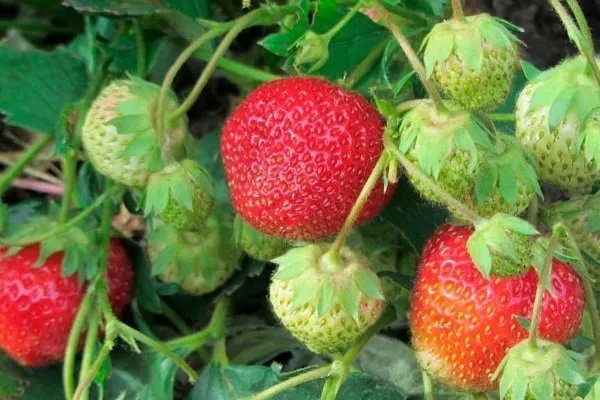
garden strawberry "Zenga Zengana" ripens in mid-June
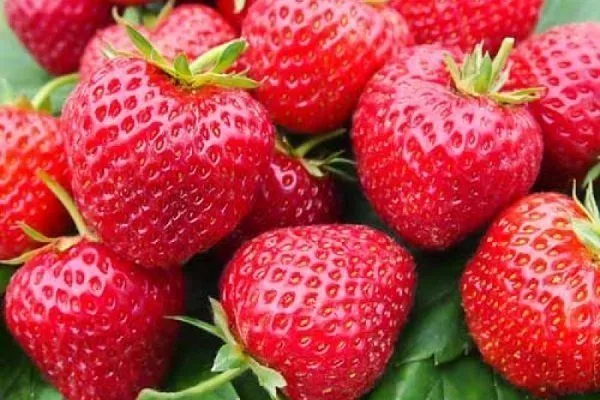
The fruiting period of the Zenga Zengana variety lasts until the beginning of September
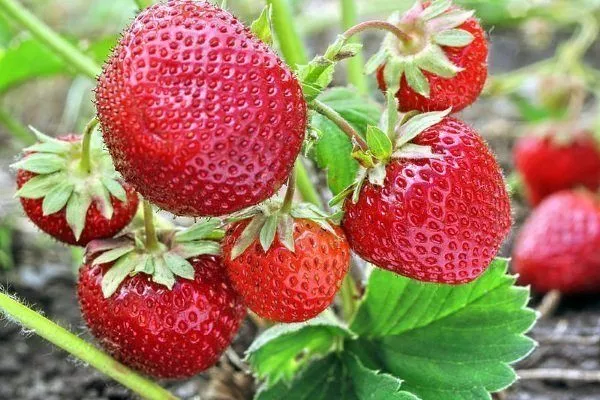
The berries of the garden strawberry "Zenga Zengana" weigh 10-15 grams, but there are specimens weighing 30 grams
Briefly about the origin
The garden strawberry (also known as the "Zenga Zengana" strawberry) was developed in Hamburg, Germany. The variety arose from a cross between the "Sieger" variety and the wild, self-seeded "Merge" variety. Breeders aimed to develop strawberries for commercial use. Breeding work began in 1942 and was completed in 1954.
This venerable variety, although it has lost some of its popularity over the past 70 years, remains a true brand. Having quickly spread throughout Europe, Zenga Zengana was for a long time the leading commercial variety.
Distinction of this variety from other strawberries
The Zenga Zengana variety has always been unique. Early in its career, one of its main advantages was its ability to freeze. Today, many strawberry varieties share this quality. But another quality remains unique: according to gardeners, Zenga Zengana maintains its varietal qualities for 7-8 years.
The positive qualities of the variety also include:
- consistently high yields;
- excellent taste;
- good transportability;
- undemanding to soils.
One of the most important advantages of this old German variety is its ability to grow in any soil. Zenga Zengana bears fruit even in heavy, loamy, and depleted soils.
A disadvantage of the German variety is its need for pollinators.
All about the variety: description, characteristics, taste
The Zenga Zengana variety is capable of bearing fruit in short daylight hours. If the daylight hours are 12 hours, bud formation occurs.
Main characteristics of the variety:
- The ripening period is late. The first berries appear in mid-June.
- Yield: 1.5 kg per bush.
- The bushes bear fruit in one place for 6-7 years.
- Non-remontant variety – bears fruit once per season.
- A small number of tendrils means the plant is spending all its energy on producing fruit.
- The weight of the berries is 10-12 g. The first berries are the largest – up to 30 g. As they fruit, they become smaller.
- The dense, void-free pulp has a sweet and sour taste and a rich aroma.
- The berries are versatile. They retain their shape in compotes and jams. They are also suitable for freezing.
- The variety can withstand heat, drought and low temperatures.
Brief botanical description:
- Bush. Tall, not spreading, but well-foliated. Flower stalks are located at the same level as the leaves or below them, allowing the berries to touch the ground. The leaves are dark green and smooth.
- Berries. Medium-sized. Broadly conical in shape. Color depends on sun exposure: bright red in the shade, dark red in the sun. Ripe berries turn a deep cherry color. The seeds are deeply indented.
Watch a video review of the Zenga Zengana garden strawberry, presented by an experienced gardener:
Boarding order
This German variety, though unpretentious, requires some care. And that begins with proper planting. Although Zenga grows in any soil, the gardener's job is to create favorable growing conditions to maximize its potential.
Selecting a location and timing
In temperate climates, seedlings are planted primarily in early spring, late summer, or early fall. The best time for planting is the first ten days of spring. In central regions, seedlings are planted between March 10 and 20. It's best to plant seedlings in the evening on a dry, sunny day. Read more about planting strawberries in spring. here.
Before preparing seedlings, choose a suitable planting site. Optimal site characteristics:
- A sunny, well-ventilated location with no standing water is ideal. A south-facing location, but not exposed to strong winds, is ideal. Low-lying areas and highly acidic soils are unsuitable.
- Strawberries grow best after legumes, radishes, carrots, beets, onions, and garlic. Undesirable precursors prone to the same diseases that affect Zenga Zengana include black currants, raspberries, and gooseberries.
Soil preparation
Despite its undemanding nature regarding soil, the variety has its own preferences – it grows best on loamy soils with a neutral reaction.
- ✓ Soil pH level should be strictly between 6.0-6.5 for optimal growth.
- ✓ The groundwater depth must be at least 1.2 m to prevent root rot.
Soil preparation procedure:
- Clear the area of weeds. If the soil contains cockchafer larvae, wireworms, or other pests, treat it with an ammonia solution—dissolve 10 ml in a bucket of water.
- Dig the soil 2-4 weeks before planting. Fertilizer is added during digging at the following rate per square meter:
- humus – 5-6 kg;
- superphosphate – 40 g;
- potassium fertilizers – 20 g.
- Check the soil's acidity. If it's too high, add dolomite flour at 300-600 g per square meter. Instead of flour, you can add chalk or ash at 100-300 g and 1-1.5 kg per square meter, respectively.
You can determine the acidity yourself by examining the beet leaves – in acidic soils they become covered with dark red spots.
Wood ash can be used as a potassium fertilizer, but potassium chloride is not recommended – strawberries are too sensitive to chlorine.
Planting patterns
Seedlings of the Zenga Zengana variety are planted according to typical strawberry patterns:
- One-line. The distance between rows is 70 cm. Between adjacent bushes in rows – 20 cm.
- Two-line. Several rows are planted in a single bed. Leave 70 cm between beds, 30 cm between rows, and 20 cm between bushes.
When growing strawberries, the method using covering material is very popular. The planting pattern is the same—rows—but the soil is covered with black plastic. To prevent the roots from overheating under the plastic, it is covered with a layer of straw.
Transplanting
Optimal temperature conditions for planting seedlings in open ground:
- air – from +15 to +20 °C;
- soil – about +15 °C.
Healthy, well-developed seedlings are selected for planting. Approximately 5-7 leaves are left, and the rest are plucked. The optimal root length is 8-10 cm; longer roots are trimmed. Before planting, the roots of the seedlings are placed in a growth stimulator.
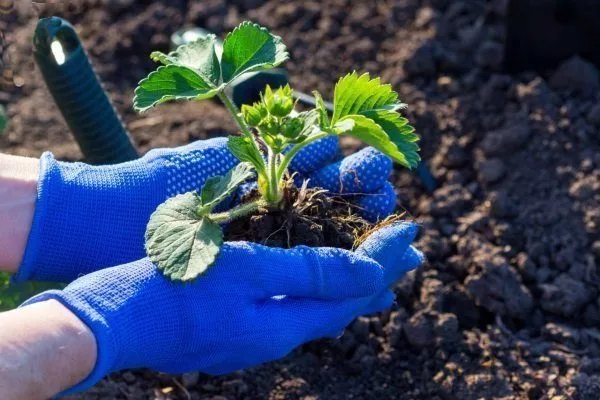
Planting order:
- In the prepared beds, dig holes equal to the number of seedlings. The depth is about 15 cm. A small mound of earth is formed in each hole.
- The seedling is lowered into the hole, carefully straightening the roots.
- Cover the roots with soil, compacting it with your hands. The growing point of the seedling should be at ground level. If the growing point is too deep, the bushes will begin to rot.
- Each hole is watered with warm water - approximately 1 liter per bush.
- It's advisable to mulch the soil with humus, straw, or sawdust. Avoid using leaves, moss, or freshly cut grass. The mulch layer should be approximately 10 cm thick.
Care Features
Caring for the Zenga Zengana strawberry isn't particularly difficult. It's just important to follow all care instructions promptly.
Watering
The variety thrives on moisture, so the plantations are watered regularly—every 1-2 weeks. Weather conditions and rainfall are taken into account. In hot weather, watering frequency increases.
When watering, the soil should be moistened to a depth of 20-30 cm. Apply water so that drops do not fall on the leaves. The best time to water is in the morning. The most important watering occurs before flowering, and then as needed.
Top dressing
Strawberries are fertilized with organic and mineral fertilizers. Fertilizing begins in early spring. When fertilizing, it's important not to overdo it with nitrogen fertilizers. These are applied in the spring because they stimulate foliage growth. Excess nitrogen will negatively impact yield.
We recommend that you also read the article about spring feeding of strawberries.
Timing and types of fertilizing strawberries Zenga Zengana:
| Period | Fertilizers applied |
| Early spring | Nitrogen fertilizers, such as urea, promote foliar growth. To prepare a solution, use 30 g per 10 liters of water. |
| The appearance of the first leaves | Watering with mullein with the addition of ammonium sulfate. |
| Beginning of May | Application of complex mineral fertilizers. |
| Before flowering | Potassium-based solutions – potassium nitrate, potassium sulfate (2 tablespoons per 10 liters). You can water the plantings with an ash solution. |
| After harvesting | Phosphorus fertilizers – ammophos, superphosphate, diammonium phosphate – increase the yield of berries next year. |
Potassium fertilizers improve the taste of berries.
Loosening, weeding and mulching
The soil is loosened before each watering, and after watering – mulchThe soil is usually sprinkled with sawdust—a 5 cm layer. Weeds are removed during loosening.
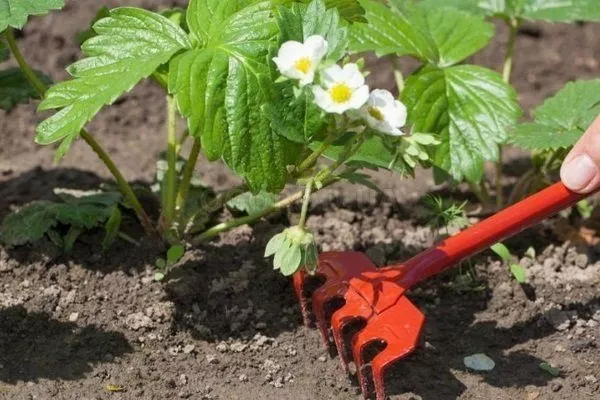
The most intensive loosening is done in the spring, when the soil is rich in meltwater. The soil is loosened between rows to a depth of 10 cm. Closer to the bushes, the loosening depth is shallower to avoid damaging the root system. During loosening, the bushes are lightly hilled to cover the roots.
Preparing for winter
Preparation for winter consists of several agricultural measures:
- The area is carefully weeded and loosened.
- The plantings are sprayed with compounds against pests and diseases.
- All tendrils and leaves are cut off.
- Sprinkle the planting with a thick layer of mulch—sawdust or peat. Straw can be used where there's little snow, and spruce branches can be used in regions with harsh winters.
After wintering, the plantings must be cleaned – mulch and weeds are removed.
First-year bushes are completely covered with coniferous branches for the winter. Alternatively, they are stretched over a frame with agrotex or spunbond. These should not be placed in rows, as the soil will quickly freeze.
Methods of reproduction
Gardeners most often propagate Zenga Zengana strawberries by division. However, if desired, this variety can be propagated by any of the existing methods:
- Dividing the bush. The best option: dig up a four-year-old plant, trim off any dead foliage, soak the roots in water, and when they soften, divide the bush into several parts—divisions.
- Mustaches and rosettes. This method doesn't produce many seedlings due to the limited number of runners. The shoots, or runners, appear in July and take root, creating a small rosette. The shoots are selected from the most productive bushes. The soil is loosened and watered, encouraging the development of the first two rosettes. The runner is then cut off to prevent it from drawing nutrients from the mother bush. When the shoots have developed sufficiently, they are dug up and replanted.
- Seeds. Zenga's flowers are female. It's impossible to obtain seed material from the fruit that matches the parent plant's characteristics. Only a Zengan hybrid and its pollinators can grow. The propagation process is standard:
- The seeds are stratified by soaking and storing them in the refrigerator at +5°C for two weeks. The seeds are re-moistened regularly to prevent them from drying out.
- The seeds are sown in a container and covered with plastic film. When sprouts appear, the film is removed.
- Plants are planted in the ground when 3-5 leaves appear on the bushes.
| Method | Time until the first harvest | Success rate |
|---|---|---|
| Dividing the bush | 1 year | 90% |
| Mustaches and rosettes | 2 years | 75% |
| Seeds | 3 years | 50% |
Tips for Pollinating the Zenga Zengana Variety
The variety produces only female flowers and cannot bear fruit without pollinators. Pollinator varieties must be planted next to Zenga Zengana. For pollination, strawberries that bloom at the same time as Zenga—in the second half of May—are selected.
Disease and pest control
The main pest threatening this old German variety is the strawberry mite. The most dangerous disease for Zenga Zengan is gray mold.
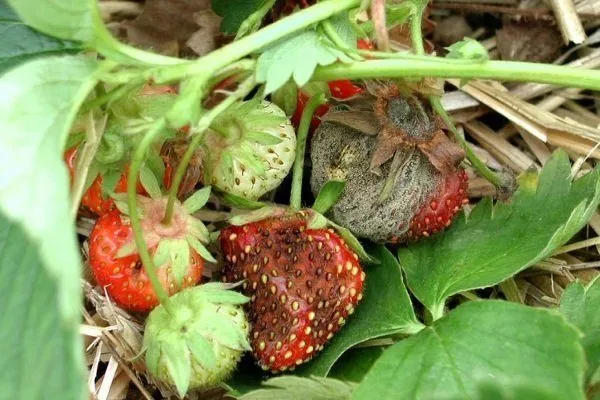
Pests and diseases of the Zenga Zengana variety, as well as measures to combat them:
| Pests/diseases | Symptoms/damage caused | How to fight? |
| Strawberry mite | Invisible to the naked eye, this insect attacks the leaves, causing them to become deformed, turn brown, and dry out. Bush growth slows, and the berries become small. | To prevent spider mites, spray the plants with a 70% colloidal sulfur solution. If spider mites have already attacked the plants, treat them with insecticides such as Iskra M or Actellic. |
| Gray mold | A fungal infection that can destroy 90% of the harvest. The berries become covered with a dark coating and rot. | Remove affected leaves or entire bushes in a timely manner.
Spray with chemicals - Apirin-B, Switch, 1% Bordeaux mixture. |
| Borax spot | Brown spots appear along the edges of the leaves. They enlarge, merging into larger spots, and the leaves dry out. | Treat crops with Oxychom and Bordeaux mixture. Apply 3% before bud break, 1% before flowering and after harvest. |
Gardeners often use a mustard solution to combat gray mold. Dissolve 50 grams of dry mustard in 5 liters of hot water. Let it sit for two days, then dilute with water 1:1.
The damage caused by gray mold and spider mites can be catastrophic, so it's important to prevent the problem early. Preventative measures:
- prevent thickening of plantings;
- weed out weeds in time;
- deoxidize the soil;
- plant garlic between rows;
- mulch the plantings with straw;
- After harvesting, trim the leaves;
- destroy affected berries in a timely manner;
- prevent the berries from touching the ground.
Harvesting and storing berries
The variety was developed for commercial use, so it's no surprise that it tolerates transportation well. However, the berries still require maximum attention during harvesting and storage.
Cleaning and storage tips:
- It's best to pick berries in the morning or evening, and always in dry weather. But if it rains and the berries are ripe, you'll still have to pick them—otherwise they'll rot or be damaged by slugs.
- Only ripe berries are collected; unripe fruits have a worse taste and smell.
- It is important to start harvesting on time – once overripe, the berries spoil very quickly.
- The berries are picked together with the sepals and short “tail” – then they do not lose their flavor for a long time.
- The berries are collected directly into storage containers to avoid having to move them around unnecessarily.
- Defective berries affected by rot or other diseases are immediately discarded.
- To prevent berries from getting crushed, stack them in no more than three layers. Choose well-ventilated containers, such as cardboard or plastic boxes. Store the berries in a cool place.
This variety is easy to grow, so even beginners can attempt it. The main problem with Zenga Zengan is gray mold. If gardeners take all necessary measures to prevent this problem, they can expect a bountiful harvest of delicious berries.