
Every summer, a bright, fragrant berry, commonly known as wild strawberry, ripens in fields and meadows. By planting this wild perennial in their gardens, gardeners reap handsome harvests of tasty and nutritious fruits.
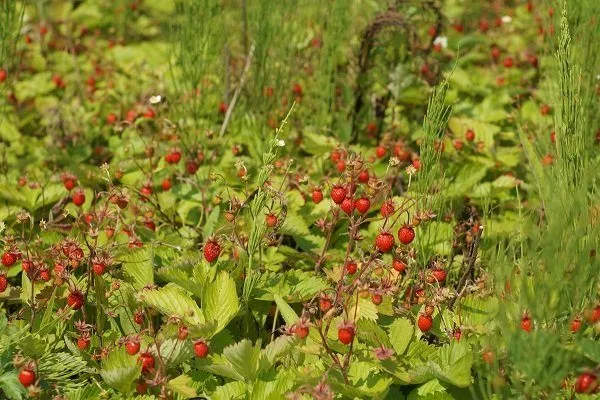
Description of the plant
The meadow strawberry (Fragaria viridis) is a close relative of the wild and garden strawberry. Not only do they belong to the same genus, but they are also very similar in appearance and taste.
| Name | Bush height (cm) | Leaf shape | Color of berries |
|---|---|---|---|
| Wild strawberry | 20 | Trifoliate, oval, serrated | Bright red |
| Wild strawberry | 15 | Uneven | Red |
Appearance of bushes
Wild strawberries have several distinctive features that make them easy to distinguish from their close relatives.
Brief description of the plant:
- Bush. Low, moderately spreading – no more than 20 cm. Shoots are creeping, tendrils are thick and short, stem is thin.
- Leaves. Trifoliate, oval, serrated at the edges. Color – emerald green. The underside is pubescent.
- Inflorescences. They consist of several flowers with white, slightly pointed petals. The diameter is up to 2 cm.
Berries
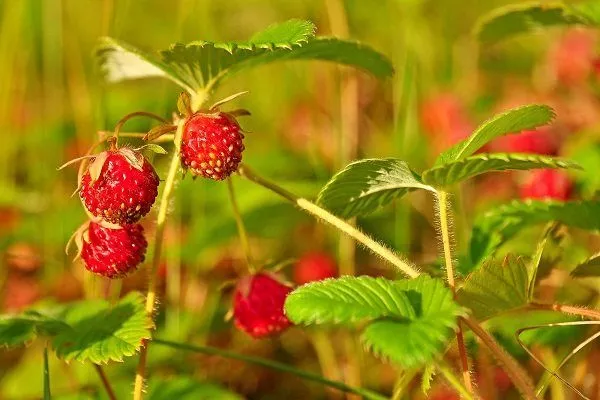
A distinctive feature of wild strawberries is their spherical berries, which weigh 1-3 g and are difficult to separate from the calyxes. At the technical ripeness stage, the berries are pinkish-red in color, with white-green spots.
When fully ripe, the berries are bright red, almost cherry-red, with firm yet juicy and aromatic flesh. Wild strawberries have a pleasantly sweet flavor. When they ripen, the entire meadow or clearing is permeated with their strawberry scent.
The taste of wild strawberries is significantly affected by weather. If it rains, the berries are watery, while in extreme heat they are dry.
Composition and properties
The sugar content of wild strawberries varies from 4.5 to 15%. Nutritional value of 100 g of berries:
- caloric content – 36 kcal;
- proteins – 0.8 g;
- fats – 0.4 g;
- carbohydrates – 6.3 g.
Wild strawberries contain many different types of acids (folic, citric, malic, etc.), copper, manganese, pectin and tannins, and ascorbic acid.
The plant has beneficial properties:
- Fresh berries. They increase appetite and improve digestion. They are useful for anemia.
- Dried berries. They have a diaphoretic effect.
- Berry juice. Indicated for scurvy and vitamin deficiency.
- Decoctions and infusions of berries/leaves. Useful for gastrointestinal diseases, colds, and kidney diseases.
- Decoction of leaves. Heals wounds and restores tissue.
- A decoction of flowers. Helps with heart and vascular diseases.
Wild strawberries are an allergen, so it is recommended to eat them in combination with fermented milk products, which reduce the allergic effect.
Differences from wild strawberries
Both wild and wild strawberries grow naturally. They are often confused, but these wild crops have many differences.
Comparison of meadow and wild strawberries:
| Parameters and characteristics | Forest | Meadow |
| Form | Elongated | Spherical |
| Sepals | Raised up | Pressed tightly against the berry |
| Leaves | Uneven | Triple, with relief, equal in length |
| Productivity | Higher because the flowers are bisexual | Low, since ovaries are formed only on female flowers |
| Ripening time | In June | In July-early August |
| Taste | More of that special strawberry flavor | Rich strawberry flavor, similar to garden strawberries |
Prevalence
This perennial plant grows wild throughout almost the entire European part of Russia. It can be found in the meadows of Crimea, Siberia, Asia, and Western Europe.
Wild strawberries are found in open spaces—in the steppe, meadows, forest belts, juniper thickets, and on hillsides. The plant prefers to grow in some shade from tall grass.
How to plant meadow strawberries?
Wild strawberries are no substitute for their garden counterparts grown for sale or for preserves. They are planted more as a delicacy, a source of taste and nutrients. Cultivation techniques for wild strawberries are almost identical to those for garden strawberries.
How to choose seeds?
The most convenient and easiest option is to buy seeds at the store. Choose seeds from a reputable supplier and with a valid expiration date. If you can't find wild strawberry seeds, harvest them yourself. This will require a trip to the field to pick the berries.
- ✓ Check the expiration date of seeds to avoid planting non-viable material.
- ✓ Pay attention to the seed producer; give preference to trusted suppliers with good reviews.
How to collect seeds:
- Choose the ripest berries from the best bushes.
- At home, using a sharp knife, remove a thin layer of the fruit along with the seeds.
- Place the seeds on a saucer lined with 3-4 layers of gauze.
The strawberry pulp dries quickly in the sun, preventing it from rotting. The seeds are collected from the cheesecloth and placed in a paper bag for sowing in the spring.
Site selection and preparation
Wild strawberries are easy to grow, so choosing a location won't be a problem. They grow well in both sun and shade. The berry produces its best fruit after:
- legumes;
- cabbage;
- salad;
- Luke;
- garlic;
- beets;
- carrots.
Site preparation:
- Dig over the soil in the fall. Add organic fertilizer (compost or humus) at a rate of 1 bucket per square meter. Add a cup of wood ash. If you weren't able to prepare the soil in the fall, do it in the spring, 2 weeks before planting.
- While digging, remove weed roots, stones and other debris from the soil.
- If the area is located in a lowland, create small beds approximately 10 cm high.
Planting dates
The timing of sowing seeds for seedlings depends on the climate in the region, and when planting in the ground, the current weather, air and soil temperature must also be taken into account.
Approximate dates for sowing seedlings:
- middle zone – end of January – mid-February;
- south of Russia – from January to March;
- Urals and Siberia – from the end of February to the end of March.
Rules and schemes
Wild strawberries are usually planted in rows—one or two rows. The planting pattern is the same as for garden strawberries, but given the small size of the bushes, the plantings can be slightly "compacted."
Classic strawberry planting scheme:
- distance between bushes – 15 cm;
- between rows – 60 cm;
- between rows (for double-row planting) – 30 cm.
How to care for wild strawberries?
Wild strawberries grow naturally without human intervention. However, when planting them in garden beds, gardeners expect a bountiful harvest, and achieving this requires some care.
Watering
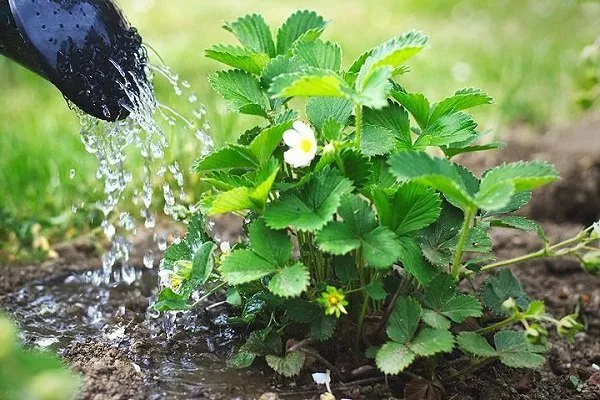
Wild strawberries aren't as demanding when it comes to watering as their garden counterparts. Watering depends on the weather. During rainy seasons, artificial irrigation isn't necessary, but during hot weather, watering frequency increases from once a week to 2-3 times.
- ✓ Water plants early in the morning or late in the evening to minimize water evaporation.
- ✓ Use water at room temperature to avoid stressing plants.
Frequency and watering rate It also depends on the age of the plants. After transplanting, seedlings are watered frequently and sparingly; as they grow, the watering rate increases to 20-30 liters per square meter.
Top dressing
Fertilizing wild strawberries is done three times: during flowering, during ripening, and after harvest. Complex fertilizers, such as "Kemira-Lux" or "Ideal," are used to nourish the berries.
Fertilizing is done simultaneously with watering to prevent root damage. After each watering, when the soil has dried slightly, it is loosened and weeds are removed. To prevent weed growth and rapid evaporation, the beds are mulched with straw.
How and when to transplant a plant?
Ready-to-plant seedlings are planted in soil warmed to 14–16°C. The approximate time for transplanting strawberry seedlings into soil in the central part of the country is the second half of April to May. In the south and north, adjust the temperature accordingly by a couple of weeks.
Trimming
To increase the yield of wild strawberries, gardeners trim off the growing runners so that the plant does not waste energy on forming rosettes.
After fruiting has finished, the bushes are pruned back to a depth of 10 cm. This removes old, drying leaves, along with any insects, fungal spores, and other pests they may harbor.
Pest and disease control
Wild strawberries thrive without spraying. When placed in a garden plot among other crops, these plants are at risk of becoming infected with various fungal, viral, and bacterial diseases.
To prevent strawberry diseases, spray them with Fitosporin or Fitoverm before flowering. These products protect the berries from rot, powdery mildew, fusarium wilt, and many other diseases and pests.
To protect strawberry beds from slugs that eat berries and young leaves, the soil is sprinkled with wood ash or crushed superphosphate.
For pest control, strawberry trees are treated with insecticides such as Karbofos, Actellic, etc. These agents protect the plant and its fruits from aphids, leaf rollers, mites, and other insects.
Propagation of meadow strawberries
Wild strawberries are a wild plant that successfully propagates without human assistance through runners and rooting rosettes. Gardeners use any convenient method for propagation:
- With a mustache. Rosettes are separated from the mother bushes and planted in prepared beds.
- Seeds. They grow seedlings from them, which are planted in open ground in the spring.
- By division. The mother bushes are dug up and divided into several horns.
Harvesting and storage
In the temperate zone, the first wild strawberries ripen in midsummer. They have a relatively dense flesh, but still require careful harvesting.
The berries are being picked along with the green sepals. They are placed in wide plastic bowls with holes in the bottom for ventilation and to prevent juice leakage. The best container for picking strawberries is traditional wicker baskets.
Storage methods:
- in the refrigerator at a temperature of 0…+2 °C – berries stay fresh for about a week;
- freezing – the berries are washed and placed in plastic containers;
- drying – in special drying devices at a temperature of +135 °C.
Areas of application
Wild strawberries are used in a similar way to garden strawberries – they're made into jams, compotes, jellies, and ground with sugar. The preserved berries are used in baked goods, and the dried fruits are added to tea and porridge.
When making wild strawberry jam, some housewives do not remove the cups from the berries to ensure a more natural product.
The plant is widely used in folk medicine. Dried berries and leaves are used to make decoctions that increase hemoglobin, lower blood pressure, improve bowel function, and normalize sugar levels.
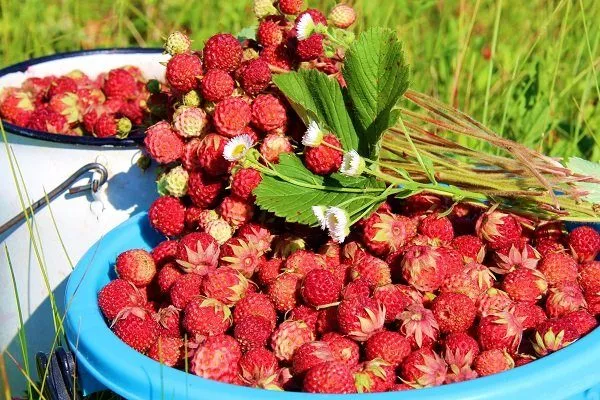
Another area of application for wild strawberries is cosmetology. They are used to make strawberry face masks, which refresh the skin and eliminate pigmentation.
Reviews
Wild strawberries won't yield large harvests, so don't count on them for home preserves. However, you can certainly enjoy these summer berries, which have a unique flavor and aroma.