
Wild strawberries are berries with a distinctive strawberry aroma that no garden variety can match. If desired, you can grow this wild plant in your own garden. Let's learn how to plant strawberries, care for them, and reap a rewarding harvest.
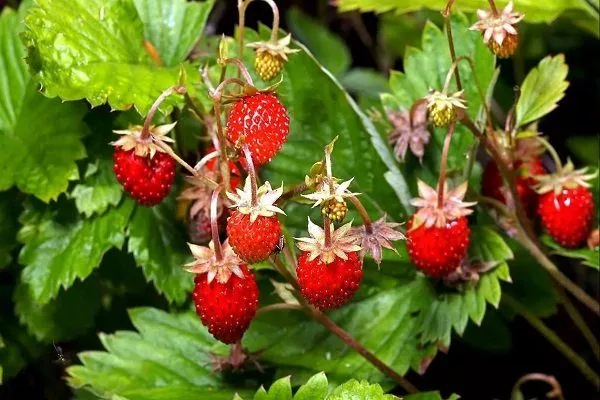
Description
Wild strawberries are prized for their delicious berries and medicinal properties. They are often referred to botanically as wild strawberries or common strawberries. The Latin name, fragare, comes from a word meaning "fragrance."
All parts of the wild strawberry plant are medicinal – berries, leaves, rhizomes, shoots.
Appearance
| Name | Flowering period | Soil type | Disease resistance |
|---|---|---|---|
| Wild strawberry | April-June | Weakly acidic and neutral | High |
| Alpine strawberry | Throughout the warm season | Weakly acidic and neutral | High |
Wild strawberry is a perennial herbaceous plant and the most common species in the Rosaceae family. The strawberry bush grows up to 20 cm tall.
Brief botanical description:
- Root system. Strawberries have a short, obliquely growing rhizome, from which numerous brown adventitious roots branch off. Shoots emerge from the horizontal roots, where strawberry buds are formed. After a year, flower stalks emerge from these shoots.
- Stem. An upright plant, densely foliated and covered with tiny bristles. In the axils of the basal leaves, tendrils grow, enabling the plant to reproduce vegetatively.
- Leaves. They are trifoliate, set on long petioles. The color is dark green, with a bluish tint on the underside, and softly pubescent. The shape is ovoid and diamond-shaped.
- Flowers. White, bisexual, with five petals, they are gathered in corymbose inflorescences and sit on elongated peduncles.
- Fruit. These are achenes embedded in a fleshy red receptacle – a berry.
Strawberries bloom from April to June, and the berries begin to ripen in June. Fruiting continues until autumn.
Berries
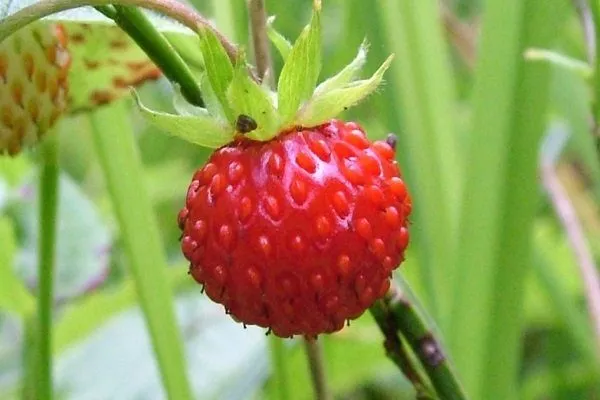
Strawberries are ovoid or round in shape. Their color is deep red or ruby. Unripe berries are pinkish, with green and white spots. Embedded in the flesh are golden-green "seeds." The sepals adhere tightly to the berry, so they come off with it.
Strawberries are juicy, tasty, and sweet, with a strong aroma. The maximum weight is 2 g. The flesh is firm. The berries don't bruise, don't leak juice, and travel well.
Composition and properties
Strawberries contain up to 15% sugar. They also contain a huge amount of beneficial substances, which is why they are used for medicinal and preventative purposes.
How does the composition of berries affect their beneficial properties?
- fiber cleanses the intestines, lowers cholesterol;
- fructose gives energy;
- glucose improves brain function;
- organic acids maintain acid-base balance;
- mineral salts promote the formation of bone tissue;
- pectin normalizes the functioning of the gastrointestinal tract, heart, and blood vessels;
- carotene improves immunity;
- essential oil relieves inflammation, rejuvenates, soothes;
- tannins prevent dysbacteriosis.
Wild strawberries contain a whole range of vitamins: A, B1, B2, C, E, and PP. 100 g of wild strawberries contain only 32 kcal. Suitable for dietary nutrition.
Prevalence
Wild strawberries are widespread throughout the world. They are found in European Russia, Siberia, parts of the Urals, Altai, the Caucasus, Kazakhstan, Kyrgyzstan, the Baltics, the forests of Ukraine and Belarus, and some regions of America.
Places where common strawberry is found:
- clearings and sparse forests;
- forest edges and clearings;
- rare shrubs;
- forest meadows and hills;
- old burnt areas.
Unlike many wild berries, strawberries don't tend to form large thickets. Grass cover suppresses the plant. Picking even a glass of berries requires considerable effort.
The largest and most productive strawberry colonies are found in freshly cleared areas. This berry loves light, so look for it in sunny areas.
Are there varieties of wild strawberries?
Wild strawberries are an ancient species, from which breeders have yet to produce varieties that are even slightly different from each other. Attempts to domesticate this wild berry have long been made, but all but one attempt has been unsuccessful.
The only wild strawberry variety successfully introduced into cultivation was the alpine strawberry. It is believed to have arisen through a successful genetic mutation.
Features of alpine strawberries:
- the berries are larger than those of the wild variety;
- the shape is more elongated;
- does not form whiskers;
- remontant – forms flower stalks throughout the warm season.
Areas of application
The use of wild strawberries is limited by economic and climatic factors. This berry is demanding in terms of growing conditions, and its yield is extremely low. Furthermore, strawberries are harvested by hand.
There is evidence that humans ate wild strawberries as early as the Mesolithic era. They were domesticated between the 15th and 17th centuries. This wild berry gave rise to many varieties of garden strawberries and strawberries. Common strawberries, whether cultivated in gardens or collected in the forest, are used for food and medicinal purposes.
How to use wild strawberries:
- The berries are eaten fresh and used to make jam, compotes, liqueurs, etc.
- Dried berries are used for medicinal purposes.
- Leaves, tendrils and rhizomes are collected to make medicines.
- The plant is used as a honey plant. Strawberries bloom early, and bees collect pollen and nectar from them.
Growing wild strawberries
If you provide favorable conditions for wild strawberries, they can thrive in your garden. The best time to plant wild strawberries is spring. In temperate climates, it's recommended to plant them in April or May.
In early spring, wild strawberry leaves are collected and brewed into tea. Garden strawberry leaves are not suitable for this purpose.
Where can I get seedlings?
Wild strawberry seedlings are collected from forests, fields, and anywhere that won't harm the ecosystem. Another option is to buy seedlings at the market. The seller must be reliable, as everbearing strawberries may be sold as wild berries.
- ✓ Seedlings must have healthy, undamaged roots without signs of rot.
- ✓ Leaves should be bright green, without spots or signs of disease.
It's recommended to plant rosettes dug in the forest the same day. To help the bushes establish themselves more quickly, try to dig them up with a clod of soil. Transport the seedlings wrapped in a damp cloth.
How to prepare the beds?
Strawberry beds are planted in level, sunny areas protected from winds. Strawberry bushes can be planted around the perimeter of tree trunks. Their roots are close to the surface and don't rob the trees and bushes of nutrients.
Growing strawberries in high elevations is not recommended—winter winds will blow away the snow, causing the plants to freeze or die completely. In summer, such areas will lack moisture, causing the already small berries to grow even smaller.
How to prepare a plot for strawberries:
- Strawberries prefer slightly acidic to neutral soils with sufficient humus. Spread manure, compost, or humus over the area—a bucket per square meter, 50 g of superphosphate, and 30 g of potassium sulfate.
- In the fall, dig the soil to a depth of a shovel. Don't break up the clumps—let them sit there all winter. For fall planting, prepare the site 2-3 weeks in advance.
- In the spring, level the dug-up area with a rake. Remove any rhizomes or debris.
Landing
Gardeners say that bushes planted in late May or early June take root best. Planting is done on a cloudy or rainy day, or in the morning or evening.
Disembarkation order:
- In the prepared beds, make small holes at intervals of 30-40 cm. The holes should be large enough to comfortably accommodate the roots. Use these dimensions as a guide when digging.
- Water the holes with approximately 0.5 liters of water.
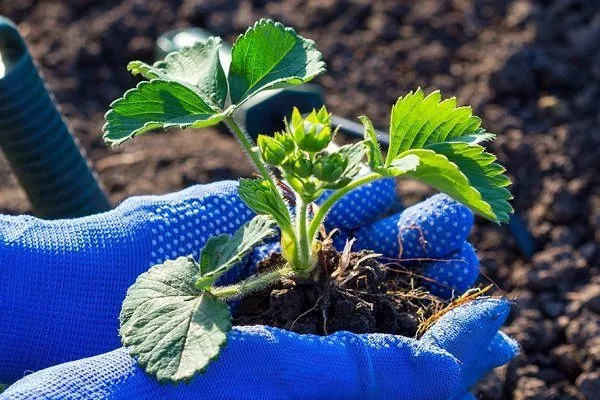
- Once the water has soaked in, place the strawberry roots into the holes. Spread the rhizomes, cover with soil, and compact them with your hands. When planting, position the rosettes so that their apical buds are at ground level.
- Water the planted seedlings. One bucket should be enough for approximately 15-20 rosettes.
Care
Wild strawberries are cared for in the same way as their cultivated counterparts. Growing the berries requires standard care—fertilizing, watering, and other agricultural practices. Even though these strawberries are wild, you can't expect a decent harvest without proper care.
Care features:
- In spring, remove dry leaves and runners. Don't pluck them; instead, carefully trim them with a knife. Remove plant debris from the beds and burn it, as it may harbor pathogens and pests.
- Beginning in spring, loosen the soil regularly. Loosen the soil to a depth of 5-6 cm in spring and 2-3 cm in fall. Before wintering, loosen the soil between rows to a depth of 10-12 cm.
- Hill up mature bushes regularly, raking soil towards the plants.
- Water your beds regularly. This will help you produce larger berries. Here's a watering schedule for strawberries:
- after flowering;
- after each berry picking;
- after fruiting is complete;
- in the fall during the formation of flower buds.
Unlike garden strawberries, wild strawberries do not need to be covered with film in the spring – the hardy berry grows well without shelter.
Top dressing
In nature, wild strawberries manage to grow and bear fruit without any fertilizer. However, to obtain a substantial harvest, the plant needs to be fed.
Feeding schedule:
- First feeding. Apply at the end of April or the beginning of May. Prepare a solution of 1/2 liter of mullein, diluted with water in a ratio of 1:6. Pour the solution into a bucket of water, add 60 g of superphosphate and 2 tbsp of wood ash.
- Second feeding. This treatment is carried out before flowering. Prepare a solution of 2 tablespoons of superphosphate and 3 tablespoons of wood ash, diluting them in a bucket of water.
- Third feeding. This is carried out after fruiting has completed. First, water the beds, then apply ammonium nitrate or ammonium sulfate, 10 and 20 grams per linear meter, respectively.
Instead of mineral fertilizers, you can add organic matter. Dilute slurry 1:6. Apply the fertilizer at a rate of 3-5 liters per 1 square meter. - Fourth feeding. This is done in late summer or early September. Apply mineral fertilizers—superphosphate and potassium salt—at a rate of 50 g and 25 g, respectively, per linear meter.
Pest and disease control
Wild strawberries are hardy plants with a strong immune system, but they still require protection. This is especially important when growing wild strawberries in garden plots, as there is a higher risk of spreading diseases and pests.
Pest control methods:
- Raspberry-strawberry weevil. The pest damages buds and leaves. Before flowering, spray strawberries with a tansy decoction. Pour 1.5 kg of fresh or 0.8 kg of dried tansy into a bucket of water. Let it steep for two days, then boil for half an hour, strain, and bring the volume to 10 liters. Add 40 g of laundry soap.
If weevils do appear on your plants, spray them with Inta-Vir. To do this, dissolve one tablet in a bucket of water. After harvesting the berries, treat the bushes with Actellic (dissolve 15 g in a bucket of water). - Strawberry mite. The pest sucks the sap from the leaves, causing them to turn brown and dry out. Strawberry bushes weaken. Before flowering, spray strawberry beds with an infusion of onion peels (soak 0.2 kg of the raw material in a bucket of water for 5 days).
If ticks appear after harvesting, mow down the leaves and treat the bushes with Fufanon (10 ml per bucket of water). - Slugs. To repel voracious gastropods, scatter slaked lime, tobacco dust mixed with wood ash 1:1 or superphosphate between the rows.
Methods of disease control:
- Powdery mildew. Spray the plants before flowering with a solution of 200 g of soap and 50 g of washing soda in a bucket of water. Alternatively, dilute 100 g of copper sulfate and 350 g of soap in the same volume of water.
If you noticed plant damage the previous year, be sure to spray your strawberries with Topaz (2 ml per bucket of water) after harvesting. Alternatively, treat the plants with colloidal sulfur (80 g per bucket of water). - Gray rot. Spray the buds with garlic infusion. To do this, crush 150 g of garlic and pour a bucket of water over it. Let it steep for 2 days.
- Spotting. Before the first leaves appear, before flowering, and after harvesting, treat the beds with an antifungal agent. A 1% Bordeaux mixture is ideal.
To prevent the spread of fungal infection, straw or film is spread over the beds, and the flower stalks are raised above the soil using special supports.
Reproduction
Wild strawberries are best propagated by runners. These are shoots that trail along the ground. For seedlings, use rosettes separated from the runners.
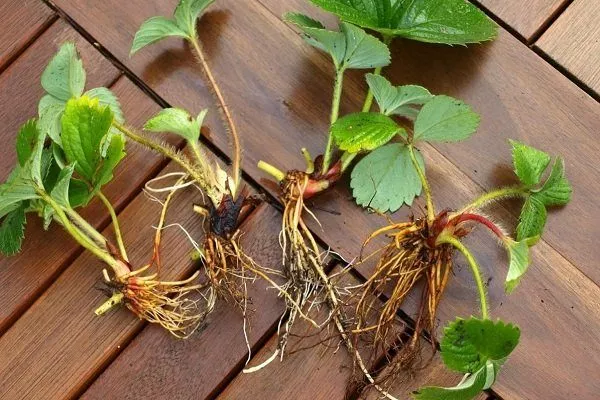
How to propagate strawberries using runners:
- At the end of summer, dig up and separate the rosettes from the runners.
- Plant rosettes in prepared beds, keeping intervals of 30 cm between bushes and 50 cm between rows.
- Water the plants, repeat watering after a week.
- Mulch the plantings.
To obtain high-quality planting material, select the bushes that will become mother plants in advance. Remove their buds in the spring so they can devote all their energy to forming rosettes.
Strawberries can also be propagated by seed, but this method takes longer than vegetative propagation. How to propagate strawberries by seed:
- Sow seeds in February.
- As soon as the first five leaves appear, transplant the seedlings into separate containers.
- Care for strawberry seedlings as you would any other plant: water, loosen the soil, and provide light.
- Plant the prepared seedlings in the beds.
The best time to plant seedlings is the end of April - the first half of May.
Collection and storage
Berries are harvested once they are fully ripe. Pick in dry weather, in the morning or evening. Pick only ripe strawberries.
How to preserve the harvest:
- Freezing. The berries are washed, the stems are removed, they are placed in small containers and placed in freezers or chests.
- Drying. The berries are dried along with the stems and leaves. The picked berries are tied into bouquets and hung in a warm, ventilated room. After a week of drying, they are removed, placed in glass jars, and sealed with lids.
The berries are dried without the stems. They are not washed before drying. The strawberries are spread on baking sheets and placed in the oven at a temperature of 30°C. First, the berries are slightly dried, then the temperature is increased to 50°C and they are dried to perfection. - Jam. It's boiled in a 1:1 ratio with sugar. Before boiling, the berries, covered with sugar, should sit for 6 hours. Next, place the bowl of strawberries on the stove, add citric acid, and boil. Once the brew comes to a boil, keep it on the heat for 6 minutes.
The sugar should dissolve completely during cooking. Pour the finished jam into jars, seal with lids, and store in a cool, dark place.
Other strawberry parts—leaves, runners, and roots—are also subject to harvesting. They are harvested in the spring or fall by drying. The raw materials are laid out under awnings or on balconies.
Wild strawberries aren't a substitute for garden strawberries. The yields vary greatly. This aromatic berry is planted as a pleasant complement to strawberries. You won't be able to make large preserves from it, but you can enjoy fresh berries and grow medicinal herbs without much effort or time.