
Carmen is a mid-season variety with versatile uses. It can be grown in any region of the country due to its high frost resistance. Its main unique feature is its flavor; it can easily be mistaken for strawberry.
Who developed the variety and when?
The Carmen strawberry originated in Czechoslovakia. Several prominent breeders worked on its development. In 2001, the variety was sent for testing to Skreblovo JSC. It passed the tests successfully, after which it began its active distribution throughout Russia.
Characteristics and description of the variety
Carmen is a tall, spreading, multi-stemmed bush with conical fruits. This is how the variety is described in many sources.
Bushes
The strawberry bushes are large and robust. They are formed from numerous thick, strong stems. The leaves are large, oval, and slightly serrated along the edges. The leaves are glossy and dark green.
The inflorescences are compact and located at leaf level. This is due to their active growth, which is caused by direct sunlight.
Berries and their taste
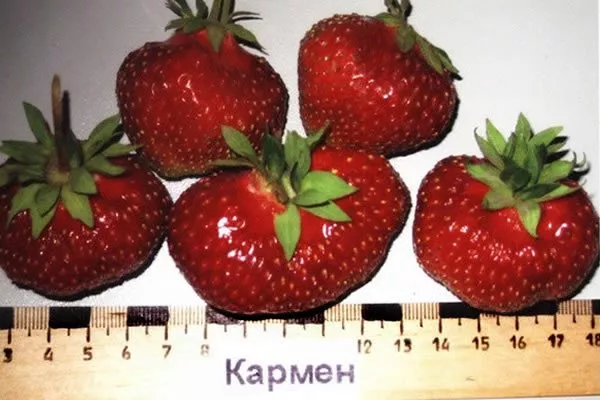
Carmen produces several harvests. The first wave of fruits weighs around 40 g, while subsequent ones weigh 17 g. This is considered average. Throughout the rest of the season, the weight remains around 17 g.
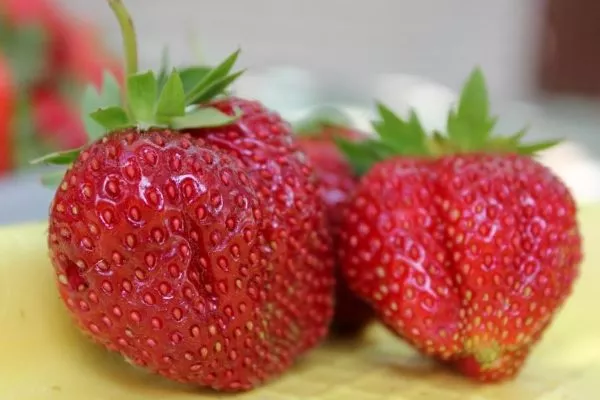
The berries are conical, slightly flattened, and widen at the stalk. They are dark red in color, turning burgundy when overripe. The surface is smooth, with attractive highlights, and the seeds are deeply embedded.
The flavor is sweet and honeyed, with a slight sour aftertaste. It's considered a dessert variety. The flesh is dense and juicy.
Productivity
A single Carmen strawberry bush yields approximately 1 kg of fruit throughout the season. The largest harvest occurs in the second year. This variety requires replanting. Growing in the same location for more than five years results in poor fruiting, with the berries becoming noticeably smaller.
Advantages and disadvantages of the variety
Carmen's main advantage is its large fruit size. But that's not the only reason to plant this variety in your garden.
Landing features
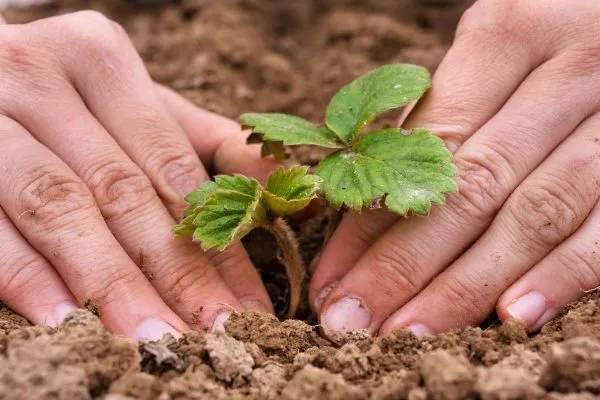
Carmen is planted using a standard procedure, the process being roughly the same as rooting other varieties. However, there are a number of peculiarities. If these are not taken into account, the plant may not take root and may bear fruit poorly.
- ✓ The soil pH level should be strictly within 5.5-6.5 for optimal nutrient absorption.
- ✓ The soil should have high water holding capacity, but at the same time be well drained to avoid water stagnation.
Timing and choice of location
Carmen is planted outdoors in early spring or fall, but at least one month before the onset of frost. It's acceptable to plant during the summer, but remember that seedlings are more expensive during this time. Choose July as the young plants will have time to develop roots before frost.
Rules for selecting a site:
- Keep in mind that the crop is shaded at first (until it takes root).
- Strawberries are not suitable for lowlands and marshy areas.
- The main requirement is the presence of sunlight and the absence of drafts.
- Fertilize sandy soil with an increased dose of humus (4 kg per 1 sq. m).
- Loosen clay soil with sand (75 kg per 1 sq. m).
Peculiarities of choosing seedlings
Purchase Carmen seedlings exclusively from specialized nurseries or trusted sellers at the market. This is the only way to guarantee that the seedlings will thrive, produce fruit vigorously, and that the varietal qualities will match those stated.
Before purchasing, carefully inspect the root system and leaves. Healthy planting material should have no spots or dry areas.
Landing conditions
The key to planting Carmen is proper soil preparation. Here's what to do:
- Dig up the soil, removing the roots of perennial weeds.
- Apply fertilizer – 10 kg of humus and 150 g of wood ash per 1 sq. m.
- Bring the soil pH to the ideal level of 5 to 7. Use fresh manure (3 kg per 1 sq. m) to raise the level, or wood ash (700 g per 1 sq. m) to deacidify.
Planting diagram
Carmen is a vigorous variety. Therefore, planting too densely will result in smaller fruits, slugs, and disease. The optimal distance between seedlings is 30 cm. Keep the row spacing around 45 cm.
Also watch a video about proper strawberry planting:
Growing and care
Strawberries, like other fruit-bearing crops, cannot grow without proper care. This includes not only watering and fertilizing, but also a number of other steps carried out in accordance with proper agricultural practices.
Watering
Carmen requires daily watering until the strawberries are established. Rainwater and melted snow are suitable.
Mature bushes are watered based on weather conditions. The soil should always be slightly moist, but not wet. When buds and fruit set, return to frequent watering.
Pollination
Carmen, grown in a garden bed, is self-pollinating. No further action is required from the gardener. If grown in a greenhouse, pollination must be done manually with a brush.
Loosening and weeding
A crust forming on the soil surface negatively impacts the crop. It blocks air circulation, which can lead to root rot. Therefore, it's important to loosen the soil regularly. This procedure should be performed after watering, along with removing weeds and unwanted vegetation.
Helps make care easier mulchingStraw, sawdust, dry grass from the garden, or peat can be used as mulch. If you prefer organic matter, remember that as it decomposes, it binds nitrogen found in the soil layers. Therefore, nitrogen-containing fertilizers should be applied more frequently.
Whisker removal and trimming
Carmen tends to produce numerous runners, which negatively impacts yield. Prune them off as soon as they appear. If plant parts are needed for propagation, select the strongest ones from healthy bushes. Discard the rest.
Top dressing
Fertilizing Carmen helps increase the quality and number of flower stalks. This procedure is performed several times per season:
- From the first days of fruit formation. Give the crop potassium supplements. Apply 15 g of monopotassium phosphate mixed with 10 liters of water per bush.
- During periods of abundant flowering, organic matter is needed. Cow dung with water (1:10) and diluted chicken manure (1:20) are used.
- At the beginning of the growing season, apply nitrogen fertilizers (for example, ammonium nitrate) at a rate of 20 g per 1 sq. m.
- During the budding and flowering period, use potassium-phosphorus fertilizers (for example, superphosphate and potassium sulfate) at 15 g of each per 1 sq. m.
- After harvesting, apply a complex mineral fertilizer to restore the soil.
If there's a phosphorus or calcium deficiency, wood ash is effective—200 g per square meter. The same substances are added to the soil before the onset of cold weather. This type of fertilizer, along with other agricultural practices, will help ensure a good harvest.
Spring care
After the snow melts, remove the covering material from the strawberry beds. Prune the plants to remove any parts that didn't survive the winter. Loosen the soil. Water the plants with a warm solution at a rate of 10 liters of water and 1 g of copper sulfate per square meter.
Preparing for winter
Carmen is a winter-hardy strawberry variety. However, during cold weather, the plant needs to be covered. Straw, pine branches, or fallen leaves can be used as a "blanket." If snow falls early in the region and continues throughout the winter, the bushes can simply be protected with a 15 cm layer of snow.
Features of growing in pots
Carmen's root system is shallow, so it can be grown in pots. However, keep these precautions in mind:
- The plant cannot self-pollinate. You'll need a gardener with a brush. Alternatively, use a fan. Point it at the planting and turn it on. The air will carry pollen from one bush to the next.
- A container of comfortable size is needed. So that the seedlings can be arranged according to the diagram. Or for one bush, one pot of an impressive size for the windowsill.
- The soil is the same as in Carmen's garden bed. But put a small layer of drainage at the bottom of the container.
- The culture is demanding of sunlight. This means it cannot grow on a north-facing balcony.
- Watering is carried out more frequently. Because the soil in the pot dries out faster.
- It will not be possible to refuse all other care procedures. It is standard for Carmen regardless of where it grows.
- Maintain the temperature. Where strawberries bear fruit, it should be at a level of +20-+22 degrees.
Treatment of diseases and preventive measures
Carmen is a variety with strong immunity. However, there's always a risk of disease. The most common culprit is gray mold, which attacks the fruit. This disease spreads rapidly and destroys large numbers of strawberries in a short period of time. It develops due to high humidity and growing in the shade. Symptoms:
- brown, wet spots with an unpleasant odor appeared on the berries;
- The strawberries were covered with a fluffy coating.
What to do:
- Collect the affected crop and destroy it.
- Treat the planting with preparations (optional): Switch (20 g per 10 l of water per 1000 sq. m), Horus (6 g of preparation per 5 l of water, the entire mixture is applied under 1 adult bush).
Teldor is suitable for preventative spraying. To do this, dissolve 8 g of granules in 2.5 liters of water, mix thoroughly, and add another 2.5 liters of liquid. Spread over 10 square meters of planting. This solution can be used once per season.
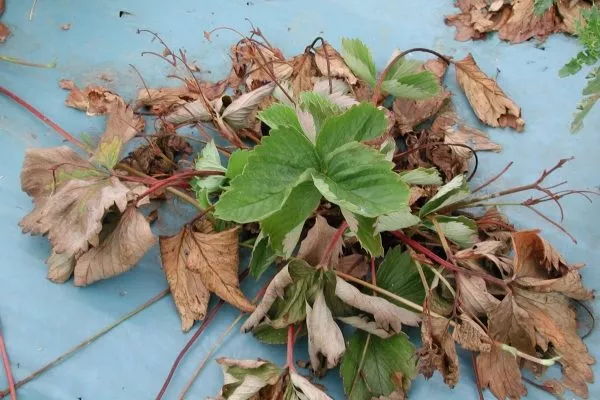
Carmen may be susceptible to verticillium wilt. Bushes suddenly and without cause begin to weaken and dry out. The disease is incurable and is very dangerous for other crops.
Pests and ways to get rid of them
Carmen is vulnerable to pest attacks. What pests can harm the plant and how to combat them?
- Nematode. Signs: Flower stalks have become short and thickened, and the leaves have lost their appeal. Remove the bush, leave the area dormant for 5 years, or dig up the plant, soak it in water heated to 45 degrees Celsius (113 degrees Fahrenheit) for 15 minutes, and replant.
- Spider mite. If affected, leaves wrinkle, turn yellow, and eventually dry out completely, stopping growth. Apply foliar treatment with Fufanon at a rate of 10 ml per 10 liters of water. Spread the solution over a 20 square meter area.
- Strawberry-raspberry weevil. Carmen's buds have stopped forming, or they're hanging on thin stems. You'll need Fufanon, in the same consistency.
- Strawberry leaf beetle. If there are many parasites, the leaves will be eaten away. At the first sign of damage, Fufanon or three sprays of wormwood decoction (150 g of dried leaves per 1 liter of water) every 5-7 days can help save the bush.
- Slugs. The main symptoms of parasitism are fruit that has changed its usual shape and holes in the leaves. The pest is afraid of the product "Groza." Sprinkle 1.5 g of the product per 1 square meter of soil.
Reproduction
Carmen can be propagated in several ways. Gardeners most often prefer the strong runners.
Mustache
The essence of this method is that the rosette rooting occurs directly in the garden bed. After all the fruits have been harvested, clear the area of unwanted vegetation, loosen the soil, and straighten the runners from each bush.
Plant the rosettes slightly deeper into the soil and water them daily. The plant will eventually take root, but don't rush to separate the seedling from the mother plant. Put off this procedure until spring.
Seeds
This propagation method is suitable for those growing strawberries on a commercial scale. Seeds are used to produce seedlings. Plant the plants in nutrient-rich containers in mid-February to early March. The seedlings will be ready for transplanting in the spring.
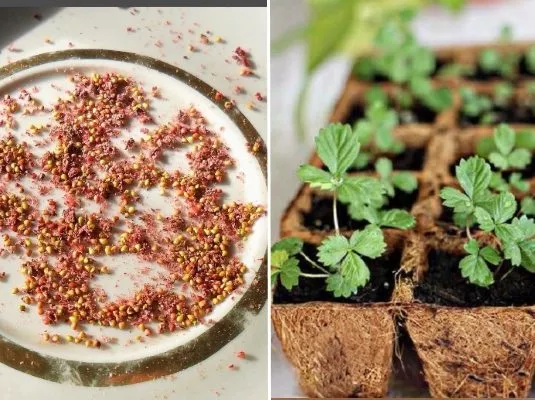
In this case, it's important to select high-quality seeds. You can buy them from a specialized nursery or harvest them from your own garden if you've already planted Carmen. To do this, peel the ripe berries, along with the seeds, and dry them in the sun. After a few days, the seeds can be stored.
Carmen can be grown from peat pellets. Place the peat pellets in a container and cover with warm water. Once they've softened, squeeze out the excess moisture and place two seeds in each pellet. The advantage of this method is that the seedlings don't need to be pricked out.
Dividing the bush
Carmen bushes can only be divided if they are between 2 and 4 years old. This procedure should be performed before flowering or in the fall, after the harvest has been completed.
Dig up the plant and divide it into two halves. Each halves should have a strong rosette with three or more leaves and a well-developed root system. Plant on a cloudy day.
Harvesting and storing strawberries
Carmen is characterized by dense berries. This characteristic allows the strawberry to retain its shape for several days. Not all varieties can boast this ability.
This variety is easy to transport, but the distance should not be too great. It must be transported in secure containers. Otherwise, the fruit will lose its marketable appearance.
Reviews from those who planted Carmen strawberries
Carmen strawberry is a variety with good frost and disease resistance. It produces sweet, bright red fruits with a slight tartness. The berries grow flush with the leaves, making it a great addition to your garden. Care is simple, and planting follows the guidelines.