
To renew their strawberry beds, gardeners often use a simple and affordable propagation method – runners. Each strawberry bush can produce several seedlings. Let's learn how to propagate strawberries using runners and the advantages of this method.
Basic rules
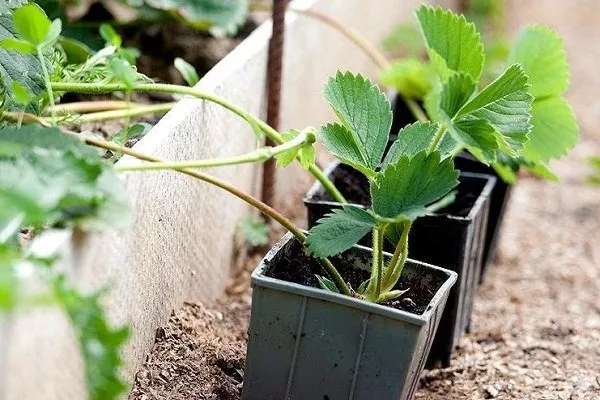
As strawberry plants grow, they send out long shoots—runners with compact bushes that eventually develop roots. This makes excellent planting material—a rosette with a well-developed root system.
Many gardeners, when propagating strawberries using runners, act at their own discretion, without following proper agricultural practices. This is the main mistake in strawberry cultivation.
To avoid losing the quality and quantity of berries when planting bushes, follow the rules for propagation by runners:
- Only the best sockets are used: strong, healthy, without damage or defects.
- Don't take planting material from bushes that have berries. It's important to determine in advance which bushes will bear fruit and which will be used for planting material.
Fruit-bearing bushes expend a lot of energy on berries, so they lack the nutrients to form strong planting material.
If strawberry bushes are used to produce both fruit and seedlings, their yield drops by 30%, and the berries become smaller and less tasty.
Most strawberry varieties can be propagated by runners. This method is not suitable for everbearing berries.
The benefits of growing strawberries using runners
Propagation by runners is a versatile propagation method that helps gardeners solve several problems at once. Without spending money on seedlings, you can refresh your berry patches, propagate a variety, or plant new plots.
Advantages:
- no special containers are needed for growing seedlings;
- there is no need to sow seeds in the ground or grow seedlings;
- no special room (greenhouse, hotbed) is required for growing seedlings;
- you don’t have to spend money on purchasing planting material;
- seedlings take root quickly and well;
- varietal characteristics are fully preserved.
Even hybrids, which are known not to transmit their varietal characteristics through seeds, can be propagated by runners.
Optimal timing
Strawberries are considered to produce the best quality planting material in early summer. Each region has its own planting time, and climate adjustments must be made. When planting, it's recommended to focus on the seedlings' readiness rather than on calendar dates.
The first root buds on the runners don't form until June. They are separated from the mother plant after a maximum of eight weeks. In temperate climates, strawberry bushes should root by the end of July, but no later than the end of August. Therefore, planting the rosettes should begin in midsummer.
What does planting material ready for transplanting look like:
- the rosette is well developed and has at least 4 leaves;
- The bush has already taken root and has powerful roots at least 7 cm long.
If you plant seedlings in the summer, they'll have time to adapt to their new location, build up strength, and prepare for winter before the cold weather sets in. Bushes separated from the mother plant will bear fruit the following summer.
Transplanting strawberries should be done in cloudy and damp weather.
How to choose a mother bush?
The lifespan of a strawberry plant in a garden bed is limited to three years—after that, their use is unsustainable. They age, weaken, and produce a meager harvest. Within this time, the berry plant must find plants with the optimal gene pool—the seedlings will come from these.
Rules for choosing queen cells:
- During the first year, prune the shoots of each bush so they can focus their energy on fruit production. While the bushes are bearing fruit, pay attention to their development, how they bloom, how many berries they produce, how large and sweet they are, etc.
- For the mother plants, select bushes that have performed well during development and fruiting. Choose disease-resistant specimens that have produced numerous, high-quality berries.
- To avoid mixing up the plants, mark the selected nursery plants. Use bright stickers, ribbons, etc.
- In the second year of life, remove any emerging shoots, buds, and stems with inflorescences from the mother plants – the bush should direct all its energy toward the formation of young rosettes.
How to choose a mustache?
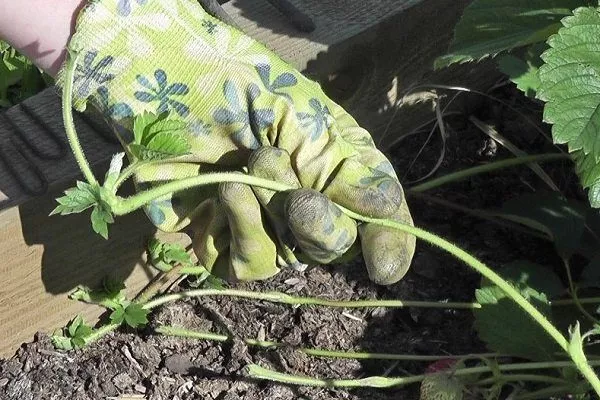
From the runners that appear a few weeks after the start of the growing season, it is necessary to select the "first line" rosettes - they are located as close as possible to the mother bush, have a developed root system and a spreading above-ground part.
All other shoots must be removed to prevent the bush from wasting energy. Often, gardeners leave only one rosette, the largest one, on the mother bush. If there aren't enough seedlings, the rosettes of the "second line" can be left.
How to prune seedlings?
Preparing the seedling for separation from the "nutritional base" begins as soon as roots appear. The rosettes are pinned to the soil, deepening them slightly. This is done by watering and loosening the soil beforehand. The growing seedlings are then cared for using standard agricultural techniques.
A couple of weeks before transplanting the rosettes to their permanent location, around the beginning of July, they should be cut off from the mother bushes. The cut should be made close to the rosettes to prevent them from wasting energy on shoots that are no longer needed.
From mulched or plastic-covered beds, rosettes must be cut without roots. They are placed in a biostimulant solution for 24 hours—Epin, Kornevin, or Zircon.
You can use peat pots to plant the rosettes at the root formation stage, without separating them from the mother plants. To ensure faster rooting and better development, it's recommended to feed them with growth stimulants such as Biolan, Ecosil, etc.
Growing seedlings
There's another option for preparing seedlings taken from strawberry runners. Trim the runners before roots appear on the young plants.
How to grow seedlings:
- Place the cut rosettes in well-moistened peat. Peat pellets are the most convenient option.
- Place the planted seedlings on a tray filled with water.
- Cover the tray with seedlings with a transparent lid.
- ✓ The optimal temperature for rooting is 18-22°C.
- ✓ Air humidity should be at least 70% to prevent the roots from drying out.
By creating a special microclimate, the rosettes take root faster. This method speeds up root formation and seedling planting. If a gardener is unable to plant strawberries on time, growing them in a mini greenhouse can speed up the process.
When growing seedlings, in any way – in pots or in the ground, it is necessary:
- Control moisture levels. The tray needs to be topped up periodically. Water the seedlings carefully to prevent them from drying out or becoming waterlogged. In the ground, water every 2-3 days.
- Feed with nitrogen fertilizers. For example, with a solution of bird droppings (1:50).
If seedlings are growing near mother plants, the soil around them must be loosened. Do this very carefully, being careful not to disturb the roots.
Preparing the beds
A few days before planting, begin preparing the beds. Choose a sunny, wind-protected site. Good predecessors include carrots, radishes, beets, garlic, and greens. Avoid planting strawberries after tomatoes, potatoes, zucchini, pumpkin, and raspberries.
The soil in the berry patch should be loose, soft, and airy. To achieve this:
- Dig the area to the depth of a shovel blade. As you dig, remove all weeds, their roots, stones, and debris.
- Add wood ash to the soil – approximately 300 g per 1 sq. m, peat and sawdust – a bucket per 1 sq. m.
- Turn over the applied fertilizer. Use a pitchfork for this purpose.
- ✓ Use only hardwood ash, avoiding softwood due to its high resin content.
- ✓ The ash must be completely cooled and sifted to remove large particles.
Along with organic matter, you can also add mineral fertilizers – 40 g of superphosphate per linear meter, and complex fertilizers for berries, for example, “Kemira-Lux”.
Transplanting
Seedlings are planted in the morning or evening, when the sun is out. Bushes are placed in rows, nests, or individually. Another option is carpet planting, in which bushes are planted in a random pattern.
The most popular method of growing is in rows. Two options are used:
- One-line. The intervals between bushes are 25 cm, the width between rows is from 60 to 80 cm.
- Two-line. The distance between bushes is 25 cm, between rows – 30-40 cm, between rows – 60-80 cm.
The order of planting seedlings:
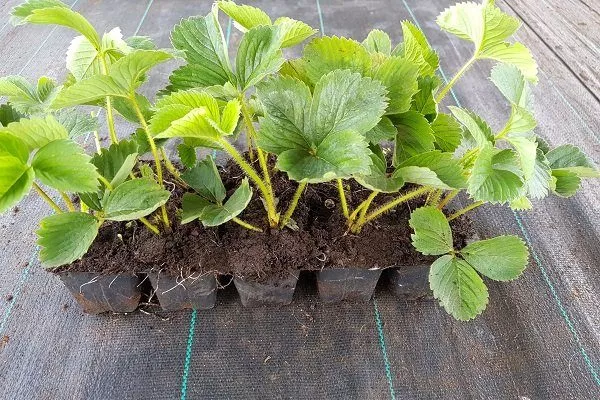
- Using sharp scissors, cut the rosette off the mother plant at a distance of approximately 10 cm. The rosette should have a tendril about 20 cm long – this will protect the seedling from drying out.
- Disinfect the seedlings. To do this, prepare a solution by mixing 3 tablespoons of table salt, 1 teaspoon of copper sulfate, and 5 liters of water. Soak the roots of the seedlings in the solution for 10 minutes.
- Prepare holes for the seedlings according to the chosen planting pattern. Water them with warm, settled water. The recommended watering rate for each seedling is 500-700 ml.
- Place the rosette into the hole so that its foot goes deep into the loose substrate, the mother “tail” should remain on the surface.
The rosette core shouldn't be buried deep; it should be level with the surface. If you cover it with soil, it will rot; if you leave it too high, it will dry out or freeze. - Water the planted rosettes generously—the beds should be literally flooded. This will allow the roots to begin establishing roots immediately.
- To make sure the bush is planted correctly, pull it slightly towards you; it should not be pulled out.
No more than two varieties of strawberries can be planted in one row.
If it's raining, the bed is covered with plastic film stretched over sturdy wire or plastic arches. The makeshift greenhouses are left open to allow free air circulation.
Rosettes don't need to be replanted if there's room in the beds. They won't experience the stress of being moved from one place to another. Simply guide the runners to the desired rooting site and secure them in place, creating new rows.
Caring for young plantings
Rosettes planted in late summer require careful care until the frost sets in. During this time, they will not only have time to take root but also grow a little.
How to care for strawberry seedlings:
- Cover the beds with transparent material. This protects the plants not only from rain but also from the sun, which can damage young plants.
- Strawberries water regularly, preventing the soil from drying out. The recommended watering rate is 1 liter per plant. After watering, loosen the space between the rows, removing weeds along the way.
- To prevent moisture from evaporating from the soil, mulch Spread peat, humus, and sawdust between the rows. This will save time and effort on weed control, as mulch inhibits weed growth.
- A month after planting, fertilize the plants. Apply potassium sulfate or any complex fertilizer for berries. Then, carefully hill up the bushes (this promotes root formation).
- Insulate your strawberry beds for the winter. For example, with pine needles—they protect from frost and allow air to pass through.
When caring for strawberry seedlings, it's important to consider current weather conditions. If planting occurs closer to fall, rain may begin, and you won't need to water the beds (assuming the cover has already been removed by then).
Typical mistakes
Propagation by runners is a seemingly simple method. But it has many subtleties that gardeners are unaware of, forget, or neglect.
Mistakes in propagation by whiskers:
- Early trimming of whiskers. If you rush to separate the rosette from the mother plant, it will not have time to develop a developed root system.
- Uncontrolled mustache growth. If too many rosettes form on a bush, they become small and underdeveloped. They are not viable and take a long time to establish themselves in a new location.
- Repeated transplants. If rosettes are replanted several times from one place to another, their roots become damaged, the bushes become weaker, take a long time to take root, and do not survive the winter well.
- Planting in heat or rain. Transplanting seedlings in rainy weather leads to the development of fungal diseases and other infections. In hot weather, the plant weakens, and its immunity is reduced.
- Unprepared soil. Strawberries require loose soil with a neutral pH to grow. If seedlings are planted in improperly prepared soil, they will be weak, will not produce a good harvest, or will not take root at all.
An experienced gardener explains two methods for propagating strawberries using runners in his video:
By propagating strawberries with runners, gardeners not only expand and renew their berry patch but also lay the foundation for a future harvest. The future yield of the new bushes depends on how correctly the runners are transplanted.
And thank you again, Marina, for your valuable advice. I used to try to use all my whiskers for propagation, but it turns out I need to select them. As embarrassing as it is, I made the same mistakes you described. Now I'll know better.