
Spring strawberry planting requires a gardener's utmost attention. It's crucial to protect young plants from recurring frosts and other adverse conditions. Let's learn how to choose the time and location for planting, and what options are available for spring planting.
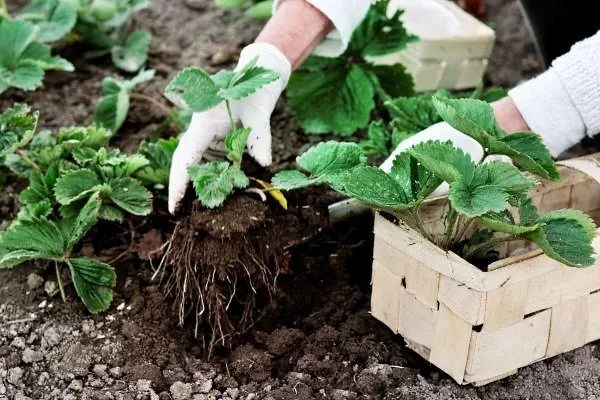
Spring planting dates
One of the keys to successfully planting strawberries is choosing the right time. Timing depends on the region, climate, and specific weather conditions. Approximate calendar dates for planting seedlings:
- in southern regions with a mild climate – March 5-15;
- in regions with a temperate climate – from April 10 to early May;
- in the northern regions – May 1-15.
These dates are approximate; it's also important to consider the weather. Strawberry seedlings are planted under the following conditions:
- stable temperature at +10…+15 °C;
- the top layer of soil warmed up to +8…+9 °C;
- On the day of planting the weather should be cloudless.
In most regions, the risk of spring frosts remains after these dates. To protect young strawberries from freezing, use film or agrofibre. They are also used to cover new plantings when prolonged spring rains begin.
Pros and cons of spring planting
Advantages of spring planting:
- Seedlings planted in the spring, when placed in a warm, favorable environment, have the opportunity to strengthen and form a powerful root system.
- The bushes, having gained strength during the spring-summer season, will enter winter healthy and will confidently withstand low temperatures.
- Bushes that do not take root in the spring can easily be replaced with new ones.
- Strawberries planted in spring require less watering, as the soil contains a lot of moisture after the snow melts.
Spring planting is especially popular in regions with harsh winters. In Siberia and the Urals, this is the only way to grow strong strawberry bushes with a robust root system. Planted in spring, strawberry bushes have time to properly establish and grow.
Spring planting is not beneficial in southern regions, as young seedlings struggle to grow and develop under the scorching sun. The same applies to the Moscow region, but there's also the added challenge of poor environmental conditions.
Choosing a strawberry seedling
When choosing strawberry seedlings, follow these rules:
- deal only with trusted sellers – nurseries and specialized stores;
- Buy varieties that are zoned for your region.
Seedlings for planting are grown independently or purchased - with a closed or open root system.
With an open root system
Bare-root seedlings (BRS) are grown in beds. Their roots are exposed, so they are often damaged during transportation and transplanting. The survival rate of these plants is lower than that of container-grown varieties.
Watch a video about spring planting of bare-root strawberries:
Signs of high-quality seedlings:
- the bush has 3-5 leaves;
- leaves are strong, elastic, shiny, slightly pubescent;
- leaf color – bright green, without defects;
- developed fibrous root system - roots are light, 8-10 cm long, strong, without signs of rot;
- the horns are thick – from 7 mm, soft light green in color;
- growth points of peduncles are developed, without damage.
With a closed root system
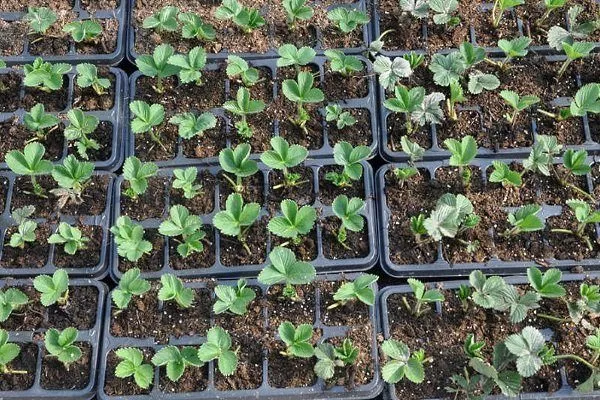
Closed-root seedlings are sold in containers or cassettes. This option guarantees a high survival rate. Closed-root seedlings are more suitable for fall planting.
When purchasing container-grown seedlings, pay attention to the following points:
- Inspect the cups—many sellers, looking to make a profit, sell seedlings with an open root system as cassettes, having transplanted them into plastic containers a day or two before sale. The authenticity of the closed root system is indicated by the root tips growing through the drainage holes.
- Inspect the seedlings. They should show no signs of disease or damage.
To grow seedlings yourself, remove excess flower stalks and rosettes from the mother plants, leaving only the two strongest. Once the runners have rooted, separate the young plants and transplant them into containers.
Planting material can also be obtained using the Dutch method, known as frigo. This technique is used to grow large-fruited strawberries. The plants are dug up in the fall, during the initial dormant phase. All leaves are removed. The leafless plants are stored until spring at temperatures ranging from 0 to -3°C.
Preparation of planting material
If you bought container seedlings, you still have about two weeks to plant them. However, it's best to plant seedlings with open roots as soon as possible. If you have to delay planting due to weather or other circumstances, you need to "preserve" the seedlings.
Strawberry seedlings are placed in dark plastic bags, first sprayed with water. They are stored in the basement for 5-7 days. The plants, left in the dark, will develop new roots, which will help the bushes establish themselves more quickly.
The procedure for preparing seedlings for planting:
- Leave no more than four leaves on each plant. Remove all the rest—this will help the seedlings take root better.
- Trim the roots with sharp pruning shears – their length should not exceed 10 cm.
- Dip the roots in a solution containing a growth stimulant. If the seedlings are in a closed root system, simply water them with the solution.
Before planting, the roots of seedlings can also be dipped in:
- clay mash;
- a mixture of humus, soil and growth stimulator;
- a mixture of mullein and clay;
- garlic infusion;
- 1% solution of potassium permanganate or iodine.
- ✓ Use only hardwood ash, avoiding softwood due to its high resin content.
- ✓ The ash must be completely cooled and sifted through a fine sieve to remove large particles.
One hour before planting, the seedlings are watered, adding mullein and herbal infusions.
Preparing the site for planting
Features of site selection:
- Strawberry plantings are located in well-lit areas. The preferred orientation of the beds is north-south or southwest. The site should be level or with a slope of 2-3 degrees. Lowlands are unsuitable, as the plants are doomed to disease and to wither from the cold air.
- The best soils for strawberries are black soil and sandy loam. Clay, sod, and light gray soils are less favorable. If the soil is heavy, add sand during digging to loosen it. The optimal pH is 5.5-6.5.
- Groundwater level is not less than 0.6-1 m.
- It's recommended to plant strawberries after lettuce, legumes, grains, radishes, beets, carrots, and parsley. Unfavorable predecessors include cucumbers, potatoes, zucchini, sunflowers, tomatoes, and Jerusalem artichokes.
Strawberries should not be grown in the same place for more than 3-4 years. Replanting should be done every 4-5 years.
How to prepare a site for planting:
- In the fall, dig the soil to a depth of 30 cm. Be sure to remove any weed roots from the soil.
- Apply fertilizer—organic and mineral. Manure or compost is the best option. Horse manure is the most valuable. Spread the fertilizer over the area before digging—two buckets per square meter. Add a cup of ash to each bucket.
- A month before planting, water the soil with hot lime (+70°C), making a solution of one bucket of water and 500 g of lime. Add 50 g of copper sulfate. Use one liter of solution per square meter.
- In depleted soils, add additional humus and ash just before planting.
There is another option for preparing the soil:
- In the fall, sow green manure in the area being prepared for strawberries. Frost will destroy the sprouted plants—beans or lupines are usually sown—and they will turn into biomass, which, as it decomposes, enriches the soil.
- In spring, dig up the soil and add fertilizer – humus or compost with added ash (one glass per bucket).
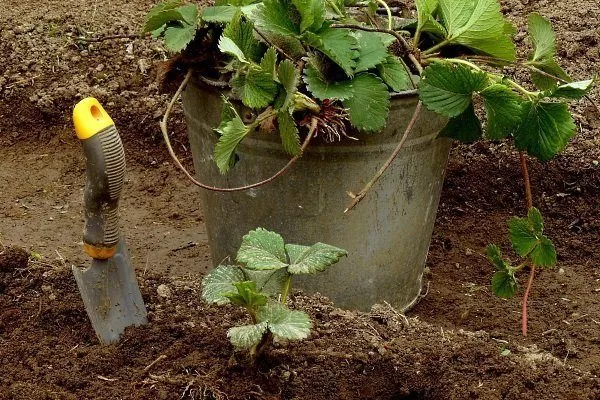
Bad "neighborhood" of cultures
When choosing a location for a strawberry plantation, consider crop compatibility:
- Avoid planting strawberries near crops that require similar nutrients – the plants will compete for nutrients.
- Neighboring crops should have similar watering regimes.
- Avoid planting crops near strawberries that will shade this sun-loving plant.
- Crops affected by the same diseases and pests should not be planted next to each other.
If you follow the above rules, undesirable neighbors for strawberries:
- all nightshade and clove crops;
- cabbage;
- raspberry;
- onion and garlic.
Favorable neighbors:
- parsley;
- salad;
- carrot;
- radish;
- spinach.
Beets, radishes, peas, beans, and lentils also make good companions for strawberries.
Planting depth and distance
When planting the bushes in prepared holes, it's important to position the growing point—the "heart"—correctly. It should be above ground level; burying the growing point too deep can cause the plant to rot. If the growing point is higher than intended, the roots will become exposed and begin to dry out.
The distance between strawberry plants depends on the variety and planting method. The minimum distance is 7 cm, the maximum is 60 cm. The smallest gaps are for carpet planting, and the longest are for row planting.
Strawberry planting methods and detailed instructions
Depending on the variety and size of the plot, the optimal strawberry planting pattern is selected.
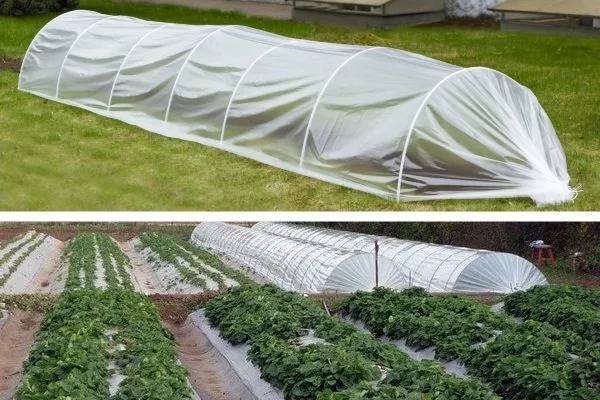
Into the film tunnels
To obtain an early harvest, seedlings are planted in film shelters:
- Install film “tunnels” immediately after the snow melts.
- Leave 1 m gaps between adjacent frames – metal or plastic.
- Plant the plot using a two-row pattern. Leave 25-30 cm between rows and 30-40 cm between adjacent plants in a row.
- Place plants in a checkerboard pattern.
Planting in tunnels begins in April. It is recommended to remove flower stalks to prevent the plants from losing vigor. The plants are watered, loosened, and all standard agricultural practices are followed. By autumn, vigorous, highly productive bushes will grow under the film.
Advantages of growing in a tunnel:
- plants are protected from excess ultraviolet radiation;
- protection from cold winds;
- a favorable microclimate is maintained under the film;
- the ripening period is shortened;
- It is easier to control the soil composition.
Disadvantages: it is necessary to constantly ventilate the tunnels, monitor humidity and temperature.
Under agrofibre (black covering material)
Planting strawberries under black mulch is a dramatic solution to the weed problem. Here's how:
- Build beds and install drip irrigation. The hoses are laid under the plastic film. The beds should be at least 80 cm wide.
- Place the covering cloth on the beds and secure it on both sides, covering it with soil and pressing it down with something heavy.
- At the pre-marked locations, make cross-shaped holes approximately 10 cm long. The distance between adjacent slits is 30 cm.
The covering material can be black or two-color. Black and white material is installed with the white side up—this creates a more favorable temperature regime.
Advantages of the covering method:
- weeds do not grow through agrofibre or film;
- the whiskers do not take root and are easy to remove;
- the berries do not touch the ground, so they are always clean;
- plant roots are developing well;
- the bushes have little contact with the soil, are practically disease-free, and there is no need to treat them with pesticides;
- In winter, plant roots feel more comfortable under cover.
Watch the video below about planting strawberries under black covering material:
In the greenhouse
In a greenhouse, strawberries are grown in one of the following ways:
- the classic way - in the ground;
- in pots;
- in plastic bags;
- on vertical beds.
In a greenhouse, you can create horizontal and vertical beds, with the latter option allowing for more efficient and economical use of space. One hundred square meters of vertical strawberry cultivation can accommodate the same number of plants as 30-400 square meters of conventional strawberry planting.
Plastic bags
This Dutch technology allows for up to five harvests per year. Here's how:
- Prepare white polyethylene bags with a thickness of 0.25-0.35 mm.
- Fill the bags with nutrient substrate and moisten moderately.
- Bags can be placed in a greenhouse, in open ground, horizontally or vertically.
- Make 9cm wide holes in the bags.
- Plant the seedlings in the holes. Leave at least 20 cm between adjacent plants.
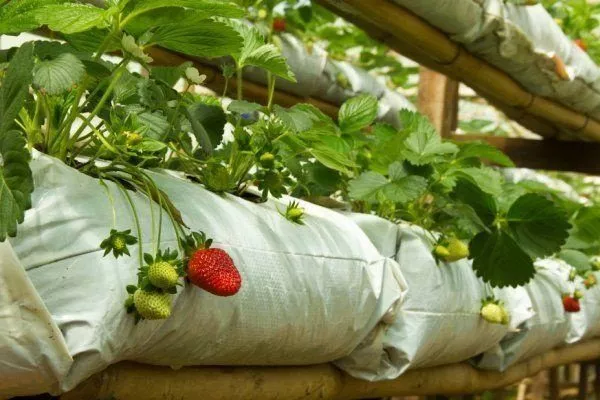
This method of growing is productive, strawberries are less susceptible to diseases, and there are no weeds at all.
Vertical garden bed
This planting option is ideal when space is limited. The steps for constructing a vertical garden bed from plastic pipe are as follows:
- Take a large diameter plastic pipe and a smaller diameter pipe.
- Insert a tube with pre-drilled irrigation channels into the center of the large pipe.
- Make holes in the pipe 20-30 cm apart. The strawberries will grow from these holes.
- Provide a drainage layer at the bottom to prevent water coming from above from accumulating in the lower part of the structure.
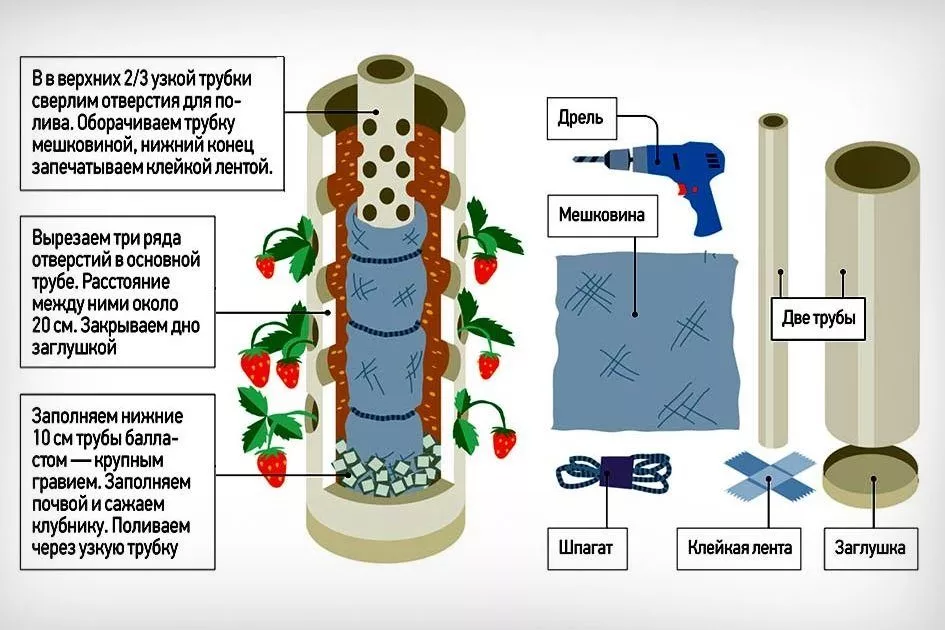
This method saves space and eliminates the need for weeding and loosening the soil. The resulting structures are attractive. Vertical beds can be constructed from any available material; this is a very cost-effective planting method that deserves the attention of our gardeners. You can also make vertical beds from old car tires stacked one on top of another to form a pole, or from a plastic barrel.
Planting seedlings in open ground
It's recommended to plant strawberry seedlings in open ground in the evening or on cloudy days. If the seedlings are in cups, simply carefully transfer them from the cups into pre-prepared holes. Seedlings in open root systems can have problems with survival, so the planting technique for them differs slightly from that for seedlings in closed root systems.
When planting seedlings with bare roots, several additional steps must be taken:
- trim the root system if necessary;
- carefully place the bush into the hole and straighten the roots;
- First, pour water into the hole, then immediately sprinkle the roots with soil and compact it.
With a standard planting scheme, the following parameters are maintained:
- hole depth – 12-15 cm;
- the distance between adjacent holes is 30-35 cm;
- the distance between rows is 40-45 cm.
Depending on the chosen planting method, the above parameters may vary. The following planting patterns are distinguished:
- One-line. The distance between bushes is 15 cm, between rows – 60 cm.
- Two-line. The distance between bushes is 20 cm, and between rows – 30 cm. This technique is more often used for summer rather than spring planting.
- Carpet. Only 7 cm are left between bushes and 30 cm between rows. This creates a favorable microclimate on the plantation, and weeds simply have no room to grow. The downside is that the berries produced are small.
- Bushy. The bushes have plenty of room to grow, and the berries are large. Viewed from above, the bushes form rectangles measuring 50 x 70 cm.
- Nesting. One bush is planted in the center, and 6 others around it, the distance between neighboring bushes is 10 cm, between nests - 30 cm.
Planting by seeds
To ensure seedlings grown from seeds are transplanted in the spring, sowing begins no later than February or March. Seeds sown in May or June produce seedlings that are used to grow berries in greenhouses during the winter.
Procedure:
- To speed up germination, soak the seeds in melted water for 2-3 days. Strawberry seeds are very small, so they are first spread out on a fleecy surface. Cotton pads or filter paper work well, for example. Then, immerse the seeds in water poured into a shallow container.
- Drain the water and cover the container with glass or film. Place it in a warm, bright place. Until the sprouts appear, add water gradually to prevent the seeds from drying out and mold from developing.
- When the sprouts appear, the seeds are planted in the soil using a match or a toothpick.
Watch a video about growing strawberries (garden strawberries) from seeds:
Caring for planted strawberries
After spring planting, strawberries need increased attention:
- Sun protection. If planting was done in open ground, the bushes should be shaded, for example, by covering them with spunbond.
- Watering. Unlike fall planting, strawberries planted in spring require less frequent watering, as the soil retains sufficient moisture after the snow melts. Subsequently, the strawberries are watered as the soil dries out. Watering should be moderate; overwatering will encourage powdery mildew and gray mold.
- Mulching. Experienced gardeners recommend covering newly planted trees with mulch for two weeks. Hay, straw, spruce branches, sawdust, and compost are all suitable mulches.
- Weeding and loosening. These measures are necessary if mulching or covering material is not used.
- Top dressing. Strawberries need to be fertilized at least three times per season. This is especially important in poor or underfertilized soils. Read about spring fertilizing. here.
You can feed strawberries with the following solutions:- Mix ammonium sulfate (1 tablespoon) with rotted manure (2-3 cups) and add a bucket of water. Use 1 liter of solution per hole.
- With a solution of nitroammophoska (1 tbsp. per 10 liters of water).
- Infusion of mullein (1:10) or bird droppings (1:20).
- Prevention and control of pests/diseases. Plants are sprayed in a timely manner with fungicides, herbal infusions, and, if necessary, insecticides.
- Trimming mustache. They are removed to prevent the plant from losing its energy to growing shoots. The first tendril emerging from the bush is usually left for planting material.
- ✓ Yellowing of leaves between the veins indicates a magnesium deficiency.
- ✓ Leaf curling can be a sign of calcium deficiency or excess moisture.
Possible errors during landing
Beginners often make mistakes when planting strawberries, here are the most typical ones:
- The fit is too tight. The spaces between the bushes are insufficient. The dense plantation lacks ventilation, leading to diseases, especially gray mold. Due to a lack of light and nutrition, the berries become smaller.
- Excess of fertilizers. Excess nitrogen causes leaves to grow excessively, while berries develop late. Excess manure can burn plant roots.
- Deepening the growth point. Plants with high or low growing points will wither.
Answers to frequently asked questions
Hobby gardeners and summer residents often have questions about planting strawberries. The table below contains the most frequently asked questions and answers.
Table
| Question | Answer |
| What should the soil composition be? | If the soil is unfavorable—light gray or gray turf—add sand and till the soil. Strawberries don't grow in acidic soil. |
| How close can bushes be placed to each other? | Don't plant plants too close together, as this will cause them to become diseased and the berries to grow small. The closest planting method is the carpet method, with a spacing of 7 cm. |
| What happens if you apply more fertilizer than necessary? | The root system may burn, or the green part of the plant – leaves, shoots – may begin to grow vigorously. |
| What is the best way to plant seedlings – on a mound or in a hole? | Either option is suitable. But if you're planting in a hole, it's important that the area isn't waterlogged. |
| How to transplant seedlings grown from seeds? | Wait until 3-4 true leaves appear, and then transplant the seedlings into the ground or into a greenhouse. |
Spring planting helps prevent young seedlings from freezing, allowing for the first harvest of berries to be harvested in the summer. Every gardener can choose the optimal strawberry planting method, from open ground to greenhouse conditions.
You know what I'm grateful for? Someone at least answered the question I was wondering about—which is the best way to plant seedlings, in a hole or on a mound? My water table is high, so planting in a hole isn't an option. Thanks for the info.