
Regular irrigation is essential for growing garden strawberries. The frequency and amount of watering depend on the time of year, the growing season, and many other factors. Let's learn how to properly water strawberries and the different irrigation methods available.
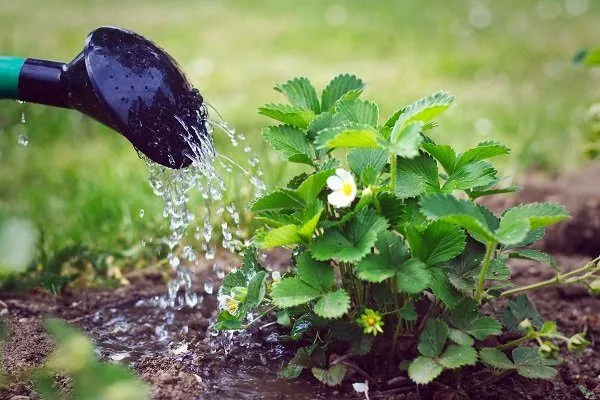
When to start watering?
In early spring, strawberries don't need watering—they get enough moisture from melting snow. When the water reserves are exhausted, begin artificially watering the beds.
The start of watering depends on the climate:
- in the southern regions and the middle zone – end of April;
- in northern latitudes – beginning of May.
You can't rely solely on the calendar. Weather conditions and other factors influence the start of the watering season. If the soil is dry and it's mid-April, don't delay – water your strawberry beds, and if it's raining, skip watering altogether.
Begin watering by removing the layer of mulch scattered in the fall. It, like old leaves, harbors pests that shouldn't be left in the garden beds. Removing the mulch allows the soil to warm up faster, which accelerates the development of leaves and roots.
In spring, it's recommended to water strawberries in the morning. Evening watering is contraindicated, as cold temperatures at night increase the risk of root rot and other diseases.
What influences the amount of watering strawberries?
Garden strawberries tolerate harsh climates well, but they are very demanding when it comes to watering. Both too much and too little water are equally detrimental to this berry. To ensure that watering doesn't harm your strawberries, consider a number of factors.
Weather conditions
Climate and weather conditions significantly impact all strawberry cultivation practices, including irrigation in particular. To minimize moisture-related issues, consider their moisture requirements when selecting varieties:
- In arid regions, it is recommended to cultivate strawberry varieties that are drought-resistant;
- In regions where damp weather is not uncommon, moisture-resistant varieties that prefer frequent watering are planted;
- In areas where there are seasonal fluctuations in precipitation and temperature, dry winds and scorching heat, it is recommended to plant varieties and hybrids with increased endurance.
The watering schedule in regions with any climate is influenced by current weather conditions:
- If the heat doesn't subside for days, and the soil doesn't have time to cool down before morning, water the beds daily, without sparing the water.
- If the weather is warm and rain falls at normal intervals, water the strawberries only as needed.
- In rainy summers, watering isn't necessary. On the contrary, you should protect the berries from excessive moisture—for example, by covering them with plastic. The greenhouse should have cross-ventilation—don't close the sides.
There's no universal watering frequency for strawberries. It depends on the soil condition. Stick your hand into the soil to determine whether it's time to water. If your fingers easily penetrate the soil and don't feel the damp layer, water the beds immediately—you're already too late.
Keep a large container in your garden or vegetable patch, fill it with water in advance, and use it for watering when it warms up in the sun.
Soil structure
When watering, consider the soil's characteristics. The frequency and amount of watering depend on its structure:
- Sand. The rate at which water penetrates into the soil depends on its content. As the sand concentration increases, water permeability accelerates. Because of the loose soil structure, plants with surface roots don't have time to absorb water.
Strawberries growing in sandy soil require more frequent watering. Watering rates are also increased to allow the plant to absorb more water. - Clay. Clay soils are dangerous when overwatered—they retain moisture, preventing it from being absorbed by deeper layers. Stagnant water leads to root rot in strawberries. Adding sand during bed preparation can help improve the situation.
If it is not possible to correct the soil structure:
- strictly adhere to the watering rate;
- if there is a lack of moisture, make deep beds;
- if the area is flooded, create raised beds;
- Provide drainage if groundwater levels are high and install drip irrigation if there is little rainfall.
Landscape features
Garden strawberries recommended for cultivation On flat areas, but not everywhere. Often, surfaces that appear ideal at first glance have a significant slope, causing one part to become over-watered, while another part, conversely, is poorly saturated.
How to solve the problem:
- Place the beds not along the slope, but across it.
- With a slight slope, terraces are unnecessary; drip irrigation is sufficient. This ensures the soil under each bush is thoroughly moistened.
Height of beds
Raised beds warm up quickly in the spring sun. Here, vegetative growth begins earlier than on flat ground. This growth is enhanced by organic layered heating beneath the beds—this lasts just long enough for the strawberry plant's life cycle (4-5 years).
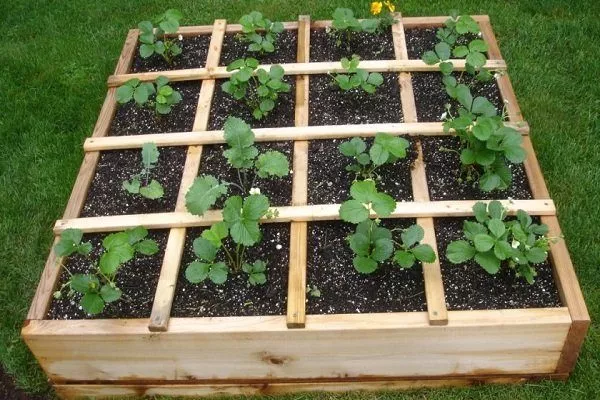
The downside of raised beds is that they dry out quickly. Melt and rainwater drain quickly, meaning strawberries in these beds need to be watered much more frequently than those in flat areas, and especially those in sunken beds.
Strawberries are typically watered daily during hot weather, but in raised beds, the frequency must be doubled. The soil is moistened early in the morning and before sunset, when the heat subsides.
Basic rules of watering
Improper watering of strawberries leads to yield loss. One incorrect action can lead not only to disease and crop loss, but even to the death of the berry plant.
How to water garden strawberries – general rules:
- use only warm, settled water;
- do not overwater the beds - this can lead to fungal diseases;
- After watering, loosen the soil to prevent crust formation and ensure air access to the roots;
- Mulch the soil after watering to retain moisture and prevent weed growth;
- to prevent moisture from evaporating too quickly, water the strawberry beds when there is no sun - in cloudy weather, in the morning, in the evening;
- At least half an hour should pass between morning watering and sun exposure.
- ✓ Use water with a pH of 6.0-6.5 for optimal nutrient absorption.
- ✓ Avoid water with high chlorine content, which can inhibit the root system.
Watering in sunny weather can cause strawberry burns. Every droplet that hits the leaves acts as a tiny lens, amplifying the energy of UV rays.
Features of watering strawberries at different stages of vegetation
At all stages of development, garden strawberries are very sensitive to watering. Moreover, at each stage, it's necessary to follow not only general rules but also a number of specific guidelines tailored to the specific needs of the current growing season.
How to water seedlings?
Rules for watering seedlings:
- to moisten the soil, use a syringe or a small enema;
- water the seedlings every 2-3 days;
- try to prevent water drops from falling on the leaves;
- Observe the watering rate, do not allow the substrate to dry out or become over-watered.
The main danger when growing any seedlings, including strawberry ones, is blackleg. This incurable fungal disease can destroy seedlings in a matter of days. It occurs when the substrate is overwatered.
As a preventative measure, water the seedlings once or twice with a fungicide, such as Trichopolum or Trichodermin. Allow 1-2 weeks between waterings.
Gardeners often confuse garden strawberries and wild strawberries. These crops belong to different species and differ in their chromosome sets. Strawberries have taller bushes and smaller berries. Unlike wild strawberries, wild strawberries are less demanding in terms of moisture.
Watering after planting in the ground
When planting seedlings in the ground, water them thoroughly. Water is poured into the holes, and once it's absorbed, the seedlings are placed in them. Alternatively, you can plant the seedlings first and then water them.
Planted strawberries are watered according to a special scheme:
- Apply enough water to ensure it's completely absorbed, without allowing it to stagnate in depressions. Otherwise, the plants won't root properly. A good rule of thumb is 10 liters of water per square meter.
- Water young plants frequently, but not excessively. Keep the soil slightly damp at all times to encourage active root growth.
- For the first 2-3 weeks, water the plantings from above. This watering promotes rooting. Water the bushes using a watering can with a shower attachment. The best time to do this is early morning.
- A month after planting, increase the watering rate, while reducing its frequency.
During flowering
When the strawberries are blooming and the weather is fine, watering isn't necessary. If the soil dries out, you'll need to water the beds. Do this very carefully to avoid water splashing onto the flowers. If it washes the pollen off the pistils, the berries won't set.
Water the flowering strawberries:
- in normal weather – every 10-14 days;
- in the morning, otherwise slugs will crawl in at night;
- in hot weather – every 3-4 days;
- watering can under the bushes or drip irrigation.
In rainy weather, be sure to cover the flowering beds with film to prevent a reduction in the number of ovaries.
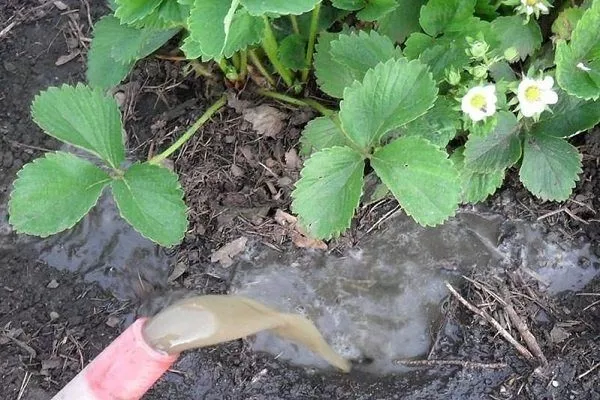
The recommended watering rate for flowering strawberries is 2 buckets per square meter. Approximately 1 liter of water per bush. The recommended watering rate for loose soil is 10-12 liters, and for clay soil, 8-10 liters. The recommended water penetration depth is 25 cm.
If strawberries don't receive enough water during flowering, their pollen will be sterile. If there's too much moisture, bees won't be able to pollinate the flowering bushes, the berries won't set, and the yield will drop.
During fruiting
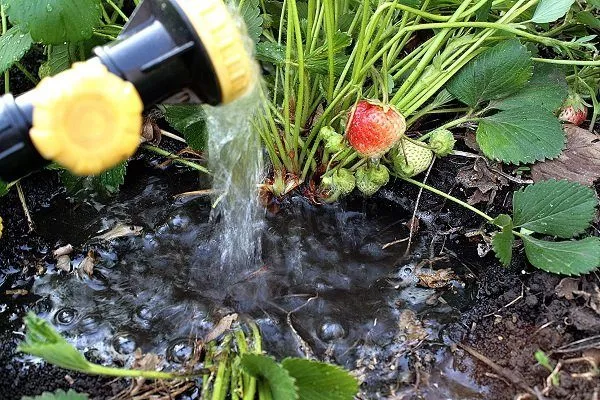
When berries appear, it's important to preserve the harvest and prevent them from rotting. Excessive moisture during this period is unacceptable, but regular watering is also essential. Apply water along furrows to avoid it touching the berries. Drip irrigation is the best option.
How to water fruiting strawberries:
- every 1-2 weeks, if it is very hot – more often;
- per 1 sq. m – 3 buckets of water;
- If the weather is rainy, additional moisture is not required;
- To retain moisture in the soil, sprinkle it with mulch, and at the same time protect the berries from contact with the ground;
- Water the beds after picking the berries.
- ✓ Leaves lose turgor and become wilted.
- ✓ Slowing down of plant growth and development.
- ✓ The berries are small and not juicy.
If strawberry bushes experience moisture deficiency during fruit formation and ripening, this negatively impacts the harvest. The berries ripen small and not juicy.
After harvesting
Inexperienced gardeners often make the mistake of not watering strawberries after fruiting has finished. During this period, flower buds for the coming season are formed and runners are growing, so water is vital for the plants.
How to water strawberries after picking berries:
- Rarely, but generously. Pour water directly onto the leaves to wash away dust and insects.
- Before the onset of cold weather, water the beds especially well - this will recharge the moisture for the winter.
Seasonal watering
When watering strawberries, gardeners focus on the growing season and weather. Many berry lovers find it easier to navigate the seasons. The crop's growing season extends across three seasons, and each requires its own irrigation techniques.
Spring
With the arrival of spring, strawberries awaken and begin their growing season. This time of year marks flowering and the beginning of berry formation.
Spring watering procedure:
- Sometimes winters are snow-free, requiring irrigation to begin earlier than usual.
- Two weeks after the snow melts, pour boiling water into the spaces between plants. Use a watering can. Pour the water from a distance of 1 meter – the water will cool to approximately 70°C and will not harm the plants.
The recommended watering rate is 0.5 liters per plant. Once the boiling water has penetrated to a depth of 10 cm, it will cool slightly further, to approximately 30°C. This boiling water will kill pests that overwinter in the upper soil layers. Repeat the treatment after a week. - Starting in late April, water your strawberries weekly. You'll need to water your strawberry beds 2-3 times throughout the spring. This calculation is helpful for those planning trips to their dachas.
Hot watering should only be used in early spring, before the strawberry bushes begin to grow. Boiling water can damage the shoots.
Summer
Irrigation during the summer season is particularly dependent on climate and weather. Weather during this period can vary from prolonged rains to heat waves that last for days. Summer marks the fruiting and development stages, so irrigation is adjusted to the growing season.
Approximate frequency of watering:
- at the beginning of summer – once every 1-2 weeks;
- when will the berries appear – 1-2 times a week;
- when the temperature rises – 4-5 times a week.
Autumn
At this time of year, fruiting ends, and frequent watering is no longer necessary. However, it shouldn't be forgotten. A total of 2-3 waterings are carried out throughout the fall. The key principle is to water infrequently but generously.
Irrigation methods
Strawberry beds are watered using all known methods. Each gardener uses the watering method that is available to them.
Manual method
This is the most labor-intensive and least effective irrigation method. Today, it's used only in dachas (summer cottages) where there's no access to a central water supply and no way to extract water from the ground.
Manual watering methods:
- From a watering can or bucket. Suitable only for small berry bushes.
- From the hose. This is a more convenient and effective method, but it requires moving the hose from one place to another. The downside of watering with a hose is that it washes away soil from under the bushes and spreads infection from infected berries throughout the berry patch.
Sprinkling
Berry plants are watered using sprinkler systems. Water is fed into nozzles, through which it is sprayed into the surrounding area.
There are two types of installations:
- Mobile. Hoses with spray nozzles are laid out on the ground and can be moved as needed.
- Stationary. Water is supplied through pipes buried in the ground or secured to the ground. Rain nozzles, which cannot be moved, are located on the surface. When constructing such installations, the placement of sprinklers is carefully considered in advance.
Drip irrigation
Today, this is the most convenient and effective irrigation method. It is used for any garden or vegetable crops, including berry bushes. Drip irrigation uses a system of plastic pipes, to which smaller diameter tubes are attached. These tubes are fitted with drippers.
Water is dispensed individually through drippers to each plant. The irrigation system is automated, eliminating the need for gardeners to waste time on watering. This option is especially convenient for berry gardens, where black film is used—it retains moisture in the soil, reducing water consumption.
Combining watering and fertilizing
Strawberries, like most crops, are recommended to be watered during or before fertilizing. To avoid exceeding the frequency and amount of watering, two agricultural practices must be combined.
How to properly combine watering and fertilizing:
- Organic and mineral fertilizers are better absorbed when diluted.
- When watering for the first time in spring, apply a nitrogen fertilizer. Ammonium nitrate, for example, is suitable.
- Combine another spring feeding with watering. Add organic matter (humus or compost) or mineral fertilizer (nitrophoska and potassium). The recommended rate is 1/2 liter of solution per plant.
- The next feeding is in the spring again. Make sure to do it before flowering. Add potassium sulfate.
- As soon as you see pests or signs of disease, spray the beds with a solution of iodine and potassium permanganate. Maximum frequency: once every two weeks.
- When the strawberries bloom, add a quick-dissolving complex fertilizer along with the water. The maximum number of applications is four throughout the growing season.
Helpful tips
Growing strawberries is full of strict rules and numerous nuances. Tips from experienced gardeners will help you achieve a good harvest:
- The ideal water temperature is 18 to 20°C. If you're lazy and don't heat the water, there's a high risk of disease and rot. Cold water degrades the quality of the berries and inhibits plant growth. However, overheating should be avoided—water heated to 40°C causes thermal burns to strawberries.
Although strawberries shouldn't be watered with water that hasn't been warmed by the sun, there are situations where this rule can be broken. Spraying cooling water protects the berry bushes from drying out in extreme heat. This is done through special sprinkler systems and creates a cooling cloud of microdroplets. - To protect your plants from fungal diseases, it's recommended to spread an antibacterial mat over the beds during irrigation. Straw is the easiest and cheapest mulch. Mulch acts as a barrier to fungi, absorbs excess moisture, and keeps the berries clean.
- Stop watering promptly. Allow at least a few days between the last watering and the first frost to occur, otherwise there's a risk of freezing the strawberry roots.
Information on watering strawberries can also be found in the following video:
If there's no water in your garden or summer cottage, and the climate doesn't offer farmers rain, don't even try to grow strawberries. This berry requires constant care, including maintaining optimal soil moisture by adjusting the frequency and amount of watering.
I didn't think watering required so much attention. I've always just run a hose under my strawberry plants. This year, I followed your recommendations closely. First, I started watering in the morning instead of in the evening. Second, I installed a sprinkler head on the same hose (news, and very welcome news for me). Third, I started paying attention to the soil composition. I learned a lot thanks to your article. This year, I can confidently say that my strawberries were watered correctly, and they rewarded me with large, sweet berries and a bountiful harvest.