
Strawberry growing requires periodic fertilization. This is essential for plant growth and development, a large, high-quality harvest, and protection from diseases and pests. Fertilization should be done in stages. A wide variety of fertilizers are available.
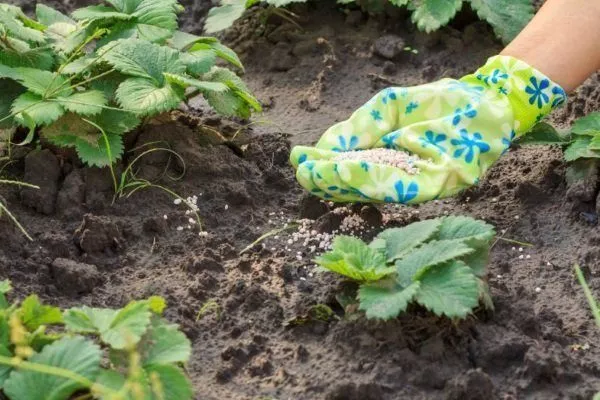
When do strawberries need fertilizing?
Fertilizing strawberries in the spring is essential. Otherwise, you risk getting a small or poor-quality harvest.
The crop can do without fertilizing in the first year of planting, provided that sufficient fertilizers were applied during the planting.
Fertilizing schedule by year
| Year of cultivation | Type of fertilizer | Peculiarities |
|---|---|---|
| 1st year | Not required (if fitted correctly) | Pre-planting application is sufficient |
| 2nd year | Organic + mineral | Nitrogen fertilizers in early spring |
| 3rd year | Only minerals | Emphasis on potassium and phosphorus |
| 4th year | Organic + mineral | Renewing plantings after the season |
From the second year onwards, the plant must be fed.
The year after planting, strawberries can be fed with both organic and mineral fertilizers. In the third year of planting, it's best to limit the fertilizer to minerals. In the fourth year, organic fertilizers can be added again.
The plant may require additional feeding if it is deficient in certain nutrients. This can be determined by the plant's appearance:
- Calcium deficiency manifests itself as darkened leaf tips that turn brown. This can lead to crop losses.
- Without sufficient potassium, leaves begin to turn pale and dry out at the edges. Due to uneven development, leaf blades become wrinkled.
- Nitrogen deficiency is expressed in weak flowering, small pale green leaves, and delayed fruiting.
- Phosphorus deficiency is manifested by slow growth of leaves and the acquisition of a reddish-green color.
- Magnesium deficiency is indicated by the plant changing its green color to red or purple.
- When there is a lack of manganese, the leaves dry out and fall off.
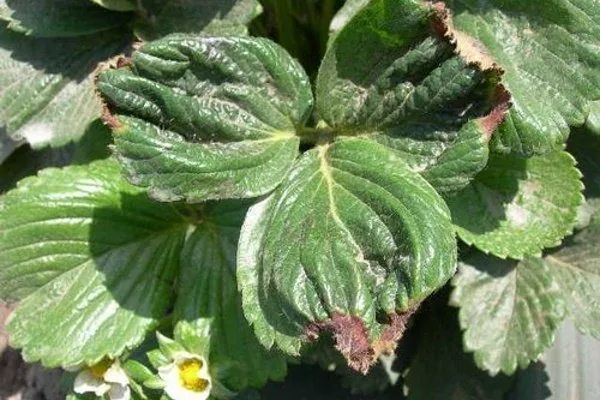
Calcium (Ca) deficiency: leaf tip burn and deformation
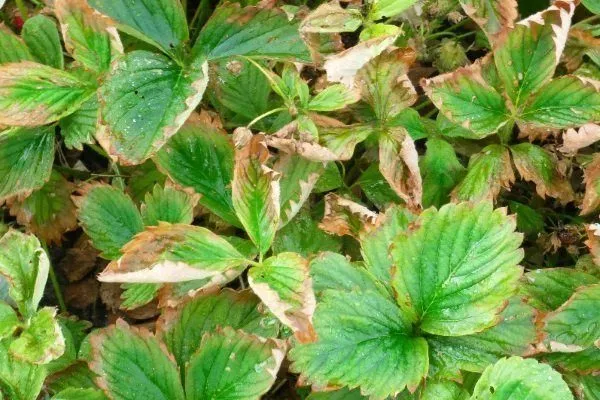
Insufficient potassium (K): leaves turn pale, edges dry out
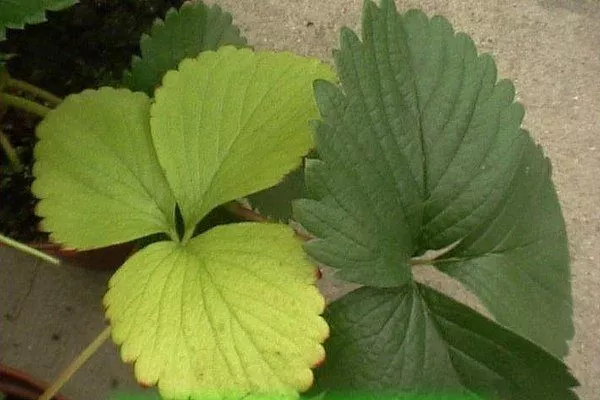
Strawberry leaves with nitrogen (N) deficiency turn light green (no bright green veins). Healthy strawberries have rich green leaves.
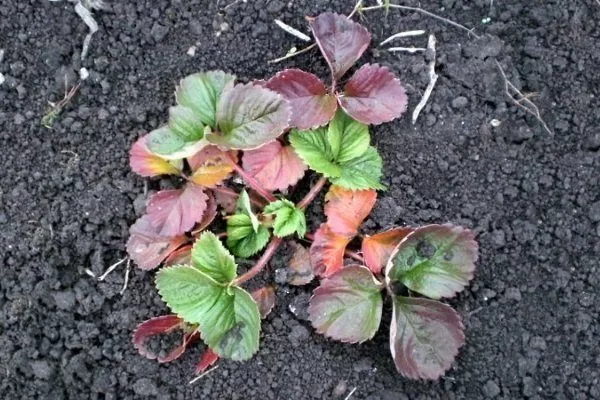
Phosphorus (P) deficiency: dark green leaves with a bluish or red tint
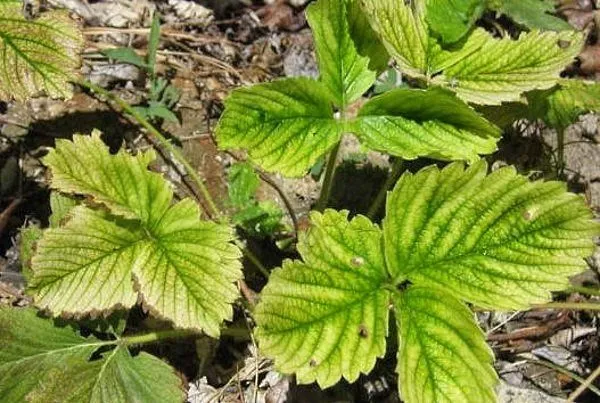
Magnesium (Mg) deficiency: leaves turn pale, areas between veins become lighter and dry out
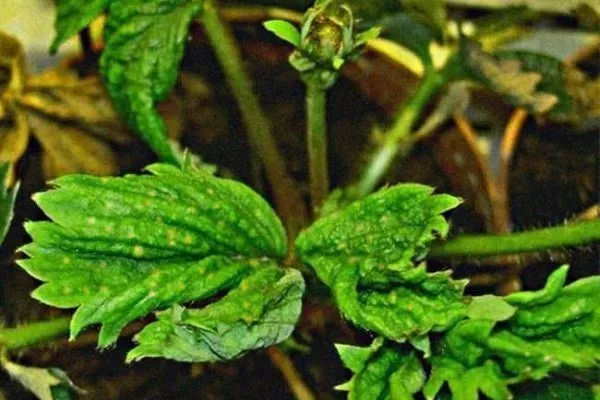
Manganese (Mn) deficiency: yellowing between veins, leaves with a mosaic of green and yellow spots
Types of strawberry fertilizers
Basic feedings are either root or foliar:
- Fertilizer should be applied to the roots after rain or watering. After applying the nutrient solution, the soil should be watered again.
- Foliar feeding usually involves spraying. It's best to choose cloudy weather for this. On sunny days, spraying is best done in the evening or early morning. Foliar feeding should be used in cases of high soil acidity, root problems, or signs of nutrient deficiency in various parts of the plant. This method of application requires a lower concentration of fertilizer.
According to their composition, fertilizers are divided into
- Organic. This variety is of animal or plant origin. This group includes compost, manure (including bird droppings), and ash.
- Mineral. Can be made based on nitrogen, potassium, or phosphorus.
- Complex formulations. These involve a combination of various micro- and macroelements.
How can you feed strawberries in spring?
Various fertilizers are used for strawberry plants. These typically include organic and mineral fertilizers. You can also use folk remedies and pharmacy products—they are no less effective.
Mineral fertilizers
In early spring, you can use nitroammophoska as a fertilizer. Dilute 1 tablespoon of the product in a 10-liter bucket of water. This amount is enough for 20 plants.
In the second half of April, urea can also be used as a fertilizer. This solution is suitable if the air temperature is at least 16 degrees Celsius. To prepare the fertilizer solution, dissolve 1 tablespoon of urea in a bucket of water. Divide the resulting solution among 20 plants.
During flowering, the plant requires potassium. To achieve this, add potassium nitrate to the water (1 teaspoon per 10 liters) and water the plants (1 liter per 2 plants). A similar solution can be used for spraying. For additional feeding during flowering, you can add potassium nitrophosphate (2 tablespoons).
When planting strawberries or a week before, superphosphates should be added.
Application rates of mineral fertilizers
| Fertilizer | Deadline for submission | Dosage | Way |
|---|---|---|---|
| Nitroammophoska | Early spring | 1 tbsp/10 l | Watering at the roots |
| Urea | April (t > +16°C) | 1 tbsp/10 l | Watering |
| Potassium nitrate | Bloom | 1 tsp/10 l | Watering/spraying |
| Superphosphate | Landing | 30 g/m² | Embedding into the soil |
You need 30 g of the product per square meter, and also add potassium sulfate or potassium magnesium sulfate (the volume is 2 times less than superphosphates).

When using mineral fertilizers, it's important to adhere to the manufacturer's recommended dosages. Otherwise, you risk losing your harvest, as it won't be edible.
Organic fertilizers
These fertilizers are attractive because they are natural. The following options are well suited for strawberries:
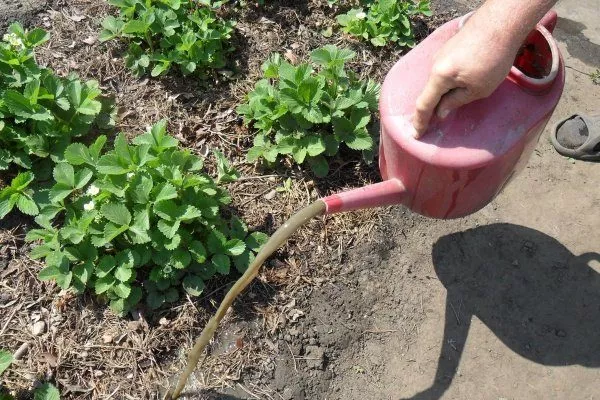
- Green tea. To prepare this remedy, fill a bucket with nettles and soak them in warm water for several days. Root feeding is done by diluting the mixture in 10 parts water. For spraying, strain the infusion and dilute it with 20 parts water. No more than 1 liter of solution is needed per plant.
- Chicken manure. This organic matter should be soaked in 20 parts water and left for several days. Add half a liter of fertilizer to each bush.
- Mullein. The fertilizer solution is prepared using the same principles as the chicken manure solution. It can be used for feeding in early spring and at the beginning of flowering.
- Compost. This fertilizer is attractive for its gentle action. Apply a layer approximately 5 cm thick around the bush, leaving some space around its base.
- Ash. The best sources of this fertilizer for strawberries are wheat and rye straw, birch, and coniferous trees. Simply place a handful of ash under each bush in early spring and repeat after pruning at the end of the season. Spring feeding can also be done with an ash infusion. If yellow spots appear on the leaves or they begin to rot, use ash as a dusting. Two tablespoons of the mixture per bush is sufficient.
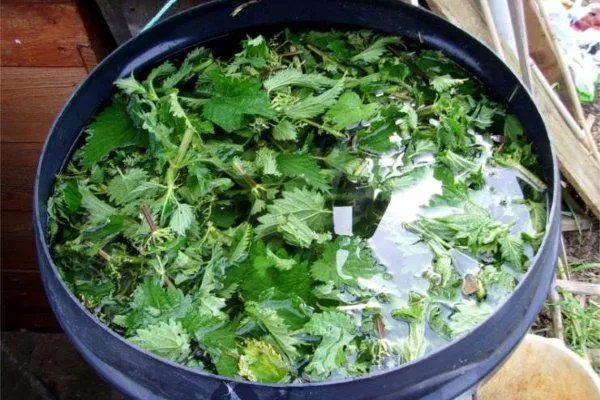
Feeding with green tea from nettles
Chicken manure fertilizer
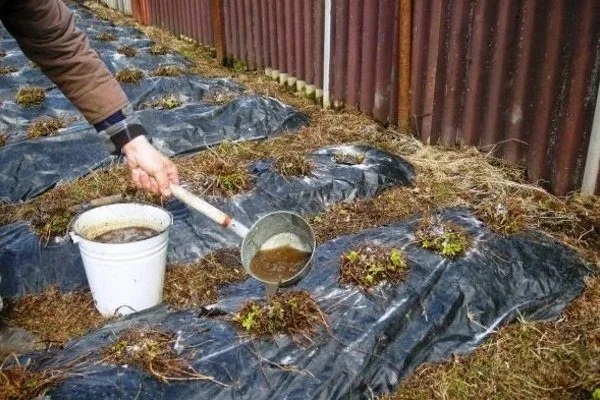
Top dressing with a mullein solution
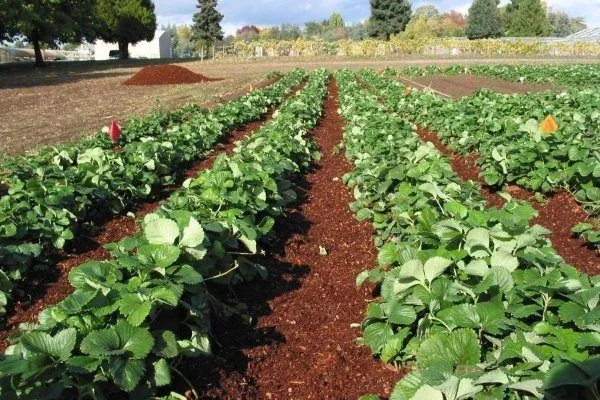
Fertilizing with compost
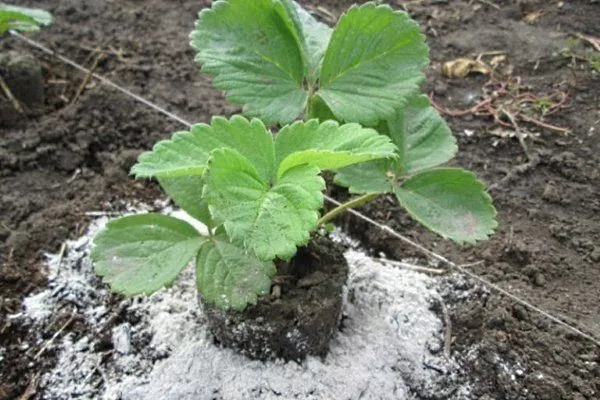
Ash top dressing
Avoid over-fertilizing with organic matter. The plant should receive most of it early in the growing season.
Don't use fresh horse or cow manure on strawberries. This fertilizer must be aged.
Complex compositions
Strawberries are often fertilized with a mixture of organic and mineral fertilizers. For the first feeding, ammonium sulfate and mullein are good. For one bucket (10 liters), you'll need 1 tablespoon of granules and half a liter of organic fertilizer. This amount should be divided among 10 plants.
Other store-bought complex fertilizers can also be used for fertilizing strawberries. These include Rastvorin, Hera, Kemira, Ryazanochka, and NutriFight.
The advantage of complex fertilizers is their balanced composition and versatility. A single product is usually suitable for several crops. It should be used according to the instructions.
Watch the video for a recipe for a complex, effective fertilizer for strawberries:
Pharmaceutical products
Several medicinal compounds can be used to fertilize strawberries. Most of them are readily available in any home:
- IodineThis product is a good fertilizer and disease preventative. It's best used as a spray before flowering. To prepare the solution, simply add 4 drops of iodine to a bucket of water. Repeat the treatment twice more, 1.5 weeks apart.
- Boric acidThis solution is effective as a spray at the beginning of flowering. To prepare the solution, dilute 5 g of the solution in a bucket of water (10 liters). You can add 30 drops of iodine and a glass of ash to the boric acid and water. Apply no more than 1 liter of the solution to each bush.
- Boric acid and potassium permanganateThis mixture stimulates fruit formation. Simply add 2 g of each product to a bucket of water. You can also add a glass of pre-sifted ash. Use the solution for spraying.
- Ammonia (10%)This remedy is beneficial for strawberry growth, increasing yield, and preventing pests. For the first application, add 40 ml of ammonia and a liter of soap solution to a bucket of water (10 liters). Water the soil with this solution, being careful not to get it on the plant itself. Repeat the application during the flowering stage. You can apply another application after harvesting. To do this, add 5 drops of iodine instead of the soap solution.
Folk remedies
Over several centuries of strawberry cultivation, people have discovered numerous ways to nourish them. The following options are particularly effective:
- Infusion of bread crusts (rye)It is enough to soak the bread in water and after a week dilute the resulting infusion in 10 parts water.
- Sour milkThis product is effective if the soil is slightly acidic. Dilute the product in 2 parts water and water the soil in a circle, 10 cm away from the bush. This fertilizer can be applied three times per season: in early spring, after harvest, and in September. The acidified product has a positive effect on yield, stimulates crop growth, and provides protection against certain diseases and pests.
- YeastYou must use a live product. Dissolve 200 g of yeast in half a liter of water and let it sit for 20 minutes. Pour the resulting mixture into a 10-liter bucket of water. Water the strawberries generously with this solution.
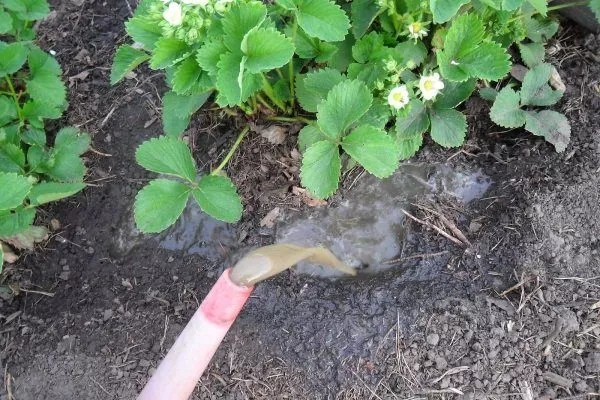
Stages of strawberry fertilizing
Strawberries should be fed according to a specific schedule. Additional fertilization is required if there are any signs of deficiency.
In standard situations, feeding is carried out according to the following scheme:
- The first time fertilizer is applied is in mid-spring, when the snow melts and the leaves have not yet opened. It's best to combine this with pruning. This prevents unnecessary damage to the plant.
- The next feeding is necessary during the flowering stage. Applying the right fertilizer will make the berries sweeter and extend their shelf life.
- Fertilizing can be done during the fruit set stage. This will positively impact the yield and berry size. Fertilizer should be applied foliarly.
- Another important spring feeding is carried out during fruit formation.
- The plant needs fertilizing once fruiting has completed. At this stage, fertilizing stimulates the formation of new roots and the formation of flower buds.
- The last feeding is carried out in the fall to prepare the crop for winter.
- March: Nitrogen fertilizers after snow melts
- April: NPK complex when buds appear
- May: potassium fertilizing during the ovary stage
- June: phosphorus and potassium after harvest
- September: organic + superphosphate
Fertilizing calendar
Common mistakes
Many inexperienced gardeners make mistakes when fertilizing strawberries. These typically include the following:
- Adding large amounts of organic matter. This leads to overgrowth of green matter, which can lead to soil rot. Excessive organic matter hinders berry formation.
- Using large amounts of bird droppings or mullein can cause foliar burn, which can ultimately kill the plants.
- Incorrectly calculating the fertilizer concentration. If you use an insufficient amount, the fertilizer will be ineffective. Excessive fertilizer can negatively affect the plant and make the berries inedible.
- Ignoring the need for spring spraying. This step is crucial for protecting plants from diseases and pests. Skipping it can result in the loss of a large portion of the harvest or even no harvest at all.
Critical consequences of errors
| Error | Consequence | Manifestation period |
|---|---|---|
| Excess nitrogen | Berry rot | 2-3 weeks |
| Overfeeding with organic matter | Fruit deformation | 1 month |
| Potassium deficiency | Dry leaf edges | 10-14 days |
| High dose of minerals | Root burn | 3-5 days |
When working with various fertilizers, personal protective equipment should be used. Some products can cause adverse reactions if they come into contact with the skin. Keep fertilizers out of the reach of children, as there is a high risk of poisoning if ingested.
Fertilizing strawberries in the spring is essential. Fertilizing is essential for the normal development of the crop, its yield, and protection from diseases and pests. Fertilizing should be done according to a specific schedule. A deficiency or excess of any nutrients can be detrimental to the plant.