
Strawberry cultivation under plastic film is used both on large farms and in private gardens. This method has become popular in areas with relatively mild summers.
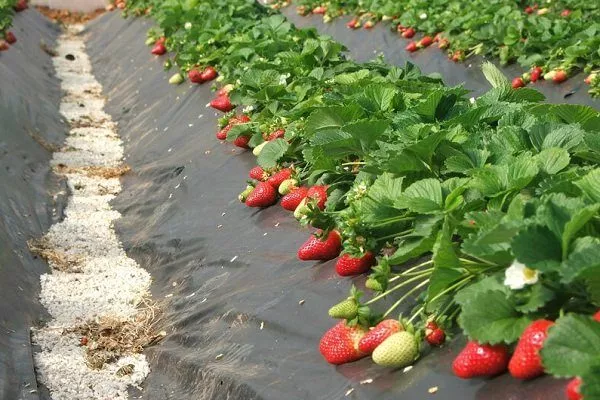
Peculiarities of growing strawberries under film
The subtleties of growing strawberries under film:
- The area where the berry rows will be located is dug to a depth of 15-20 cm.
- Manure and mineral fertilizers are added to the soil.
- The soil is covered from above with straw, hay, aged compost and other mulching material.
- To protect against pests living in the soil (mice, moles, shrews, etc.), sheets of cardboard or fine-mesh metal mesh are buried under the beds at a depth of 20-25 cm.
- The beds are covered with film.
- Strawberry bushes are planted in slits spaced 20 cm apart in each row. The row spacing is 65-70 cm.
- Check the soil pH 2 weeks before planting: the optimal level for strawberries is 5.5-6.5.
- Add organic fertilizers at a rate of 5-6 kg per 1 m² to improve the soil structure.
Advantages and disadvantages of the method
Growing strawberries under film has the following advantages:
- No weeds under the covering material. Grass can only grow in the slits near the strawberry plants and is easy to remove.
- The soil under the film remains constantly moist. Much less water is required for irrigation compared to traditional strawberry growing methods.
- The runners won't root in the shelter. If you want to obtain planting material, you can trim them off and grow them elsewhere.
- The bush and berries are much less likely to be infected by pathogens that live in the soil.
- The berries do not come into contact with the soil and do not rot during heavy rainfall.
- On the surface of the covering material, the berries warm up better and ripen faster.
- Pest control is easier. The film prevents them from reaching the fruits and leaves.
This method also has its disadvantages:
- If the summer is rainy, mold and fungal colonies can develop under the film in the dampness.
- Weeds can grow through the roots, making them difficult to remove.
- Additional costs are required for plant protection products.
- Purchasing agrofibre is expensive. The more durable the fibre, the more expensive it is.
- To effectively irrigate the crops, it will be necessary to install drip irrigation systems.
Film selection
There are many different types of covering materials available today. Manufacturers recommend using them for three years or more.
- ✓ Consider the light transmittance coefficient of the film: for strawberries, the optimal range is 80-85%.
- ✓ Check the film’s resistance to UV radiation: its service life should be at least 3 seasons.
Perforated film at least 40 microns thick is suitable for covering. You can purchase film with pre-punched holes for the bushes.
There are the following types of films:
- Black and white.Used in hot regions. The bottom layer is black and heated by the sun, creating a greenhouse effect. A crust does not form on the soil surface; it remains loose.
The top white layer protects the plant and berries from burns and overheating when in contact with the material. - Black or dark brown.It's used in northern regions where summer temperatures are cooler. The dark film warms the soil more intensely, encouraging the roots to develop a more branched structure.
In winter, film and layer mulching material underneath it they prevent the roots of the strawberry bushes from freezing. - Transparent.The film allows the soil to warm up well. However, weeds grow more rapidly under the transparent cover. They can only be removed with herbicides.
- Reinforced. This relatively new technology is a three-layer covering. Between the two light-stabilized layers is a reinforcing mesh. It has a long service life, and the material resists tearing in strong winds and hail. If damaged, the cover can be repaired.
Planting strawberries under black film
The best time to plant strawberries is in late spring or early summer, when the soil has warmed up sufficiently. Follow these steps to plant the berry bushes:
- Choose a location where nothing has been planted for several years.
- Loosen the soil, break up or remove any hard clods of earth.
- Make beds at least 80 cm wide, with a distance between rows of about 70 cm.
- If necessary, apply a layer of mulch (hay, straw, compost, weeded weeds) 20-30 cm thick.
- Leave the prepared area for 8-10 days to allow the soil to settle. During this time, set up the irrigation system. Drip irrigation is ideal.
- Cover the beds with plastic film. There should be no folds or creases. Press the edges of the material firmly into the ground or bury them.
- Make holes for the bushes at 40 cm intervals. It's best to stagger the holes so the plants don't crowd each other. Make 15 cm long cross-shaped cuts in the cover, folding the corners inward.
- Treat strawberry rosettes in a light pink solution of potassium permanganate or use another disinfectant.
- Plant strawberry bushes and water (about 1 liter of water per bush).
- Compact the soil around the roots.
- Turn the corners of the cuts on the film outward and cover the soil around the stems with them to prevent weeds from growing.
An experienced gardener will explain how to plant strawberries under plastic in the following video:
Post-planting care
Further care of strawberries comes down to timely watering, weeding rare weeds, proper feeding, pest control.
Watering
Drip irrigation and sprinkler irrigation are suitable for strawberries grown under plastic. Avoid watering during flowering.
For good berry growth and ripening, three treatments per month (approximately 1 liter of water per plant) are sufficient. Reduce the frequency of watering during periods of rainfall.
Don't use a hose for watering. A strong stream of water will wash away the roots and weaken the plants.
Top dressing
Strawberries don't tolerate acidic soils well. They respond well to the application of nitrogen-containing complex fertilizers or manure before planting.
During the first year of life, avoid frequent and heavy fertilizing, as this can harm the young plants. The nutrients added at planting will be sufficient.
Approximate composition of fertilizer during planting:
- 25 g urea;
- 25 g potassium salt;
- 40 g superphosphate;
- 1 bucket of humus.
Mix the ingredients. Add 1-2 tablespoons of the mixture to each hole. Be sure to water the plants after applying the fertilizer.
The following spring, after removing dried leaves and debris from the beds, prepare a mixture:
- 2 cups of cow dung;
- 1 tbsp ammonium sulfate;
- 1 bucket of water.
Mix all the ingredients. Sprinkle the fertilizer under the bushes. You can add a few spoons of wood ash.
Weeding
Weeding when growing strawberries under plastic is easy. Remove weeds from around the bushes promptly, and don't let them get too big, otherwise they'll be difficult to get rid of.
Pest control
The process of pest control comes down to the following actions:
- Collect slugs from the film in a timely manner.
- In spring, to prevent the appearance of aphids, weevils, and spider mites, spray the plants with a weak solution of ammonia (40 ml per bucket of water), boric acid (1 g of powder per 10 l of water).
- In autumn, remove debris and dried stalks from the beds.
- Use EM (effective microorganisms) products to spray mulch and plants themselves.
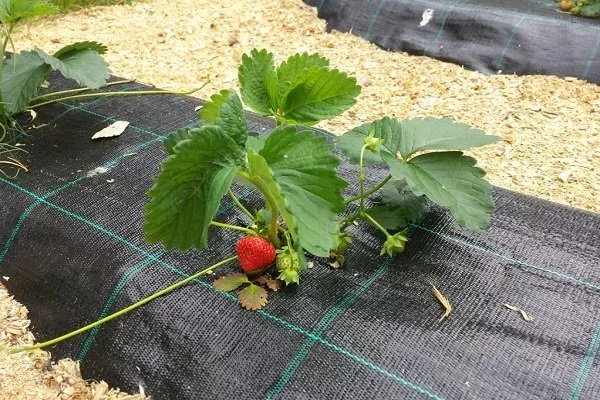
Planting strawberries under plastic is becoming increasingly popular every year. This method makes gardeners' work easier, helps them achieve excellent harvests, and saves them virtually no time on strawberry care.