
Almost every gardener grows strawberries, so the question of how to protect them for the winter is always relevant. Since strawberries come in different varieties, each has its own specific preparation requirements. Climate and weather conditions are also taken into account to determine the exact timing of the work.
The need for shelter
Strawberries are considered a cold-hardy crop, but despite this, they still require protection. How and when to do this correctly depends on various factors.
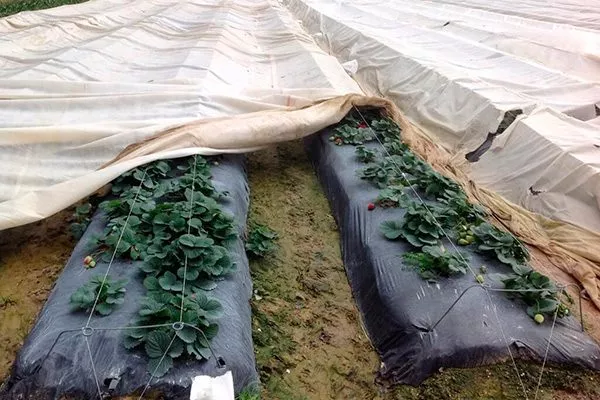
| Name | Fruiting period | Frost resistance | High maintenance |
|---|---|---|---|
| Regular strawberries | The beginning of summer | Average | Low |
| Everbearing strawberries | Before the frosts | High | High |
Regular strawberries
Fruiting usually ends with the arrival of autumn; some varieties don't bear fruit until early summer, so it's important to take care of it first. Covering will allow:
- Protect them from the first unexpected frosts and subsequent thaws. The fact is that when a sudden warm spell arrives, the bushes wake up and mistakenly perceive the improved weather as the beginning of the growing season. If you cover the strawberries, they will remain at a stable temperature, so no changes will occur.
- To hide from the cold winter wind, since the culture dies from its influence.
- Protecting the root system. If the bushes aren't insulated, the roots will freeze, but only if the climate zone experiences a snow-free winter.
Protection of common strawberry varieties is carried out using any standard methods.
Everbearing strawberries
This strawberry variety bears fruit until frost. Experts recommend starting covering it in mid-autumn, meaning before all the berries are ripe.
In normal climates, covering with straw or other natural material is sufficient, but in northern latitudes, agrofibre or similar covering will be necessary. This will ensure very early flowering and fruiting.
In the greenhouse
In greenhouse conditions, strawberries don't need shelter, provided the structure is sound. Sometimes, simply sprinkling it on the soil is sufficient. mulchIf the greenhouse is poorly insulated, use spunbond or similar, but always in one layer.
Timing and regionality
The time it takes to prepare strawberries for winter depends on the region and the current weather, but there are two key points that cannot be ignored: a stable temperature of -5-8 degrees Celsius for 5-8 days, and soil freezing to a depth of 4-5 cm.
| Name | Recommended period of shelter | Recommended covering material | Features of the shelter |
|---|---|---|---|
| Siberia | End of September | Coniferous branches | Additional shelter is necessary due to harsh winters. |
| Amur Oblast | First half of September (north), second half of September (south and center) | Spruce branches, fallen leaves, corn stalks | Use of non-woven covering material in the absence of snow |
| Khabarovsk Krai and Transbaikalia | Late October (Khabarovsk Krai), mid-October (Transbaikalia) | Agrofibre | The need for a frame structure |
| Moscow region | Beginning of November | Spruce branches | Additional covering with non-woven materials with installation of an arch |
| Leningrad Oblast | The last days of October or the first days of November | Spruce branches | Taking into account humid climate and sudden temperature changes |
| Volga region | End of October | Spruce branches | Accounting for increased humidity |
Siberia
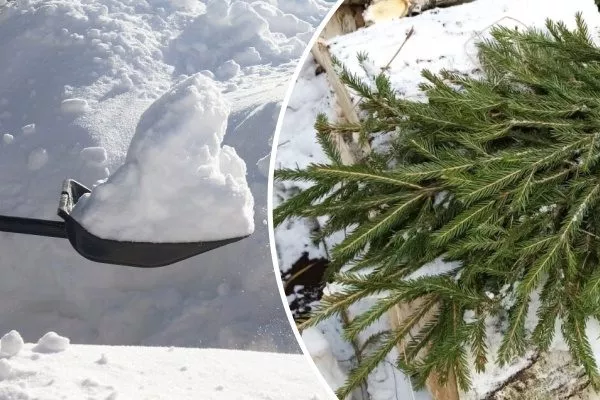
Winters in this region are harsh, with temperatures exceeding 40-45 degrees Celsius. Frosts arrive early in the fall, and there's a lot of snow. Therefore, the deadline for covering is late September. Snowy winters typically call for snow cover, but with such significantly higher temperatures, it won't provide protection.
Additionally, cover the strawberries with pine branches.
Amur Oblast
The Amur Region is large, so the timing for covering strawberries varies:
- in the northern part – the first half of September;
- in the south and central – the second part of September.
If a lot of snow is expected, it is enough to use spruce branches, fallen leaves, corn stalks; if there is no snow, use non-woven covering material.
Khabarovsk Krai and Transbaikalia
The Khabarovsk Krai is famous for its strong, cold winds, which cause irreparable damage to sensitive strawberries. Temperatures drop sharply as early as November, so the crop should be covered in late October. In Transbaikal, however, the bushes are prepared a little earlier, around the middle of the same month.
It is recommended to use primarily agrofibre and similar materials as the material, and it is necessary to create a frame structure so that the shelter does not come into contact with the plants.
Moscow region
Since the climate in the Moscow region is not particularly dry, bushes should be insulated in early November. For cover, use spruce branches, which will later be covered with snow. If you prefer non-woven materials, first install an arch and stretch agrofibre over it.
Leningrad Oblast
The climate in St. Petersburg is humid, with sharp temperature fluctuations, so the optimal time for insulation work is the end of October or the beginning of November.
Volga region
Preparatory work begins around October 15th, and the sheltering begins at the end of the month. This is largely due to the high humidity in the Volga region.
Is it necessary to shelter in the South?
Covering isn't always necessary, especially when growing winter-hardy strawberry varieties. However, if the current weather is unstable, work should begin from late November to late December.
What kind of shelter should I use?
The choice of covering material depends on many factors, including climate, weather, strawberry variety, ease of use for the gardener, and cost. Insulating materials are generally divided into two types: natural and artificial. Each has its own characteristics.
| Material | Thermal conductivity (W/m K) | Recommended layer thickness (cm) |
|---|---|---|
| Agrofibre | 0.05 | 1-2 |
| Straw | 0.04 | 20 |
| spruce branches | 0.03 | 20-30 |
Application of agrofibre and its analogues
Agrofibre is a non-woven material that is in high demand among gardeners. It is quite affordable and can be used repeatedly (up to four years). It comes in rolls with a fabric-like structure. It is classified into different types depending on its density. However, it's not recommended to use very dense options for covering strawberries, as condensation can occur.
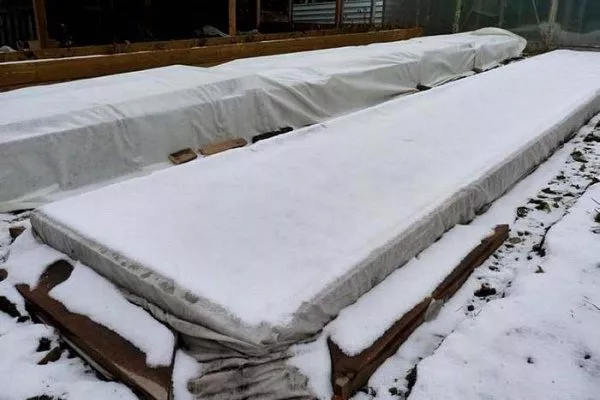
Although these are artificial materials, they have the following advantages:
- light weight (no pressure on plants);
- air permeability, due to which putrefactive processes do not occur;
- insects and rodents are not attracted;
- environmentally friendly (polypropylene is used for production);
- no condensation.
There are also some drawbacks: it cannot be used as a primary covering in harsh climates, so other materials are placed underneath the agrofibre or similar materials, such as spruce branches, straw, etc.
Another disadvantage is that it is not suitable for use in humid climates and frequent thaws in winter – the fabric allows water to pass through, so after the onset of frost the plant will become covered in ice.
Mulching
Mulching is used in all regions, but in different ways. For example, in the South, spreading mulch is sufficient, while in the Central and Southeast Asian regions, additional cover will be required.
What can be used:
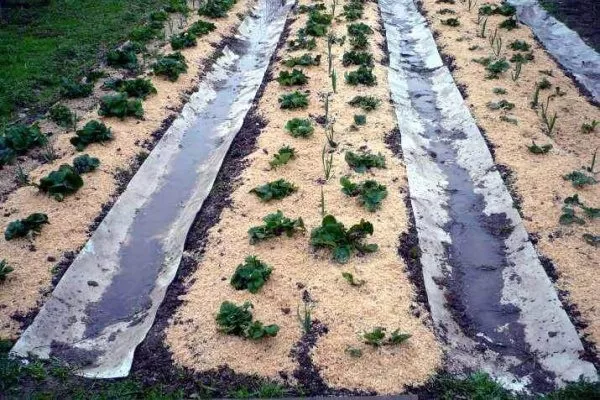
- Wood shavings or sawdust. A good, affordable option that retains heat. However, there is a significant drawback: the material absorbs moisture, accumulating it, which can lead to strawberry rot. Therefore, experts recommend using sawdust only in regions with little snowfall and short thaws.
The layer should be about 9-12 cm. Other disadvantages include a decrease in the amount of nitrogen in the soil, soil acidification (sometimes this is necessary), and after rain and severe frost, the wood shavings become covered with ice, requiring all the sawdust to be removed in the spring.

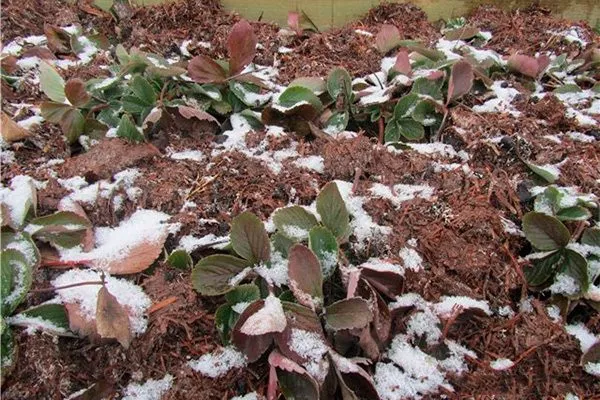
- Compost or humus. This is the best mulch option because it enriches the soil with nutrients, retains and releases heat well, and doesn't rot. The layer should be 7-10 cm thick. It must be covered with non-woven fabric on top; film is prohibited, as this will start the strawberry's growing season.
Straw and hay
These are traditional Russian materials that have been used by humanity for many years. Therefore, natural raw materials offer many advantages:
- maximum environmental friendliness;
- retains heat well;
- when it rots, it does not harm the strawberries, but on the contrary, improves the structure of the soil, saturating it with useful elements;
- Being a natural antiseptic, it prevents the growth of bacteria.
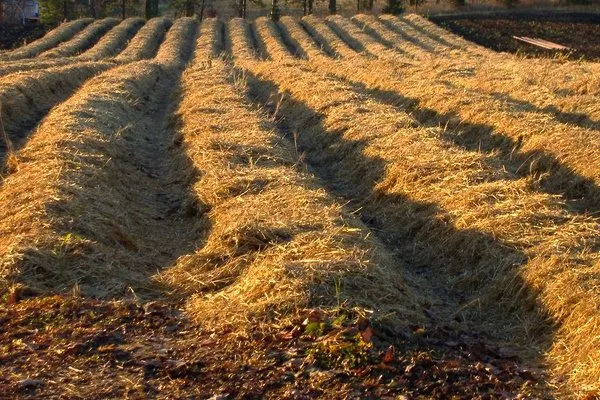
There's one drawback: hay and straw are very popular with rodents, but mice are the most common eater, and they also enjoy strawberry shoots. The material layer should be 20 cm thick. It can be used in any climate zone except the North, which requires additional insulation.
Fallen leaves
This is the most cost-effective material for covering strawberry bushes. You can use leaves from any tree, but oak trees retain heat best. There's no point in using walnut leaves—they don't provide any warmth.
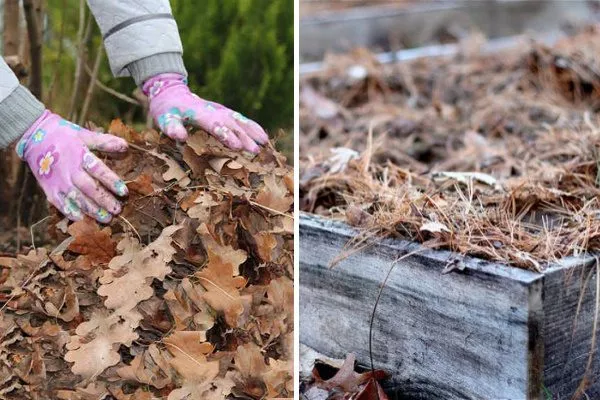
You shouldn’t collect material from fruit trees either – there is a risk of infection (this is only possible if you are sure that the trees are completely healthy).
The advantages and disadvantages are identical to the previous option. It's important to lay completely dry leaves in sunny weather.
Pine needles and spruce branches
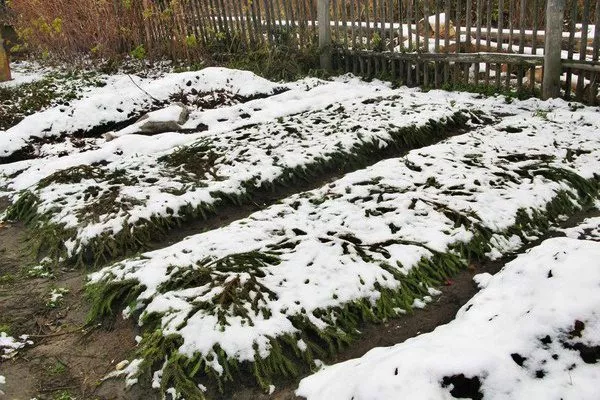
Coniferous branches are considered the best material for many crops. This natural shelter should be laid in a layer of at least 20 cm and no more than 30 cm.
There are many advantages:
- environmental friendliness;
- for free;
- no mold forms, strawberries do not rot;
- bacteria do not develop (due to essential oils);
- is not susceptible to pest and rodent attacks (again, it repels the specific smell);
- well ventilated;
- does not rot;
- protects from wind and snow;
- Ideal for all climate conditions.
Among the negative aspects, slight acidification of the soil is noted (but it can be done soil liming, to fix this).
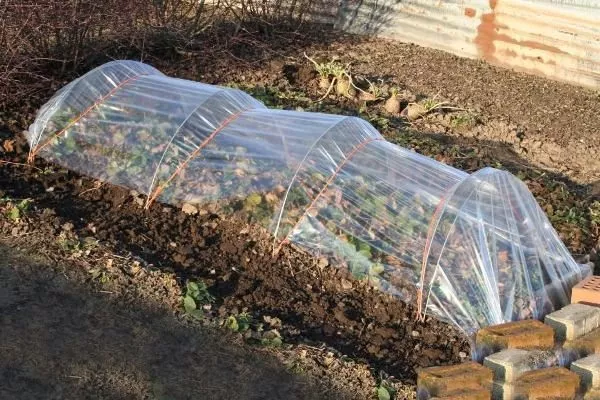
Film
Plastic coverings should be used with extreme caution because they are completely airtight, which promotes condensation. This leads to the strawberries rotting with the slightest thaw. These processes promote the development of pathogenic microflora, leading to fungal infections.
Polyethylene film is used extremely rarely, but there are situations in which it is possible:
- late cover, early revelation;
- annual crop.
White mustard and oats
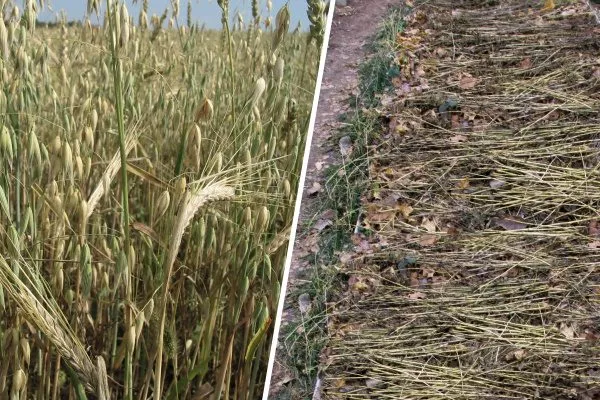
These are green manure crops that are sown between rows of strawberry bushes. If you plant oats or white mustard in late summer, the crops will grow and cover the bushes by the time the weather gets colder.
Other benefits:
- there is no need to do anything, as the green manure will lower its stems onto the strawberries on its own;
- no rotting, mold, or high humidity;
- excellent breathability;
- snow lingers;
- after mowing it can be used as mulch;
- the soil is saturated with useful substances.
No defects were found.
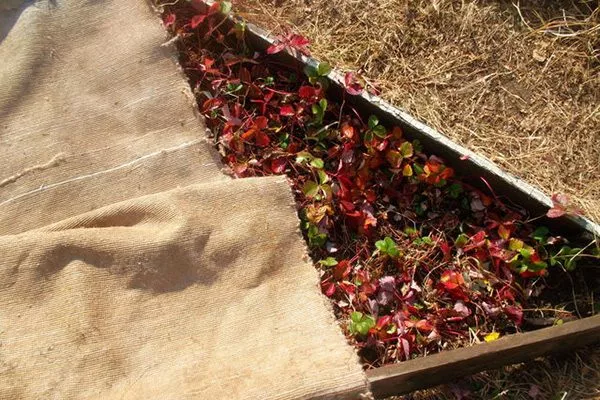
Rags
Every home has some unwanted rags, so using them is considered free. Rags retain heat well, but only those made from natural fibers (synthetics are best avoided, as they transfer cold). Keep in mind that the covering must be tightly applied—don't leave any empty spaces.
It's important to pre-treat the fabric. To do this, use Bordeaux mixture at a 7% concentration.
Reeds
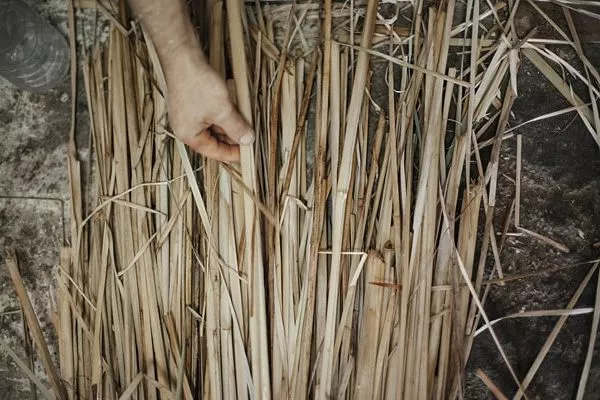
Many gardeners compare reeds to spruce branches, as they retain heat just as well, allow air to pass through, prevent snow from penetrating, and don't fly off even in strong winds. For insulation, reeds are laid 10-20 cm apart. Dried reeds are used.
How to prepare strawberries in autumn?
To help strawberries survive the winter, it's important to prepare the bushes for the dormant period in advance. These preparations are carried out immediately after harvesting.
Preparing the garden bed
As soon as the last berries have been picked, weed the bed. Be sure to remove all weeds. Strawberries have a delicate and sensitive root system, so all handling must be done carefully. For example, if it's not possible to pull out the weeds along with the large root, it's best to cut them off and remove the root in the spring, when the plant has gained strength.
Necessarily fertilizers are applied. Peculiarities:
- the feeding period is the last days of September or the first days of October, depending on the climate;
- what is allowed to be added - manure, compost, humus, wood ash, Kemira or Superphosphate preparations;
- You cannot use fresh manure - only rotted manure.
What other work is being carried out:
- hilling bushes along rows;
- removal of fallen leaves and debris;
- 3 days before covering, spray the foliage with Bordeaux mixture (concentration 3%), and water the soil with the same composition;
- laying mulching material.
Preparing strawberries
Strawberry bushes also require some prep work. Here's what to do and how:
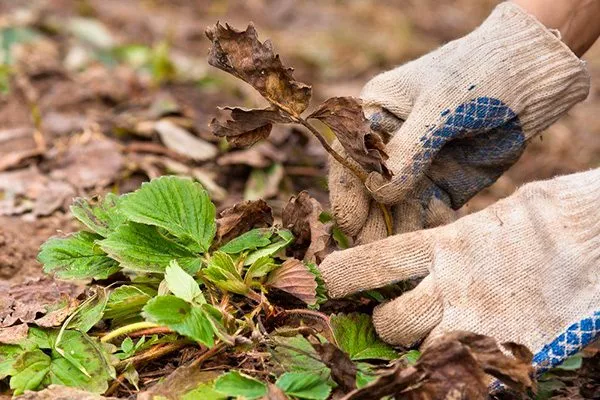
- Inspect each bush for damage, pests, and diseases. If present, remove them.
- Cut off the tendrils and tear off the dry leaves.
How to properly cover strawberries?
The technique for insulating strawberries depends on various factors, but mostly on the planting method and age.
Adult
If strawberry bushes are over three years old, the plant is considered mature and already has a developed immune system, strong roots, and well-developed stems. Therefore, during snowy winters, there's no need to cover the bushes thoroughly. Covering them with straw or spruce branches is sufficient.
In other cases, covering is essential, as the growing point may freeze, which could result in the bush not developing in the next season.
Planted in autumn
If the seedlings were planted in the fall, they need to be covered especially carefully, as they are still fragile. The bushes are surrounded with straw, hay, or sawdust to protect the root system. A covering material is stretched over them.
Young
Insulation is carried out in the same way as for seedlings planted in the fall. Agrotex, agrofibre, spunbond, or lutrasil are used as covering materials.
Planted in tires or boxes
If strawberry plants are grown in boxes, tires, pipes, or other containers, there's no point in insulating them, as experts recommend bringing the plants indoors. The temperature should be around 5°C (41°F), and no higher. Otherwise, the strawberries won't go dormant but will continue to grow.
If you decide to leave the tires and boxes outdoors, then carefully cover the beds with spunbond in 2-4 layers.
In the pyramid
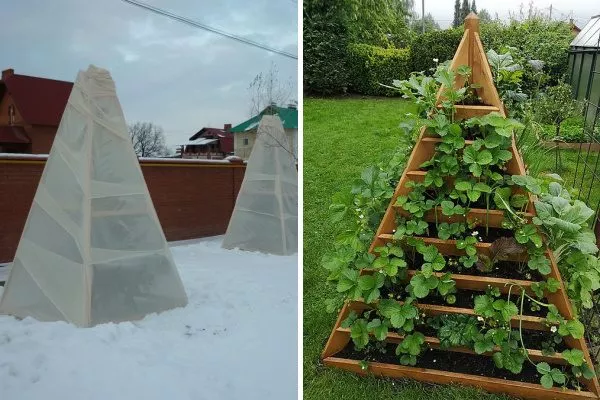
Pyramid cultivation doesn't require shelter in southern regions. If winters are snowy, the snow can be removed with a shovel. Otherwise, spruce branches or stretched agrofibre are sufficient.
When to disclose?
Removing winter cover from strawberries begins immediately after the snow melts. This period occurs between late March and early May, depending on the region. But the most important factor is maintaining a constant daytime temperature of 10°C (50°F) and a nighttime temperature of at least 0°C (32°F).
Never remove the cover abruptly – first open the bushes for 2 hours, the next day for 3 hours, etc.
Which strawberry varieties can be grown without covering?
Breeders are working hard to develop frost-resistant strawberry varieties, and they're succeeding. The following varieties are particularly popular today:
- Anastasia. Bred in Siberia, it can withstand significant frosts. A 5 cm layer of snow is used for cover.
- First-grader. It was bred in the same place, but the snow layer should be thicker – about 7-8 cm. It is considered a large-fruited variety.
- Elizabeth II. In addition to frost resistance, strawberries are not afraid of fungal infections.
- Gigantella. It has a strawberry flavor and was developed in Holland.
- Honey. Developed by American breeders, it is distinguished by its early fruiting.
- United Kingdom. A very aromatic variety with large berries.
- Alba. The berries can be harvested as early as May and are most often used for industrial-scale cultivation.
Tips for covering strawberries for the winter, common mistakes
Gardeners and summer residents new to growing strawberries often make mistakes. To avoid them, follow the advice of more experienced gardeners:
- If you use natural covering materials, be sure to cover the bushes with wire mesh. Or install special repellents. Otherwise, rodents will ruin the strawberries, as natural materials always attract their attention.
- Be sure to water your strawberries in the fall—about a couple of weeks before the expected frost. This will prevent root depletion.
- Distribute the covering material, especially the spruce branches, as evenly as possible, so that there is no room for drafts.
- If you use plastic film, make several narrow holes in it; this will eliminate the risk of the bushes rotting.
Also watch a video about preparing strawberries for winter:
Knowing how to properly cover strawberries for the winter and what materials to use can help preserve your plants. The quality of the insulation determines the future harvest, as healthy plants produce abundant fruit for a long time.