
The Kimberly garden strawberry is a Dutch variety successfully grown throughout Russia. It's ideal for commercial cultivation—the hardy and easy-to-grow plants produce a bountiful harvest of large, sweet berries. Learn about the specifics of growing Kimberly strawberries.
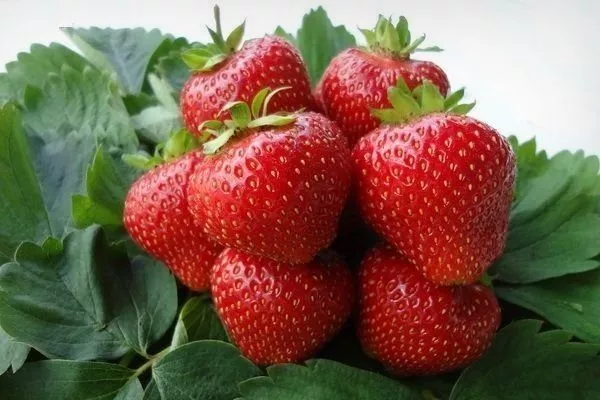
Garden strawberry 'Kimberly'
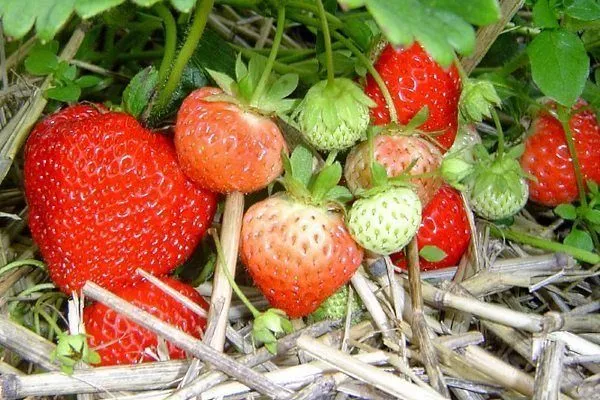
The Kimberly variety has excellent taste and good yield
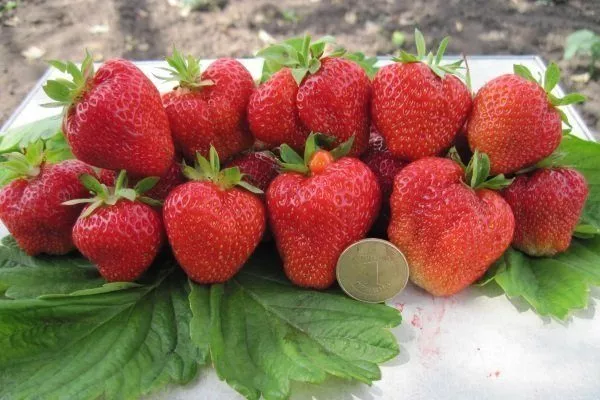
The marketable appearance makes 'Kimberly' one of the best varieties for commercial use.
Botanical description of the variety
| Name | Productivity | Ripening time | Disease resistance |
|---|---|---|---|
| Kimberly | 1-2 kg per bush | the last ten days of May | average |
Brief botanical description of the Kimberly variety:
- Bushes. Vigorous, compact, and not dense. The runners are thick and sparse. However, to increase yield, even these need to be removed.
- Leaves. Large, concave, light green, glossy, with serrated edges. The leaves are oval in shape.
- Fruit. Sweet, large, glossy, with a caramel aroma. There are almost no small berries. The flesh is dense, without voids. The berry is conical in shape, resembling a heart.
- Flowers. Large, white, and bisexual, they contain a lot of pollen, making them quick and easy to pollinate.
- ✓ Optimum soil acidity for Kimberly: pH 5.5-6.5.
- ✓ Minimum distance between bushes: 30 cm to ensure sufficient ventilation and lighting.
The flower stalks are low, practically at ground level. If the berries touch the soil, the risk of powdery mildew increases.
Kimberly strawberry qualities
Kimberly is a mid-early variety suitable for growing in open ground and under plastic. It is suitable for any region, including Siberia and the Urals. It is considered promising, boasting high yields and resistance to any adverse conditions.
Main agrotechnical indicators:
| Characteristics/parameters | Description/Meaning |
| Fruiting | non-remontant variety – bears fruit once |
| Ripening time | the last ten days of May |
| Average weight of berries | 20-35 g, maximum – 50 g |
| Productivity | 1-2 kg per bush, per 1 ha - up to 150 c |
| Taste | sweet, but not cloying |
| Aroma | smells like caramel |
| Disease resistance | medium (can be affected by anthracnose, as well as pests such as slugs, weevils, etc.; resistant to gray mold, white and brown spot, and powdery mildew) |
| Tasting score | 5 (this is the highest score) |
| Drought resistance | tall, able to survive long periods of drought, recovers thanks to a powerful root system |
| Frost resistance | high, withstands frosts down to minus 18 °C |
Other characteristics of the variety:
- The variety bears fruit once per season. With adequate nutrition, the berries remain uniform throughout the harvest period, which lasts about three weeks.
- Kimberly is called a strawberry only by tradition; in fact, it is a garden strawberry.
- The variety is demanding of light. If there are few sunny days in the spring, the bushes grow poorly and bloom late, and the berries lose their sugar content.
- In northern regions, the berries may not ripen during the short summer—the core and base remain white, they contain little sugar, and the taste is average.
- In southern regions, heat during the fruiting period negatively impacts yields—berries overheat and bushes grow slowly.
- The berries are easy to transport and retain their marketable appearance for a long time.
- The fruits do not lose their shape during heat treatment and freezing.
Watch a video review of the Kimberly strawberry variety below:
How to choose the right Kimberly seedlings?
To ensure seedlings survive the winter and bear fruit safely, they must be of good quality and completely healthy to begin with. Rules for selecting seedlings:
- Do not buy seedlings at the market, from sellers you do not know, or in places not designated for the sale of this product.
- When purchasing seedlings, pay attention to their appearance. The leaves should be uniform in color, without spots or other damage that would indicate a fungal infection.
- Pale, wrinkled, or wilted leaves are a sign that your seedlings are infected with a serious disease. Not only will the plant not grow and develop normally, but it will also infect other strawberries in the area.
- Seedlings with open roots should have a fibrous root system at least 7 cm long.
- If seedlings are sold in containers or cups – with closed roots – they should fill the entire underground part.
- The roots should not be over-dried, otherwise the plant risks not taking root.
- Store seedlings that have been purchased but not planted for several days with the roots immersed in water - this technique will not only prevent the plant from drying out, but will also facilitate rooting.
Does the variety have any disadvantages?
The Kimberly variety has been known to farmers and amateur gardeners for about 10 years. This strawberry has proven itself to be a reliable and productive variety, but it does have some drawbacks:
- It bears fruit poorly in Kamchatka and the Northern Urals. In northern regions, the variety doesn't develop its full flavor.
- Fruiting is not uniform, it is spread out over several weeks.
- In regions with harsh winters, it freezes and then recovers with difficulty.
- Loves warmth. In cold years, it grows poorly and loses productivity.
- It bears fruit poorly in regions with hot, dry summers. Here, Kimberly seedlings do worse than many commercial varieties.
- It requires a lot of moisture. In hot summers, berries that are not properly watered become soft and "cooked."
- Kimberly is an intensive growing variety – it requires regular feeding and watering.
Landing dates and location
There are two options for planting Kimberly seedlings:
- In spring – in the first ten days of May.
- In autumn – in August-September.
These are the dates for the temperate climate. In regions with a milder climate, seedlings are planted primarily in the fall—in late September or even early October. The weather in the fall is milder and more favorable for young plants. In northern regions, it's best to plant in the spring to avoid exposing young plants to low temperatures. Read on to learn how to plant strawberries in the spring. here.
Kimberly's berries taste much better when grown in open ground rather than in a greenhouse.
How to choose a planting site:
- The variety is very demanding in terms of lighting – the sunniest areas are chosen for it.
- The site must be protected from gusty winds.
- A southern slope of the beds is desirable.
- The soil should be fertile and well-drained. It is preferable for the soil to contain peat or sand.
- The area should be cleared of plant debris, including roots. If necessary, the soil should be disinfected—this should be done in advance to prevent toxic substances from damaging the seedlings.
- Undesirable predecessors include tomatoes, peppers, eggplants, and other nightshades. Strawberries are planted after legumes, greens, carrots, radishes, garlic, and onions.
- Kimberly's neighbors should not be plants that attract the same pests as garden strawberries.
- The presence of marigolds, calendula, tansy, nasturtium, parsley, lemon balm, garlic, cilantro, and fennel is desirable in the area.
- You can't grow strawberries in one area for more than 4 years - the soil becomes depleted, and a lot of parasites, bacteria, and viruses accumulate in it.
- Two weeks before planting, add compost or humus to the soil at a rate of 5 kg per 1 m².
- Carry out deep digging of the area to a depth of 25-30 cm to improve aeration.
- A week before planting, test the soil for acidity and adjust it if necessary.
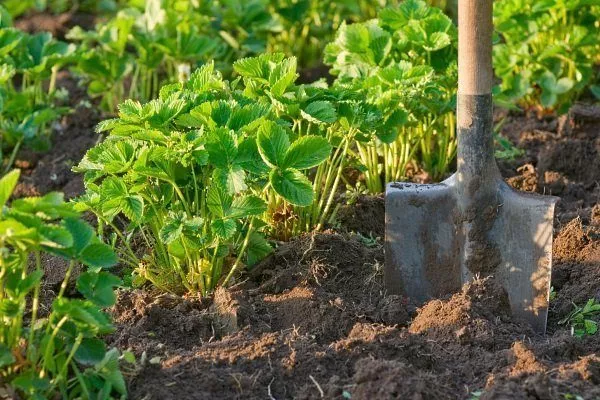
How to plant strawberries?
Kimberly can be propagated using any existing method—vegetatively, by seed, or by dividing the plant. Vegetative propagation is considered the most reliable method for producing varietal seedlings. The plants produce a few runners, and if planted sparsely, they can be rooted in the space between rows without replanting the plant.
Seeds
The procedure for growing seedlings from seeds:
- Shortly before the end of winter, place the seeds in a container with general-purpose soil, pre-moistened with a spray bottle. Place them directly on the soil without pressing them down.
- Cover the container with seeds with film.
- The film is removed daily to ventilate the planting.
- The soil is watered as needed.
- When sprouts appear, the film is removed.
- When the plants have several leaves, the seedlings are taken out to harden off and then planted in a permanent location.
This method of propagation is not popular among gardeners, firstly, it is labor-intensive, and secondly, when planting from seeds there is a risk of losing some varietal qualities.
Mustache
This is the most popular propagation method among gardeners. Propagation procedure:
- Two-year-old plants are selected for propagation by runners. Runners are usually removed to ensure good fruiting. On selected plants, the runners are not removed, but left for propagation.
- When rosettes appear, their roots are slightly buried in the soil. The soil around the rosettes is watered.
- The rosettes can be transplanted into containers so that they grow a little, and then transplanted to a new location.
By dividing the bush
Propagation by division is slightly less popular than propagation by runners. The procedure is as follows:
- Select a vigorous bush, dig it up, and divide the rootstock into two or more parts.
- It's best to have a heart on each separated section. The bushes are then planted in their permanent location.
Seedlings
The easiest way to propagate is by planting ready-made seedlings purchased from a specialist retailer, store, or nursery. Seedlings are sold in two types:
- With open roots It's best to plant it directly in the ground. If this doesn't work, immerse the roots in water. Then, before planting, trim the roots to a length of 7-10 cm.
- With closed roots. Planting such seedlings is easy: you just need to water them and then transfer them, along with a lump of soil, into the planting hole.
Caring for Kimberly
The Kimberly variety doesn't require anything special—just standard care. The main thing is to keep in mind its low frost resistance and to insulate the plantings for the winter.
Watering, weeding, loosening
Immediately after planting, water the seedlings daily. After the water has absorbed, gently loosen the soil, being careful not to disturb the roots. Avoid allowing the soil to dry out or crack. While loosening, remove weeds—they are easier to remove from moist soil. As the plants age, reduce the frequency of watering.
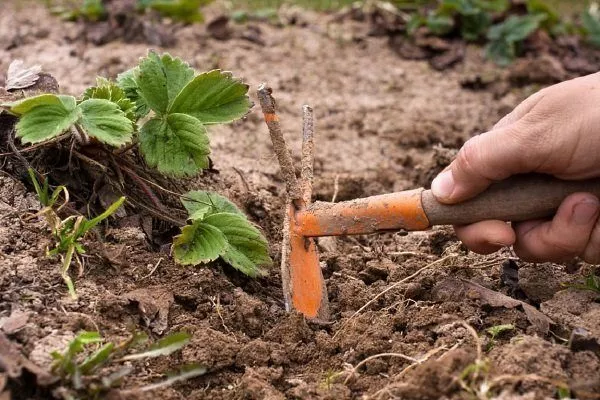
Kimberly loves moisture—the soil should be moist to a depth of 30 cm. During rainy summers, watering is not necessary, but in hot summers, the frequency of watering increases, with the bushes watered every other day. The recommended watering rate is 2-3 liters per plant. The best way to water garden strawberries is with drip irrigation.
Top dressing
Spring begins with the application of nitrogen fertilizer. This is done immediately after removing the cover: dead foliage is trimmed, the soil is loosened, and a nitrogen fertilizer is sprinkled on top. During the season, strawberries are fertilized three times.
Timing of application and composition of fertilizers:
| Period of contribution | Composition and dosage of fertilizers |
| Early spring | Fertilize with an infusion of mullein/bird droppings (1:10/1:20), a solution of horse extract (50 g per 10 liters), urea or ammonium nitrate (10-30 g per 10 liters). Apply 0.5 liters of liquid solution per bush. We also recommend reading our full article on spring feeding of strawberries. |
| Formation of buds | Feed with wood ash – 1-2 tablespoons per bush. Or use a commercial mixture containing microelements. |
| Autumn – end of the growing season | Superphosphate is poured into the grooves (depth 15 cm) made along the rows - 1 tbsp. per 1 running meter. |
To improve yield, spraying is recommended:
- During flowering – with a solution of boric acid (1 g per 10 l).
- In August, during the formation of flower buds for the next year - with a urea solution (15 g per 10 l).
Do you need mulch?
Mulching is not mandatory, but it has a very positive effect on crops and saves farmers from unnecessary labor. This agricultural practice solves two problems at once:
- prevents weed growth;
- retains moisture in the soil.
It's best to start soil mulching During the active flowering period. Various materials are suitable as mulch: sprinkle the soil with straw, dry grass, or fallen leaves. Sawdust and pine needles can also be used on alkaline soils, as they increase the soil's acidity.
Before mulching, straw and grass are dried in the sun to kill insects and weeds.
Trimming
If seedlings are planted before winter, all foliage is removed. A similar pruning is performed annually at the end of the growing season, just before frost. Pruning helps the plant grow stronger, increasing its future yield. To encourage shoot growth, the bushes are pruned further, leaving only the stems.
Not only leaves and shoots are pruned, but also runners during the growing season. This is done to direct the plant's vital juices to the berries. If the runners are not pruned, the berries will be few and smaller than usual.
The best option is to divide the bushes into two groups: one for harvest and one for propagation. Or simply spend one year on propagation, without trimming the runners, which would sacrifice a high yield.
Wintering
There's only one case where you can forego insulating the Kimberley: if you're certain there will be significant snow cover. Since there can be no guarantee of this, strawberry plants must be covered.
Agrofibre, pine branches, or special covering material are used as insulation. Straw and fallen leaves should not be used, as they are full of larvae and rodents, and such insulation is too harmful. Covering plantings with dark film or fabric is not recommended, as they will cause rotting.
The best insulation option is to construct an arch and then stretch the covering material. This leaves air between the plants and the covering, preventing freezing.
Diseases and pests of the Kimberly variety
It's much more profitable to spray strawberries before signs of infection appear. If plants do become infected, they can be cured in most cases, but yield losses are inevitable. A major advantage of Kimberly is its resistance to powdery mildew. This strawberry, compared to other varieties, is susceptible to this serious disease.
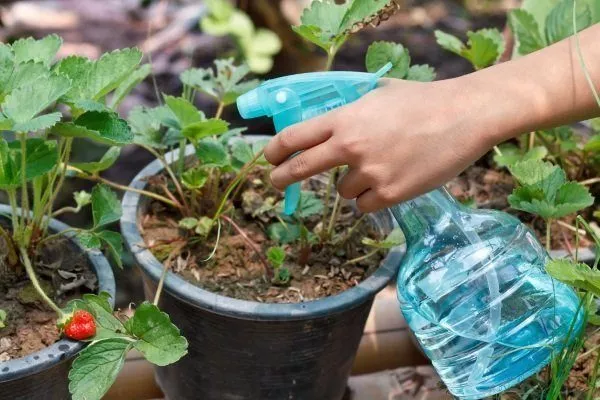
The main pests in Kimberley are strawberry mites, aphids, nematodes, and strawberry weevils. Bushes infested with nematodes are almost impossible to save—the infected plant is uprooted and destroyed.
Pest and disease control measures:
- Spray with broad-spectrum insecticides during the leaf formation period. Typically, Karbofos is used—60 g dissolved in a bucket—or Aktara—2-3 g. These products are effective for two weeks, then repeat the treatment. These products kill all pests—aphids, weevils, etc.
- Plants are treated with fungal disease control products using a similar regimen: on young foliage and again two weeks later. The plants are sprayed with systemic fungicides such as Bordeaux mixture, Skor, HOM, and Ridomil.
The preparations – insecticides and fungicides – are changed annually to prevent insects and fungi from developing immunity.
It is especially important to prevent damage by gray mold:
- Plant garlic between the rows.
- Remove dry leaves in a timely manner.
- Do not allow the soil to become over-watered.
- Remove weeds in a timely manner.
- Spray with Topaz before flowering.
Other methods of pest and disease control:
- Spraying with iodine solution - take 10 ml of iodine per 100 ml of water.
- Dandelion infusion helps fight pests: add 0.5 kg of the plant to a bucket of warm water.
- You can use garlic infusion. Grind several heads of garlic and steep them in 3 liters of water for a week.
Application of berries
An important characteristic of Kimberly berries is their firm flesh. The fruits retain their shape well. They can be refrigerated for 2-3 days without risking spoilage. However, Kimberly berries are primarily used for table purposes. They are eaten fresh. However, they can also be used for preserves, such as compotes, jams, and preserves. Freezing and drying are also possible.
Reviews of the variety
The Kimberly variety has so many advantages that it's bound to attract gardeners. With simple cultivation techniques, it's possible to achieve high yields even in harsh climates. With just a little effort, a bountiful harvest of caramel-flavored strawberries is guaranteed.