
How to water strawberries to ensure a good harvest? Despite the plant's low maintenance, well-moistened soil is essential for large, sweet, juicy, and flavorful berries. In this article, we'll explore watering considerations based on the season and plant development stages.
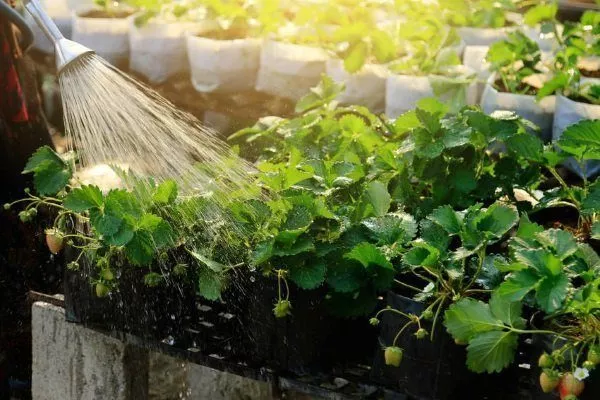
Basic rules of watering
The strawberry root system is superficial and cannot lift water from deep in the soil, and the leaves easily evaporate moisture.
- ✓ The mulch layer thickness should be at least 5 cm to effectively retain moisture.
- ✓ Use organic mulch (straw, sawdust) for additional soil nutrition.
- ✓ Avoid using fresh grass to prevent rot and disease.
There are basic rules that are important to follow when watering:
- Water only with warm water – cold water is not absorbed by the plant.
- Do not overwater, otherwise fungal diseases will appear.
- Combine watering with loosening to ensure access of moisture and oxygen to the roots.
- After watering, mulch the bushes to retain moisture in the soil.
- In damp weather, during flowering and ripening of berries, cover strawberries with agrofilm to avoid fungal diseases.
- Water early in the morning or late in the evening, as daytime watering causes moisture to evaporate quickly before it can be absorbed by the plant.
- Drops on leaves in sunny weather, acting as a lens, can cause plant burns.
- Calculate the watering time so that at least 30 minutes pass between morning watering and the sun shining.
Seedling
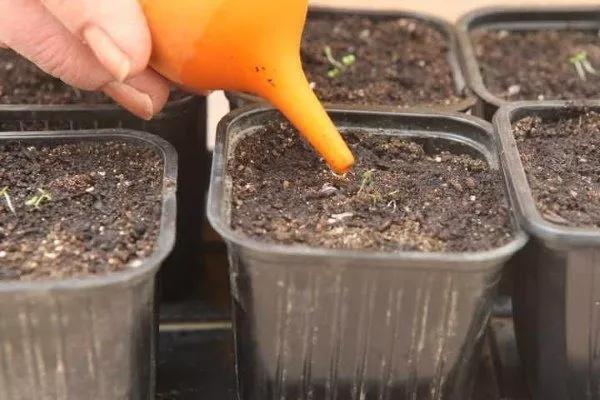
When growing strawberry seedlings, there's a risk of blackleg disease. Therefore, monitor soil moisture and adjust the frequency and intensity of watering as needed:
- Water using a syringe or a small enema.
- Water the seedlings every 2-3 days.
- Use settled water at room temperature.
- Avoid allowing drops to fall on the leaves of seedlings to avoid staining.
- Do not overwater - this will lead to the appearance of black leg.
- Do not overdry the seedlings, as this will slow down their growth.
- Water early in the morning or late in the evening.
- For preventive purposes, carry out 1-2 waterings at intervals of 1-2 weeks with fungicides (Trichopolum, Trichodermin or Planriza).
After landing
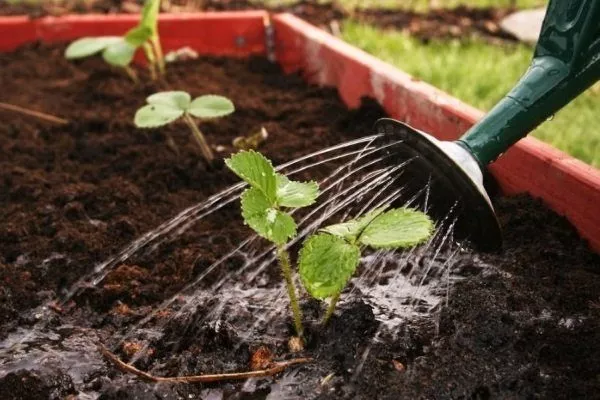
When transplanting into the ground, fill the holes with water and let it soak in, then plant the strawberry bushes in the moist soil. Alternatively, plant the bushes first and then water them thoroughly.
- Check the soil pH; the optimal level for strawberries is 5.5-6.5.
- Add organic fertilizer (compost or humus) 2 weeks before planting.
- Ensure good drainage to avoid waterlogging.
Next, water as follows:
- Water thoroughly so that it's fully absorbed and doesn't stagnate in the hole, otherwise rooting will be difficult. No more than 1 bucket of water is needed per square meter.
- After planting, water the plant frequently, but little by little, so that the soil surface remains constantly moist – this is necessary for the strawberry to grow new young roots.
- In the first weeks, watering the leaves helps the plants take root; do this once a week early in the morning from a watering can.
- During the second ten-day period, increase watering volume but decrease its frequency. In 20-50 days, the plants will be ready to survive the winter.
During flowering
In favorable weather, you can skip watering altogether, but if watering is necessary, ensure that the water reaches the roots without damaging the flowers—pollen should remain on the pistils. Watering guidelines during this period include:
- Under favorable conditions, water once every 10-12 days.
- During this period, water only in the morning, as slugs appear in damp, cool soil at night, so the soil under the bushes should remain dry at night.
- In rainy and cloudy weather, stop watering and cover the plants with film to protect them from precipitation.
- On hot and dry days, water at intervals of 3-4 days.
- Use drip irrigation or a watering can under the bush, making sure that the water does not expose the roots and under no circumstances should it get on the flowers.
- Use warm, settled water.
- The recommended watering rate during flowering is approximately 20 liters per square meter (1 liter per plant). However, it's also advisable to pay attention to the soil type:
- Loose soil that drains well – 10-12 liters of water per 1 square meter.
- Clay soil will require 2 liters more water.
- Water should penetrate to a depth of 25 cm.
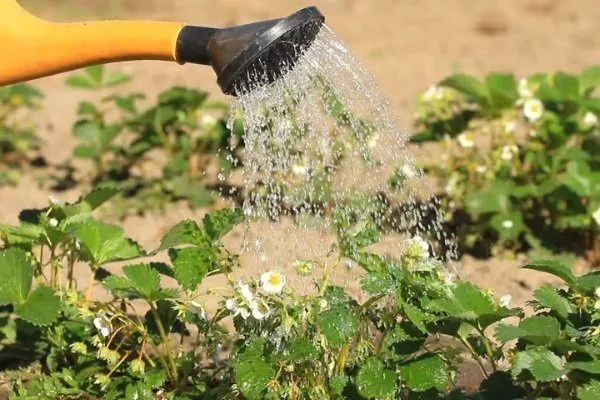
If the soil is over-dried, the pollen will become sterile, and if it is over-watered, the bees will have difficulty pollinating the wet plants and the berries will not set.
During the fruiting period
During this time, regular watering using furrows or drip irrigation is important.
Watering features:
- Watering frequency: once every 1-2 weeks, the norm per 1 sq. m is about 30 liters of water.
- In dry weather, water more frequently, since without enough moisture the berries will ripen dry, small and hard.
- If it rains, do not water to prevent the berries from rotting.
- To retain moisture in the soil, mulch the strawberries sawdust, chopped straw or black covering material.
- Before watering, go around and pick the ripe fruit. This will protect the berries from contamination, and if it's hot, the moisture will evaporate, creating a sort of steamer, causing the fruit to spoil.
- After harvesting, the plants set flower buds for next year and grow runners. Therefore, don't neglect the bushes. Water infrequently but thoroughly, rinsing the leaves to remove dust and pests.
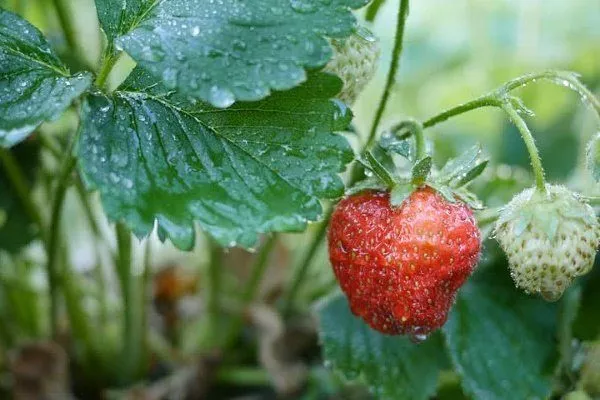
In winter, the soil is almost dry, so that the strawberries do not dry out, before frost, moisten the plantings well.
What should the water be like?
For proper watering, so as not to harm the plants, the quality and temperature of the water used plays an important role.
The requirements for water are as follows:
- The water must be clean, warm and settled.
- Collect water from the well in a tank in advance, let it settle for 24 hours, and only then use it for irrigation.
- Using cold water directly from a well can cause disease and rot in strawberries, as well as deteriorate the quality of the fruit, reduce its quantity, and slow down plant growth.
- In hot summers, there is a risk of the water in the tank becoming too hot. If its temperature exceeds 40 degrees, watering should also be avoided, as this could cause thermal burns to the strawberries.
- The optimal temperature for watering is 18-20 degrees.
Seasonal watering: when, how and how much to water?
Beginner gardeners tend to their strawberries only until harvest, then forget about them. In fact, after the berries are harvested, the next crucial stage begins: the formation of runners, flower buds, and preparation of the plant for winter. And the next year's harvest depends on how well and timely the plant receives water. Let's take a closer look at the specifics of watering during different seasons.
Spring
Schedule for preparation and implementation of spring watering:
- Before watering, remove old mulch from the strawberries.
- Check the soil to see if it is dry. If the winter was light on snow, watering is necessary.
- A couple of weeks after the snow melts, water the strawberries with hot water. Use a watering can to pour boiling water over the strawberries and the soil between the bushes from a height of 1 meter. At this height, the water will have time to cool slightly (about 60-70 degrees Celsius) and will not harm the strawberries.
Approximately 500 ml of water is required per bush. At a depth of 10 cm, near the roots, the temperature will already be around 30 degrees Celsius. Pests overwintering in the topsoil will be destroyed. This boiling water treatment can be repeated after a week.
But this is done only in early spring, before the strawberries begin to grow, as young shoots can get burned by hot water. - Since these plants have a shallow root system, they need water from the moment they emerge. Therefore, the sooner you start watering, the better your strawberries will grow.
- From the end of April to the beginning of May, strawberries are watered once every 6 days.
- In total, 2-3 heavy waterings will be needed during the spring.
- For spring watering, before the bushes flower, a sprinkler irrigation method is suitable. This will wash away all dirt and dust from the leaves.
In the video below, a gardener talks about watering strawberries in the spring:
Be sure to weed, otherwise they will block the strawberry roots' access to water. And after watering, mulch the plants.
Summer
Watering is carried out as usual during the fruiting period - abundantly 1-2 times a week.
By July, the temperature rises, and watering is increased to 3-5 times a week.
Autumn
After the harvest, strawberries need to recuperate before winter. To do this, water them 2-3 times in the fall before the cold weather sets in.
At least 20 liters of water are required per square meter. It's important not to overwater the soil during the final watering, as a sudden freeze will cause the roots to freeze, potentially killing the strawberries.
Combining watering and fertilizing
It is advisable to apply additional fertilizers simultaneously with watering; in liquid form they are better absorbed by plants:
- During the first spring watering, add nitrogen by diluting ammonium nitrate with water.
- Also in one of spring feeding Water the strawberries with organic fertilizer—compost or humus. You can dilute 2 level tablespoons of nitrophoska and 1 tablespoon of potassium per 10 liters (0.5 liters) of this solution per plant.
- The second feeding is carried out before flowering, with potassium sulfate.
- If pests or diseases appear, feed with potassium permanganate or iodine, but not more than twice a month.
- During flowering, add a quick-release complex fertilizer when watering. Four applications per season are sufficient.
Read the article about How to feed strawberries in autumn.
In this video, a plant-growing expert explains how to properly water and fertilize strawberries:
Irrigation methods
There are several ways:
- Manual – carried out from a watering can or bucket, good for small beds, but this method requires the most labor.
- From the hose – it takes less effort, but the water flows unevenly, the stream can damage and wash away the bushes, and spread the fungus from the infected berries throughout the entire area.
- Drip irrigation:
- Moisture is immediately supplied to the roots, the spaces between the rows remain dry, and the number of weeds is reduced.
- Preserves the soil structure.
- Significant water savings are achieved (approximately 2 times less than with other types of irrigation).
- The ability to regulate the degree of watering – decrease or increase the amount of water supplied depending on the situation.
- The plants receive water around the clock (this is convenient if you need to leave for a while and the strawberries are left without care).
- Along with water, plants can be given fertilizers diluted in it.
- Plants and soil remain clean.
- It is easy to assemble a drip system yourself at home.
- Wind does not affect moisture distribution.
- Completely unsuitable for anti-frost irrigation.
- Sprinkling – special spray nozzles are used, water is supplied by a pump from a storage tank.
- Allows you to moisten the soil to the required depth without disturbing its structure.
- Improves the microclimate of the site.
- Can be used in areas with rugged terrain.
- A wide range of nozzle sizes allows you to adjust the intensity of the water pressure.
- Additional costs for electricity.
- Water loss at the site boundaries.
- The problem of compaction of the outer soil layer and the formation of a crust on it.
- Furrow irrigation – they are made around each hole at a distance of 25-30 cm from the center of the bush, and filled with water.
- Allows you to quickly saturate the soil with water.
- Preliminary leveling of the site is required.
- The roots may become washed away.
- Compared to irrigation, water loss is 10% lower
- Salinization of the soil between the furrows is possible.
- The end section receives less water.
| Method | Water efficiency | Labor costs |
|---|---|---|
| Drip irrigation | High | Low |
| Sprinkling | Average | Average |
| Manual watering | Low | Tall |
To properly care for strawberries, it is advisable to combine several different types of watering.
Drip irrigation
Drip irrigation is a system of tubes connected to thinner tubes with drippers via tees. These tubes deliver small amounts of water to specific spots under each bush. This option is convenient when planting under black covering material—the moisture is retained in the soil, eliminating the need for frequent watering.
Materials needed:
- Water tankIt is advisable to take a large-volume one, from 100 liters.
- Pump for supplying water to the tank - selected depending on the water supply source.
- Drip tapesThey come with different water hole spacings (from 10 to 30 cm)—choose one according to your growing scheme. The tapes must be able to withstand pressure differences.
- Main hose.
- Tap– to shut off the water if necessary.
- Filter– for water purification.
- Connectors with seals.
- Plug to the other end of the main hose and to the ends of the drip tapes.
Installation instructions:
- Place the water tank at a height of approximately 2 m. This will ensure sufficient pressure to supply liquid to the system.
- Make a hole in it, slightly above the bottom of the tank. This will prevent sediment from accumulating in the tank from getting into the drip lines.
- Attach a tap to the tank to open/close the water supply.
- Install a filter to clean the water from small debris.
- Attach the main hose and run it perpendicular to the strawberry beds.
- Attach drip tapes perpendicularly to the main hose using connectors (fittings), and then attach the drippers themselves to them.
- Plug the ends of the drip tapes with caps.
- Check all connections carefully for leaks.
With proper care, a drip irrigation system will last for years. For the winter, the system should be disassembled, thoroughly dried, and cleaned, and then cleaned again in the spring before reassembling.
In the following video you will see a simple drip irrigation diagram:
Necessary materials
To install a sprinkler system you will need:
- Sprinklers (sprinkler heads) allow for watering angles from 90 to 270°. Most commonly used are 1.2 cm nozzles and a spray pressure of approximately 9 kg/cm².
- Hoses or lightweight plastic pipes, preferably HDPE (low-density polyethylene) pipes, designed for a pressure of about 10 atm.
- A pump to provide the required water pressure (or connection to the central water supply).
Sprinkling
With this method, water is supplied under pressure to the sprinkler nozzles and thrown into the air through them - the water breaks into small droplets and, falling from above onto the leaves and ground, moistens them like rain.
Sprinkler systems are:
- stationary – when water is supplied through pipes hidden underground to a depth of up to 40 cm or mounted on the ground, and only sprinklers come to the surface.
- mobile – watering hoses with sprinklers are located on the ground surface and can be moved around the site.
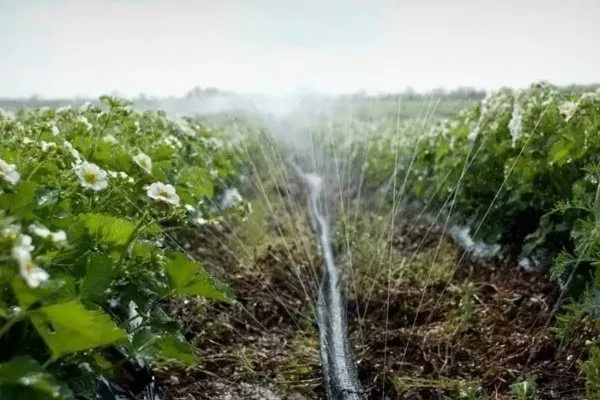
Installation instructions
Sprinkling is good to use in areas with rugged terrain and close groundwater levels.
Installation sequence:
- Lay the hose (pipe) in the desired location. If you have multiple hoses, connect them using tees to form a main line. If you're using a single hose, simply unroll it for watering.
- Attach the sprinklers, positioning them so that the area to be irrigated is completely covered by the water jets. Sprinklers are typically placed at the corners of a square or triangle.
- When watering a small area, mini-installations with a hose and a watering can gun are suitable.
- The optimal droplet size is 1.5 to 2.5 mm. You can adjust the jet pressure and droplet size by varying the water pressure.
- Install mesh filters to protect against small debris and sand.
- Install a storage tank for settling and heating water (with a volume of approximately 1-1.5 cubic meters for every 5 acres).
- Connect the entire system to the pump.
- Adjust your watering so that the water flow rate doesn't exceed the soil's absorption rate. Otherwise, the water won't be absorbed into the soil, puddles will form, and the soil will become waterlogged, meaning air will be displaced and a dense crust will form on the soil surface. Also, too much water pressure and large drops can crush strawberry leaves to the ground and cover them with mud.
Helpful tips
Here are some more helpful tips that will come in handy when growing strawberries:
- Although watering shrubs with cold water is not recommended, this option can sometimes be useful. In areas with extreme heat, watering with sprinklers that transform the stream of water into a multitude of tiny droplets will prevent plants from drying out. The mist not only moistens the soil but also reduces the air temperature to a tolerable level.
- To prevent strawberries from contracting fungus while watering, you can use straw as an antibacterial cushion – it blocks the fungus and absorbs excess moisture. The straw will also keep the berries clean.
The volume of water for irrigation depends on the following factors:
- Soil composition. On loamy and clay soils, less frequent watering (several times a week) is sufficient, although additional loosening is required. Sandy loam soils are more demanding and require watering every day or even several times a day.
- From the plant variety.Different strawberry varieties require different amounts of water.
- Depends on weather conditions.In hot and dry climates, water evaporates faster, so watering more frequently is necessary. In cold and cloudy weather, watering should be reduced.
- From the landing site. Strawberries growing in the shade require less soil moisture than open, well-lit and ventilated beds.
- From the growth period.According to this criterion, the watering rules for strawberries are the same for all varieties.
- Depends on the climate of your region. In the middle zone, in the spring and summer, watering 3 times a month is sufficient, and in August and September - no more than twice a month.
One of the key factors for a tasty and bountiful harvest is timely watering. If you keep the soil from drying out during hot summer days, water, loosen, and fertilize your strawberries, you can harvest delicious berries up to three times per season.