
The name of the Gigantella strawberry speaks for itself – the variety is characterized by its enormous size. It has enjoyed high demand among both consumers and gardeners for many years, yet it remains unregistered in our country. The variety is characterized by increased winter hardiness, but low drought tolerance.
Description
The cultivar was developed by breeders in the Netherlands. With the goal of producing a large-fruited and resilient plant, Dutch specialists crossed several promising strawberry hybrids.
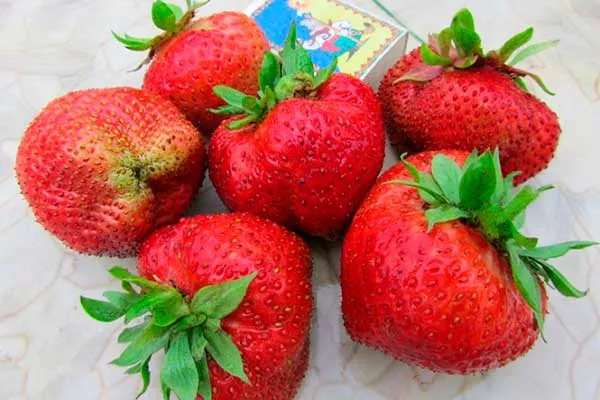
There is an opinion among gardeners and farmers that the original name of the Gigantella Maxim variety has undergone changes and has become known in various forms, such as Gigantella maxi (implying maximum) and Maxim (a popular interpretation).
Some believe these names refer to the same variety, while others view Maxim as an improved and refined version of Gigantella. These differences are likely related to marketing strategies and may indirectly indicate the use of deceptive advertising techniques.
External characteristics of the plant
This variety is characterized by robust, vigorous shrubs. Their height reaches up to 60 cm under very favorable conditions. Otherwise, the height does not exceed 40 cm, and the diameter is 50 cm.
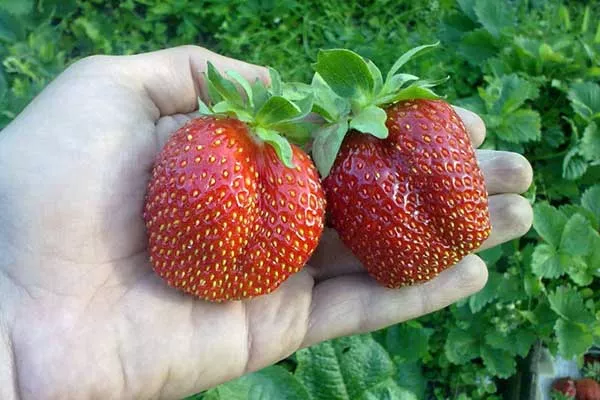
- ✓ The first year leaves are light green, becoming darker and matte with age.
- ✓ The antennae are thick, dense and powerful, with a strong attachment to the ground.
Other parameters:
- Leaves. They are quite large and wide, with a slightly wrinkled surface and large teeth. Their color depends on their age: in the first year after planting, they are light green, but later become darker and more matte.
- Antennae. They are rarely called pet names because they are not only long but also thick, dense, and powerful. Their distinctive feature is their strong attachment to the soil and rapid rooting. However, they don't form in large numbers, and their numbers only decrease over the years.
- Peduncles. Multiple on one plant – 15-35 units. Each peduncle forms about 2-8 buds with snow-white petals (the flowers are usually five-petalled).
Taste and characteristics of berries
Like the bush, the berries are diverse—their shapes are astonishing. They can be shaped like an open accordion, a comb, ribbed, triangular, or flattened. However, these are only seen in the first flush. Later, conical fruits with blunt or rounded ends develop.
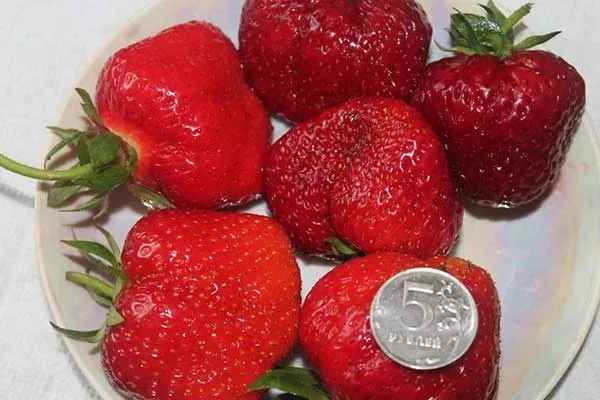
Other characteristic features:
- color - rich red, but more often matte;
- surface – rough, granular-convex;
- weight - at the first collection 100-120 g, then 50-60 g;
- berry diameter – from 7 to 10 cm;
- pulp – at the same time dense and juicy-watery, but there are never any empty spaces inside (they are usually typical for large fruits);
- taste - It is characterized as unique because it combines strawberry and pineapple;
- seeds – light, well convex;
- aftertaste – spicy metallic;
- aroma – pineapple, medium intensity;
- purpose – universal (freezing, canning, etc.).
Please note the following characteristics:
- fruit ripening begins from the base of the fruit and ends at the top, which may remain white if not fully ripe;
- To fully enjoy the sweetness of the fruits, pick them when the color is uniform across the entire surface;
- berry type – dessert;
- the transportability of berries is excellent, but only if the fruits are picked before they reach biological ripeness (then the pulp is still dry and very dense;
- The shelf life in the refrigerator is one week, which is considered excellent;
- When defrosted after freezing, the berry's structure is fully preserved.
Characteristics
To ensure Gigantella continues to produce abundant and consistent fruit, the bushes need to be replanted every 7-9 years. This procedure will help rejuvenate the plant.
Ripening period and yield
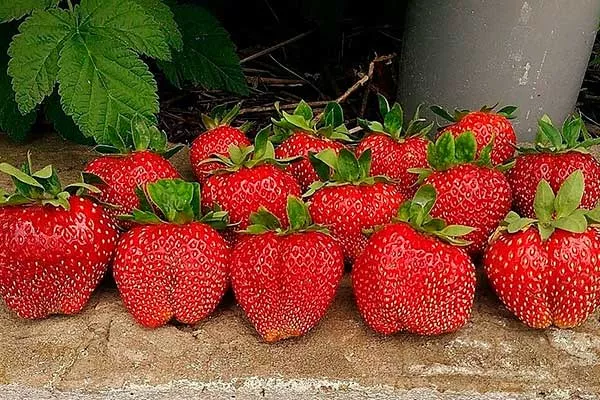
Strawberry bushes begin blooming in the first half of May, and fruiting begins on June 20th. This variety is not everbearing. Gigantella is a mid-late variety with a long fruiting period. A single, carefully tended bush can yield up to 2.5-3 kg of high-quality, sweet berries.
Winter hardiness and need for shelter
Gigantella strawberries are frost-resistant. Bushes easily survive temperatures as low as -28.9 degrees Celsius in open ground. However, in regions with particularly harsh winters, it is recommended to provide protective cover for the plants.

What and how to do before wintering:
- In preparation for winter, you need to remove weeds around the bushes and damaged leaves, and also loosen the soil for better aeration.
- A thick layer of humus or manure should be placed on the beds and covered with plastic film, which will help retain heat.
- The plant's tendrils should be covered with soil to prevent them from freezing.
- There is no need to tear off all the leaves, as they protect the roots from freezing.
- Covering the strawberries should begin with the first steady frost, and uncover the plants in the spring as soon as the snow begins to melt.
- Suitable materials include spruce branches, spunbond and agrofibre (it is advisable to make a frame over the bushes).
Pollination
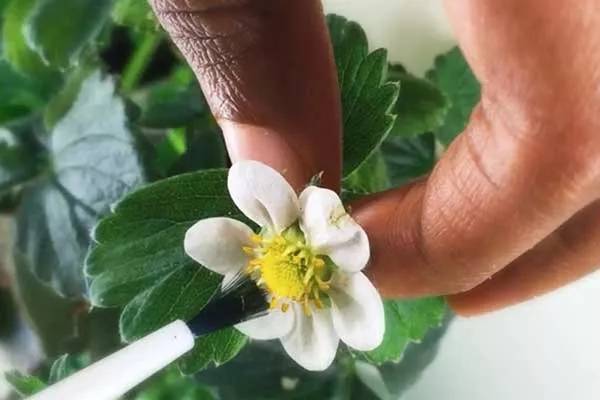
The Gigantella variety requires special attention when it comes to pollination. While the strawberry can be wind-pollinated, the best yield (a 25-30% increase) can be achieved by manually transferring the pollen. A standard paintbrush is suitable for this purpose.
Planting strawberries in the ground
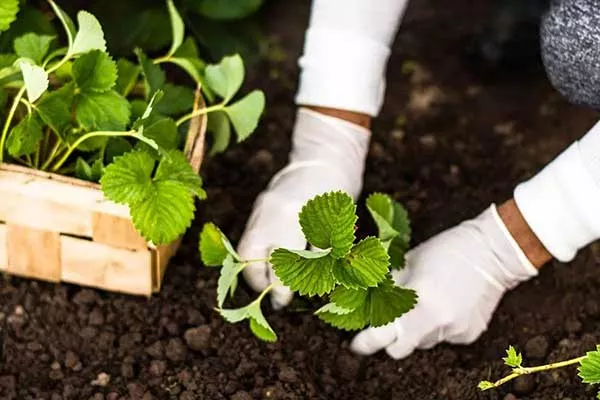
The large-fruited Gigantella strawberry requires fertile soil to produce a bountiful harvest. Ideal pre-crops for this variety include peas, broad beans, and lentils, which help enrich the soil with nitrogen.
- ✓ The optimal soil acidity for Gigantella should be within the range of 5.5-6.5 pH, which is critical for the absorption of nutrients.
- ✓ The distance between bushes should be at least 50 cm to ensure sufficient aeration and prevent diseases.
Varietal nuances:
- It is important to let the soil rest for one season before planting.
- In central Russia, the optimal time for planting is from April 20 to May 10. Accordingly, earlier in the south, later in the north.
- Before planting, it is necessary to thoroughly moisten the soil and form holes for the seedlings.
- It is important to plant no more than 4 bushes per 1 sq. m.
- When working, ensure that the growing points remain above soil level.
Caring for plantings
Caring for Gigantella is not significantly different from caring for other strawberry varieties, but there are a few special features:
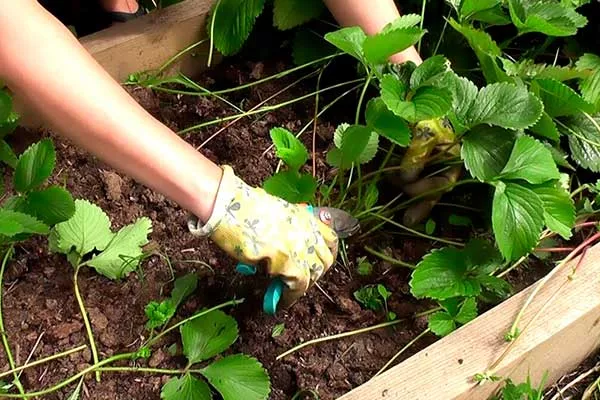
- The bushes grow quickly and form many runners, which should be removed in a timely manner to maintain productivity.
- For propagation, it is enough to leave 5 tendrils on several bushes so as not to weaken the main plant.
- Gigantella can be grown using the carpet planting method, which allows all runners to root. This allows for a harvest in the first year.
- Remove weeds regularly if strawberries are planted in regular beds.
- Water once a week. This is sufficient. Increase the frequency during hot weather, and reduce it during rainy periods.
- Diseased bushes should be removed immediately.
- Before fruiting begins, it is advisable to mulch the soil to prevent fruit rotting.
- Apply fertilizer before fruiting begins and repeat after harvesting, using nitrophoska and wood ash.
Diseases and pests
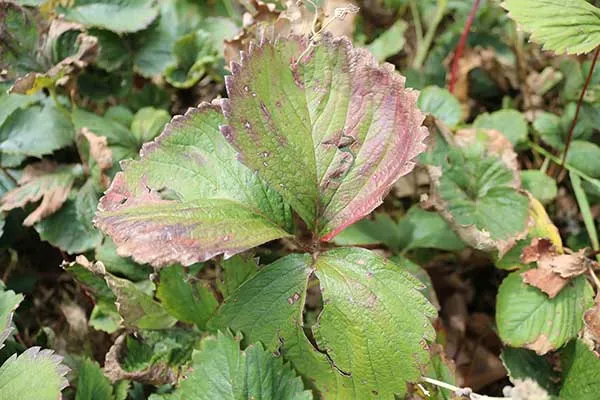
Gigantella has good natural immunity. This variety is rarely susceptible to disease or pest attacks. However, preventative measures are necessary to maintain plant health.
Preventive measures include:
- In spring, it is recommended to spread onion peels between the bushes, which not only enriches the soil but also repels insects.
- Using pine needles for mulch helps prevent berries from coming into contact with wet soil and reduces the risk of rot.
- Planting marigolds helps protect plants from weeds and nematodes.
- Planting onions or garlic between rows of strawberries is to protect against grey mould.
- The use of aggressive chemicals is permitted only in cases of widespread infestation. During the fruiting period, it is recommended to resort to traditional methods to prevent chemical buildup in the berries.
Reproduction - methods
The following technologies are used for Gigantella:
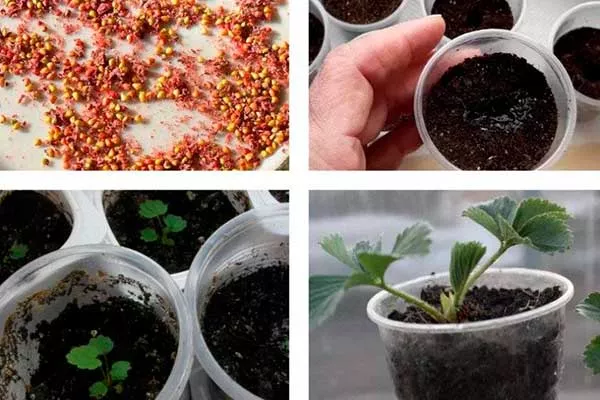
- Seed method. This involves stratifying and disinfecting the seeds before planting. They are sown in containers with water- and air-permeable soil, which should be moistened, the seeds are lightly pressed into the substrate, and the container is covered with plastic wrap.
After the sprouts emerge, the covering is removed and the seedlings are moved to a bright location. Pricking out occurs when the seedlings have developed 3-4 true leaves, after which the plants are fed with mineral fertilizer.

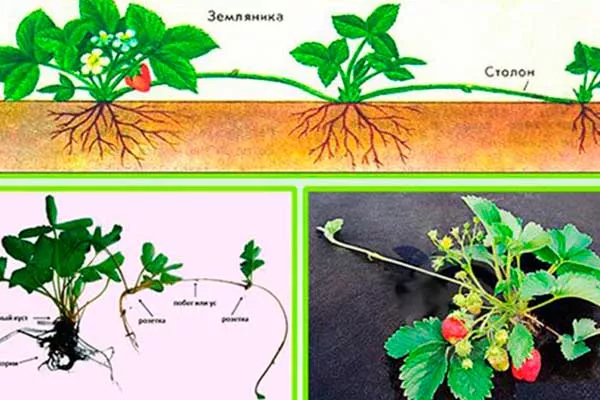
- Propagation by dividing the mother bush. You can dig up and carefully divide the mother plant into rosettes, or cut off a section of the plant directly in the ground with a sharp object. Treat the cut with a pink solution of potassium permanganate or sprinkle with a wood ash solution.
This method is one of the most gentle and allows the rosettes to quickly take root in a new location.
- Breeding by whiskers or mother offspring. Select healthy shoots and root them in separate cups without cutting them off from the mother plant. The Gigantella variety has strong runners, which facilitates the rooting process. This way, the young shoot receives dual nutrition: from the plant itself and from its own nascent roots.
Once the offshoot has successfully rooted and developed a root system, it can be separated from the mother plant. After this, the offshoots from the cups can be transplanted to their permanent location.

Advantages and disadvantages
The main advantage of Gigantella is the large size of its berries. However, the variety also has other positive and some negative qualities:
Simple tips for protecting strawberries
To prevent powdery mildew and nematodes from infesting strawberries, be sure to plant marigolds around them, and calendula against other fungal diseases. Strawberry crops are often attacked by slugs; common parsley can help repel them.
Reviews
Gigantella strawberries are considered high-yielding and frost-hardy, but they also tolerate extreme drought. Fruits come in a variety of shapes and sizes, but always meet consumer preferences. It's crucial to replant the bushes every few years.