
One of the easiest and most accessible ways to renew old strawberry plantings and plant new ones is by dividing the bushes. We'll learn how to select strawberries for transplanting, how to plant them, and how to care for them.
What is division?
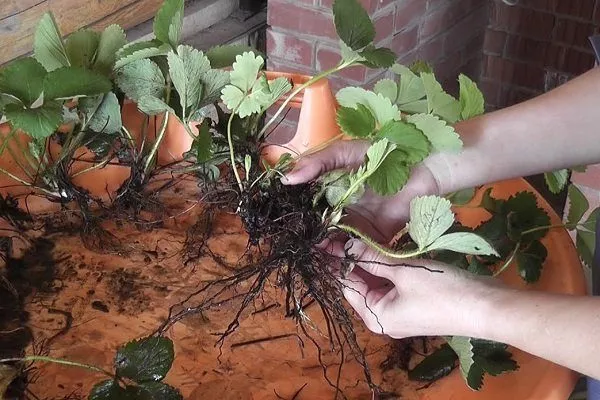
Dividing a bush is one method of propagating perennials, allowing you to obtain several young plants from a single mother plant. A mature bush is divided into two, three, or more parts with well-developed roots.
It is not recommended to divide mother plants into too small horns - they will be weak and take a long time to take root.
The most popular method of propagating strawberries is mustacheBut there are hybrids and varieties, mostly remontant, that produce few or no runners. It is these plants that are recommended for propagation by division.
Advantages and disadvantages of the method
The main advantage of propagating strawberries by division is the simplicity of the process. Compared to growing seedlings and rosettes, this method requires no special effort.
Pros propagation by division:
- the new plants completely retain their varietal characteristics;
- fast rooting and good survival rate – up to 90%;
- new bushes produce a full harvest the following season;
- the method is applicable throughout the season;
- the possibility of improving yield by selecting the most powerful bushes with large berries.
Bushes intended for division are not plucked from buds, as with runner propagation. Gardeners can harvest the crop first and then replant.
There are virtually no downsides to propagation by division. Rather, there is a requirement: the mother plants must be healthy, strong, and have a robust root system. Their leaves should be free of damage, disease, or pests.
When is the best time to divide bushes?
It's recommended to plant strawberry bushes in the spring. The earlier you plant young plants, the faster they'll establish themselves and the better they'll survive their first winter. Within a year, the cuttings will produce their first full harvest.
Features of strawberry propagation in different periods:
- Spring. If planting is done in the spring, the flower stalks of young bushes are removed so that the plants can direct all their energy towards root development and the growth of green mass.
- Summer. Berry bushes can be propagated in the summer, but only in cloudy weather. Replanting berries in extreme heat is not recommended.
- Autumn. Propagation by division is practiced until early October. Strawberries should not be planted later than this date, as the runners will not have time to root before the cold weather sets in, and most of the planted bushes will freeze even in light frosts.
Spring propagation provides the best chance of survival and is a good foundation for future harvests. Fall planting has its advantage – it allows for a full summer harvest.
Selection of mother plants
The maximum period of stable strawberry production is four years. Keeping it in the garden for longer than this period is pointless. Mature four-year-old plants are ideal for propagation by division. One bush produces 15-18 suitable pods.
- ✓ The bush must be at least 2 years old to ensure sufficient root mass.
- ✓ The presence of at least 3 healthy, well-developed rosettes on the bush.
Before dividing the bushes, gardeners monitor the berry plantation for a full year, noting the strongest and most productive specimens. To avoid losing the mother plants in the berry patch, they mark them, for example, by placing a small stone near them, setting a stake, or tying ribbons.
Old strawberry bushes are easily distinguished from young ones by their tough, dark brown roots, darker leaves, and numerous rosettes.
Experienced gardeners plant berries in such a way as to ensure both a harvest and propagation each year. To achieve this, they create four beds on each plantation, each containing first-, second-, third-, and fourth-year berries.
How to carry out division correctly?
To propagate strawberries from bushes, you'll need a shovel, pruning shears, and a container of water. How to divide a strawberry bush:
- Insert the shovel around the mother plant one by one.
- Remove dried leaves and flower stalks, if any.
- Using your hands, pull the bush upward and shake it a little to loosen the soil.
- Place the dug up bush in a container with water.
- Carefully separate the mother plant into several clumps. Try not to pull too hard to avoid damaging the plants. The water will help you separate the clumps easily without straining.
- Use pruning shears to trim away old, discolored, and dried roots. Only the young roots should remain.
If double horns (two bushes on a single root) separate during division, they are carefully cut in half. This will leave two seedlings.
An experienced gardener will give recommendations on propagating strawberries by dividing the bush in the following video:
Landing rules
Depending on the size of the rhizomes, gardeners decide whether to plant them directly in prepared beds or let them grow a little longer. When replanting, they consider not only the size of the root system but also the type of cultivar.
Planting seedlings for further growing
It's recommended not to plant antlers with poorly developed roots directly into their permanent location. To continue growing them, use small containers, preferably peat pots.
- Mix peat and garden soil in a 1:1 ratio one week before use to stabilize the pH.
- Check the moisture content of the substrate – it should be slightly damp, but not wet.
- Add 10% perlite or vermiculite to improve root aeration.
Transplantation for further growing:
- Prepare a substrate of peat and garden soil (1:1) and fill the containers halfway with it.
- Place the horn in the center of the pot.
- Cover the roots with substrate up to the root collar.
- Water and cover with film.
After a month or a month and a half, plant the grown horns in the garden. The downside of this method is the risk of disease when transplanting into the ground. Using peat pots gives a much better chance of successful establishment.
Transplanting to beds
When the horns reach the desired size, they develop large, fleshy foliage. It's important to plant the mature strawberries before October.
The procedure for transplanting grown-up horns is the same as when landing well-developed horns separated from the mother bush:
- A week before, dig up the soil and add a bucket of organic fertilizer (compost, humus) to it.
- Dig holes of a suitable size so that the roots of the horns fit freely into them.
- Place the seedling in the hole, cover it with soil up to the root collar, compact it with your hands, and then water.
How to plant remontant varieties?
Everbearing varieties bear fruit several times during the summer or never stop producing. Many cannot be propagated by any means other than division.
Dividing is recommended in the fall, 20 days before the first frost. Spring division is less common and is done before flower stalks appear, or by removing them if they have already grown before the work begins.
Caring for young seedlings
Planted horns require extra attention from the gardener. They need strength to take root, so it's important to plant them in time. water, loosen and feedThe optimal temperature for the growth and development of strawberries is +18…+20 °C.
How to care for planted horns:
- Watering and loosening. The recommended watering frequency is approximately once every 2-3 days. Increase this frequency if necessary. As the seedlings establish themselves, water less frequently. A day or two after watering, carefully loosen the soil, being careful not to get too close to the seedlings to avoid damaging the roots, which are located close to the surface of the strawberry plant.
- Mulching. To reduce moisture evaporation and prevent weed growth, the soil sprinkle with a layer of mulchFor this purpose, straw, dry grass, and other natural materials are used.
- Top dressing. This is necessary during spring replanting. A complex mineral fertilizer is added to the soil. Fertilizing frequency is once a month.
- Protection. To prevent diseases and pests, plantings are sprayed with fungicides and insecticides.
Around October, the new strawberry plant is watered generously. This is a moisture-replenishing watering that increases the plants' chances of surviving the winter.
Common mistakes and problems
Despite the simplicity of the method and the good chances of survival, problems often arise when propagating strawberry plants by division. Experienced gardeners offer advice on how to avoid these mistakes:
- It doesn't take root well. The acceptable loss rate among planted horns is approximately 10%. If this figure increases, the plants are lacking nutrients and require fertilizing. Strawberries don't like high acidity—add wood ash.
- Poorly developing. If the root collar is below the soil level, the bush does not grow and does not produce berries.
- He is sick. If your bushes are affected by late blight and powdery mildew, your crop rotation may be out of sync. Strawberries should not be planted after potatoes and tomatoes.
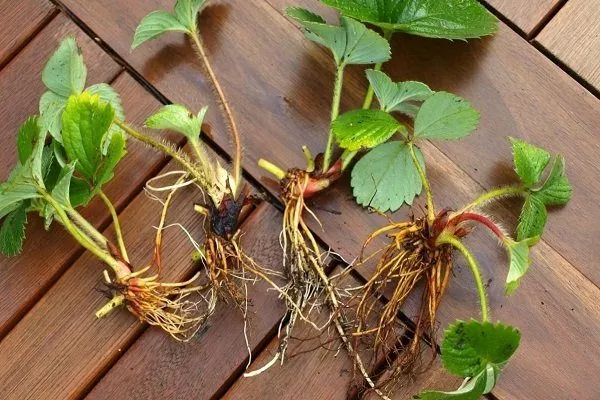
Dividing the plant is a universal propagation method suitable for all strawberry varieties. It's convenient because it's simple, time-consuming, and ensures a full harvest.
I've divided strawberries a couple of times in my life, but only 5-6 out of 10 bushes survived. Now I understand what was going on—the weaker ones needed to be nurtured, but I planted them straight into the garden beds, and that's why they died. Thank you so much for the valuable information! I'll definitely try this method in the spring. By the way, I was discussing this on a forum, and experienced gardeners told me it's the right way to do it.