
The strawberry mite is an arachnid insect. It multiplies rapidly, infecting and destroying strawberry plantations along the way, particularly affecting varieties with delicate leaves and sweet fruit. It is microscopic in size, making it virtually impossible to detect early.
General characteristics of strawberry mites
The strawberry mite, known by its Latin name Tarsonemus fragariae, attacks not only agricultural crops but also ornamental plants. It is divided into many subspecies, but only three types are found in our gardens.
Appearance
| Name | Body size (mm) | Color | Activation conditions |
|---|---|---|---|
| Transparent | 0.19-0.20 | Transparent | Humid environment |
| Common two-spotted | 0.24 | Light green-brown | Warm dry foliage |
| Cyclamen mite | 0.3 | Light green | Wet and dry conditions |
The external characteristics of strawberry mites vary depending on the variety. In our latitudes, we encounter species with the following distinctive features:
- Transparent. This is the most common species. Its body size is approximately 0.19-0.20 mm, it has no coloration, and is completely transparent. It actively reproduces in humid environments. It feeds on the juice of strawberry leaves. It is most often encountered in the spring.

- Common two-spotted. The body length is 0.24 mm. Reproduction requires warm, dry foliage. The pest is light green-brown in color, with darker spots on its surface. It feeds on foliage.
- Cyclamen mite (Tarsonemus pallidus). The body length reaches 0.3 mm. Unlike the two previous species, it is active in both wet and dry conditions. The body color is light green.
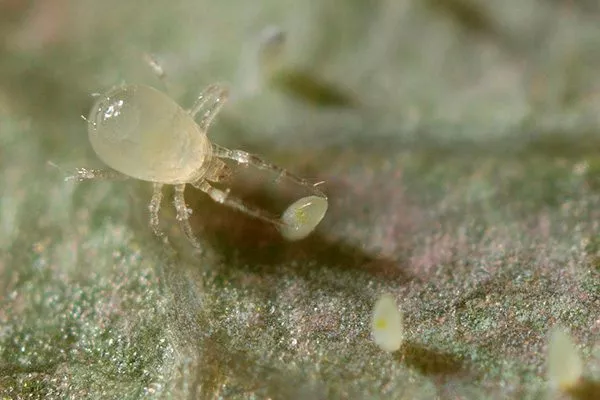
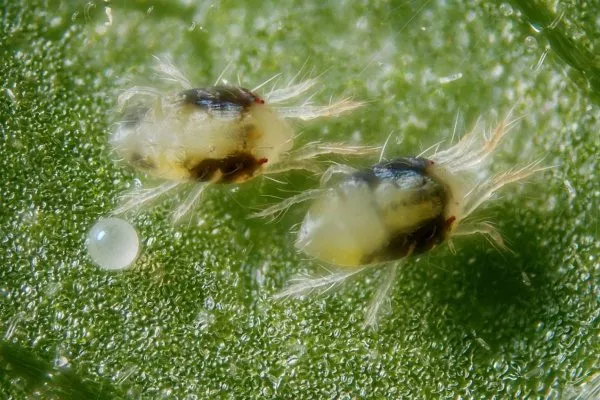
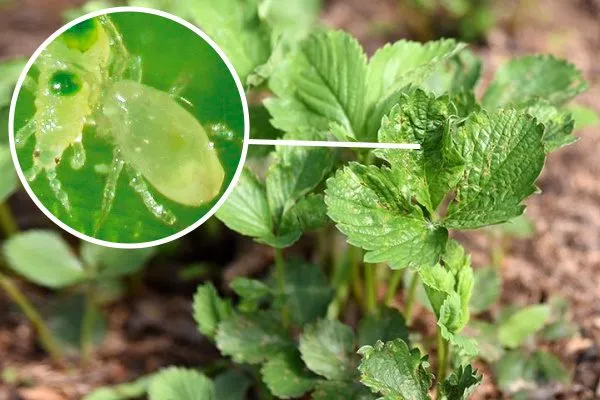
All these species have a translucent structure and belong to the group of variegated mites, with oval bodies and a flattened surface. Their legs are long and triangular, and their heads have two antennae.
Behavior
The strawberry mite's favorite location is the central part of the strawberry bush. This growth point (rosette) is where young leaves begin to emerge, which are considered very succulent for the pests.
Strawberry mites reproduce quickly. The rosette becomes crowded, and the microscopic parasites spread throughout the entire bush.
This is particularly true for the young, as adults remain inside to reproduce – the eggs must be kept under reliable protection.
Reproduction
Favorable conditions for strawberry mites are between 13 and 25 degrees Celsius, especially during rainfall, which increases soil moisture and leads to active reproduction. Here's how this happens:
- the female localizes in the center of the bush, where she lays eggs;
- The eggs hatch into larvae and develop into imago (the complete cycle lasts 30-41 days).
If the summer is warm and rainy, the process of turning an egg into an insect is shortened, down to 2-3 weeks.
During a single season, a generation changes several times (about 4-5). With the arrival of frost, females begin to seek shelter behind stipules, but males give in, resulting in their death. Females, however, survive until spring, after which they reproduce again.
Geographic distribution
Back in 1905, Australian scientists discovered the first strawberry mites on strawberries, hence the pest's name. Twenty-three years later, the insect was found in America. Today, the mite is distributed worldwide, but prefers temperate climates.
Life expectancy
Female strawberry mites are more resilient than males. The life cycle of females is 23 days, while that of males is 18 days. When frost sets in, the pests enter a state of suspended animation until a favorable period arrives.
What crops are susceptible to strawberry mites?
While the strawberry mite was originally found exclusively on strawberry bushes, today it is also found on the following plants:
- dicotyledonous crops;
- raspberry;
- delphinium;
- gerbera;
- cyclamen and others.
Other unpleasant consequences that arise from the invasion of strawberry mites:
- cessation of plant development;
- leaf deformation;
- unripe berries;
- reduction in crop yields;
- deterioration of taste;
- decreased frost resistance;
- weakened immunity, resulting in crops being susceptible to disease.
If the mite population is large, the plants dry out in the heat/rot in the rain and die.
Signs of appearance
Plants become infested for various reasons, but most often because the planting material is contaminated from the start. Due to the pest's microscopic size, it's virtually impossible to detect when purchasing.
To be prepared for an invasion, pay attention to the negative factors that contribute to strawberry mite infestation:
- rainy weather and warm at the same time;
- shading of the strawberry bed;
- dense planting;
- presence of nightshade crops nearby;
- ignoring agricultural practices.
Birds, other insects, and humans can carry insects. In humans, you can bring the pest into your garden on shoes, garden tools, and clothing. Always disinfect these items after working in infested areas.
The sooner you begin combating garden pests, the easier it is. Pay attention to the signs that help you recognize strawberry mites:
- the bushes stop developing;
- the leaves take on a wavy shape, wrinkle, but only young ones;
- the berries remain green and fall off;
- Old leaves dry out quickly, turning into a yellow mass.
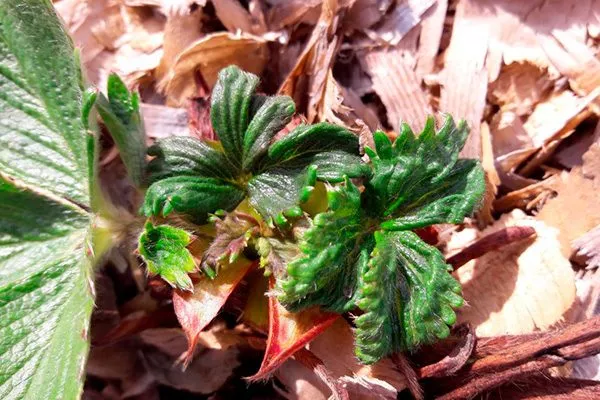
The main symptom of the presence of strawberry mites is a silvery-white coating on the back of the leaves.
How to fight strawberry mites?
There are many methods for eliminating ground mites, but it's important to combat them at the initial stage of plant infestation. Otherwise, saving the strawberries is impossible.
Experts recommend a comprehensive approach to pest control and strict adherence to all instructions for use of any given product.
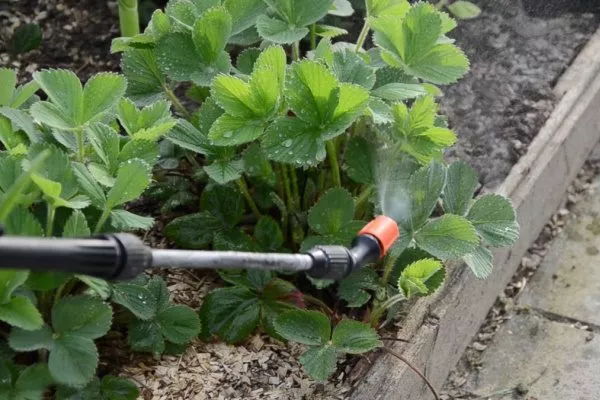
Chemicals
Chemical-based products are considered the most effective in controlling strawberry mites. However, some treatments require repeated and combined treatments, meaning two or more products are used.
Chemical agents:
- Aktara. This is a stomach-contact insecticide, killing insects within 24 hours. Numerous reviews confirm that the product is highly effective. There are two treatment options:
- spraying – 2 g of Aktara per 10 l of water;
- root watering - for 10 liters take 8 g, for one bush you need 300 ml.
- Fitoverm. This is a latest-generation biological product. Four treatments are required for complete pest eradication. The interval between treatments is 5-7 days. The key conditions for achieving results are a lack of precipitation and wind, and avoidance of low temperatures. Features:
- Dilute 10 ml of the product in 1 liter of water.
- Spray the bushes.
- Fufanon. The product is based on malathion. Three treatments are required, as the substance is not very toxic. The interval between treatments is 6-7 days. For 10 liters of water, 30 ml of the product is required.
- Switch. It's considered a fungicide, typically used to treat diseases. Despite this, Switch is quite effective against strawberry mites. Application instructions:
- Dilute 2 g of the product in 10 liters of water.
- Irrigate the strawberry plantation.
- Karbofos. The toxicity is moderate, as it contains malathion. Treatment can be carried out in various ways:
- spraying - take 60 g of the preparation per 10 liters of water;
- root watering – 30 ml per 1 liter of water (per 1 sq. m).
- Marolex. Experienced gardeners consider this product highly effective against adult beetles, but it is ineffective against larvae. Apply the product at least four times, spaced 5-6 days apart. The procedure involves spraying only, at a dosage of 100 ml of the product per 10 liters of water.
- Colloidal sulfur. This is a low-toxicity pesticide available as a liquid suspension. A special requirement is that the thermometer should not drop below 10 degrees Celsius; 20 degrees Celsius is ideal. Spraying methods:
- at an average level of damage, 10-20 g of the substance is sufficient for 10 liters of water;
- in case of a large-scale invasion, about 50 g is required per 10 liters.
- Thiovit Jet. A sulfur-based preparation. It is low-toxic to humans, and processed berries are permitted for consumption. For irrigation, add 80 g of soluble granules to 10 liters of water.
- Neoron. It comes in ampoules and is based on bromopropylate. It has no negative impact on bees. Since Neoron does not destroy egg masses, treat the bees 3-5 times. Spray with a solution of 5 ml per 10 liters of water. This is enough for 10 square meters.
- Potassium humate. It's considered a fertilizer that has a negative effect on strawberry mites. Add 1 teaspoon of fertilizer to 1 liter of water and apply it to the root zone. The dosage is calculated per 1 square meter.
Additionally, the following medications can be used:
- Kemifos;
- Vertimek;
- Akarin;
- Actellic;
- Sunmite;
- Masai;
- Omayt;
- Vertigo;
- Ridomil Gold.
Biological methods
Several decades ago, this technique was used only by large agricultural organizations. Today, it is available to small farmers and hobby gardeners alike. The idea is to release predatory insects onto strawberry plantations that consume mites.
Most often, entomophages grown in laboratory conditions are released into garden beds. Other insects:
- Encarsia - feeds on the egg masses of strawberry mites;
- Phytoseiulus bug - eats adults;
- Trichogramma - lays its own eggs in the mite's clutch.
This is an expensive technique, but it is quite environmentally friendly and highly effective.
A biological method for controlling strawberry mites includes planting plants that repel pests with their odors:
- lavender;
- catnip;
- tansy;
- medicinal rosemary;
- calendula;
- chamomile;
- marigold;
- dandelions.
Folk methods
Gardeners also often use folk remedies, as many of them have been proven effective. Their main advantage is their lack of toxicity, making strawberries and wild strawberries safe to eat.
What can be used against strawberry mites:
- Soda and soap. For spraying, make a mixture of 50 g of brown laundry soap, 50 g of soda (calcined soda gives the best results) and 10 liters of water.
- Onion infusion. You'll need 200-300 g of onion peel per 10 liters of water. How to make:
- Boil the water.
- Pour over the husk.
- Cover with a lid.
- Leave to infuse for 5 days (be sure to keep it warm).
- Strain.
- Tomato broth. It's considered effective, but to enhance the reaction, it's recommended to add 2-3 tablespoons of grated laundry soap per 10 liters of solution to the prepared solution. Preparation process:
- Take 1 kg of green tomato mass (tops), 10 liters of water.
- Place on the fire and cook for about 3 or 4 hours.
- Let it cool naturally.
- Strain.
- Dilute the resulting decoction with the same amount of water.
- Spray the bushes generously.
- Garlic tincture. Press 200 g of peeled garlic through a garlic press and pour in warm water (8-10 liters). Let it steep for about 6 hours, strain, and spray the strawberries.
- Ammonia. For 10 liters of water, you'll need just 30-40 ml of alcohol. The solution can be poured directly onto the bush or sprayed.
- Marigolds, calendula, chamomile. Make an infusion from them. For 10 liters of boiling water, add 300 g of freshly picked flowers. Infuse under a closed lid for 3-4 hours. Both misting and root watering are acceptable.
- Celandine. It is prepared in the same way as in the previous case, but the dosage is smaller - 100 g of grass per 10 liters of water.
If strawberry mite infestation is extensive, folk remedies won't help. It's best to try other methods or completely exterminate the bushes.
Thermal methods
Heat treatment is most effective on seedlings, but can also be done on mature plants. In the former case, the method involves the following steps:
- Prepare two containers. Fill one with water at a temperature of 15 to 18 degrees Celsius, and the other with water at a temperature of 40 to 50 degrees Celsius.
- Before planting, first dip the seedlings in hot liquid, then in cool liquid.
There are also other methods of heat treatment:
- Pouring boiling water. During the summer, water the bushes with hot water. The maximum temperature is 55-70 degrees Celsius, but no higher, otherwise you risk burning the plant.
After the procedure, be sure to let the soil dry out, then water and hill up the bushes. Use about 500 ml per planting. - Burning. Used for severe infestations. A blowtorch or torch is used. The goal is to burn away the green material almost to the root collar. Experts consider this method questionable, as it increases the risk of plant failure.
- Hot greenhouse. Apply in summer. Cover the beds with thick plastic film for three days. Monitor the temperature—it should range from 40 to 60 degrees Celsius. If the temperature rises above this, some of the plants will burn.
Agrotechnical techniques
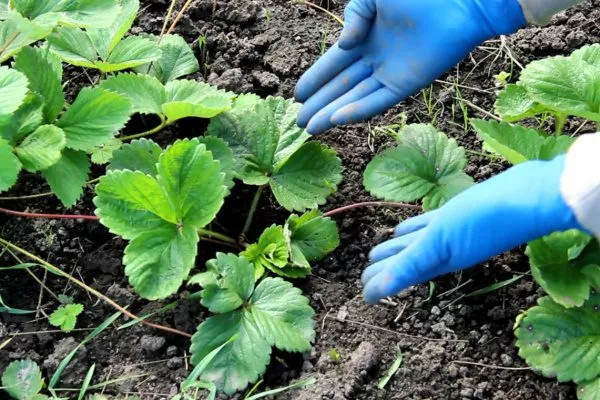
Agricultural practices require strict adherence to all requirements for a specific strawberry variety. For example, while agronomists recommend watering the crop once a week, doing so more frequently is prohibited, as high humidity attracts strawberry mites.
There are general rules:
- Monitor the humidity level - during heavy rains, it is better to cover the strawberry garden with plastic film like a low canopy;
- weed and loosen the beds in a timely manner;
- disinfect garden tools;
- water the bushes with settled water;
- trim off excess mustache;
- Observe crop rotation requirements.
If it's not possible to strictly adhere to these rules, for example, when growing strawberries in a garden, choose varieties that are highly resistant to mites:
- Torpedo;
- Zenga Zengana;
- Dawn;
- Knight;
- modern hybrids.
- ✓ The presence of a dense leaf blade, less attractive to ticks.
- ✓ High content of natural repellents in leaves.
Features of processing depending on the time of year
Depending on the season, choose the right strawberry mite control products. Some substances contained in these products are harmful to plants at different stages of the growing season.
Features based on time period:
- Spring. When the flower stalks emerge and temperatures reach 10 degrees Celsius or higher, it's best to spray with products such as Actellic. This allows for the safest possible suppression of pests at the initial stage.
A mandatory requirement is to treat mainly the core of the rosette and the leaves from the back side. - Summer. By this time, widespread damage is usually already evident, but on the other hand, this is the time for berries to ripen. Using excessively chemical treatments is not recommended. Instead, opt for biological treatments (Actofit, Fitoverm).
Treat the bushes only after harvesting. The next harvest should be done in 6-7 days. - Autumn. At this time, there are no fruits. Feel free to treat the plants with any chemicals.
Some gardeners ignore this procedure in the fall, believing the insects will die during the winter cold. This only applies to males, as females tolerate frosts well, reviving with the thaw.
Measures to prevent the appearance of pests
To prevent the appearance and spread of strawberry mites in your strawberry beds, take preventative measures early. Here are some dos and don'ts:
- If ticks are already present, treat and remove the affected areas;
- dig up the beds more often;
- sprinkle the soil with wood ash;
- Before planting strawberries, disinfect the bushes;
- inspect plants more often;
- Buy seedlings from nurseries, not from spontaneous markets, where the likelihood of having eggs increases 5 times;
- do not over-water the crop, as these are the most favorable conditions for strawberry mites;
- trim the above-ground leaves in a timely manner, especially after harvesting the next crop;
- carry out preventative spraying of bushes before flowering begins;
- do not thicken the plantings;
- Plant pest-repellent plants nearby;
- Buy strawberry varieties that are resistant to strawberry mites.
Strawberry mites are a dangerous enemy not only of strawberries but also of other crops. Carefully familiarize yourself with the signs of an insect infestation, adhere to agricultural practices, and implement timely preventative measures.