
Blackberries have always been inferior in popularity to their red competitor, the raspberry. They were primarily harvested in forests, where they grew into impenetrable thickets. Today, many gardeners and summer residents actively grow this berry, thanks to the availability of varieties, easy to cultivate - productive, large-fruited and even thornless.
Biological description of blackberries
Blackberries are creeping shrubs or subshrubs whose vines grow up to 1.5-2 meters long. Like their close relative, the raspberry, blackberries belong to the Rosaceae family. A distinctive feature of wild blackberries is their sharp, tenacious thorns, which make picking the berries extremely difficult.
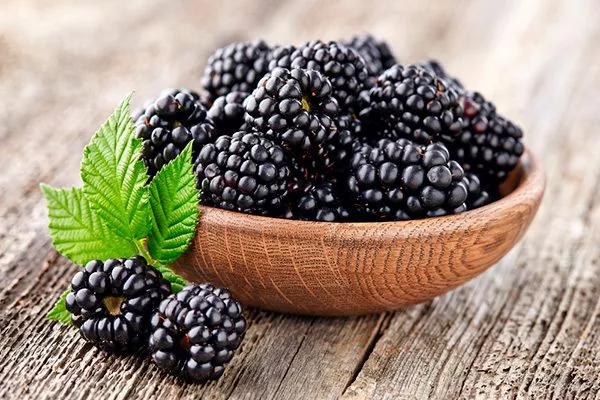
The plant has a perennial rhizome and shoots that live for two years. The leaves have a complex structure, green above and whitish below. Blackberries bloom in May or June, depending on the climate zone. The flowers are small, white-pink, and the fruits are drupes, initially red, then dark blue. Depending on the species and variety, the berries have a bluish-gray bloom or a glossy sheen.
In the wild, blackberries grow primarily near bodies of water or in sunny forest edges. Both common and evergreen varieties exist. In Russia, two species are most common in the wild: bushy and blue.
How do blackberry types differ from varieties?
Botanists count approximately two hundred varieties of blackberries. Particularly numerous have been developed in the United States, where this berry is grown on an industrial scale. The main priorities in developing new varieties are yield, fruiting time, thornlessness, and ripening time.
Taking into account the listed criteria, blackberries are classified into several types:
- type of shoots - erect, semi-climbing and creeping;
- ripening periods - early, mid-season and late;
- fruiting - normal and remontant;
- thorns - prickly and thornless;
- Cold resistance - normal and frost-resistant.
- ✓ Consider the climate zone of your region to select frost-resistant varieties.
- ✓ Pay attention to the type of soil preferred by the chosen variety.
- ✓ Consider the need for support for climbing varieties.
All these classifications are arbitrary, and the same variety can belong to several types. For example, blackberries can be climbing, late-ripening, or thorny.
By grouping varieties into species, experts help amateur gardeners and industrial producers select the optimal planting material.
Types of blackberries
Blackberries are divided into species not only based on characteristics convenient for gardeners but also based on botanical characteristics. In nature, blackberries are represented by more than ten species, grouped together in the genus Rubus of the Rosaceae family.
In Russia, the word blackberry refers mainly to two biological species: the blue one (Rubus caesius) and the bushy one (Rubus fruticosus).
| Name | Type of shoots | Ripening time | Fruiting | Spikes | Cold resistance |
|---|---|---|---|---|---|
| Ordinary | erect | mid-season | ordinary | prickly | ordinary |
| Elm-leaved | semi-climbing | early | remontant | prickly | frost-resistant |
| Split | creeping | late | ordinary | thornless | ordinary |
| Folded | erect | mid-season | remontant | prickly | frost-resistant |
| Gray-blue | semi-climbing | early | ordinary | thornless | ordinary |
| Nesskaya | creeping | late | remontant | prickly | frost-resistant |
| Early | erect | mid-season | ordinary | thornless | ordinary |
| Armenian | semi-climbing | early | remontant | prickly | frost-resistant |
| Bear | creeping | late | ordinary | thornless | ordinary |
Ordinary
The common blackberry is one of the many species of bush blackberry (Rubus fruticosus). It is native to central and northwestern Europe.
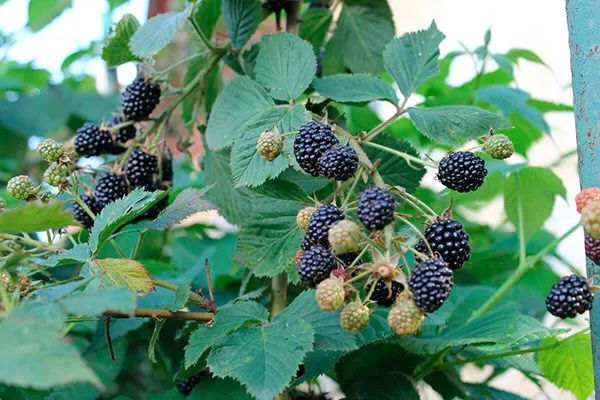
Brief botanical description:
- The stem is purple-lilac, with longitudinal grooves and a glaucous bloom.
- The shoots are covered with thorns, strong, long, slightly curved.
- The leaves are composed of five individual leaflets with serrated edges. They are dark green on top and pale green underneath. The central leaflet is diamond-shaped and pointed.
- The flowers are pale pink, medium-sized, up to 2 cm in diameter. The stamens are white or pink, and the pistils are yellowish or reddish.
- The fruits are spherical in shape.
Elm-leaved
The blackberry (Rúbus ulmifólius) is native to the Mediterranean region. This deciduous plant, like the common blackberry, belongs to the Rubus fruticosus group.
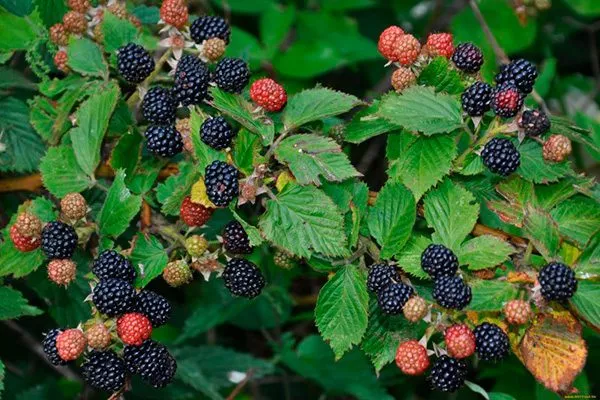
Brief botanical description:
- The stem and shoots are pubescent, up to 3 m in length, the thorns are flattened, curved;
- The leaves consist of 3-5 leaflets with serrated edges and longitudinal petioles; the central leaflet is larger than the lateral ones. The leaves are dark green above, without pubescence, and lighter green below, with pubescence.
- The flowers are pale pink, collected in dense inflorescences.
- The fruits are multi-druped, shiny, black.
Its distribution area includes the Mediterranean region, Western Europe, Great Britain, and Denmark. The elm-leaved blackberry has been successfully adapted to North and South America, South Africa, and Australia.
Split
The cut blackberry is one of the many species of Rubus fruticosus. Its original range is unknown; it may be a natural mutation of Rubus nemoralis. This species of blackberry is prone to becoming feral; today, it is naturalized in Europe and found in North America and Australia.
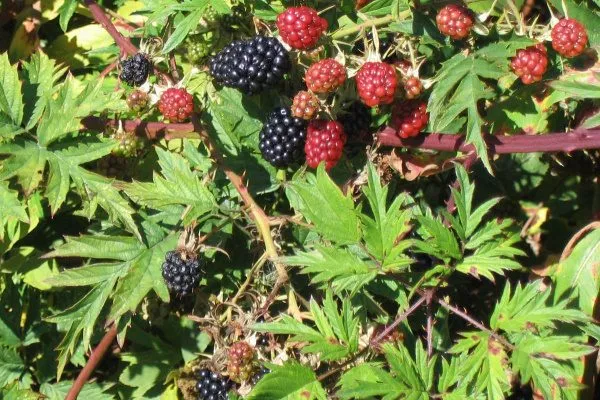
Brief botanical description:
- The stems are angular, thick, strong, branched, covered with sickle-shaped flat spines (1.2-3 mm).
- Leaves are composed of 3-5 leaflets, each of which is divided into multiple serrated segments.
- Flowers are whitish-pinkish, up to 2.5 cm in diameter.
- The fruits are black, up to 1.2 cm in diameter.
Since the 19th century, the cut blackberry has been cultivated as a fruit plant. In particular, its chimeric mutation, thornless, is cultivated. It was also previously often used as a groundcover.
Folded
The plicated or bush blackberry (Rubus plicatus) is widespread in Europe and is also found in the European part of Russia.
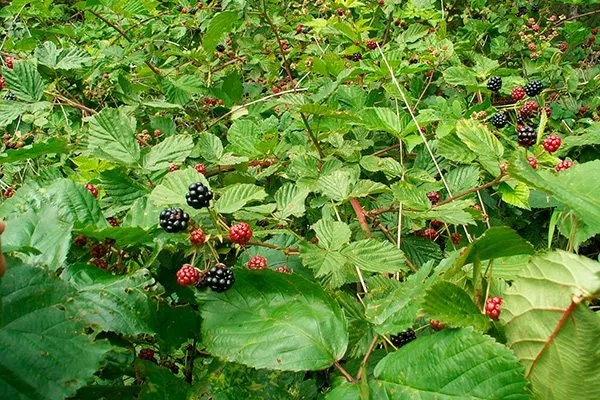
Brief botanical description:
- The stem is covered with wide, sickle-shaped spines, yellow or crimson.
- The leaves are composed of 3-5, rarely 6-7 leaflets, often overlapping each other. The central leaflet is the largest and widest, pointed.
- The flowers are white, with elliptical petals and a shaggy receptacle. The pistils are yellowish or reddish.
- The fruits are black drupes.
Gray-blue
The blueberry bush grows to 50-150 cm in height. It is widespread throughout Europe, North America, and Asia. It grows in woodlands, floodplain meadows, and gardens, often forming impenetrable thickets.
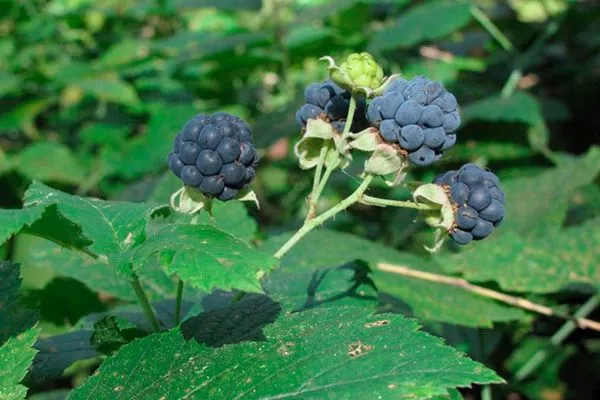
Brief botanical description:
- Shoots - at one year of age are cylindrical, with pubescent branches and many irregularly shaped thorns.
- The leaves have serrated edges, are divided into three parts, and have lanceolate stipules. The petioles are covered with spines. The pubescence is bilateral. The color is light green.
- The flowers are large, with white petals of a broadly ellipsoid shape.
- The fruits are composed of a few black drupes with a bluish bloom. The seeds are large and flattened.
The blue blackberry produces fairly juicy berries, but their flavor is inferior to that of other species. However, the blue blackberry variety is an excellent honey plant—bees can produce up to 20 kg of honey per hectare.
Nesskaya
Blackberry (or blackberry) is a low biennial shrub that reaches 1-2 m in height.
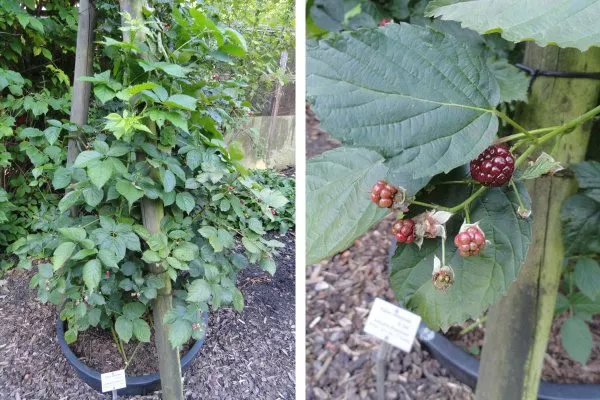
Brief botanical description:
- The stem is straight, with many thorns, the shoots are pubescent.
- The leaves are alternate, consisting of 3-5-7 oppositely placed leaflets.
- The flowers are white, about 2 cm in diameter, collected in inflorescences of 5-10 pieces, honey-bearing, attract bees.
- The fruits are initially green, then red, and turn reddish-black when ripe. The berries are approximately 1 cm in size.
Bushy blackberries grow in temperate and warm climates. Their thickets can be found in southern Europe and Scandinavia. In Russia, they are especially abundant in the Arkhangelsk region and the Caucasus.
Early
Early blackberry (Rubus praecox), Crimean or Taurian, is common in southern Europe. The bush reaches 2-3 meters in height and prefers forest clearings, open slopes, and the banks of bodies of water. It is often found in the Crimean mountains and on the Kerch Peninsula.
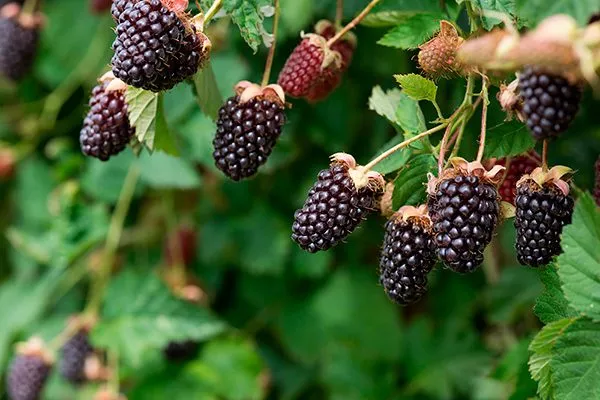
Brief botanical description:
- The shoots are bare, with sparse and powerful thorns.
- The leaves are large, dense, hairy on the veins, smooth on top, felty on the bottom, greenish-ash in color.
- Flowers are collected in elongated inflorescences, white or pale pink
- The fruits are complex drupes, round in shape and black in colour.
Armenian
The Armenian blackberry (Rúbus armeníacus) is native to what is now Armenia. This deciduous tree is believed to have originated there, but it does not grow wild in Armenia.
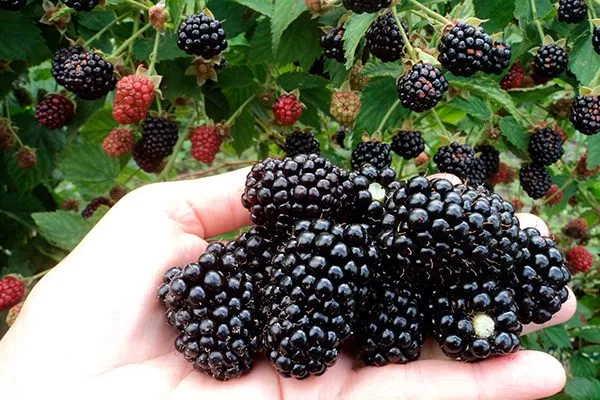
Brief botanical description:
- Shoots reach 1-2 m in length and are covered with sharp and hard thorns.
- The leaves are on fairly long petioles of 3-5 unequal leaflets with bluntly serrated edges, bright green.
- Flowers are pale pink, up to 2 cm in diameter.
- The fruits are large and black.
The plant is naturalized in Europe, North America, and Australia.
Bear
Bearberry is native to North America, with a range extending from California to Colombia. This dioecious deciduous shrub is widely used in breeding new blackberry varieties due to its increased resistance to fungal infections.
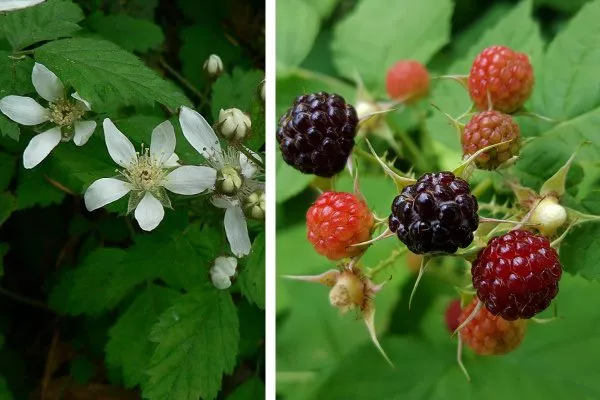
Brief botanical description:
- The stem and shoots are creeping and rooting, pubescent only during the first year of life, then becoming bare. Branching is extensive, and the thorns are sharp and curved.
- Leaves consist of three leaflets with serrated edges. Length: 3-7 cm, with the central leaflet being larger than the others, reaching 10 cm in length.
- The flowers are whitish-pink and form on two-year-old shoots. Each flowering shoot bears several leaves and one flower. Alternatively, the inflorescence may consist of 4-10 flowers.
- The fruits are oblong, sometimes spherical, multi-drupe fruits, reaching 2.5 cm in length. The diameter is about 1 cm.
North American Indians ate the bearberry, fresh or dried. It was also used in various religious rituals. The leaves of the bearberry are recommended for tea.
White blackberry
Blackberries can be not only dark blue or black, but also white. However, this is not a species, but a cultivar developed by breeder Luther Burbank. Another name is snowberry (white blackberry).
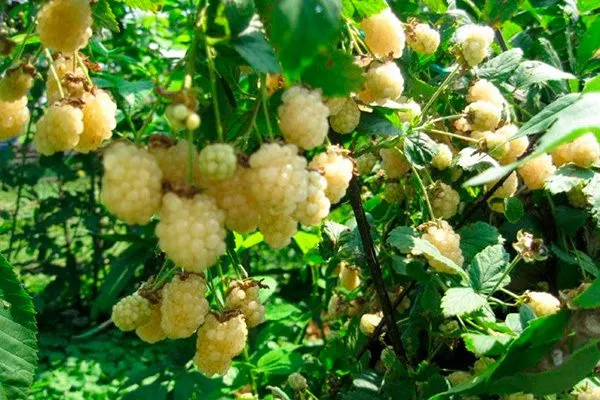
The first step toward developing a snow-white blackberry was the discovery of a wild, pale-colored berry near New Jersey. This blackberry was later named "Crystal White." The breeder crossed it with the Lawton variety and other light-colored berries.
In total, the breeder tested 65,000 hybrids. All were unsuccessful. However, success was finally achieved in 1984. Currently, only one white blackberry variety is commercially available: 'Polar Berry.' It has a mid-early ripening season and a long fruiting period.
Description of Polar Berry:
- The shoots are powerful, straight, up to 2-3 m in length.
- The fruits are large, glossy, oval-shaped, weighing 9-11 g. White blackberries have a sweet taste and a pleasant berry aroma. One Polar Berry bush produces up to 5 kg of berries.
The Polar Berry variety is high-yielding, frost-hardy, drought-resistant, and highly disease- and pest-resistant. Yields are further increased with winter shelter.
Is there a red blackberry?
Many gardeners use the term "red/pink blackberry." In fact, there is no such thing as a red blackberry. The berry they mistake for one is actually called a blackberry. This crop is the result of painstaking breeding.
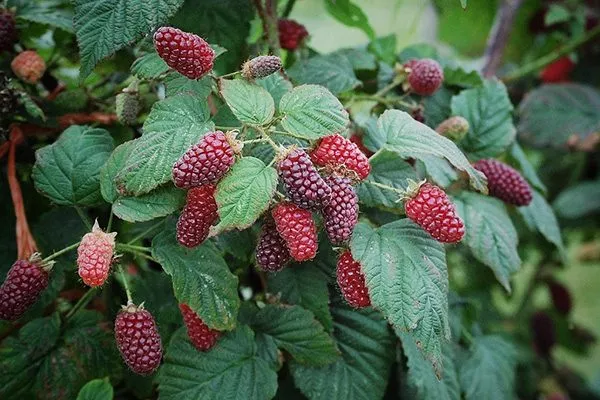
Black raspberry is a hybrid created by crossing wild blackberries and traditional American varieties. The reason for this development was the difficulty of producing frost-hardy, resilient, and drought-resistant raspberries. The hybrid successfully achieved this goal.
Brief description of blackberries:
- leaves - trifoliate;
- The fruits are large, weighing 10-12 g, sweet and sour, with a raspberry aroma.
Advantages:
- the fruits are dense, do not become soggy or wrinkled when washed;
- large berries - they are easy to pick and process;
- variety of flavors - blackberry varieties can have more or less sweet/sour flavors;
- the fruiting period of hybrids is twice as long as that of the original plants - 10 years versus 5;
- high yield - 3 kg from one plant;
- high frost resistance.
Blackberries are easier to grow; they produce large bushes that are easy to harvest. The fruits ripen in the second half of summer. Currently, about a dozen blackberry varieties have been developed, each with slightly different characteristics.
Blackberries are a productive and delicious berry, unfairly ignored by many gardeners and summer residents. There are varieties of blackberries that are completely thornless, bearing large, sweet berries. Based on these, breeders have developed many varieties that deserve the attention of berry lovers and winter preparations.