
Reuben is a blackberry variety characterized by early maturity and high productivity. Domestic gardeners have come to appreciate it for its ability to produce two harvests of delicious, large berries per year. It is suitable for growing not only outdoors but also in greenhouses. It exhibits its best qualities in protected soil.
History of selection
The variety was developed in 2005 through the joint efforts of scientists from the US and UK. It was developed by crossing the blackberry crosses APF-44 and 2292T2, with breeders working at the following institutions:
- University of Arkansas;
- English plant nursery Hargreaves.
It was named after one of its creators, John Reuben Clark. It underwent seven years of testing and became available for sale in 2011.
Description of berry crops
Before you begin growing Ruben blackberry bushes, familiarize yourself with their botanical description, flowering and fruiting characteristics, and technical specifications.
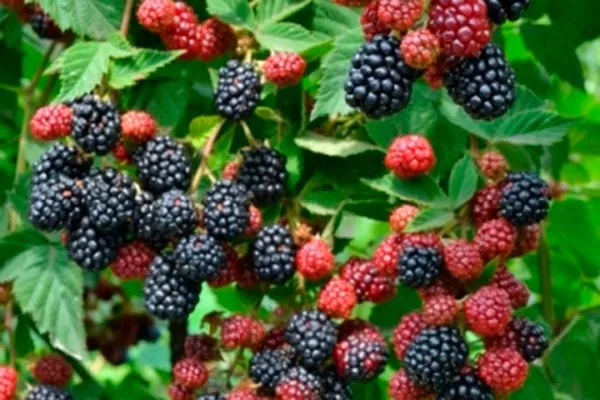
General information about the plant
The bushes of this cultivar are compact yet vigorous. The root system is well developed. A description of their appearance includes:
- “height” – 1.5-1.8 (maximum possible height – up to 2.5 m);
- upright structure;
- vertical orientation of shoots;
- their lack of tendency to weave;
- the branches are not long, thick and strong (they are distinguished by their resistance to wind loads and the weight of numerous large berries);
- green color of young and light brown color of adult shoots;
- the presence of medium-sized thorns, sparsely located along the entire length of the branch;
- good foliage.
- ✓ Upright bush structure without a tendency to weave.
- ✓ Presence of medium-sized thorns along the entire length of the branch.
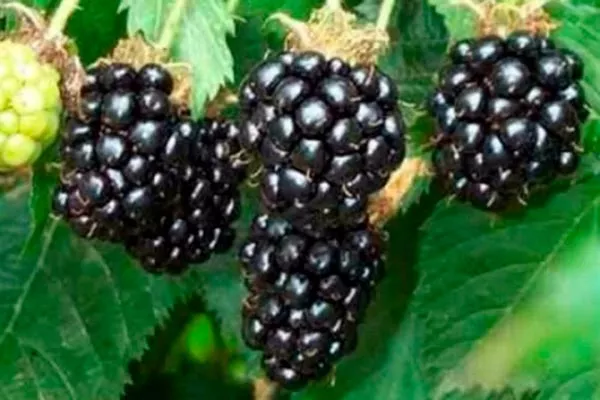
The plant produces few shoots. It requires no support thanks to its strong, straight stems that do not bend toward the ground. Its fruits ripen in clusters of 5-9.
Berries and their taste qualities
Ruben's harvest has a marketable appearance and excellent consumer characteristics. The berries are large and attractive. They are characterized by the following external characteristics:
- length - up to 4.5 cm;
- weight - from 8 g to 14.4 g (the average weight of the fruit is 10 g);
- round-conical shape;
- black glossy skin;
- dense and juicy pulp.
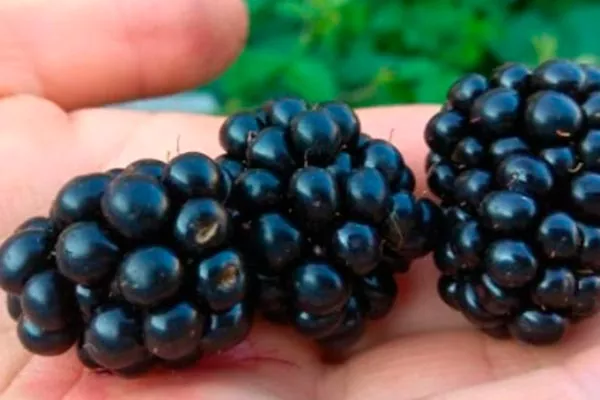
The flavor of this blackberry variety is quite good. Its flesh is sweet with a subtle tartness, aromatic, and juicy. It has a tasting score of 4.5 out of 5. Connoisseurs may find the berry's flavor mediocre: lacking in complexity and uninteresting.
Characteristics
The Ruben variety boasts many excellent qualities (yield, early maturity). However, its technical characteristics are far from outstanding. For example, blackberry bushes of this variety cannot be considered frost-resistant.
They can only withstand temperatures down to -16°C. They are not suited to the climate of northern regions. However, they tolerate short-term cold spells during harvesting well.
Ripening time
This garden crop is an early-ripening variety. The first berries of the season ripen by mid-June. Fruiting lasts for more than a month:
- from the second half of June;
- until July 20.
The second harvest wave (when Ruben is grown as an everbearing crop in suitable conditions) occurs in early autumn. The berries ripen in late August. Gardeners harvest them throughout September and for another 2-3 weeks in October.
Flowering period or what to do with the Ruben variety
Large white flowers bloom on blackberry bushes in Moscow region gardens in June. In warmer climates, budding begins earlier. However, if you grow the berry crop to yield two harvests per season (preserving last year's shoots), the young vines will bloom later.
- ✓ The optimal temperature for pollination should not exceed +27°C.
- ✓ The required air humidity for successful pollination must be high; the use of fogging devices is possible.
Many gardeners encounter pollen sterilization during the flowering season, which leads to the failure of fruit set. This problem is triggered by high temperatures. At 27-30°C, the variety is unable to pollinate. For this reason, growing it in the south, where hot temperatures are common as early as May, is not recommended.
For successful pollination, Ruben blackberries also require high humidity. If humidity is low, gardeners must resort to tricks:
- to the use of fogging systems;
- to the stretching of special nets that stabilize ultraviolet radiation.
Heat resistance
The Ruben blackberry does not tolerate drought well. It also tolerates high temperatures above freezing, which prevents it from pollinating and producing fruit.
This variety is not suitable for growing in the dry and hot climates of southern regions. There, the bushes will need to be shaded with a special net to prevent pollen sterilization.
Is the Ruben variety everbearing?
Reuben is a variety that can be grown as a regular garden blackberry or as a remontant blackberry. The choice depends on the growing method chosen:
- To obtain two harvests per season (summer and fall), the crop is grown as a remontant plant. Berries are first produced by the two-year-old shoots of the bush, and in September by the one-year-old shoots that emerged that spring.
Gardeners immediately prune branches that bore fruit in June and July by 15-20 cm. New growth is left untouched. This will provide the first flush of harvest the following summer. - The second cultivation method yields one harvest per season. The berries ripen on one-year-old shoots. Fruiting occurs in late August.
To achieve this result, gardeners annually prune all branches to the roots after the berries are picked. This method is considered intensive.
Growing in the south also prevents the crop from becoming everbearing, as pollination, which guarantees a harvest from annual shoots, is unlikely due to the heat. Experienced gardeners believe that two waves of fruiting are most easily achieved by cultivating the variety indoors.
Growing regions
Residents of the central part of Russia and Ukraine (except for the south and southeastern regions of the country, where the climate is dry and hot) can plant Ruben berry bushes in their garden plots.
Yield indicators, fruiting periods
The variety is considered high-yielding. Its characteristics are as follows:
- 3.5-5.5 kg is harvested from 1 bush by summer residents who cultivate it outside the shelter;
- 4 kg/1 plant is the average yield of Ruben blackberry;
- gardeners growing berry crops in a greenhouse receive up to 7.5 kg/1 bush;
- Farmers cultivating blackberries on an industrial scale harvest up to 30,000 kg of berries per hectare.
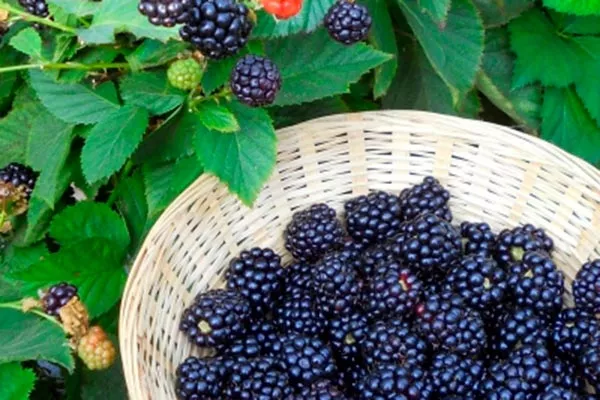
Fruiting of berry crops is observed at the following times:
- in June-July - two-year-old shoots (when growing the variety as a remontant one);
- in the first half of autumn - young shoots (second harvest);
- the second half of April, May - when growing indoors, depending on the chosen method;
- The second half of summer, September – harvesting from one-year-old shoots with an intensive method of blackberry cultivation, which involves annually cutting out all the branches of the bush.
This variety has the ability to increase its yield. Seedlings begin bearing fruit 3-4 years after planting in the garden. The first year, a bush produces at least 3.5 kg of berries. In subsequent years, the yield increases.
Application of berries
The Ruben blackberry crop has versatile uses:
- the berries are eaten fresh;
- they are added to desserts and fruit salads;
- used for making wine;
- frozen for the winter.
The fruits are characterized by good shelf life and transportability. They do not wrinkle, do not leak, and do not lose their marketable appearance during transportation. These qualities make this variety attractive to farmers producing commercial berries.
Resistance to diseases and pests
Ruben is renowned for its high resistance to disease and insect pests. With intensive cultivation methods, where all annual growth is pruned, the risk of infection and pests is minimal or nonexistent.
Methods of reproduction
Gardeners often complain about the difficulties in propagating the everbearing Ruben blackberry:
- it produces few shoots, which is why this method of obtaining new plants is rarely used;
- Due to its erect, unbending shoots, it is not possible to propagate it by layering;
- cuttings can only be carried out in a greenhouse using growth stimulating preparations and phytolamps;
- Berry crops are not propagated by seeds, since this method does not ensure the preservation of varietal qualities.
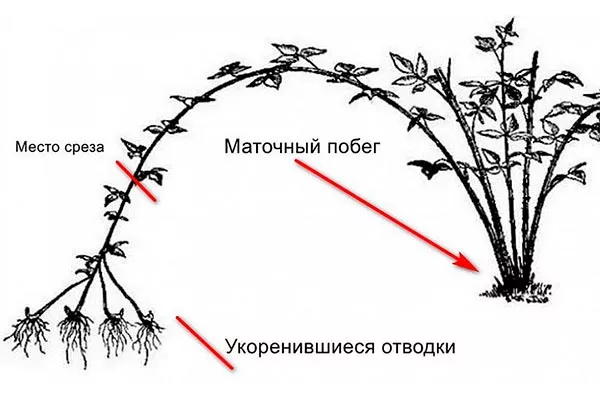
The most accessible method for gardeners to obtain new seedlings is dividing the bush. This involves digging up the plant and separating it into several parts, ensuring that each part retains several healthy shoots and strong roots.
Landing rules
Blackberries are capricious and demanding when it comes to growing conditions and care. Choose your berry planting site carefully, prepare it properly, and plant it wisely. Successful rooting depends on this.
Recommended timeframes
Plant the Ruben blackberry bush within the following timeframes:
- in autumn (at the end of October) - in the southern regions;
- in the spring before bud break (April) - in other areas.
Choosing a suitable location
Without replanting, the bush will grow and bear fruit successfully in one spot for 10-15 years. Set aside a spot in your garden for berry planting that meets the following requirements:
- shaded (direct sunlight is contraindicated for the Ruben blackberry, it grows well in light partial shade);
- located next to a fence that will protect the bush from drafts and gusty winds;
- with fertile loose soil, preferably light loam with a slightly acidic reaction;
- not located in a lowland with marshy land;
- where there was previously a planting of green manure, cereal, legume or melon crops - the best predecessors for blackberries.
Avoid planting blackberries in areas previously occupied by strawberries or raspberries. These crops are poor precursors for blackberries. Growing them after them increases the risk of disease in the Ruben berry bushes.
Soil preparation
Before you begin planting, prepare the soil in the selected area by completing the following steps:
- digging;
- clearing of weeds and plant debris;
- adding sand for loosening if the soil is heavy clay;
- enrichment with peat to increase fertility (consumption rate - 5 kg per 1 sq. m).
Selection and preparation of seedlings
Purchase Ruben blackberry bushes from our nursery. Choose seedlings with straight, flexible, and smooth shoots covered in light gray bark and well-developed roots that smell like fresh earth.
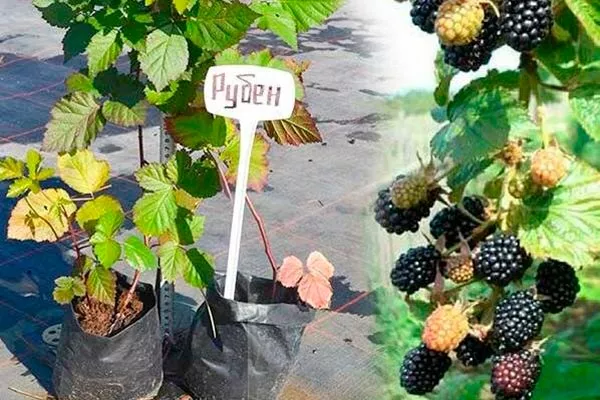
The day before planting, soak the lower part of the plant in water for 12 hours. If desired, you can add a growth stimulant.
Algorithm and landing scheme
The culture of this varietal variety is shown in 2 planting schemes:
- sparse, in which the distance between bushes is 1.3-1.5 m, and between rows - 1.5-2 m;
- compacted: distance between plants - 0.8 m, between rows - 2 m.
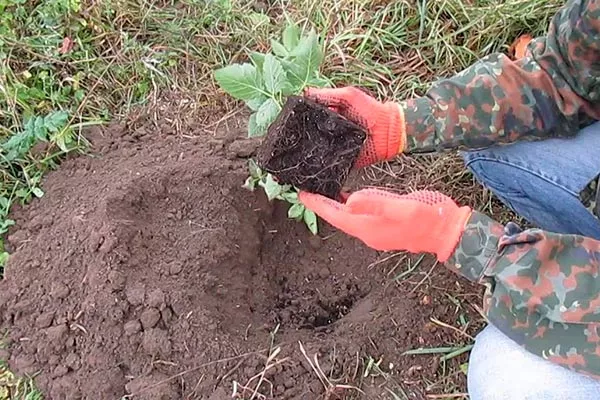
Plant everbearing blackberries in your garden plot, following these step-by-step instructions:
- Dig a planting hole. It should be 30-40 cm deep and 50 cm wide.
- Fill it 2/3 full with nutrient-rich potting soil. To make the nutrient-rich soil, combine the garden soil taken from the hole with humus or compost and nitroammophoska (45 g per plant). You can also add other mineral fertilizers: potassium sulfate (20-30 g) or superphosphate (40 g).
- Water the hole.
- After 10-14 days, place the seedling on the mound of soil mixture. Spread out the roots.
- Fill the hole with soil. Firm it around the trunk. Make sure the root collar is buried 1.5-2 cm deep.
- Water the seedling using 10 liters of settled water.
- Mulch the tree trunk area.
Subsequent care of the culture
Provide your Ruben bushes with all the necessary care to ensure a bountiful harvest, and if you're lucky, even two waves of fruiting.
Features of caring for the Ruben blackberry variety
The yield of a blackberry planting depends on many factors:
- agrotechnical measures performed by the gardener;
- climatic and weather conditions.
You can provide the most favorable environment for abundant fruiting of the Ruben blackberry by cultivating it in closed ground.
In an open garden area, you will need to resort to the following agricultural techniques:
- In early spring, install hoops over the bushes and cover them with white agrofibre. Keep the plants covered until the shoots reach 1.5 m. This will speed up fruiting.
- Mulch the soil under the bushes with acidic peat to retain moisture in the soil and prevent weed growth.
- Loosen the soil under the blackberries in spring and autumn to improve soil aeration.
- If flowering occurs during hot weather, cover the bushes with a special net. This will help preserve the blackberry's ability to pollinate.
How to water correctly?
The berry crop itself is moisture-loving, but the Ruben variety is characterized by low drought tolerance. Ensure its bushes receive the correct watering regime:
- moisten the soil under the plants regularly, at least 2 times a week;
- use at least 5 liters of water per bush;
- During dry periods, water the berry planting more often;
- 7 days before mass flowering, increase water consumption and watering frequency.
How to feed blackberries?
Feed the Ruben blackberry with organic and mineral fertilizers, following these rules:
- Apply nitrogen fertilizer in the spring after removing the covering from the bushes;
- at the beginning of budding, “treat” the plant with complex mineral fertilizer;
- during the formation of berries, water the garden crop with a solution of mullein (1:10) or green infusion;
- In the fall, apply potassium-phosphorus fertilizer (for example, use monopotassium phosphate).
Foliar feeding is beneficial for blackberry plants. Spray them with water containing chelates. During hot weather, apply the fertilizer every 10-14 days, alternating between Epin and Zircon.
Every 2-3 years, improve the fertility of the soil where your berry bush grows by adding a nutrient mixture. Prepare it using the following ingredients (the quantities listed are for each plant):
- ammonium nitrate - 40 g;
- Superphosphate - 100 g;
- potassium sulfate - 30 g;
- humus - 7 kg.
Does the Ruben blackberry need staking?
Bushes of this foreign variety can grow without support. They don't require staking. Experienced gardeners resort to this procedure to prevent a possible complication, such as partial rotting of the fruit growing on the lower shoots.
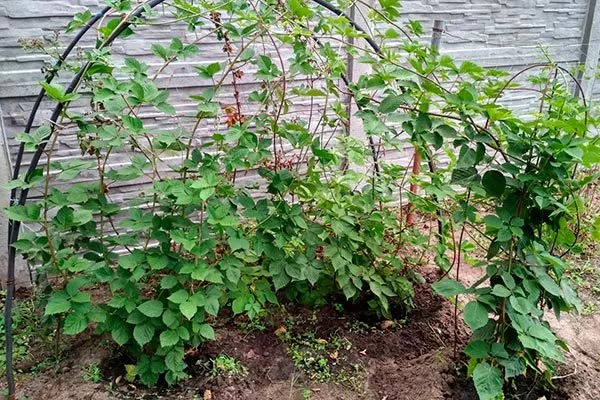
It makes sense to secure branches to a trellis (multi-row, T-shaped, or V-shaped) in the plant's third year of life, when its shoots reach 2 m in length. This measure helps reduce the stress on the branch caused by the weight of the fruit.
Preparing for winter
If you mow down all the blackberry bush shoots annually, limiting yourself to one harvest per season, raising a mound of soil over the root ball will be sufficient. Thanks to the thick layer of soil, the plant will not freeze even in the harshest winter.
When growing Ruben as a remontant variety, you'll need to cover the plants before frost sets in. Follow these step-by-step instructions:
- Carefully remove the shoots from the trellis.
- Cut off all last year's branches.
- Tie up the current year's growth, bend it towards the ground and secure it.
- Insulate them with spruce branches, straw, agrofibre and dry soil.
If you have the opportunity, build a tunnel shelter for the blackberry bushes for the winter.
Diseases and pests: methods of control and prevention
Despite the fact that this variety is highly resistant to pests and diseases, preventative spraying of its plantings is not recommended. This is especially necessary if you are leaving last year's shoots on the bush to obtain two harvests per season.
To prevent berry crops from becoming diseased, treat the plantings with copper-containing preparations in the spring and fall.
If poorly cared for, blackberries are prone to the following diseases:
- Chlorosis. This unhealthy condition of the bush provokes iron deficiency. Spraying with chelates will solve the problem.
- RustThe risk of fungal infection increases with soil moisture deficiency. At the first signs of disease, apply a garlic infusion or a sow thistle decoction. If the infection is severe, apply colloidal sulfur (a 1% aqueous solution).
To prevent the disease, apply Bordeaux mixture to young foliage in spring. - AnthracnoseThe disease affects young shoots, causing them to stunt, wither, and die.
To prevent anthracnose damage, apply peat-manure compost in the fall and treat the bush with Bordeaux mixture in the spring. - SeptoriaBushes growing in humid climates or in flooded areas are susceptible to the disease. Dense planting also contributes to the disease. The fungus attacks one- and two-year-old shoots.
Preventive and treatment measures are similar to those prescribed for blackberries against anthracnose and rust.
Failure to follow proper agricultural practices can result in pest infestations, including caterpillars, mites, leafhoppers, and shoot aphids. Treating blackberries with Nitrafen (1% concentration) in early spring can help prevent pest infestations. This treatment is recommended once every three years.
Positive and negative qualities
The Ruben variety, according to experienced gardeners, has many advantages:
Reviews
Ruben is a remontant berry variety that gardeners successfully grow in their gardens. Its popularity stems from the bushes' robust immunity, high productivity, and ability to produce two harvests per season. Adults and children alike enjoy the sweet, slightly tart flavor of its blackberries, which can be enjoyed all summer and into early fall.