
Blackberries are a capricious fruit crop. They are especially demanding when it comes to pruning. Failure to do so risks losing the harvest. A fast-growing tree without timely pruning can distort the appearance of the plot. This pruning must be carried out in accordance with proper agricultural practices.
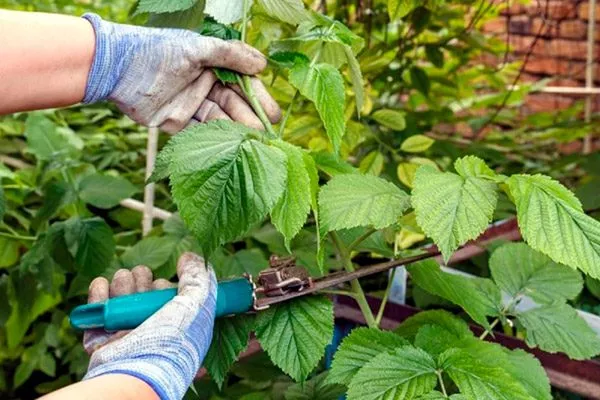
Preparation of tools and materials
Pruning blackberries is not easy. The numerous thorns and prickly bristles make the process difficult, so sturdy fabric gloves, arm protectors, and a rubberized apron are essential.
- ✓ The pruning shears must have sharp blades for a clean, burr-free cut.
- ✓ A pruning shear with a telescopic handle should be adjustable to work with bushes of different heights.
- ✓ A garden saw is necessary for removing branches thicker than 2 cm.
- ✓ The garters must be soft so as not to damage the bark of the branches.
The following tools will be needed:
- pruning shears;
- pruning shears, if the bush is neglected, it is better to take one with a telescopic handle;
- garden saw (may not be needed if branches are removed regularly);
- ties for fixing branches on a support for climbing varieties (jute or polypropylene rope).
Disinfect all equipment before starting work. A weak solution of potassium permanganate or alcohol will do.
Recommended dates for the procedure
Blackberry pruning is carried out throughout the growing season. There are no strict timeframes.
In the spring
In this case, everything depends on weather conditions. In the South, the shrub begins to awaken after winter in early spring—in March. In northern latitudes, growth only activates in May.
- ✓ The air temperature must be consistently above +5°C.
- ✓ The soil must thaw to a depth of at least 10 cm.
- ✓ No precipitation on the day of pruning.
It is best to take into account not the month, but several signs:
- the snow cover has completely melted;
- positive temperatures are observed both during the day and at night;
- the first buds on the shoots have not yet swollen;
- the risk of unexpected frosts has passed.
Many gardeners prefer to choose the time of work based on data from lunar calendarSuch tips and tricks have been proven in practice and do not cause harm to the plant.
In the fall
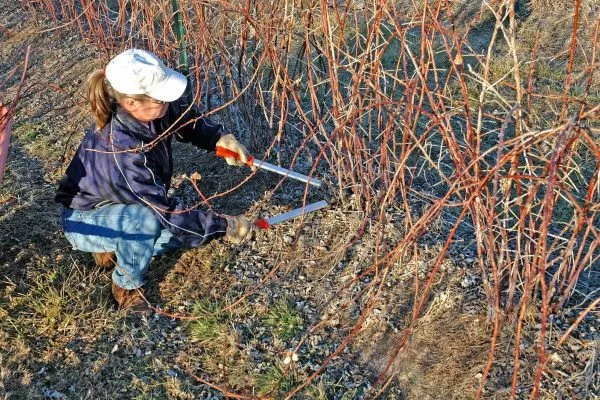
Pruning blackberry branches in the fall is an important procedure. The health of the bush and the level of fruit production in the following season depend on it. The timing isn't set, but it's usually done in October. Here's what to look for:
- the harvest is fully collected;
- the leaf fall is over;
- The old branches began to dry out.
When temperatures drop, it's recommended to remove side shoots. Some prefer to do this at the peak of the growing season. The only mistake is that by skipping this procedure, gardeners increase yields but reduce the taste of the fruit.
In summer
The expected time for summer pruning is early to mid-June. The work is carried out in two stages. The second phase occurs in July. The benchmark is when the bush reaches 1 m in height.
Is blackberry pruning necessary in winter?
Blackberries are covered during the winter. There are several methods. Disturbing the plant during cold weather is not recommended. Pruning is done in the fall. Removing shoots during frosty days can result in a high risk of plant death.
Types of pruning
There are several types of blackberry pruning. Each serves its own purpose. Failure to do one can have a detrimental effect on the plant.
Sanitary
It's considered essential. The procedure is performed in the spring. The main goal is to prevent the development of disease and the proliferation of pests that may have overwintered in the soil near the stem, or remained in bark cracks or buds.
Thinning
An equally important variety. The essence is the removal of non-viable branches and shoots, and pruning of young shoots.
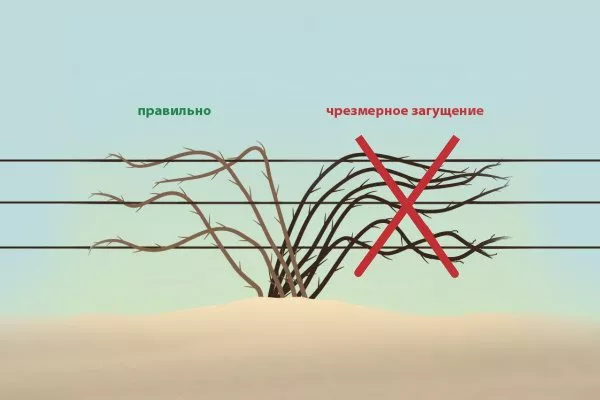
Performs many functions:
- promotes branching of stems;
- ensures the supply of useful microelements and sunlight to important parts of the crop;
- stimulates plant growth, flowering, uniform ripening of fruits, and increased yield;
- enhances the taste of blackberries;
- prevents the transfer of fungal spores and pest larvae;
- increases resistance to sub-zero temperatures;
- makes it easier to care for the crop and pick berries.
Rejuvenating (a must!)
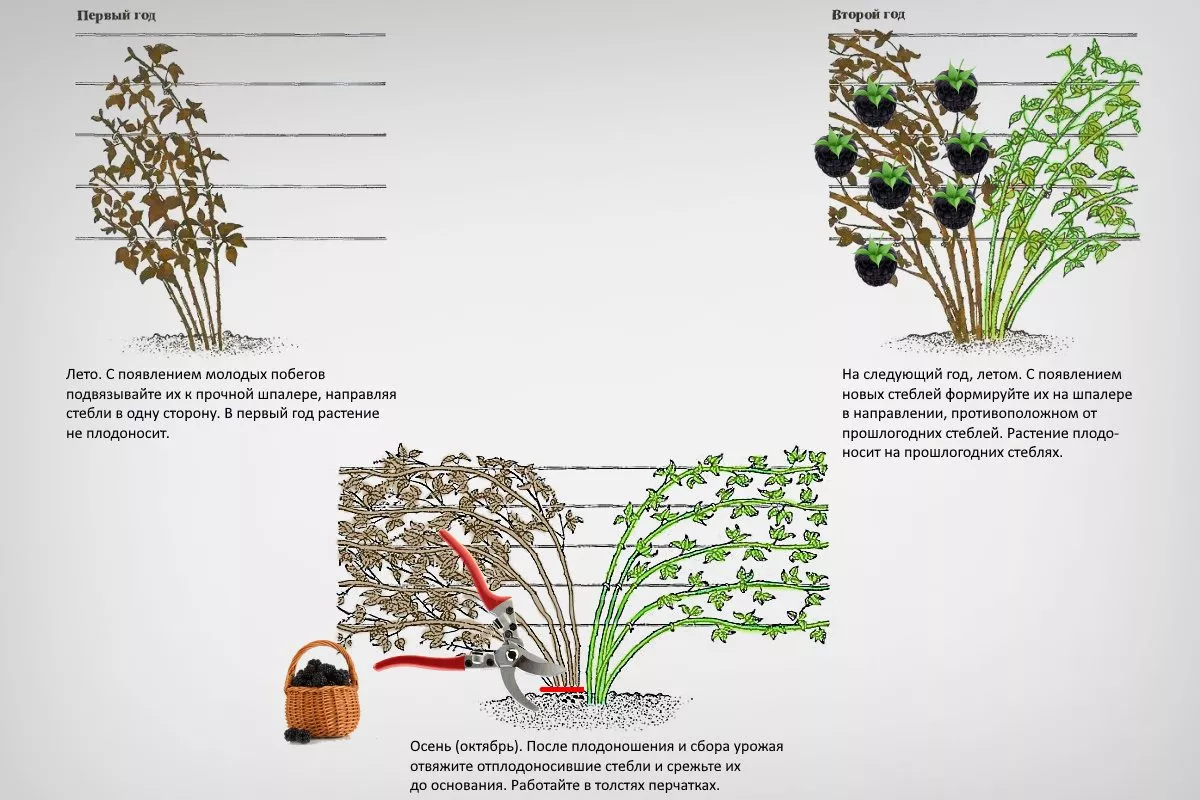
Blackberries are shrubs with a two-year growth cycle. Branches begin to bear fruit in the second year. By the third, they become useless. Remove them. Otherwise, they will cause the bush to become overgrown and encourage pathogens to develop.
If left untreated, other shoots may stop developing, as the older parts feed on the sap of the young shoots. This procedure is usually performed in the fall.
Pruning rules
It's not enough to simply determine the timing of pruning. Adherence to certain rules is essential. Each type has its own set of guidelines.
Spring
The first thing you should do before pruning in the spring is to carefully inspect the bush. Keep a few things in mind:
- the plant's growth is blocked by last year's shoots, which had berries on them;
- remove shoots with traces of rodent attacks or frozen areas;
- cut off dark-colored, brittle, and rough to the touch shoots right to the root (to healthy tissue);
- If part of the shoot has died, then prune down to the first healthy bud; they should all be viable.
Summer
Another name for summer pruning is pinching. The goal is to shorten branches that have reached 2-3 meters in length. This procedure is performed only on young shoots. Before the cold weather sets in, they will recover, develop into healthy, full-fledged branches, and produce a good harvest in the spring.
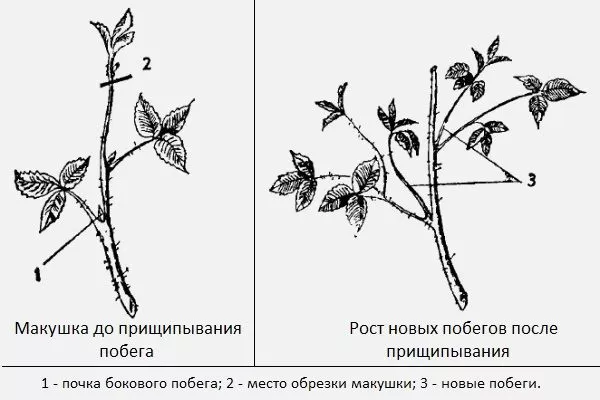
Rules:
- pinch the tops at a comfortable height;
- There should be 5 sheets left on each part;
- leave the side branches intact;
- In Central Russia and Siberia, do not carry out work with one-year-old specimens.
Autumn
The main feature of autumn pruning is to remove all branches down to healthy tissue so that no stumps remain.
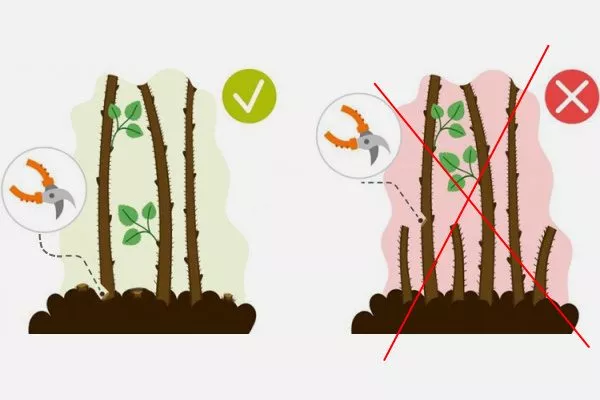
Correct and incorrect removal of shoots
What you need to know about fall pruning:
- get rid of two-year-old shoots, they interfere with air circulation;
- remove weak branches, leave only 10, which you shorten to 50 cm;
- The shoots only take away the plant's strength - remove them.
Step-by-step diagrams and bush formation
Several types of blackberries can be found in gardens: upright, climbing, everbearing, and thornless. Pruning patterns vary depending on the variety.
Pruning remontant blackberries
This type of blackberry is the easiest to train. The work is carried out in the fall or spring. If you prefer the former option, the task is to prune the shoots that have grown during the season and produced fruit. Remove them at the root.
Springtime work is aimed at increasing yields, not creating a decorative appearance. In this case, the following procedure is recommended:
- Trim branches that have not formed ovaries and are more than 1 m long by 10 cm.
- Shorten the main shoot by 50 cm.
- Get rid of the undergrowth.
The process is shown in more detail in the video below:
Erect
Upright blackberry bushes are distinguished by their fragile stems. They are very difficult to bend. Any careless movement will damage the crown.
What to do:
- Select a day after fruiting ends.
- Remove all straight shoots that did not produce berries this season.
- Prune weak branches. Leave only 9-10 healthy ones on the bush.
Details on pruning an upright variety of blackberry are in the video below:
Climbing, creeping
These blackberry varieties have flexible, thin shoots about 10 meters long. They grow on supports. Prune after harvest, following these instructions:
- Remove all branches located on the right side.
- On the left side, leave only 10 healthy shoots.
The specifics of the procedure are described in the following video:
Thornless
There are few such representatives of this species; most blackberry varieties have numerous small thorns. This variety is especially popular with novice gardeners because it's the easiest to prune.
The shrub develops from lateral shoots. Remove deformed, weak, and dry shoots in the fall. In the spring, perform sanitary pruning, leaving only seven healthy young branches.
The algorithm of actions is presented in the video below:
How to regulate the number of shoots?
Thinning blackberry shoots involves removing unnecessary stem shoots. The number depends on the perennial variety. For upright blackberry plants, it's recommended to leave no more than 4 shoots. For climbing, thornless blackberry plants, up to 7.
How to shorten stems?
It's important to shorten the stems rather than trim the entire bush. Shoots are shortened by 1/4. This results in a full harvest, as the ovaries are strong and healthy.
How to care for the crop after pruning?
Caring for blackberries after pruning differs little from the standard regimen. The plant needs water. Apply up to 3 liters per bush. Avoid excess water, as it will cause root rot.
Loosen the soil with each watering. After the moisture has been completely absorbed, apply nitroammophoska – dissolve 20 g in 10 liters of water, 200 ml per plant.
Common mistakes and recommendations
Beginners often make mistakes when pruning blackberries, which lead to reduced yields. The most common mistakes are:
- Carrying out work to remove parts of the bush in the first year of growth. Perennials are pruned in the second year, in the spring. Young shoots are always left, even if they are improperly formed, but this does not apply to those affected by diseases and pests.
- Getting rid of young, one-year-old branches. It is on them that berries are formed.
- Neglect of the number of cuts. If there are no problem areas, the procedure can be omitted. Annual treatment ensures the formation of shoots, suckers, and abundant fruit, but their taste leaves much to be desired.
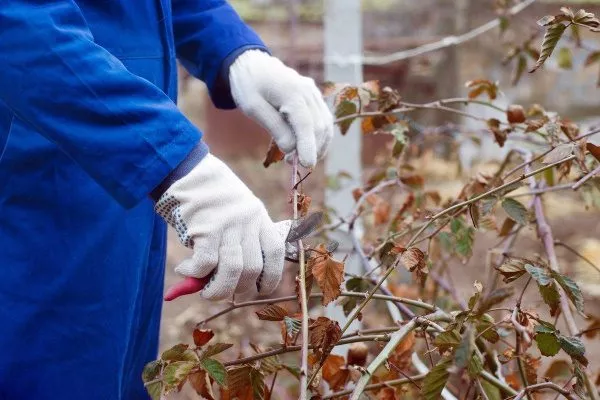
Peculiarities of pruning young and old blackberries
Pruning young and mature blackberries differs slightly. Here are some nuances to consider:
- Shorten the stems of young plants by 10-15 cm. If you cut more, the plant will die during the winter.
- An adult perennial often gets sick if there are old, broken, diseased, damaged shoots, even in small quantities.
- Young bushes are prepared for frost immediately after leaf fall. If parts are removed immediately before covering, there's a high risk of losing the planting, as the plant won't have time to strengthen before the temperature drops.
Blackberry pruning is an important maintenance procedure that serves many purposes. The most important are increasing yield and developing a strong immune system. This work is carried out throughout the growing season, taking into account the plant variety.