
Blackberries are a fruit crop with tasty, healthy berries. The bush has a compact size. A combination of positive characteristics makes the plant a popular choice for gardens. This perennial is considered easy to grow. In fact, growing it requires following many rules.
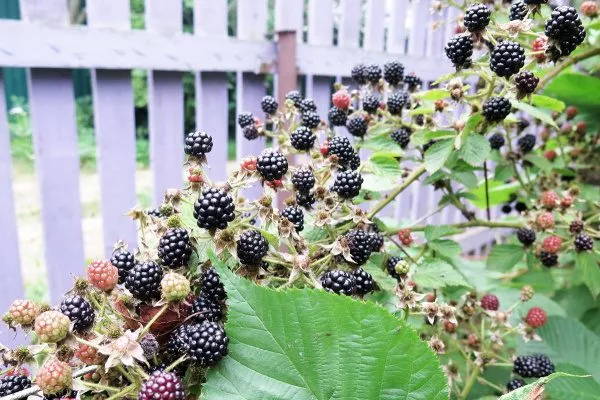
Spring and summer care: nuances
Spring is an important time for blackberries. The health and fruiting ability of the plant depend on how well it is cared for after winter dormancy.
What work to carry out:
- Removing the cover. Take action after the air temperature reaches +5 degrees.
- Loosening the soil around the trunk. This is necessary for air circulation and activation of the root system.
- Fertilization. Otherwise, the crop will not be able to grow green mass.
- Trimming. Failure to remove frozen branches and parts risks stunting the bush's growth. It will focus its energy on recovery rather than on bud formation. Learn more about pruning blackberries Read in our other article.
- Treatment against diseases and pests. In spring, the perennial is most vulnerable.
- Tying up the stems. Support makes a gardener's life easier. Watering, pruning, and so on take less time.
The yield of the planting and the taste of the fruit depend on how effectively the summer care measures are carried out.
What the culture requires in summer:
- watering;
- weed removal;
- loosening and mulching the soil;
- pruning, bush shaping;
- application of fertilizers.
The procedures are simple, but they are carried out according to certain rules, taking into account many nuances.
For more information on caring for blackberries in the summer, watch the video below:
Watering blackberries
Blackberries require a lot of moisture. Their root system is deep. This is why it's important to loosen the soil before watering it. The optimal depth is about 10 cm. This allows water to penetrate all the root shoots and remain in the soil layers for a relatively long time.
- ✓ The water temperature for irrigation should not be lower than 18°C to avoid stressing the plant.
- ✓ The soil should be loosened to a depth of 10-12 cm before watering for optimal water penetration.
Other features:
- It's best to use warm liquids. Cold temperatures encourage the spread of fungal infections.
- There's no strict watering schedule; water as the soil dries out. Overwatering is just as dangerous as drought.
- Pay special attention to the procedure during the flowering and fruit ripening phases.
- Water the plant in the morning or evening to prevent sunburn.
- Weed beforehand. Otherwise, weeds will take some of the moisture.
- The amount of water applied depends on weather conditions. Dry and hot weather warrants 10 liters per bush. During the rainy season, a maximum of 6 liters is recommended.
Top dressing
Blackberries, like all other fruit crops, cannot grow properly and produce a harvest without the necessary micronutrients. Regular fertilization is essential. The process is simple:
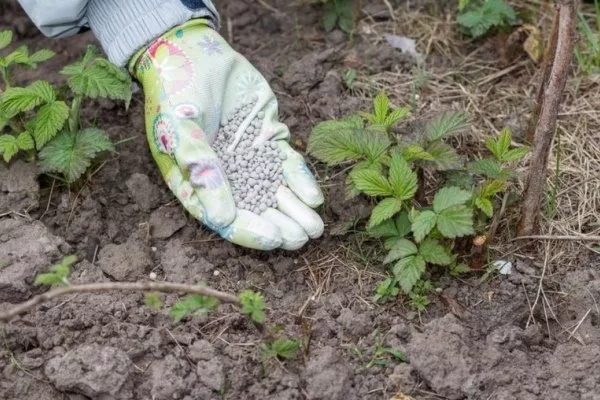
- In spring, the shrub requires a large amount of nitrogen. The substance is responsible for the intensive growth of green mass, in which photosynthesis occurs, which is necessary for the formation of tasty, large berries.
Both organic and mineral fertilizers are suitable. Gardeners often use ammonium nitrate or urea. The dosage is the same: 20 g per 5 liters of water. This is enough to water one blackberry bush. If you prefer organic fertilizers, use 5 kg of peat (per 1 square meter). - Add potassium shortly before flowering begins. This will help the plant produce numerous buds, which will contribute to a good harvest in the future. The main rule is to avoid using fertilizers containing chlorine. Otherwise, the berries will become toxic and unfit for consumption.
Potassium sulfate works well. You'll need 40 g per square meter. You can also buy the solution in capsule form (it works faster). Then, dissolve one ampoule in 10 liters of water and water the plant. - At the beginning of autumn the rhizome needs to be fed. This procedure will help the plant survive the winter successfully. Phosphorus is essential. Any phosphate is suitable – 50 g per square meter. This feeding doesn't need to be done every year; once every three years is sufficient.
Young plants are fertilized in the second year, as they still utilize the fertilizer added to the planting hole. However, if this wasn't done, fertilizing is necessary in the first year as well.
Pest and disease control
Blackberries are occasionally susceptible to disease. They are susceptible to fungal, viral, and infectious diseases. Rust is often seen on the bushes. Some varieties are susceptible to powdery mildew, purple spot, and gray mold.
What you need to know:
- To prevent diseases, spray with Bordeaux mixture. Add 10 g of the mixture to 1 liter of water.
- If dry leaves and shoots are observed, or fruit deformation is present, professional treatment with Topaz or Thiovit-Jet will be required.
- A soap solution (10 liters of water + 300 g of 72% laundry soap) is needed to repel pests from the berry bush.
- The overwhelming majority of blackberry diseases are treated with Batrider and Gerold.
Tying up the stems
Blackberry shoots, depending on varieties, can reach lengths of up to 2 meters. They often form dense thickets. Therefore, the branches need to be tied up. The purpose of this procedure is not only to facilitate the plant's care.
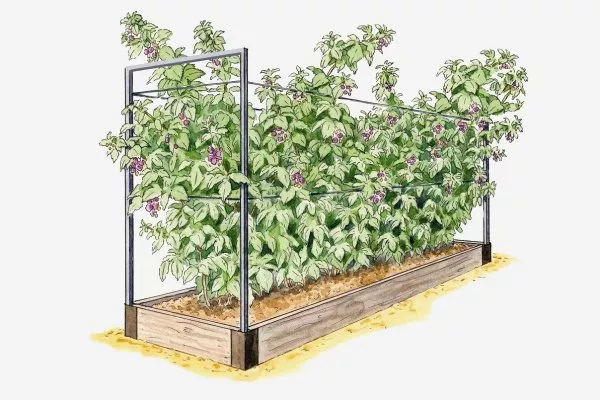
An experienced gardener can tie a bush to anything. The right solution is to use a special trellis, which is readily available. There are several types of trellises available.
Single-lane:
- The simplest. Suitable for those with a small number of bushes growing on their property.
- Plant the plant in 1 row, distribute the shoots vertically and horizontally, and tie them to twine stretched between the posts.
- The height of the trellis can be up to 3 m.
- The rope is stretched in two rows, spaced approximately 1.5 meters apart. The first is positioned 50 cm above the ground. This support is essential for young seedlings.
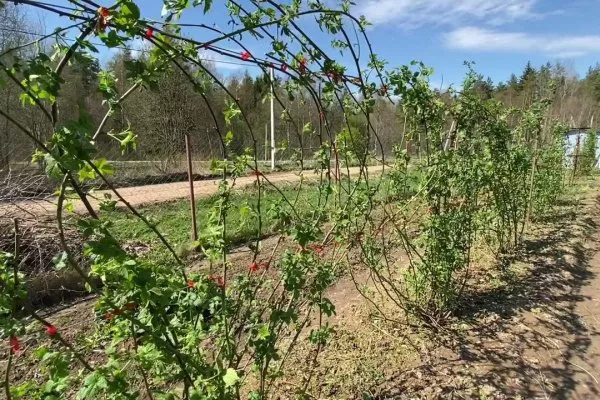
Two-lane. Needed for large plantings. There are several varieties:
- T-shaped. These are posts dug into the ground. Several 1-meter crossbars are welded to them, spaced 50 cm apart. Rope is attached to the ends, to which the shoots are tied. The center of the planting is empty, allowing for better ventilation.

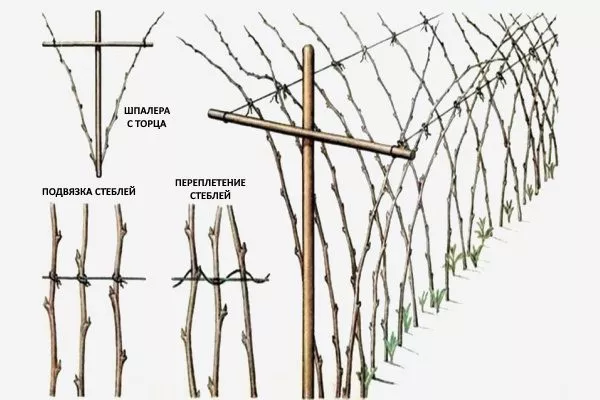
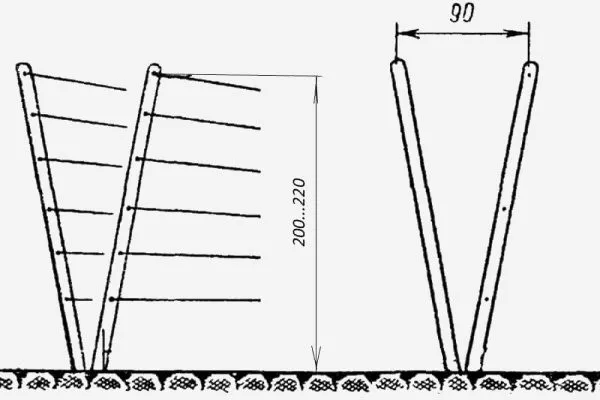
- V-shapedThe most popular. Two posts are connected to form a V. The horizontal wire is attached at 50 cm intervals.
- U-shaped. Essentially, it is a pergola – a special canopy made of wooden or metal beams, a base for climbing plants that are supposed to create shade.
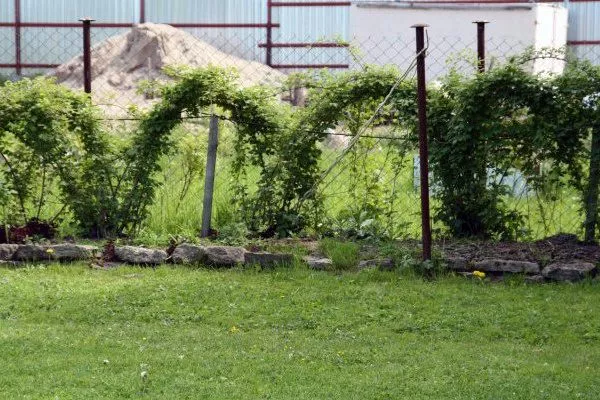
Arch. Another device for securing blackberries. The structure should be about 2 m high. Plant the plants on both sides and tie them in place at 50 cm intervals.
What is the best way to tie it:
- Twine or wireIn this case, the distance between the posts should be at least 1.5 m.
- Thin reinforcement. The required distance between such elements is 50 cm, and between the posts 3 m.
There are several materials for securing blackberry branches, the main thing is that they should not slip and do not decompose under the influence of UV rays:
- nylon tights, twine;
- special plastic clips;
- garden holders;
- tapener.
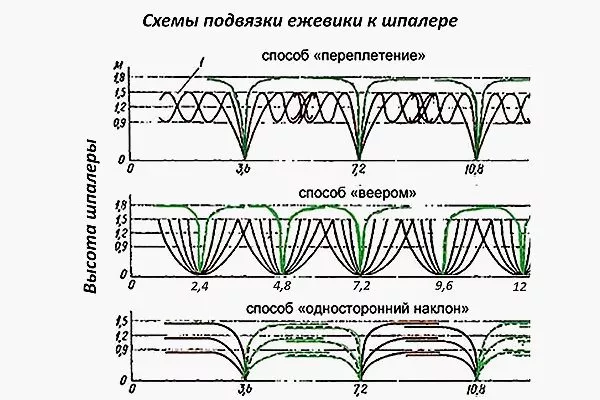
When tying blackberries, there's one rule: direct older shoots in one direction and younger shoots in the other. This is easiest to do on a V-shaped or T-shaped trellis. If the site has a simple structure, a fan-shaped arrangement of branches is more appropriate. Following this advice can significantly increase yields.
Pruning and shaping
Prune blackberries twice per season. Don't be afraid to remove too many shoots. It's better to leave fewer, but healthy, branches: five young ones will yield more than 10 with excess wood or signs of deformation.
What you need to know:
- Autumn. Remove spent and damaged shoots at the root. Green shoots that have stopped growing will also be of no use. Shorten strong branches by a quarter. Ultimately, after this work, 8-10 healthy shoots should remain on the bush.
- In the springRemove frozen shoots. It's easy to know what to remove. Living parts are brown, firm, and have a slight sheen.
- ✓ The bark of the shoot should be smooth, without cracks or spots.
- ✓ The buds should be well formed and show no signs of drying out.
Simply performing sanitary pruning of a fruit tree isn't enough. It's important to properly shape the bush. The rules vary, depending on the plant variety:
- Erect blackberry. The fan method is best. In the spring, lift the shoots onto the trellis and place them in the center, directly above the roots of the bush. Place all the young shoots on either side of the growing point and tie them to the lower wires. The branches will grow parallel to the soil surface.
In autumn, remove the shoots located in the middle, leave the side ones. - creeping plantDivide the bush into two parts: vegetative and fruiting. Wrap the old shoots on the right side of the support structure, and the young growth on the left.
Before frost, prune the climbing branches. Inspect the planting and remove any unsightly branches; there should be 8-10 remaining. Remove all branches located on the right side at the base.
Propagation of blackberries
Propagating garden blackberries is easy. There are several methods, all of which produce new fruiting plants. The method chosen depends on the variety. For example, upright blackberries produce many root suckers that can be used as planting material.
Propagation by apical layering
This option is suitable for trailing blackberries. Here's how to proceed:
- In mid-August, bury their one-year-old shoots next to a healthy bush, leaving only the top 10 cm long above the soil.
- Staple them on both sides.
- Water and mulch the planting with any plant material.
- In October, roots will appear on the apical layers. Carefully separate them, dig them up, and transfer them to a separate, pre-prepared growing site.
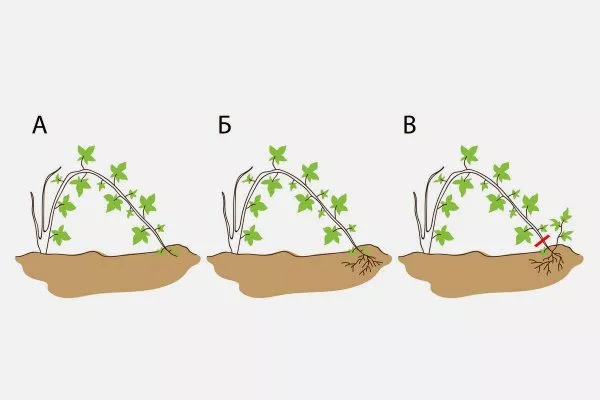
Propagation by horizontal layering
A propagation variation that produces the largest possible amount of planting material. Suitable for climbing blackberries.
Actions:
- At the beginning of August, place one-year-old branches on the ground.
- Bury them to a depth of 20 cm. You can simply generously cover them with moist soil, leaving only the tops of the plants at the top.
- After 2 months, roots and young shoots will appear.
- Dig them up and transplant them to a separate area.
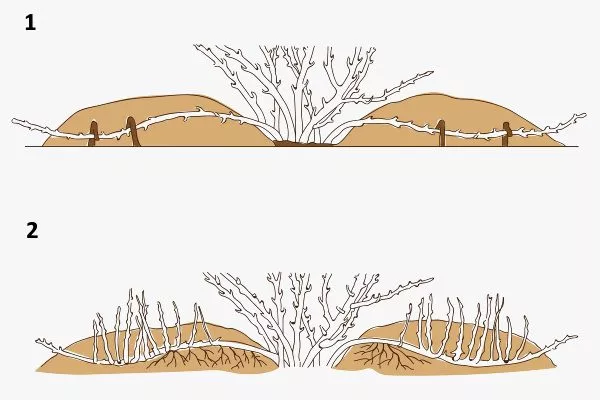
When choosing this method, keep in mind that some of the harvest will be lost, since the branches being laid could bear fruit, but they perform other functions.
Propagation by root suckers
This method produces blackberry shoots. Propagating the perennial plant this way is easy. What to do:
- There should be root suckers within a 30 cm radius of the bush. Inspect the area.
- Find the part that has grown to 10 cm in height.
- Dig up the shoots along with the root ball. Don't pull out the main root; carefully cut the planting material with pruning shears.
- Plant the future bush in a separate bed.
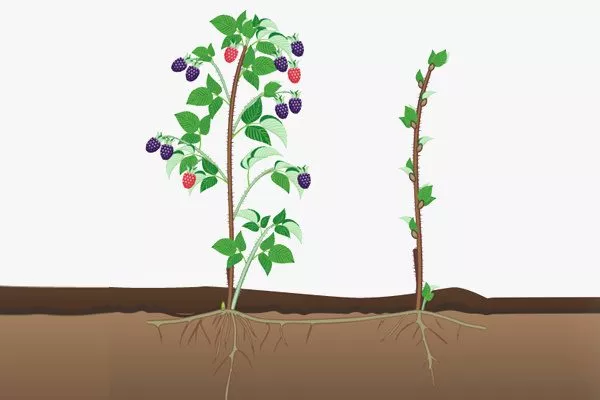
Begin work at the end of June. This way, the young root elements won't drain the plant's energy for growth. Furthermore, the planting material will have time to establish itself well before the frost sets in.
Propagation by dividing the bush
A surefire way to propagate blackberries. Some varieties don't produce horizontal vines or root suckers, but dividing the bush is always possible. Here's the procedure:
- Dig up the plant in spring or fall.
- Divide it into individual shoots with developed root systems. One plant can produce 3-6 seedlings.
- Transplant to a separate area.
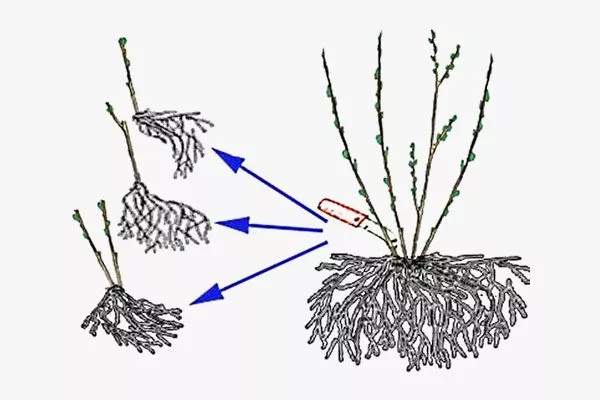
If roots were cut, shoots were broken, or some shoots were lost during division, this is not a problem. Blackberries can be propagated from root pieces or stem cuttings.
Preparing different bushes for winter
Blackberries are always needed protect from frostPlants need to be covered even in regions with mild climates. There's no ideal time to begin this work. You should begin preparing the plant for cold weather immediately after harvesting, a month before temperatures drop.
The first thing to do is to prune the bush in the fall, depending on the variety. Next, lay the branches on the ground. This procedure has its own nuances:
- Erect blackberry. Preparations for winter should begin in the summer. Hang weights on the shoots to ensure a gradual slope and prevent damage to the tree's branches. To prevent breakage, place a rigid, round object (the tree trunk) at the base. Bend the branches so that the bend follows a radius. Secure the branches in the desired position using staples or stakes.
- Climbing variety. Remove the plant from the support, bend the stems towards each other, gather the rods together, and tie them with rope.
If you can't lay an upright bush on the ground, place hay or straw between the branches and wrap it with covering material. This also protects seedlings from frost.
The best covering material is considered to be:
- Hay, straw. They are light and allow air to circulate well, but field mice may infest them.
- Spruce branches. It protects from cold and pests.
- Polyethylene. It reliably protects against the cold, but forms condensation.
- Non-woven material. Not relevant during the thaw period.
- Snow. CThe best solution: install a frame over the bush and cover it with any material. After a heavy snowfall, create a snow dome.
Harvesting blackberries
Blackberries ripen over a long period, from mid-July to the end of August. Harvest times vary by region. The key is to remove the berries from the branches at the right time. They tend to overripe quickly, after which they fall off and lose their distinctive flavor.
Signs of ripeness:
- black color with a bluish tint;
- soft consistency;
- a small hole in the center of the drupe is completely filled;
- the berries are easily separated from the stalk.
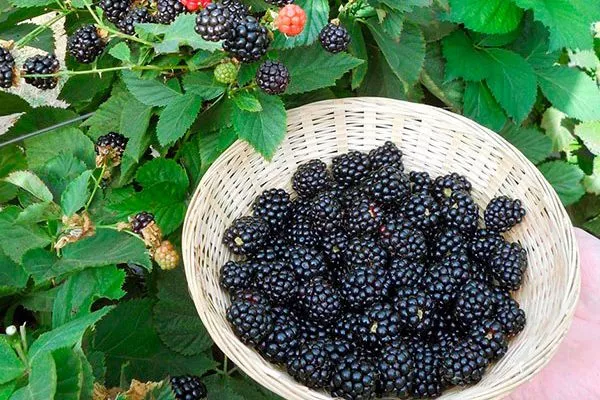
There are rules for picking blackberries:
- Choose a dry, warm morning. After rain, the fruit will be watery and not sweet, as the tissues absorb a lot of moisture.
- Leave the stem on to maximize shelf life.
- Don't shake the container. The skin is very delicate.
- You can use a fruit picker. Be careful, as many fruits tend to get crushed.
If the weather is cold and you haven't harvested all your blackberries, cut off some green blackberry stems and place them in a vase of water. The berries will ripen quickly, and their flavor will remain pleasant.
Peculiarities of growing blackberries in the Urals and Siberia
Blackberry care in the Urals and Siberia differs little from the standard. The plant also requires watering, fertilizing, tying the stems, loosening the soil, etc.
What is important to consider when growing a perennial for a cold climate:
- For the winter, cover the plant with spruce branches and snow. Careful protection from severe frosts is essential.
- Pruning is carried out as early as possible in the spring, since there are few warm days needed for tissue restoration.
- March is the month when replanting should be done (if required).
- Over the summer, the planting is fertilized three times—before, during, and after fruiting. This is necessary to strengthen the immune system. Complex fertilizers in various forms are applied.
Mistakes when growing
All the care needed for blackberries ensures a bountiful, delicious harvest. If any problems arise, it's due to the gardener's negligence.
What you may encounter:
- No fruits. Reasons: poor covering of the bush for the winter, incorrect pruning (removal of fruiting shoots).
- Poor plant growth, small berriesAll this is the result of violation of agricultural practices, improper application of fertilizers, and failure to water.
- Lack of maturation. This indicates that the perennial does not have enough sunlight (the location was chosen incorrectly), and there is a lack of useful microelements.
Blackberries will delight gardeners with delicious fruit and a bountiful harvest only if they receive careful care throughout the season. If any agricultural maintenance is neglected, the crop will grow poorly.