
The Giant blackberry is a remontant variety that, in addition to its large fruit, boasts a host of other advantages, making it quite popular among gardeners and summer residents. However, only those gardeners willing to tolerate its thorns choose this blackberry.
History of creation
The Giant variety belongs to the everbearing group, which appeared in horticulture at the end of the last century. These varieties can produce two harvests per season, as the fruit appears on two types of branches simultaneously—one from the previous year and one from the first.
This characteristic allows for the cultivation of everbearing varieties, including the Giant variety, in areas with very harsh winters. Furthermore, pruning all shoots eliminates virtually all blackberry pathogens and pests.
The Blackberry Thornless Giant was developed in the United States, where it is extremely popular. This variety is believed to be a hybrid, so it is propagated primarily by division.
Description of the variety
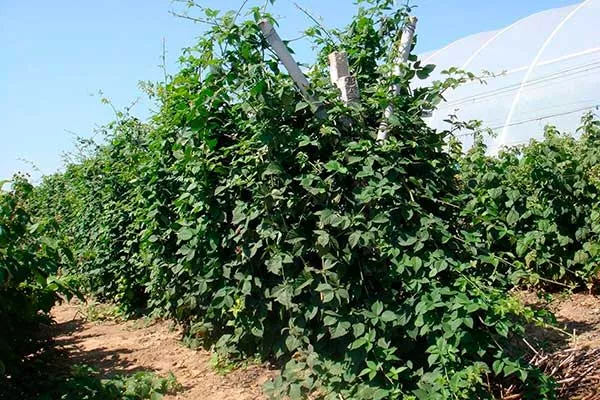
The Giant blackberry bush has spreading shoots, long, sturdy, yet easily bendable and covered in thorns. The bush grows to a height of 2-2.5 m. The flowers are large, reaching 3-4 cm in diameter.
Berries and their taste
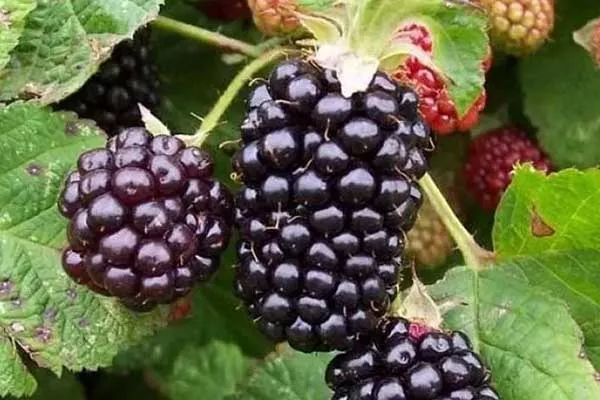
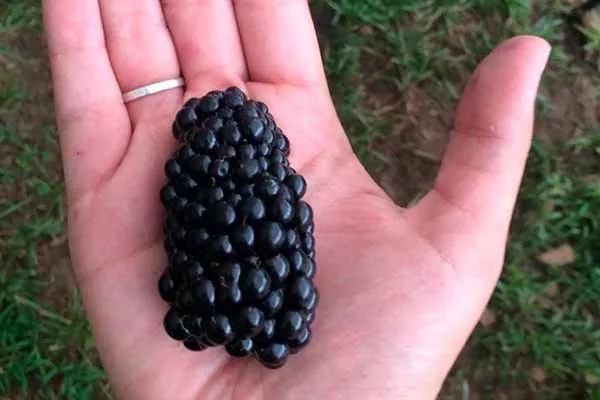
The Giant blackberry produces very large, purple-black fruits. It has a sweet flavor and a rich, blackberry-like aroma (reminiscent of wild berries), with almost no acidity. The fruit is elongated and conical in shape. The average berry weight is 9 g, with some specimens reaching 20 g.
Productivity and ripening time
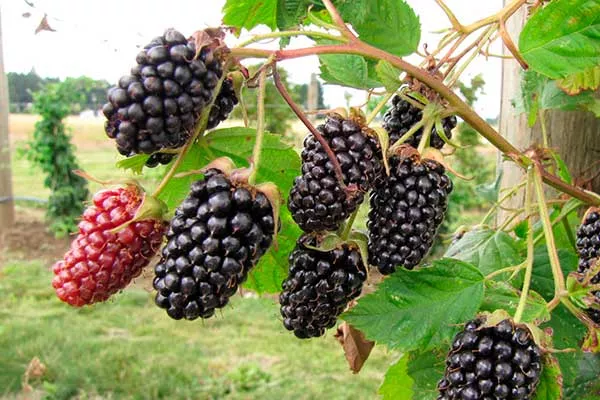
Giant blackberry bushes begin bearing fruit in the second year. The everbearing Giant blackberry blooms in two waves from June to September, with fruiting beginning in July. The fruiting period generally lasts for a month and a half. A single bush yields 25-35 kg.
Pros and cons
The Giant blackberry has many advantages that prove important in temperate climates. But before planting this variety in your garden, it's helpful to familiarize yourself with all its advantages and disadvantages.
Subtleties of planting
The Giant blackberry has long shoots that require support. When growing this variety, trellis support is essential.
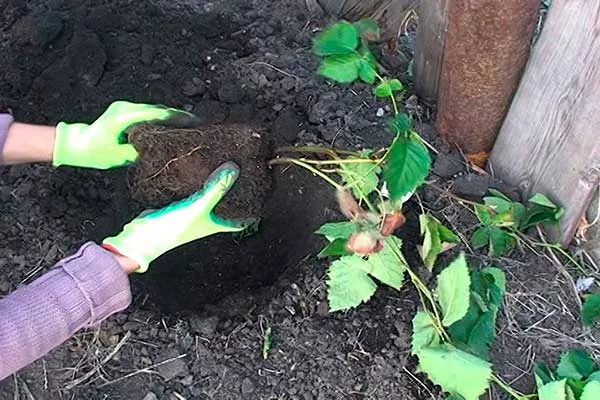
Landing features:
- Selecting a site. It should have good lighting, but in the south, locations with some shade are preferred. It's best to provide shade during peak sun hours, as the plant doesn't tolerate scorching sun well. Sunlight can cause burns on the leaves and fruit.
- Soil. This variety is demanding regarding soil composition and structure. It prefers fertile chernozem, light and loose, sandy loam, or loamy soils. Clay soils, even highly nutritious, are unsuitable for this crop due to their low water and air permeability; under such conditions, the plant's roots die. Swampy lowlands are contraindicated. The soil should be slightly or neutrally acidic. High limestone content is dangerous, as it causes chlorosis.
- Selection of seedlings. It's advisable to purchase several seedlings at once. The ideal age is one or two years. They should have a strong root system, with one-year-olds having fine roots, and two-year-olds having at least three roots about 15 cm long.
- Disembarkation times. In temperate climates, blackberry seedlings are recommended to be planted in the spring; in the south, in the fall. The exact timing depends on the specific climate conditions in each region. In the spring, planting occurs before the start of the growing season, and in the fall, a month before the onset of severe cold weather.
- Subtleties of landing. Seedlings are planted in holes approximately 30 cm deep and the same diameter. The distance between adjacent plants should be 1-1.2 m. The width between rows should be 2 m.
- ✓ Soil pH should be between 5.5-6.5 for optimal nutrient absorption.
- ✓ The organic matter content of the soil should be at least 3% to ensure good structure and water-holding capacity.
Trimming
Before pruning, a gardener must determine their goals. The first option is a large harvest by the end of summer, the second is a wave of fruiting beginning in June. The first requires a full pruning of the shoots, which is carried out in late autumn; the second requires winter protection.
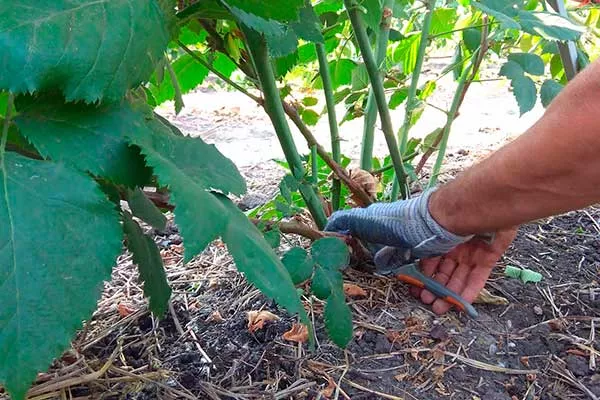
To achieve a wave-like fruiting, pre-winter pruning is omitted. This work is carried out only in the second year, at the end of summer, after fruiting. Bush training is carried out in the fall, leaving 5-6 replacement shoots per bush.
Other growing features
With proper care, the Giant blackberry will bear fruit throughout the second half of summer and part of autumn.
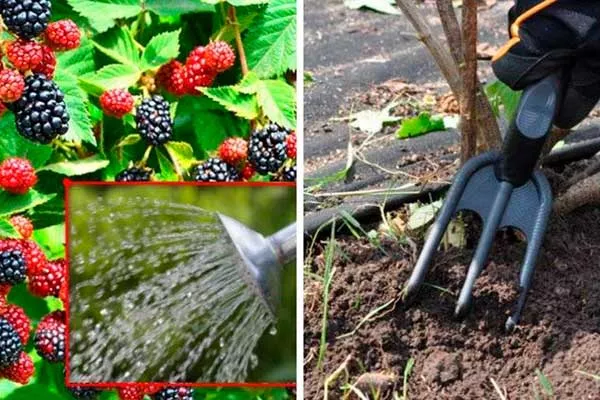
- At the beginning of spring, apply a complex fertilizer with NPK 10-10-10 at the rate of 100 g per bush.
- During the flowering period, add potassium fertilizers to improve the quality of the fruits.
- After harvesting, apply phosphorus fertilizer to prepare the plant for winter.
Care nuances:
- Watering. This variety requires regular watering, adjusted according to weather conditions. In hot weather, watering should be increased more frequently—every 2-4 days. Without water, the fruits will not be as large and juicy as expected by the variety. Overwatering is contraindicated for this variety, as it negatively impacts the quantity and quality of the harvest.
- Top dressing. Fertilizers are applied throughout the season. In spring, complex fertilizers are preferred, while potassium and phosphorus fertilizers are preferred in summer, as these are essential for the formation of large, sweet berries.
- Shelter for the winter. This variety is relatively frost-hardy, withstanding temperatures down to -30°C. In the south, this variety requires no insulation. In regions with frosty winters, shelter is essential. Unpruned shoots are removed from the trellises and bent to the ground. First, they are covered with hay or sawdust, then covered with spunbond or another suitable material.
- Diseases. The variety has good immunity, but under unfavorable conditions, the bushes can be affected by fungal infections. A 3% Bordeaux mixture helps prevent this problem. The plant can also suffer from chlorosis, which can be combated with complex fertilizers.
- Pests. The greatest threats to the Gigant variety are aphids, spider mites, and flower beetles. Insecticides can help control them: in the fall, water the soil with diluted Aktara, and in early spring, apply two applications of Fitoverm.
Giant blackberries are most often propagated by rooting the top or by cuttings.
Harvesting
The fruit is harvested in two stages. The berries ripen relatively uniformly, but not all at the same time. Ripeness is determined by taste and the ability to pull away. If the fruit easily pulls away from the branch, it's ripe; if it resists, it needs time to ripen.
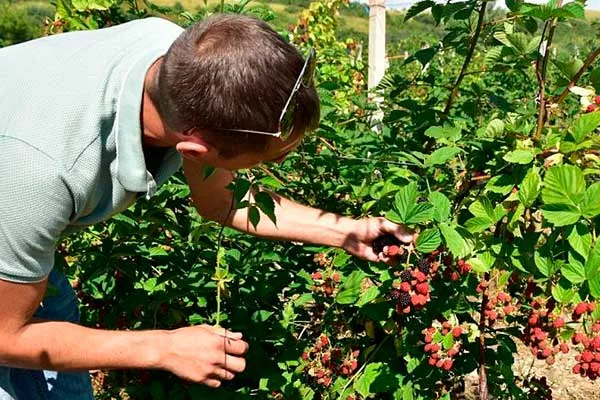
Berries should be picked as they ripen. If you wait until all the berries are ripe, some will overripe and dry out. It's recommended to pick them in warm, sunny weather. Berries can be stored in the refrigerator for several days; they can also be frozen.
Application
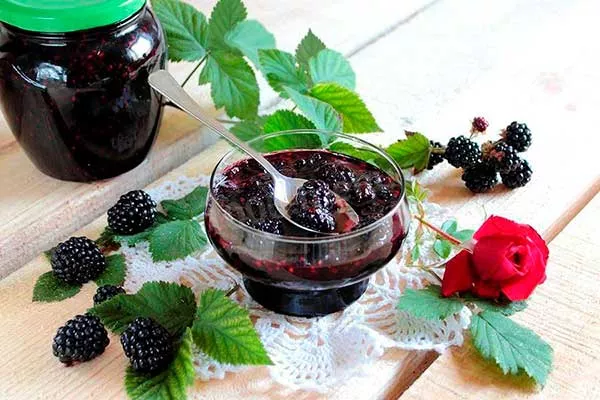
Giant blackberries are eaten fresh and processed. They are used to make jams, preserves, and other winter preserves. They also make excellent compotes, fillings for baked goods, and a variety of desserts. Large, sweet blackberries make excellent liqueurs and juices.
Giant blackberries are a powerful source of vitamins and minerals. Regular consumption boosts immunity and improves metabolism. Blackberry juice has antiseptic properties, making it suitable for wound healing.
Reviews
The Giant variety is currently the subject of much debate. Because it's imported and relatively new, there's no definitive information about it. Furthermore, there are discrepancies in its description. The size of the fruit is clear—they are truly large and oblong—but the presence or absence of thorns remains to be seen.