
The Golden Melon is a reliable choice for those who value a stable and high-quality harvest. This variety is highly resistant to diseases and pests and possesses numerous positive varietal characteristics. To achieve good growing results, it is essential to provide the plant with proper and regular care.
Who developed the variety and when?
Developed by experts from the Krasnodar Research Institute, it was added to the State Register in 1979. Initially recommended for cultivation in the Lower Volga and North Caucasus regions, it has also become popular in other regions of Russia and the CIS, despite its original purpose.
Characteristics of the Golden Melon
Golden melon grows successfully in gardens, chosen for its excellent characteristics. Below is a detailed description of this melon variety.
Description of the plant and fruits
The plant has a climbing growth habit, although the number of shoots is not very large. Key features:
- The main shoot has an average length of about 1.5 m. The side shoots are shorter.
- The green leaves have a kidney-shaped configuration with entire lobes that do not reach the base of the leaf petiole.
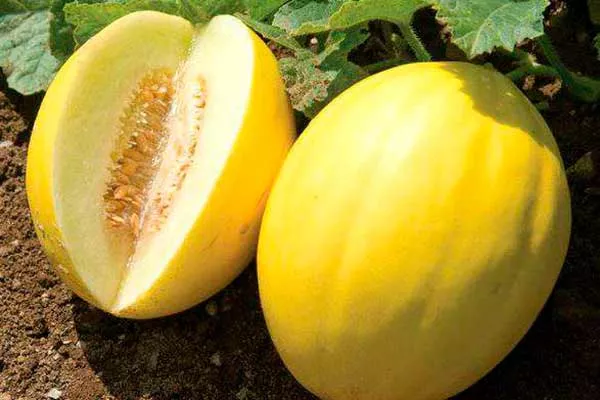
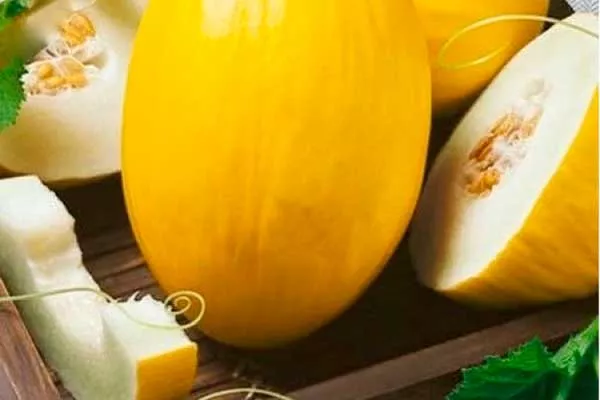
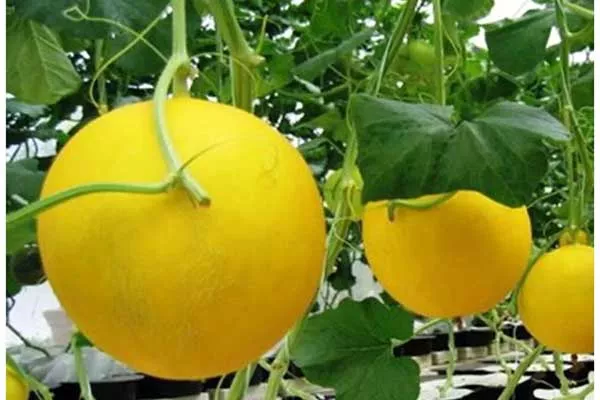
- The peel is a rich lemon-yellow color, sometimes with a slight orange tint, which becomes more noticeable when fully ripe.
- The surface is patternless. When unripe, a net-like pattern may be visible, which disappears by harvest time.
- The shape is round, with a slightly elongated tip. The size is large, reaching an average weight of 1.5-2 kg.
- The bark is of medium thickness and has a leathery texture with a smooth surface.
Taste and purpose
It has dense, white, and tender flesh, while the core has a yellowish tint. It has a sweet flavor, juiciness, and an intense aroma.
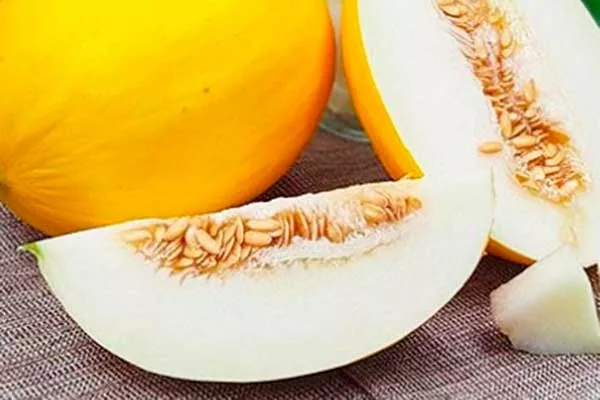
The tasting score is 4 points. In addition to fresh consumption, the pulp is used for canning and desserts.
Ripening and yield
This is a mid-early ripening crop. The time from germination to harvest ranges from 71 to 84 days. This variety is considered high-yielding, with an average yield of up to 25 tons per hectare.
Pros and cons of the variety
Gardeners note several significant advantages of the crop. The main advantages are:
- Stable yield. Despite drought or lack of sunshine, it remains stable. Soil fertility is of paramount importance for successful cultivation.
- Excellent transportability. The dense flesh and tough skin make this variety suitable for long-distance transport, explaining its widespread distribution throughout the country.
- Excellent keeping quality. It is well preserved at a temperature of about +4°C and humidity of 70-80%, without access to sunlight, which allows it to be stored for up to 3-4 months.
- Disease resistance. It has high resistance to diseases and becomes infected with fungal and viral infections only at high air humidity and low temperatures.
- Versatility of cultivation. It can be grown both in open ground and in greenhouses, where the vines and fruits can be suspended from trellises.
Among the negative qualities, agronomists note the unsuitability for processing into candied fruit or juice due to the insufficiently dense pulp.
Landing rules
Regardless of the sowing method, the seeds must be treated with a 0.2% potassium permanganate solution for 30 minutes at a temperature no higher than 50°C. After this, rinse the seeds with warm water and plant them in a seedling container or directly into the ground.
- ✓ The optimal soil pH should be in the range of 6.0-6.8 to ensure the best absorption of nutrients.
- ✓ The soil should be well-drained, with an organic matter content of at least 3%.
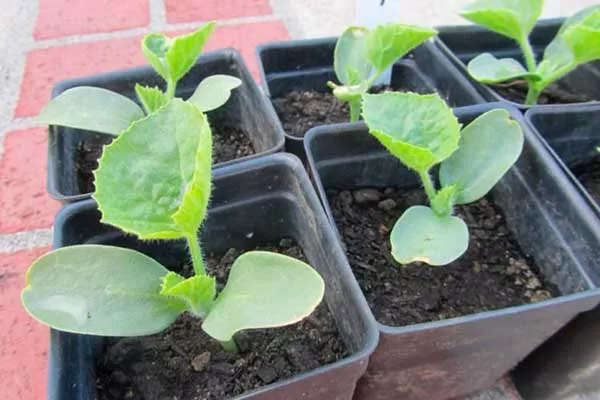
When growing from seedlings, sow the seeds in individual pots to minimize damage to the root system during subsequent transplanting. For seedlings, use a light soil mixture—sand and peat, or garden soil with added sand.
Key points for growing Goldenrod
To ensure a good harvest, adhere to certain agricultural practices when cultivating. Follow these recommendations:
- Loosening and hilling. During the first two tillings, loosen the space between rows to a depth of 10-15 cm, then to a depth of no more than 8-10 cm. Leave the soil around the stems undisturbed to avoid damaging the roots. Carefully remove weeds during loosening.
As soon as lateral shoots begin to form, earth up the seedlings. Stop mechanically cultivating the soil once the foliage closes. Guide the stems in the desired direction to prevent them from crossing. - Topping. Perform the initial shaping during the seedling growth stage. After transplanting the seedlings into open ground, continue the process as they adapt. Pinch the main shoot, leaving 2-3 lateral shoots—shape them at the level of the second pair of leaves.
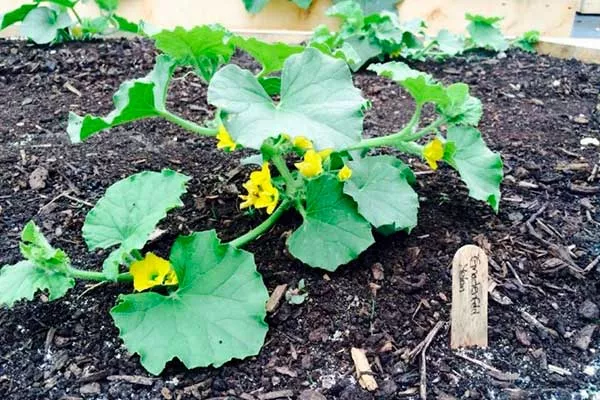
Remove excess flowers, leaving 2 to 6 ovaries spaced apart on the bush. Remove non-fruiting shoots to prevent them from draining the main stem. - Growing in a greenhouse. Ventilate the greenhouse regularly, especially during fruit ripening, to prevent rot. Place plywood or a covering material under the melons.
Harvesting
The signal to harvest is the wilting of the foliage and the juicy yellow color of the fruit. They separate easily from the stems. This usually occurs in the second half of August. This melon variety is characterized by uniform ripening.
- ✓ The fruits produce a dull sound when tapped, indicating their ripeness.
- ✓ Easy separation of the stalk from the fruit is a sign of full ripening.
It's best not to rush the harvest to allow time for full ripening. In some cases, you can also harvest a few greenish fruits, which can be left to ripen further in sun-drenched containers or indoors.
Storage rules
For long-term storage, prepare boxes lined with sawdust or straw. A cellar maintained at around 4°C is ideal. The plant tolerates transportation well and can be stored until mid-winter.
Diseases and pests
The crop is known for its resistance to diseases and pests. In greenhouses, isolated cases of damage sometimes occur:
- Broomrape. A parasitic plant, lacking roots and using suckers to feed on shoots and leaves. Mechanical control methods include weeding before seeds and flowers form. Additionally, deep tillage and crop rotation are recommended.
- Melon fly. The insect measures no more than 6.5 mm, but its color is bright and rich, with a pale yellow tint. The pest settles on the surface of the plant and feeds on the sap of the leaves and stems. This results in the formation of characteristic brown holes, in which the parasite lays its eggs.
Dig the soil deeply in the fall and summer, avoid overwatering, treat the seeds with pesticides before planting, and loosen the soil several times throughout the season. Spray the beds with the insecticide Kemifos. - Downy mildew. Yellow-green spots appear on the leaves, gradually increasing in size. When humidity is high, a gray, powdery coating, consisting of fungal spores, forms on the underside of the leaf.
To prevent disease, disinfect seeds before sowing by warming them in hot water or soaking them in a potassium permanganate solution. Collect and destroy affected plants, and weed regularly.
At the first signs of disease, spray the plantings with a urea solution, Bordeaux mixture, or Topaz or Oxychom. - Root rot. This disease is caused by fungi and spreads within a plot due to high humidity and weakened immunity. Symptoms include stunted growth and wilting of plants, rot lesions, and necrosis on the roots.
Regulate soil moisture and irrigation systems, loosen and disinfect the soil, add fresh soil to the root collar at the first signs of infection, and practice crop rotation.
Spray the beds with 2% copper sulfate, Bordeaux mixture, Topaz, Fundazol, or Fitoflavin. Treat the stems, shoots, and leaves with ash, slaked lime, chalk, or charcoal.
Reviews
The Golden melon produces good results and high quality with proper care. Its disease resistance, large size, and excellent flavor make it an attractive choice for gardeners. It's important to follow proper cultivation practices to ensure optimal conditions for plant development and a high-quality harvest.